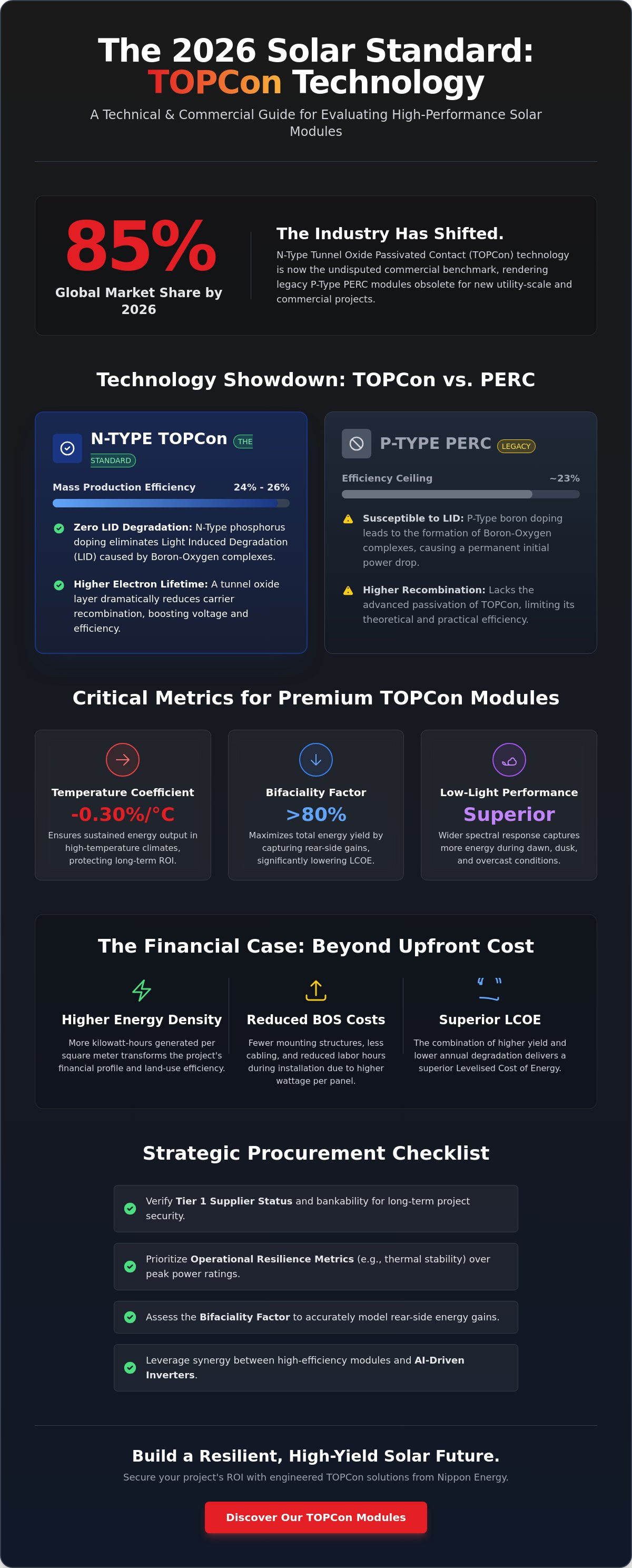
By the start of 2026, TOPCon technology has captured nearly 85% of global solar production, effectively rendering legacy PERC modules a relic of the previous decade. You've likely noticed that the market is now saturated with N-type modules, making it increasingly difficult to distinguish between standard offerings and truly elite hardware. While the industry has shifted, the primary challenge remains in justifying the initial capital expenditure by accurately calculating the long-term impact on your Levelised Cost of Energy. High-level procurement now requires a deeper understanding of how specific cell architectures perform under thermal stress and over decades of operation.
This guide provides the technical and commercial criteria you need to master when evaluating topcon solar panels for sale to ensure your energy infrastructure is both high-yielding and future-proofed. We'll examine why mass-produced efficiencies of 24% to 26% and a superior temperature coefficient of -0.30%/°C are the new benchmarks for commercial success. By the end of this analysis, you'll have a clear framework for comparing Tier 1 modules and optimizing your project's ROI through precision engineering and data-driven procurement. Every decision you make today serves as the foundation for your asset's performance in the years to come.
Key Takeaways
- Understand why N-type silicon architecture is the definitive 2026 successor to PERC, offering extended electron lifetimes and enhanced degradation resistance.
- Analyze critical performance metrics, specifically the temperature coefficient, to ensure sustained energy output in high-temperature climates.
- Optimize total energy yield by assessing the 'Bifaciality Factor' of topcon solar panels for sale to maximize rear-side efficiency gains and lower LCOE.
- Develop a strategic procurement checklist to verify Tier 1 status and secure long-term ROI through a rigorous supplier vetting process.
- Leverage the synergy between high-efficiency TOPCon modules and intelligent AI-driven inverters to build a resilient and future-proofed power infrastructure.
The Shift to N-Type: Why TOPCon is the 2026 Standard for Solar Procurement
Tunnel Oxide Passivated Contact (TOPCon) technology has transitioned from a premium alternative to the undisputed commercial benchmark. In 2026, the global solar industry has largely abandoned P-type Passivated Emitter and Rear Cell (PERC) architectures in favor of N-type silicon. This shift is driven by a fundamental increase in electron lifetime. By adding a thin tunnel oxide layer and a highly doped polysilicon layer to the rear side of the cell, TOPCon architecture effectively reduces carrier recombination. This engineering refinement allows for higher open-circuit voltage and improved efficiency across the module. When evaluating topcon solar panels for sale, procurement officers are no longer just buying hardware; they're securing assets with a verified market share of almost 85% of global production.
Understanding the N-Type Advantage
The core of this technological transition lies in the substrate material. Legacy P-type cells use boron-doped silicon, which is susceptible to the formation of boron-oxygen complexes when exposed to sunlight. This phenomenon leads to Light Induced Degradation (LID), causing an immediate and permanent drop in power output. N-type wafers use phosphorus doping instead. This strategic choice eliminates boron-oxygen related LID entirely, ensuring that the initial energy yield remains stable over time. While PERC modules often hit an efficiency ceiling around 23%, mass-produced TOPCon cells now achieve efficiencies between 24% and 26%. This technical evolution places TOPCon among the most advanced types of solar cells currently available for large-scale infrastructure deployment.
TOPCon vs. PERC: The Economic Reality in 2026
The financial justification for selecting topcon solar panels for sale extends beyond simple module pricing. Although the upfront cost per watt may carry a marginal premium over remaining PERC stock, the higher energy density significantly reduces the Balance of System (BOS) costs. Higher wattage per panel means fewer mounting structures, less cabling, and reduced labor hours during installation. These savings, combined with a lower annual degradation rate, result in a superior Levelised Cost of Energy (LCOE) for the project owner. For utility-scale developers, the ability to generate more kilowatt-hours per square meter transforms the project's financial profile from a standard utility to a high-performance energy asset. You can explore a deeper technical breakdown of these architectures in our guide to TOPCon solar panels.
Critical Specifications to Evaluate When Buying TOPCon Solar Panels
Identifying superior hardware within the 2026 market requires a shift from peak power ratings toward operational resilience. Tier 1 modules distinguish themselves through superior material purity and advanced passivation techniques that maintain performance under extreme conditions. Recent PV Tech market analysis indicates that while TOPCon has reached nearly 85% of global production, the performance gap between entry-level and premium modules has widened. When evaluating topcon solar panels for sale, engineers must prioritize the power-to-weight ratio. High-wattage modules that maintain a manageable weight allow for higher energy density on commercial rooftops without requiring expensive structural reinforcement.
Low-light performance and spectral response also serve as critical differentiators. TOPCon cells excel in capturing energy during the "blue" hours of early morning and late evening, as well as under cloudy conditions. This wider spectral response ensures that the system begins generating power earlier and shuts down later than legacy systems. These marginal gains in daily uptime accumulate into significant annual yield improvements, directly impacting the project's internal rate of return.
Temperature Coefficient and Thermal Stability
In high-heat regions like Dubai, Riyadh, or Karachi, the temperature coefficient is the most vital metric for long-term ROI. Standard monocrystalline modules often suffer significant power loss as temperatures climb, but Tier 1 TOPCon modules typically feature a temperature coefficient of -0.30%/°C. Cell voltage output decreases as the operating temperature of the cell increases. Because TOPCon panels maintain higher thermal stability, they deliver a higher energy yield in desert environments compared to P-type alternatives. This resilience ensures that your investment continues to perform at peak capacity when energy demand is at its highest.
Degradation Rates and Warranty Longevity
The transition to N-type silicon allows for a more robust performance guarantee over a 30-year lifecycle. The 2026 industry standard for TOPCon modules limits first-year degradation to approximately 1%, with subsequent annual degradation held at 0.4%. This is a notable improvement over the 0.5% or 0.6% annual loss common in older technologies. Procurement teams should differentiate between the product warranty, which covers workmanship and materials, and the linear power performance warranty. Because N-type wafers are immune to Light Induced Degradation, manufacturers can confidently offer 30-year power guarantees. For those seeking these high-performance benchmarks, Nippon Energy provides engineered N-type solutions designed for maximum longevity.
Maximising Yield: The Role of Bifaciality in TOPCon Procurement
In the 2026 procurement landscape, the majority of topcon solar panels for sale are bifacial by design. This architectural choice is not accidental; it is a calculated response to the industry's demand for the lowest possible Levelised Cost of Energy (LCOE). Bifacial modules capture sunlight from both the front and rear surfaces, leveraging reflected irradiance to boost total power output. The effectiveness of this secondary generation is measured by the 'Bifaciality Factor,' which represents the ratio of rear-side efficiency to front-side efficiency. For high-performance TOPCon cells, this factor typically ranges between 80% and 85%, significantly outperforming the 70% average of legacy bifacial PERC modules.
Calculating the actual energy yield requires a precise assessment of albedo, or surface reflectivity. A standard grassy field may offer an albedo of 0.15 to 0.25, while specialized reflective membranes or white gravel can push this value above 0.80. This environmental variable directly dictates the 'bifacial gain,' which can range from a 5% to a 30% increase in total energy production. When these gains are integrated into a financial model, they effectively offset the marginal cost of bifacial hardware, resulting in a more resilient energy asset. Procurement teams must view bifaciality as an engineering requirement rather than a premium feature.
Bifacial Gain in Commercial and Utility Projects
Commercial-scale deployments benefit immensely from dual-glass construction. This design replaces the traditional plastic backsheet with a second layer of tempered glass, enhancing mechanical strength and providing superior resistance to Potential Induced Degradation (PID). These structural improvements ensure that the module maintains its integrity over a 30-year operational life. When paired with single-axis tracking systems, the benefits are amplified as the panels follow the sun's trajectory, optimizing the angle for both direct and reflected light. For a detailed exploration of these dynamics, refer to our comprehensive guide on bifacial TOPCon solar panels.
Installation Considerations for Bifacial Modules
Optimizing rear-side irradiance requires specific installation parameters that go beyond standard monofacial practices. Mounting height is the most critical factor; raising the modules further from the ground allows more diffuse light to reach the rear surface. In industrial rooftop settings, the application of reflective coatings or membranes can transform a standard roof into a high-albedo surface, maximizing the yield of topcon solar panels for sale. Professional solar EPC services integrate these spatial variables during the initial design phase to ensure that the physical layout of the array supports the technical capabilities of the hardware. This holistic approach ensures that the theoretical efficiency of the cell translates into measurable kilowatt-hour gains.
Strategic Procurement Checklist: Selecting the Right TOPCon Supplier
A successful procurement strategy for topcon solar panels for sale begins with a comprehensive audit of the manufacturer's bankability and environmental, social, and governance (ESG) compliance. In the 2026 market, 'Tier 1' status is no longer just a measure of nameplate capacity; it reflects a supplier's ability to provide granular supply chain transparency and maintain a high level of R&D investment. This investment is crucial because it ensures the supplier is continuously refining cell passivation and metallization processes. This ensures that the hardware you purchase won't be orphaned by a company that lacks the financial resilience to honor 30-year linear performance warranties. Institutional investors now demand a rigorous vetting process that includes on-site factory audits and a deep dive into the purity of the N-type silicon supply chain to mitigate ethical and operational risks.
Verifying Technical Datasheets and Certifications
Technical specifications must be substantiated by rigorous third-party testing rather than internal marketing materials. You should insist on certifications such as IEC 61215 and IEC 61730, alongside specialized tests for salt mist or ammonia corrosion if your project sits in a coastal or agricultural zone. For large-scale procurement of topcon solar panels for sale, requesting batch-specific flash test reports is a standard requirement to verify that the modules meet their rated nameplate capacity. Claims regarding 'PID-free' or 'LID-free' performance are only as credible as the independent laboratory data that supports them. Verifying these metrics prevents the long-term yield loss that occurs when inferior materials are used in cell passivation or frame construction. Independent verification acts as a safeguard for your project's projected cash flow.
Logistics, Lead Times, and Local Support
Operational success depends on the manufacturer's regional footprint and logistical reliability. Suppliers with established warehousing hubs in Dubai, Tokyo, or Berlin significantly reduce the risks associated with global supply chain volatility and shipping delays. Long lead times in utility-scale project execution can lead to substantial financial penalties or missed interconnection windows, which can derail the project's financial viability. Beyond the initial delivery, you must evaluate the availability of local technical support and long-term asset care. Professional solar system maintenance ensures that your high-efficiency modules continue to operate at peak performance throughout their entire lifecycle. Choosing a partner with a local presence ensures that technical issues are resolved with minimal downtime, protecting your energy infrastructure from prolonged outages. To begin your procurement journey with a trusted global partner, you can view our engineered TOPCon solutions and consult with our technical team.
Nippon Energy: Engineered TOPCon Solutions for Global Infrastructure
Nippon Energy functions as a high-tech architect for global energy systems, moving beyond the traditional role of a hardware supplier. We recognize that the true value of topcon solar panels for sale lies in their seamless integration into a larger, intelligent ecosystem. Our approach prioritizes the technical synergy between high-performance modules and advanced power electronics to eliminate efficiency bottlenecks. By pairing our N-type modules with Smart AI solar inverters, we ensure that every watt generated is orchestrated with maximum precision. This integrated strategy is centralized through the NipponHev system, which provides total energy orchestration for commercial and industrial stakeholders seeking a unified power architecture.
The Nippon Advantage: Precision Engineering
Our Japanese heritage defines our commitment to quality control and technical precision. This disciplined engineering mindset ensures that Nippon hardware maintains its structural integrity in the world's most demanding environments. Whether deployed in the intense thermal stress of Riyadh or the varying climatic conditions of Lahore, our modules are tested to exceed standard durability benchmarks. We provide end-to-end solar project development and EPC services, allowing us to manage every variable from initial site assessment to final commissioning. This comprehensive oversight eliminates the technical friction often found in multi-vendor deployments. By maintaining control over the entire value chain, we deliver a more reliable and productive energy infrastructure that stands up to decades of operational demand.
Future-Proofing with Integrated Storage
Energy resilience in 2026 requires more than just high-efficiency generation; it demands the ability to store and manage power dynamically. Nippon TOPCon panels are engineered to work in tandem with our lithium-ion battery storage systems, creating a robust, closed-loop energy environment. This integration allows for peak shaving and load shifting, which are essential for optimizing the economic profile of large-scale projects. AI-driven monitoring platforms analyze performance data in real-time to optimize discharge cycles and predict maintenance needs before they impact your yield. This level of intelligence ensures a maximized ROI over the 30-year lifecycle of the asset.
Strategic procurement is the foundation of long-term energy security. We invite project developers, institutional investors, and industrial stakeholders to engage with our project development teams for custom hardware configurations. Consult with Nippon Energy today to initiate a technical feasibility study. Our engineers will help you navigate the complexities of topcon solar panels for sale to ensure your next project is built on a foundation of excellence and technical authority.
Engineering the Future of Global Energy Infrastructure
The transition toward N-type silicon has fundamentally redefined the benchmarks for utility-scale and commercial energy assets. By prioritizing modules with a -0.30%/°C temperature coefficient and high bifaciality factors, you ensure your infrastructure remains resilient against the escalating thermal demands of high-heat regions. When you evaluate topcon solar panels for sale, the decision must be grounded in Tier 1 bankability and a proven track record of engineering excellence. These technical criteria are the primary drivers of an optimized Levelised Cost of Energy and long-term project viability.
Nippon Energy combines Japanese engineering precision with global EPC expertise to deliver high-efficiency systems backed by 30-year performance warranties. Our integrated approach ensures that your hardware is not just installed, but orchestrated for maximum yield in even the most extreme environments. Request a Technical Procurement Quote for Nippon TOPCon Systems to secure a high-yield energy future for your next deployment. Your project's long-term ROI starts with a commitment to technical authority and superior hardware orchestration.
Frequently Asked Questions
Are TOPCon solar panels better than HJT for commercial use?
TOPCon technology is currently the preferred choice for commercial scale due to its optimal balance of high efficiency and manufacturing cost efficiency. While Heterojunction (HJT) offers a slightly lower temperature coefficient, TOPCon's rapid achievement of price parity with legacy technologies makes it the pragmatic benchmark for maximizing ROI in 2026. This allows developers to deploy high-efficiency systems without the premium capital expenditure often associated with HJT.
What is the typical price range for TOPCon solar panels for sale in 2026?
Market data from early 2026 shows that TOPCon modules have reached near price parity with older P-type technologies. While specific project costs fluctuate based on silver prices and regional tax policies, procurement teams find that topcon solar panels for sale offer a superior value proposition by reducing the Levelised Cost of Energy through higher wattage and lower degradation. Prices remain competitive due to the massive global shift toward N-type production capacity.
How do TOPCon panels perform in high-temperature climates like the Middle East?
TOPCon modules are engineered for superior thermal stability, featuring a temperature coefficient of approximately -0.30%/°C. This specification ensures that the panels maintain higher voltage levels and energy output during extreme heat compared to standard modules. This technical resilience makes them the ideal hardware for large-scale deployments in desert environments where thermal stress typically limits energy yield.
What is the expected degradation rate of a TOPCon module over 25 years?
Tier 1 TOPCon modules are designed with a first-year degradation limit of 1% and a subsequent annual linear degradation rate of 0.4%. By the end of a 25-year operational cycle, these panels typically maintain nearly 90% of their original nameplate capacity. This enhanced longevity is a direct result of N-type silicon's immunity to boron-oxygen related Light Induced Degradation.
Can TOPCon panels be used with standard string inverters?
Yes, TOPCon modules are compatible with standard string inverters, provided the inverter's electrical ratings match the module's high current output. It's essential to verify that the inverter can manage the increased power density effectively. Integrating these panels with intelligent orchestration systems ensures that the higher energy yield is captured and converted with minimal clipping or thermal loss.
What are the bifaciality benefits of TOPCon compared to PERC?
TOPCon cells achieve a bifaciality factor between 80% and 85%, which is significantly higher than the 70% average found in PERC modules. This means the rear side of the panel is far more efficient at converting reflected sunlight into electricity. This technical advantage can increase total system yield by up to 30% when installed over high-albedo surfaces like white gravel or reflective membranes.
Is it worth upgrading from PERC to TOPCon for residential installations?
Upgrading is highly recommended for residential projects with limited roof space. Because TOPCon modules offer higher efficiency ratings, you can generate more power from a smaller number of panels. This higher energy density, combined with better low-light performance, ensures that the system begins generating power earlier in the morning and continues later into the evening, accelerating the overall return on investment.
How do I verify if a TOPCon panel supplier is truly Tier 1?
Verification involves auditing the supplier's bankability through recognized financial reports and ensuring they possess a robust R&D pipeline. A Tier 1 supplier will provide transparent supply chain documentation and independent laboratory certifications for all topcon solar panels for sale. You should also request third-party flash test reports for your specific batch to confirm that the hardware meets its technical performance claims.


