
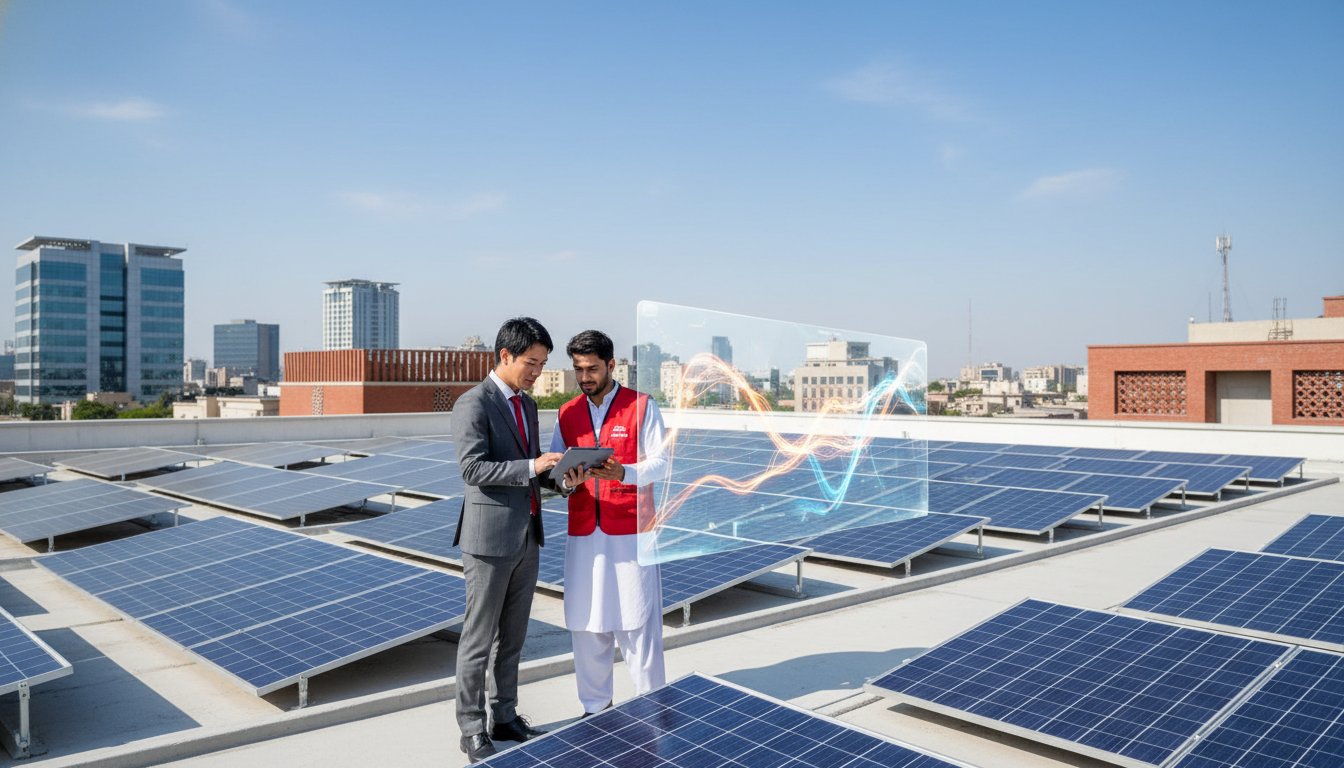
What if your solar investment was engineered to thrive under the 2026 net billing regulations rather than just surviving them? Most energy consumers in Pakistan are currently grappling with the shift to a PKR 11 per kWh buyback rate and the persistent threat of hardware degradation in the extreme heat of Lahore and Multan. It's a challenging environment where standard panels often fail to deliver promised yields. Understanding the Nippon HJT solar panels price in Pakistan requires a shift in perspective from upfront capital expenditure to long-term Levelized Cost of Energy (LCOE). This high-efficiency technology is specifically designed to maintain peak performance when temperatures soar, ensuring your infrastructure remains a high-yielding asset rather than a thermal liability.
This market analysis discovers the technical drivers and economic variables shaping the 2026 solar landscape. You'll gain a clear understanding of how N-type heterojunction cells provide a superior ROI despite currency fluctuations and variable import duties. We'll provide a detailed procurement roadmap and validate why HJT performance is the critical factor for maximizing self-consumption in the current regulatory framework. By the end of this guide, you'll have the technical clarity needed to secure future-proof energy hardware for your commercial or residential project.
Key Takeaways
- Understand why Heterojunction Technology (HJT) has emerged as the superior technical successor to TOPCon and PERC systems in Pakistan's evolving energy landscape.
- Analyze how the unique dual-layer cell architecture of Nippon HJT panels maintains high efficiency during extreme 45°C+ summer temperatures to protect your energy yield.
- Evaluate the critical market variables, including import duties and currency exchange rates, that influence the Nippon HJT solar panels price in Pakistan for 2026.
- Discover how the synergy between high-efficiency HJT hardware and lithium-ion battery storage maximizes self-consumption under the new net billing regulations.
- Learn the structured procurement steps for initiating a professional feasibility study to ensure your solar infrastructure is engineered for long-term ROI.
The 2026 Solar Landscape in Pakistan: Why Nippon HJT is the Strategic Choice
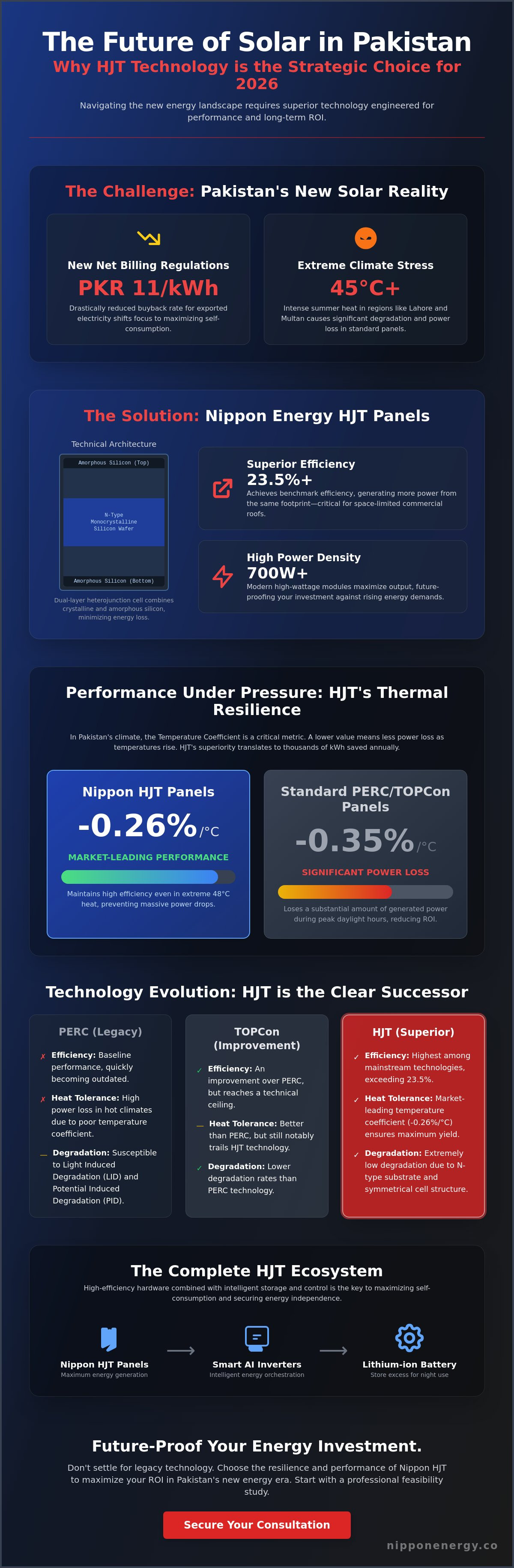
Pakistan's energy sector underwent a fundamental transformation in early 2026. The transition from net metering to a net billing system under the NEPRA (Prosumer) Regulations has significantly lowered the buyback rate for exported electricity to approximately PKR 11 per kWh. This regulatory pivot forces a shift in investment strategy. It's no longer sufficient to install high volumes of low-cost hardware. Instead, the market now prioritizes high-efficiency N-type technology to maximize internal consumption. Consequently, the Nippon HJT solar panels price in Pakistan is evaluated by savvy investors as a tool for long-term energy security rather than a simple commodity purchase.
Heterojunction technology (HJT) has emerged as the definitive successor to TOPCon and PERC architectures. By utilizing a sophisticated Technical Architecture of Nippon HJT, these cells combine crystalline silicon with amorphous thin-film layers to reach efficiency benchmarks beyond 23%. This Japanese-engineered resilience is critical for the South Asian market, where extreme thermal stress often compromises the lifespan of standard modules. While legacy 500W panels were the previous decade's standard, the 2026 market demands 700W+ modules to ensure maximum power density and sustained output.
The Shift from Capacity to Efficiency
Commercial enterprises in Karachi and Lahore face persistent space limitations. When roof area is finite, the only way to offset rising industrial tariffs is to increase the efficiency of every square inch. Nippon Energy has led the adoption of HJT cells to address this specific pain point, ensuring the Nippon HJT solar panels price in Pakistan reflects the high-density power yield provided. These panels allow businesses to generate significantly more power from the same footprint, directly improving the return on investment. This transition from raw capacity to high-precision efficiency is what defines the current solar era in Pakistan.
Defining the HJT Advantage in 2026
HJT technology serves as a high-performance foundation that achieves 2026 efficiency benchmarks of 23.5% and higher. When paired with smart AI solar inverters, these panels form an intelligent energy ecosystem capable of real-time orchestration. This integration future-proofs energy assets against volatile utility price hikes by prioritizing the most cost-effective power source at any given second. By investing in Nippon hardware, you're not just buying a panel; you're securing a durable, high-wattage asset engineered to withstand 45°C+ summers without the aggressive degradation rates common in older P-type technology.
Technical Architecture of Nippon HJT: Performance Beyond the Price Tag
The architecture of Nippon HJT modules represents a significant advancement in photovoltaic engineering. By layering amorphous silicon over a high-quality monocrystalline wafer, the cell creates a symmetrical structure that effectively eliminates traditional energy losses. This sophisticated design is the core reason why the Nippon HJT solar panels price in Pakistan is regarded as a strategic investment in technical resilience. These modules don't just generate power; they maintain a high-efficiency plateau that standard P-type or TOPCon panels cannot replicate under heavy stress.
Thermal Resilience in Pakistan’s Climate
Heat is the most persistent threat to solar performance in the South Asian region. Standard solar modules typically operate with a temperature coefficient of -0.35%/°C or worse, leading to massive power drops during peak daylight hours. In contrast, Nippon HJT panels feature a market-leading coefficient of -0.26%/°C. For an industrial plant in Multan where summer temperatures often hit 48°C, this difference prevents thousands of kilowatt-hours from being lost to heat dissipation every year. In coastal regions like Karachi, the moisture-resistant properties of the amorphous layers protect against humidity-induced degradation. This thermal stability directly lowers the total cost of ownership by ensuring the system delivers its rated output when demand is highest.
Bifacial Performance and Energy Density
Maximizing energy harvest in 2026 requires more than just front-side absorption. Nippon HJT panels offer a bifaciality factor of up to 90%, which is significantly higher than most competing technologies. This allows the rear side of the module to capture reflected light from the ground, particularly in high-albedo environments like sandy soil or white industrial roofs. By deploying high-wattage modules of 730W or more, developers can drastically reduce Balance of System (BOS) costs since fewer racks and cables are required to reach the target capacity. When analyzing HJT vs. TOPCon Pricing in Pakistan, the long-term reliability of HJT becomes the deciding factor. While some N-type technologies face degradation risks, HJT is engineered to retain 90% of its initial performance after 30 years. Some developers choose to pair these assets with topcon solar panels to balance CAPEX and performance across diverse terrain. To see how these specifications align with your specific energy goals, you can review our technical documentation for a deeper dive into module physics.
HJT vs. TOPCon Pricing in Pakistan: Evaluating Long-Term ROI
A common error in energy procurement is the over-prioritization of initial capital expenditure (CAPEX) at the expense of lifecycle value. While the Nippon HJT solar panels price in Pakistan typically sits at a premium compared to TOPCon alternatives, this delta represents a strategic hedge against energy inflation. The true metric for any large-scale installation is the Levelized Cost of Energy (LCOE), which measures the total cost of building and operating a system over its entire lifespan. In Pakistan’s 2026 economic environment, HJT technology delivers a lower LCOE by generating more kilowatt-hours per installed watt, effectively diluting the impact of the initial hardware cost.
Initial Investment vs. Lifecycle Value
The price per watt delta between HJT and legacy technologies is often offset within the first few years of operation. Because Nippon HJT panels utilize an N-type wafer with zero Light Induced Degradation (LID), they yield up to 10-15% more energy annually in the high-irradiance conditions found across Sindh and Punjab. This increased generation density directly translates to a smaller system footprint, which reduces the structural steel and cabling requirements. Furthermore, the robust cell architecture simplifies solar system maintenance by providing greater resistance to micro-cracking and PID (Potential Induced Degradation), ensuring the hardware remains a high-performing asset for decades.
ROI Benchmarks for 2026
Payback periods for commercial solar projects in Pakistan have shifted due to the 2026 net billing regulations. Under the current PKR 11 per kWh buyback rate, the financial viability of a project depends entirely on maximizing self-consumption and minimizing grid reliance during peak tariff hours. High-efficiency hardware is no longer a luxury; it's a requirement for maintaining a 4-5 year payback window. To optimize this equation, the NipponHev system integrates HJT panels with intelligent storage to capture every fraction of surplus energy. This integrated approach ensures that the Nippon HJT solar panels price in Pakistan is justified by a superior internal rate of return (IRR), providing a definitive insurance policy against technology obsolescence as the market moves toward 750W+ standards.
- LCOE Advantage: Lower degradation and higher bifaciality result in more total energy produced over 30 years.
- Space Efficiency: Higher wattage modules reduce the land or roof area required for commercial megawatt-scale projects.
- Thermal Stability: Sustained output during the 45°C+ summer months prevents the ROI "dip" common in standard modules.
Market Dynamics: What Determines the Nippon HJT Solar Panels Price in Pakistan?
The 2026 fiscal policy in Pakistan has created a sophisticated pricing environment for renewable hardware. While the federal government opted against imposing new General Sales Tax (GST) on solar panels in the 2026-27 budget, customs duties remain a primary variable. These duties currently fluctuate between 5% and 20% based on the country of origin and technical classifications. Consequently, the Nippon HJT solar panels price in Pakistan is influenced by these regulatory shifts alongside the "Pakistan Solar Panels & Allied Equipment Manufacturing Policy 2026-2035." This policy introduces cascading tariffs to incentivize local production, making the timing of procurement a critical variable for industrial and commercial developers.
Local Regulatory and Economic Factors
Currency volatility adds a layer of complexity to hardware acquisition. The pricing structure is sensitive to the PKR/USD/JPY triad. Fluctuations in any of these currencies can shift hardware costs rapidly. Global supply chain trends, including the stabilization of high-purity silicon prices and the increased manufacturing scale of HJT cells, help mitigate some of these local pressures. By utilizing solar EPC services, project owners can leverage bulk procurement advantages and structured logistics to lock in pricing during favorable market windows. Logistics costs from manufacturing hubs to Karachi port, combined with inland transport to northern industrial zones, must be factored into the total landed cost. Professional EPC partners manage these variables to provide a buffer against the pricing volatility that often plagues retail-level solar transactions.
Technology Tiers and Authentication
Technical integrity is paramount in a market where the Nippon HJT solar panels price in Pakistan reflects premium Japanese engineering. In a price-sensitive environment, the risk of counterfeit or sub-standard modules is significant. Direct procurement from Nippon Energy ensures that every module carries the Tier 1 certification required for project bankability. This certification is essential for securing financing from local and international lenders who demand verified performance data. Japanese quality assurance is not merely a label; it is a guarantee of structural integrity and performance longevity. Authenticated hardware maintains its value over a 30-year lifecycle, whereas unverified modules often suffer from rapid degradation that destroys the initial ROI. To ensure you are receiving genuine Tier 1 hardware for your next project, consult with our technical procurement team for a verified feasibility study and quotation.
- Regulatory Exemptions: Monitoring current SROs is vital for capturing tax exemptions on renewable energy components.
- Supply Chain Scale: Increased global HJT production in 2026 is helping to narrow the price gap with older TOPCon technology.
- Bankability: Tier 1 status ensures your energy asset is recognized as a high-value security by financial institutions.
Procurement Strategy: Securing Your Nippon HJT Investment
Securing a high-performance solar asset requires a methodical approach that transcends simple retail transactions. Because the Nippon HJT solar panels price in Pakistan reflects a sophisticated engineering profile, the procurement process must be equally rigorous. A structured roadmap ensures that the hardware is not only authentic but also integrated into a system designed for maximum thermal resilience and energy density. This strategic foresight prevents the common pitfalls of mismatched components and unverified performance claims that often undermine large-scale energy investments.
Consultation and Feasibility
A site-specific energy audit is the foundational step in any professional deployment. This audit analyzes consumption patterns, structural load capacities, and local irradiance levels to determine the optimal module configuration. By integrating Nippon HJT panels within the NipponHev system architecture, developers can bridge the gap between generation and storage. This integrated approach allows for the intelligent orchestration of energy through Smart AI monitoring, which tracks HJT performance in real-time post-installation. This data-driven oversight ensures that the system maintains its efficiency benchmarks throughout its 30-year lifecycle, providing a level of transparency that standard installations lack.
The current regulatory environment in Pakistan makes the synergy between HJT panels and Nippon Lithium-ion Battery Storage Systems essential. High-efficiency heterojunction cells generate significant surplus during peak daylight hours. Without advanced storage, this energy is exported at the lower net billing rate of PKR 11 per kWh. Integrating lithium-ion technology allows for the capture of this high-value power, shifting it to evening hours to offset expensive grid tariffs. This configuration is highly customizable, catering to both the high-capacity needs of industrial zones in Karachi and the precision requirements of high-end residential projects in Lahore.
Finalizing the Solar Asset Purchase
The final phase of procurement involves establishing long-term hardware integrity through end-to-end EPC services. Nippon Energy provides comprehensive project development that covers everything from Tokyo-standard quality assurance to local installation. Warranty terms for Nippon HJT panels in the South Asian region are specifically designed to account for local environmental stressors, providing a secure performance guarantee. Selecting a partner that manages the entire lifecycle, from procurement to maintenance, ensures that the Nippon HJT solar panels price in Pakistan translates into a tangible, long-term ROI. To begin the transition to a high-efficiency energy future, you can Request a 2026 customized quote for Nippon HJT solar panels through our official distribution hubs. This ensures you receive a solution that is technically validated and economically optimized for the 2026 market.
Securing a High-Performance Energy Future
The 2026 energy market in Pakistan demands a transition from commodity-grade solar to high-precision engineering. As utility tariffs continue to rise and net billing regulations favor maximized self-consumption, the technical advantages of HJT technology have become indispensable. By prioritizing low degradation rates and superior thermal stability, investors can secure an asset that delivers consistent yields for three decades. While the Nippon HJT solar panels price in Pakistan reflects its Tier 1 status and Japanese precision engineering, the long-term Levelized Cost of Energy (LCOE) provides a clear path to fiscal security.
Integrating these modules within the proprietary NipponHev architecture ensures that every kilowatt-hour is captured and utilized efficiently. With our global presence and dedicated local support hubs in Karachi and Lahore, we provide the technical infrastructure necessary for large-scale success. This is not merely a hardware purchase; it's a commitment to architectural excellence and energy resilience. We invite you to consult with our Tokyo-trained engineers for a custom HJT solar proposal to begin your transition toward an optimized, intelligent energy future.
Frequently Asked Questions
Why is the Nippon HJT solar panels price in Pakistan higher than TOPCon?
The premium reflects the sophisticated manufacturing process required to fuse crystalline silicon with amorphous thin-film layers. This dual-layer architecture results in superior efficiency and a much lower temperature coefficient than TOPCon modules. While the initial investment is higher, the long-term Levelized Cost of Energy is lower due to increased energy yields and better thermal resilience.
What is the expected lifespan of Nippon HJT panels in high-temperature areas like Multan?
Nippon HJT panels are engineered for a 30-year operational lifecycle even in extreme environments. Their N-type wafer technology is naturally resistant to Light Induced Degradation and Potential Induced Degradation. This structural integrity allows the modules to retain approximately 90% of their original power output after three decades of exposure to 45°C+ temperatures.
How much more electricity do HJT panels generate compared to PERC in Pakistan?
HJT panels typically generate between 10% and 15% more annual energy than standard P-type PERC modules. This gain is driven by a higher bifaciality factor and superior low-light performance during dawn and dusk. In high-irradiance zones, this extra kilowatt-hour production justifies the Nippon HJT solar panels price in Pakistan by significantly accelerating the project's payback period.
Are there any government subsidies available for HJT solar panels in Pakistan in 2026?
There are no direct cash subsidies for hardware in the 2026-27 budget. However, the federal government has maintained General Sales Tax exemptions for solar components to encourage renewable adoption. Large-scale industrial developers should consult current SROs for potential tax credits associated with the Pakistan Solar Panels & Allied Equipment Manufacturing Policy 2026-2035.
Can I use Nippon HJT panels with any inverter, or do I need the Nippon Smart AI Inverter?
Nippon HJT panels are technically compatible with any high-quality string or hybrid inverter that meets the required voltage specifications. However, we recommend the Nippon Smart AI Inverter for optimal system orchestration. This integration allows for granular performance monitoring and ensures the highest possible efficiency when paired with our proprietary lithium-ion battery storage systems.
What is the degradation rate of Nippon HJT panels after 25 years of use in Karachi?
The annual degradation rate for these modules is exceptionally low, typically averaging less than 0.4% per year. After 25 years of operation in Karachi's humid and coastal climate, the panels are expected to maintain over 90% of their nameplate capacity. The amorphous silicon layers provide a robust barrier against moisture and salt-induced corrosion that often affects legacy hardware.
Does Nippon Energy provide a local warranty and technical support in Lahore?
Nippon Energy maintains fully operational technical support hubs in both Lahore and Karachi. These centers are staffed by experienced engineers who provide local warranty fulfillment and site-specific troubleshooting. This local presence ensures that our clients have direct access to Japanese-standard quality assurance without the delays associated with international logistics.
How does the bifacial gain of HJT panels affect the total system price?
Bifacial gain improves the economics of the system by increasing the total energy harvest from the same footprint. While the Nippon HJT solar panels price in Pakistan accounts for this advanced bifacial architecture, the extra power generated from the rear side reduces the cost per kilowatt-hour. This makes the system more profitable over time by leveraging reflected light from the ground or roof surface.


