

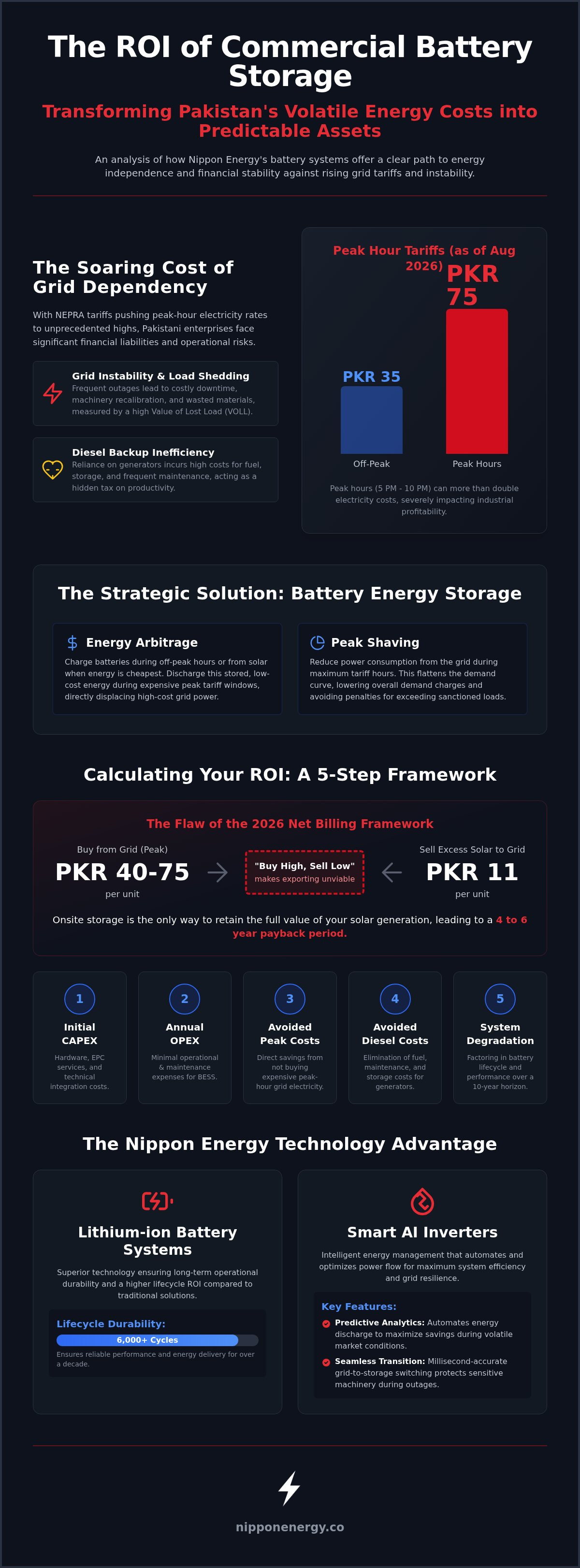
With grid electricity costs reaching as high as PKR 75 per unit during peak hours in 2026, the traditional "wait and see" approach to energy management has become a significant financial liability for Pakistani enterprises. You're likely feeling the strain of unpredictable surcharges and the rising cost of diesel backup power during frequent operational downtime. It's a frustrating cycle that makes long-term budgeting nearly impossible. This guide demonstrates how the roi of commercial battery storage pakistan has shifted from a luxury to a technical necessity, offering a clear path to energy independence and a stable 5 to 10 year financial forecast.
We'll analyze the latest NEPRA tariff structures and the impact of the 2026 net billing framework. You'll discover how Nippon Lithium-ion Battery Storage Systems and Smart AI Inverters work in tandem to transform volatile power expenses into predictable strategic assets. By the end of this analysis, you'll understand exactly how to secure your facility against grid instability while achieving a payback period that aligns with your corporate growth objectives.
Key Takeaways
- Mitigate the financial impact of peak-hour tariffs by transitioning from grid-dependency to autonomous, battery-backed operations.
- Master the 5-step financial framework to accurately project the roi of commercial battery storage pakistan, factoring in CAPEX and avoided diesel generation costs.
- Evaluate the technical superiority of Nippon Lithium-ion Battery Storage Systems, which leverage 6,000+ cycles to ensure long-term operational durability.
- Leverage Nippon Smart AI Inverters to automate energy discharge through predictive analytics, maximizing system efficiency during volatile market conditions.
- Understand the necessity of turnkey Solar EPC Services for integrating high-performance storage solutions within Pakistan's complex industrial infrastructure.
The Economic Drivers for Commercial Battery Storage in Pakistan
The industrial landscape in Pakistan faces an era of unprecedented energy volatility. As of August 2026, NEPRA tariff structures have pushed commercial electricity rates to a range between PKR 35 and PKR 75 per unit. This pricing disparity creates a massive overhead for manufacturing units that rely solely on grid-tied systems. The roi of commercial battery storage pakistan is no longer calculated simply by energy savings; it's defined by the strategic avoidance of these peak-hour surcharges. By integrating Battery Energy Storage Systems (BESS), enterprises can decouple their operational costs from the grid's most expensive cycles.
Energy arbitrage serves as the primary engine for financial recovery in this market. This process involves charging Nippon Lithium-ion Battery Storage Systems during off-peak windows or via solar generation and discharging that power when grid prices hit their maximum. Beyond the direct unit cost, businesses must account for the logistical drain of diesel generators. Fuel procurement, storage security, and frequent maintenance intervals for backup generators represent a silent tax on productivity that battery storage effectively eliminates. Shifting from mechanical backup to solid-state storage reduces the total cost of ownership while enhancing facility uptime.
Understanding Peak vs. Off-Peak Tariff Impact
Pakistani Time-of-Use (ToU) billing structures penalize heavy consumption during evening windows, typically between 5:00 pm and 10:00 pm. During these hours, the cost per kilowatt-hour can double, inflating the fixed billing components of an industrial connection. Battery systems mitigate this by performing peak shaving. Peak shaving is the reduction of power consumption during maximum tariff hours to lower overall demand charges. By utilizing stored energy to flatten the demand curve, facilities protect their bottom line from the most aggressive pricing tiers and avoid the punitive charges associated with exceeding sanctioned loads.
The Cost of Load Shedding to Industrial Productivity
Reliability is a quantifiable asset in the Pakistani market. For many textile and chemical plants, even a micro-interruption in power leads to an extensive Value of Lost Load (VOLL) due to machinery recalibration and wasted raw materials. Nippon Smart AI Inverters manage this risk through millisecond-accurate grid-to-storage transitions. This seamless orchestration ensures that sensitive industrial controllers remain powered, preventing the cascading financial losses associated with abrupt operational stops. The stability provided by Nippon Lithium-ion Battery Storage Systems transforms a facility from a passive grid consumer into a resilient, self-sufficient energy hub that maintains high-performance output regardless of grid status.
Calculating ROI: The Financial Framework for Storage Investments
Quantifying the roi of commercial battery storage pakistan requires a transition from simple cost-accounting to a comprehensive life-cycle analysis. In the 2026 fiscal environment, characterized by an 11.5% State Bank of Pakistan benchmark policy rate, capital allocation must be precise. Financial directors should evaluate storage through a five-step framework: initial CAPEX, annual OPEX, avoided peak-tariff costs, avoided diesel fuel expenses, and system degradation over a 10 year horizon. While the payback period remains a primary metric for many Pakistani CEOs, the Internal Rate of Return (IRR) often provides a more accurate picture of how storage assets hedge against the future of Pakistan's electricity grid volatility.
The 2026 regulatory landscape has introduced a new net billing framework under NEPRA's Prosumer Regulations. With exported solar units valued at only Rs 11 per kWh while grid electricity costs between Rs 40 and Rs 50 per unit, the "buy high, sell low" dynamic has fundamentally changed. This price gap makes onsite storage the most effective tool for value retention. Instead of exporting excess energy for a minimal credit, businesses now store that energy to displace expensive grid consumption during peak windows. This shift has effectively shortened the payback period for commercial and industrial sectors to approximately 4 to 6 years.
CAPEX vs. Long-term Yield
Initial investment calculations must account for hardware, EPC services, and technical integration. While the 2026 solar panel price in Pakistan has stabilized, the valuation of lithium-ion battery packs is influenced by specific customs rulings, such as Valuation Ruling No. 2062/2026. To maximize the yield of these investments, pairing storage with high-efficiency Nippon HJT Solar Panels ensures the lowest levelized cost of charging. These panels provide the high energy density required to fill storage reserves quickly, even during shorter winter days or hazy conditions in industrial hubs like Karachi and Lahore.
Energy Arbitrage and Revenue Generation
The primary financial driver for storage is energy arbitrage. Charging batteries at off-peak rates significantly accelerates ROI by widening the spread between the cost of stored energy and the avoided cost of peak-hour grid consumption. Proposed 2026 ToU net metering policies suggest even higher evening discharge rates of Rs 18 to 22 per kWh for electricity supplied back to the grid. This potential for future revenue streams, combined with the immediate reduction in monthly bills, transforms the battery from a backup tool into a profit center. To see how these variables apply to your specific facility, you can explore our detailed Solar Project Development and EPC services for a customized financial projection.
Lithium-Ion vs. Lead Acid: The Lifecycle ROI Comparison
Selecting the storage medium is a fundamental architectural decision that dictates the long-term financial viability of an energy project. When calculating the roi of commercial battery storage pakistan, many procurement teams fall into the trap of prioritizing upfront CAPEX over lifecycle durability. Traditional lead-acid batteries often appear attractive due to lower initial costs; however, they frequently destroy ROI through rapid degradation and high replacement frequencies. In the harsh industrial environments of Sindh and Punjab, where ambient temperatures regularly exceed 45°C, the technical limitations of lead-acid chemistry become a significant financial liability.
Nippon Lithium-ion Battery Storage Systems are engineered to provide 6,000+ cycles at high depths of discharge. This longevity stands in stark contrast to lead-acid alternatives, which typically fail after 500 to 1,000 cycles when subjected to the rigorous demands of daily peak shaving. Beyond cycle life, the physical footprint of the system impacts the total value proposition. Lithium-ion technology offers superior energy density, allowing for compact installations that preserve valuable industrial real estate. This space efficiency is critical for facilities in crowded hubs like the Korangi Industrial Area, where expanding the physical footprint for bulky battery banks is often impossible.
Total Cost of Ownership (TCO) Analysis
A 10 year TCO analysis reveals that a single lithium-ion installation outlasts at least four to six lead-acid battery banks. This cycle of frequent replacement involves more than just hardware costs; it includes recurring labor, logistics, and the operational risk of system downtime during changeovers. Integrating Lithium-Ion Battery Storage into your energy architecture eliminates these hidden expenses. Nippon systems offer significantly lower OPEX because they don't require the regular water topping or specialized ventilation systems mandatory for lead-acid setups. This "set and forget" reliability ensures that the projected roi of commercial battery storage pakistan remains on track without unexpected maintenance spikes.
Efficiency and Round-Trip Losses
Energy efficiency directly correlates with the speed of capital recovery. Round-trip efficiency refers to the ratio of energy retrieved from storage compared to the energy used to charge it. Lead-acid systems often suffer from losses as high as 20% to 25%, meaning a quarter of your generated or purchased energy is wasted as heat. Nippon systems achieve a round-trip efficiency of 95%+, ensuring that nearly every kilowatt-hour stored is available for use during high-tariff periods. Maintaining this high performance requires professional Solar System Maintenance to monitor cell balancing and thermal management, which further protects the health of the battery cells and maximizes the system’s financial yield over its entire service life.
Maximizing Storage Performance with Smart Orchestration
Hardware alone doesn't guarantee a return on investment; the intelligence governing the system determines its ultimate financial efficacy. Nippon Smart AI Inverters serve as the neural center of the energy architecture, managing the complex interplay between grid prices, solar generation, and battery state-of-health. By utilizing predictive analytics, these systems incorporate real-time weather data to adjust storage reserves. If the AI forecasts a period of low solar irradiance, it prioritizes grid-charging during off-peak windows to ensure the facility remains shielded from peak-hour tariffs. This level of precision is vital for maintaining the roi of commercial battery storage pakistan, as it prevents the accidental use of expensive grid power during high-demand periods.
Total facility management is achieved through the integration of the NipponHev System. This platform synchronizes industrial loads with available energy assets, ensuring that heavy machinery cycles align with peak battery discharge capabilities. Real-time monitoring protocols prevent deep discharge cycles that can prematurely age lithium cells. By maintaining the battery within its optimal voltage range, the system protects the manufacturer’s warranty and ensures the asset performs reliably for its full 10 to 15 year design life.
AI-Driven Energy Management
Automation eliminates the inherent risks of human error in energy management. Smart AI Solar Inverters execute energy arbitrage by calculating the most profitable time to charge and discharge without manual intervention. These systems analyze historical consumption patterns to "learn" the facility's unique load profile, optimizing the timing of peak shaving events. Technical data confirms that continuous AI monitoring extends battery life by 15-20% by preventing thermal stress and over-cycling. This technical orchestration ensures that the roi of commercial battery storage pakistan is realized through both immediate bill reduction and long-term asset preservation.
Future-Proofing with Modular Storage
Industrial energy requirements are rarely static. A modular energy architecture allows businesses to scale their storage capacity in alignment with operational growth. This approach avoids the financial strain of over-provisioning at the start of a project. Instead, companies can add storage modules as production lines expand or as the spread between peak and off-peak tariffs widens. This flexibility ensures that the energy system remains a dynamic asset rather than a rigid cost center. To explore how intelligent orchestration can secure your facility's energy future, contact our team for a comprehensive Nippon Lithium-ion Battery Storage Systems consultation.
The Nippon Energy Advantage: Turnkey ROI Excellence
Transitioning from financial modeling to physical deployment requires a partner capable of managing complex technical risks. While hardware specifications define potential, the actualized roi of commercial battery storage pakistan depends on the precision of the installation and the quality of the surrounding infrastructure. Professional Solar EPC Services ensure that battery banks are integrated with the correct switchgear and protection systems to prevent thermal runaway or premature cell degradation. Nippon Energy provides direct access to proprietary HJT and TOPCon technologies, ensuring that the charging source operates at peak efficiency to maximize the energy available for storage.
Our localized presence in Karachi, Lahore, and Faisalabad allows for a nuanced understanding of regional grid behaviors and environmental challenges. A generic ROI calculator can't account for the specific voltage fluctuations of the K-Electric grid or the heavy particulate matter in Faisalabad’s industrial zones. We provide customized feasibility studies that ground every ROI calculation in reality, using data from existing Pakistani installations rather than theoretical global averages. This methodical approach ensures that your capital expenditure leads to a predictable and high-performing energy asset that meets your 2026 financial targets.
Engineering for the Pakistani Climate
Nippon Energy prioritizes durability through advanced thermal management systems specifically designed for the subcontinental heat. Our battery enclosures feature active cooling protocols that maintain cell temperatures within the optimal range, even when ambient temperatures in Sindh or Punjab climb past 45°C. Industrial-grade dust and humidity protection prevents the ingress of contaminants that cause micro-shorts or corrosion in coastal cities like Karachi. Verified performance data from our local installations confirms that these engineering safeguards are essential for maintaining the system’s round-trip efficiency and protecting the long-term financial forecast of the project.
Next Steps: Consultation and Feasibility
Initiating a transition to energy independence begins with a comprehensive commercial energy audit. Our engineering team analyzes your facility’s 12 month load profile to identify peak shaving opportunities and determine the optimal battery-to-solar ratio. The timeline from procurement to commissioning typically spans several weeks, depending on the scale of the modular integration and existing site conditions. Understanding this progression is vital for aligning the project with your fiscal year budgeting and operational cycles. If you're ready to secure your facility against the volatility of the national grid, contact our technical teams in Lahore or Karachi to begin your site-specific feasibility analysis and solidify your roi of commercial battery storage pakistan.
Securing Your Industrial Energy Future
The landscape of Pakistani energy has fundamentally changed. Relying on legacy lead-acid systems or unmanaged grid connections is no longer a viable financial strategy for modern enterprises. By implementing high-cycle lithium-ion technology and smart AI orchestration, your facility can finally decouple operational costs from volatile tariff hikes. The roi of commercial battery storage pakistan is secured through precision engineering and the strategic avoidance of peak-hour surcharges. Nippon Energy combines Japanese-engineered reliability with a strong local EPC presence in Karachi and Lahore to deliver systems that thrive in harsh climates. Our proprietary high-cycle lithium-ion technology ensures your investment remains a high-performing asset for over a decade. It's time to transform your energy overhead into a predictable competitive advantage. Request a Professional Energy Audit and ROI Forecast from Nippon Energy to begin your transition toward total energy independence.
Frequently Asked Questions
What is the average payback period for commercial battery storage in Pakistan?
Commercial and industrial sectors in Pakistan typically see a payback period of 4 to 6 years for solar with battery energy storage systems. This timeline is accelerated by the widening gap between the cost of stored energy and escalating grid tariffs. By reducing reliance on expensive peak-hour power, businesses recover their initial capital investment through cumulative monthly bill savings and reduced diesel generator maintenance.
How does the 2026 NEPRA peak-hour tariff affect storage ROI?
The 2026 NEPRA peak-hour tariff, which ranges from PKR 35 to PKR 75 depending on load, directly increases the financial utility of energy storage. Storage systems allow facilities to perform peak shaving, effectively shifting consumption from high-tariff evening windows to lower-cost off-peak periods or solar-generated reserves. This strategic shift is the primary driver for the roi of commercial battery storage pakistan in the current regulatory climate.
Can I integrate Nippon Lithium-ion batteries with my existing solar system?
Nippon Lithium-ion Battery Storage Systems are designed for seamless integration with existing solar infrastructure through our Smart AI Inverters. Our EPC team evaluates your current inverter capacity and solar array output to ensure technical compatibility. This process often involves a system upgrade to manage the bidirectional power flow required for efficient battery charging and discharging cycles.
Is lithium-ion safe for high-temperature industrial areas like Korangi?
Lithium-ion technology is exceptionally safe for high-temperature zones like Korangi when supported by industrial-grade thermal management. Nippon systems utilize active cooling and specialized enclosures to maintain cell temperatures within safe operational limits even when ambient heat exceeds 45°C. These safeguards prevent thermal runaway and ensure consistent performance in the challenging climatic conditions of Karachi and Lahore.
What is the difference between ROI and payback period in energy storage?
Payback period measures the time required to recover the initial investment through energy savings, whereas ROI calculates the total gain over the system's entire lifecycle. While a 5 year payback period is a common target, the roi of commercial battery storage pakistan accounts for the 10 to 15 year lifespan of the equipment. This includes the total avoided costs of grid power and diesel fuel over the system's service life.
Does the government of Pakistan offer incentives for commercial battery storage?
The Government of Pakistan is finalizing the National Lithium-ion Battery Manufacturing Policy 2026-31 to encourage local assembly and reduce import costs. Additionally, the State Bank of Pakistan maintained a benchmark policy rate of 11.5% in July 2026, which influences the financing landscape for renewable energy projects. These regulatory frameworks aim to stabilize the energy market and support industrial energy independence.
How long do Nippon Lithium-ion Battery Storage Systems actually last?
Nippon Lithium-ion Battery Storage Systems are engineered to provide over 6,000 cycles at a high depth of discharge, which typically translates to a service life of 10 to 15 years. This durability is significantly higher than lead-acid alternatives, which often require replacement every 2 to 3 years. The longevity of our lithium-ion cells ensures that the system remains a productive financial asset long after the initial payback period has concluded.
Should I choose HJT or TOPCon panels to pair with my storage system?
The choice between HJT and TOPCon depends on your specific efficiency requirements and site conditions. Nippon HJT Solar Panels offer superior temperature coefficients and higher energy density, making them the preferred choice for maximizing charging rates in harsh climates. TOPCon panels provide a high-performance alternative with excellent efficiency, both of which integrate effectively with our storage systems to ensure the lowest levelized cost of energy.


