
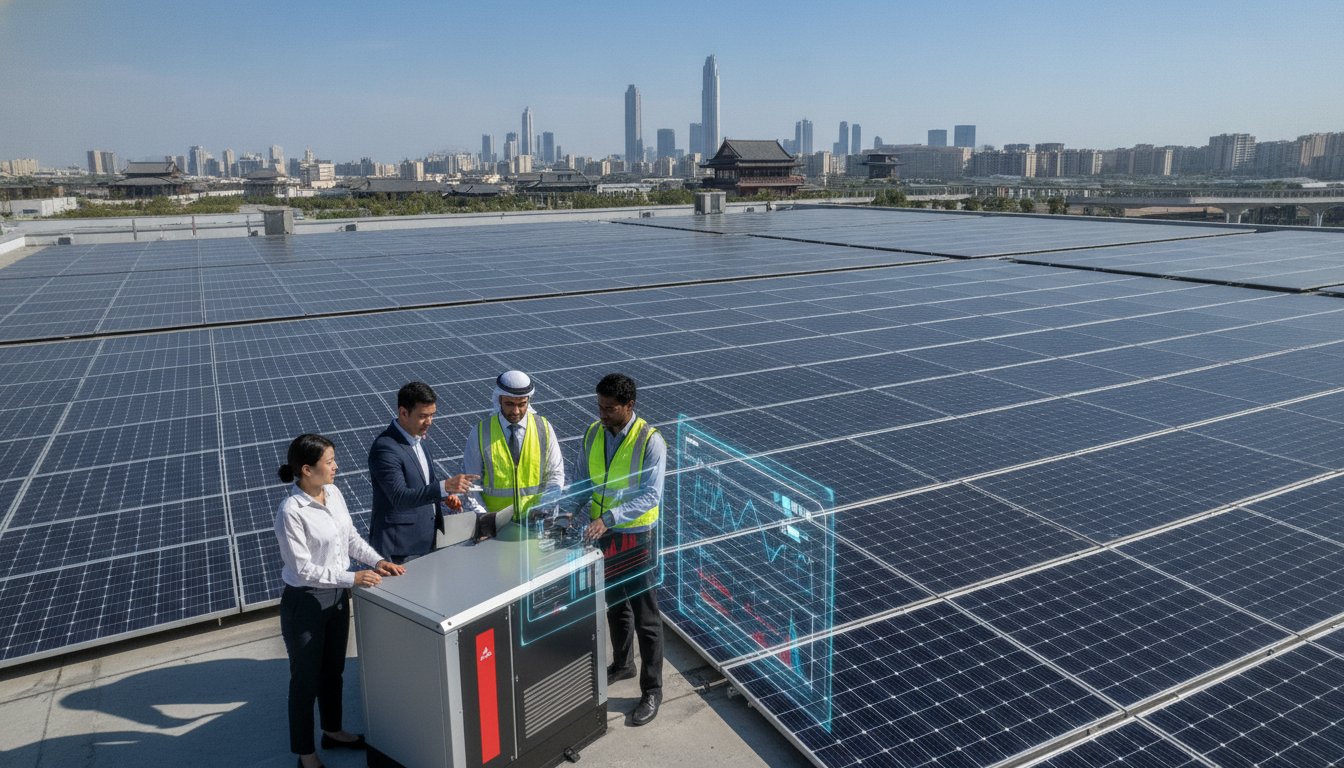
With national commercial electricity rates climbing by 7.4% year-over-year to 13.51¢/kWh as of April 2026, the traditional retail model is facing a silent fiscal crisis. You've likely noticed that rising grid tariffs and extreme peak-demand charges from HVAC systems are eroding your net operating income. Implementing solar for shopping mall energy cost reduction is no longer a peripheral sustainability goal; it's a structural necessity for long-term fiscal stability.
This strategic guide reveals how to leverage high-efficiency HJT solar technology and AI-driven storage to slash retail energy overheads. We'll analyze the technical path toward a significant reduction in Levelized Cost of Energy (LCOE) through the orchestration of dispatchable assets. By integrating Japanese-engineered infrastructure with intelligent management systems, you'll secure energy independence from volatile grids and enhance ESG ratings for discerning investors. We examine the 2026 EPC lifecycle to ensure your project meets critical federal tax credit deadlines while maintaining the highest standards of structural integrity and performance.
Key Takeaways
- Analyze the specific energy consumption profiles of retail infrastructure to identify how HVAC and lighting loads create high-cost peak demand penalties.
- Evaluate the performance metrics of HJT versus TOPCon technologies to determine which cell architecture provides the optimal temperature coefficient for your site.
- Leverage AI-managed Nippon Lithium-ion Battery Storage Systems to achieve effective solar for shopping mall energy cost reduction by solving intermittency issues.
- Navigate the 2026 EPC lifecycle through rigorous structural audits and strategic procurement to ensure long-term system durability and project compliance.
- Secure enhanced ESG ratings and fiscal stability by adopting an integrated, end-to-end infrastructure approach from a high-tech global partner.
The Escalating Energy Crisis for Retail Infrastructure
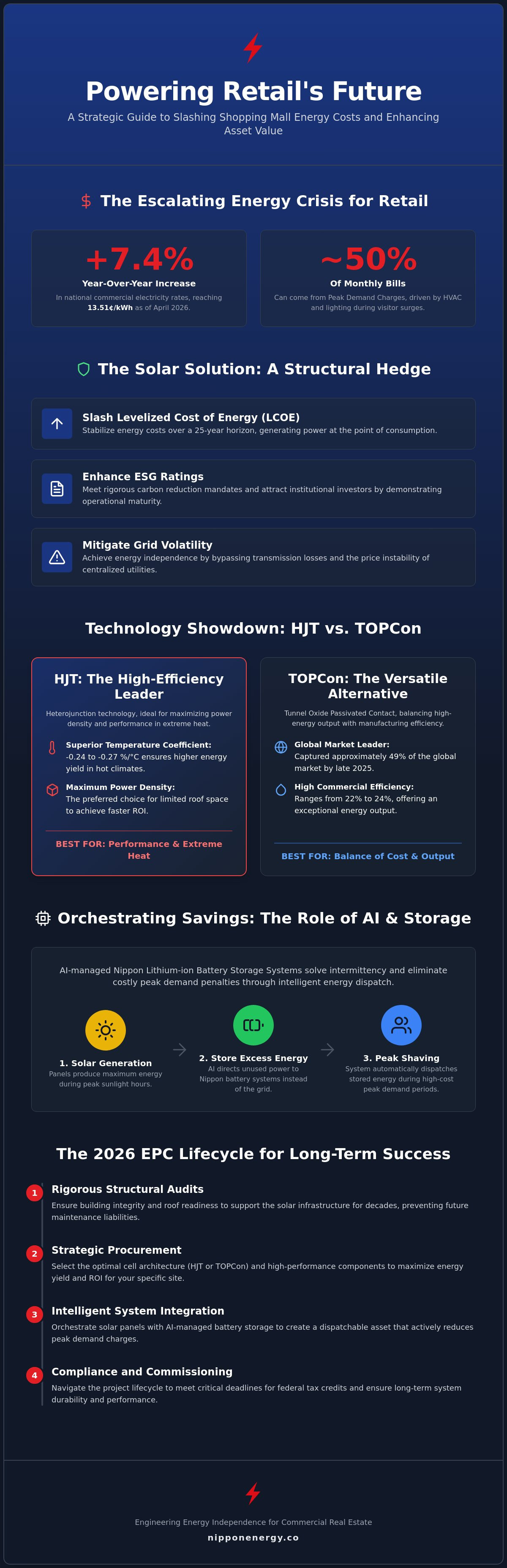
Shopping malls are unique thermodynamic environments. They require constant climate control, high-intensity lumen output, and continuous mechanical operation for vertical transportation systems. This high-baseload profile makes retail developments particularly vulnerable to grid instability and price volatility. As of April 2026, average commercial electricity rates in the US reached 13.51¢/kWh, representing a 7.4% year-over-year increase. Relying solely on traditional energy procurement has transitioned from a standard operational expense to a primary fiscal liability that erodes profit margins.
A Rooftop solar power system provides a structural hedge against these escalating costs. By generating power at the point of consumption, mall operators bypass the transmission losses and service fees associated with centralized utilities. This shift is critical for achieving solar for shopping mall energy cost reduction, as it allows for the stabilization of the Levelized Cost of Energy (LCOE) over a 25-year horizon. The 2026 baseline for commercial efficiency now requires facilities to function as active microgrids rather than passive consumers.
The Impact of Peak Demand Charges
Peak demand charges are surcharges applied by utilities based on the highest level of electricity used during a single billing period, often accounting for up to 50% of a commercial facility's monthly bill. Retail environments experience sharp spikes in consumption when HVAC systems ramp up during midday visitor surges. This creates a significant gap between grid supply capacity and retail demand cycles. Solar infrastructure intercepts these spikes by providing supplemental power exactly when the grid is most expensive, effectively flattening the facility's demand profile and reducing high-load penalties.
For retail managers seeking to implement these strategies, Energy Efficient provides tailored solar, battery storage, and EV charging solutions designed to optimize commercial energy consumption.
ESG Mandates and Investor Expectations
The 2026 regulatory environment has moved beyond superficial green initiatives toward rigorous, data-backed carbon reduction mandates. Institutional investors now prioritize assets with high ESG ratings, viewing renewable energy infrastructure as a marker of operational maturity and risk mitigation. Implementing solar for shopping mall energy cost reduction strategies directly increases the Net Operating Income (NOI), which in turn raises the overall valuation of the commercial real estate asset. Global markets now demand transparency in energy sourcing, making on-site generation a prerequisite for capital acquisition and long-term tenant retention. This transition ensures that retail portfolios remain compliant with emerging carbon disclosure requirements while providing a predictable energy cost structure for the next two decades.
Comparing HJT and TOPCon for Commercial Rooftop Yield
Selecting the appropriate photovoltaic cell architecture is a foundational engineering decision that dictates the 25-year yield profile of a retail asset. While baseline modules might offer lower initial costs, the performance delta between modern cell technologies determines the ultimate success of solar for shopping mall energy cost reduction. Technical architects must evaluate power density, temperature coefficients, and degradation rates to ensure the system remains a performing asset rather than a maintenance liability. In 2026, the industry has shifted toward N-type architectures, which offer superior resistance to light-induced degradation and better performance in low-light conditions.
Nippon HJT Solar Panels: The High-Efficiency Leader
Heterojunction (HJT) technology utilizes a symmetrical structure that combines crystalline silicon with amorphous silicon thin films. This architecture results in a superior temperature coefficient of -0.24 to -0.27 %/°C, significantly outperforming legacy systems. In high-ambient environments like the Middle East or South Asia, these panels maintain higher voltage levels during peak thermal periods. When evaluating topcon solar panels against HJT, the latter provides a higher energy yield in extreme heat. This makes HJT the preferred choice for malls with limited roof space where maximizing power density per square meter is a critical requirement for achieving a faster ROI.
TOPCon Technology: The Versatile Commercial Alternative
Tunnel Oxide Passivated Contact (TOPCon) technology has captured approximately 49% of the global market by late 2025. With commercial efficiencies ranging from 22% to 24%, Nippon TOPCon Solar Panels offer an exceptional balance between manufacturing cost and high-energy output. These cells are particularly effective on typical mall roofing materials due to their high bifaciality, which allows the panels to capture reflected light from the roof surface. For massive retail developments with expansive rooftops, the lower initial CAPEX of TOPCon often leads to a more competitive Levelized Cost of Energy (LCOE) over the project's lifecycle. Both technologies ensure that your solar for shopping mall energy cost reduction strategy is built on a resilient, high-performance foundation. You can review our technical specifications to determine which cell architecture aligns with your facility's specific thermal and structural profile.
Orchestrating Savings: The Role of AI and Storage
Generation capacity represents only half of the technical equation for modern retail infrastructure. While high-efficiency panels produce significant power, the timing of that production often misaligns with the facility's peak consumption periods. Achieving true solar for shopping mall energy cost reduction requires a transition from passive generation to active energy orchestration. This is where the integration of Nippon Lithium-ion Battery Storage Systems and intelligent control layers becomes the deciding factor in project ROI. Without a dispatchable storage component, excess energy is often exported to the grid at unfavorable rates while the facility remains exposed to high evening tariffs.
Peak Shaving and Load Management
Nippon Lithium-ion Battery Storage Systems provide the necessary buffer to solve the intermittency inherent in solar production. By utilizing lithium ion battery storage, mall operators can capture surplus energy during low-occupancy morning hours and deploy it when grid tariffs are at their highest. The integrated AI algorithms analyze historical consumption patterns and real-time weather data to predict imminent load spikes, triggering an automated battery discharge to maintain the facility's demand below the penalty threshold. This process, known as peak shaving, directly targets the most expensive components of a utility bill. It ensures that the solar asset provides maximum financial value even during periods of cloud cover or high visitor traffic.
Intelligent Inverters and Grid Interaction
The smart ai solar inverter acts as the central processor for this entire ecosystem. It manages complex bi-directional power flow between the solar array, the battery bank, and the local grid with millisecond precision. These units feature advanced fault detection and predictive maintenance capabilities, identifying potential component failures before they cause system downtime. High-performance retail environments can't afford energy interruptions; therefore, the inverter's ability to provide remote monitoring and automated diagnostics is essential for operational continuity.
For developers seeking a unified platform, the nipponhev system offers a pre-engineered, integrated solar architecture that streamlines the deployment of these technologies. This level of intelligent orchestration transforms a standard rooftop installation into a sophisticated power plant. It maximizes the fiscal impact of solar for shopping mall energy cost reduction initiatives across global portfolios, providing the technical foundation for long-term energy independence.
The 2026 EPC Lifecycle for Shopping Mall Solar
The transition from technical design to physical infrastructure requires a disciplined Engineering, Procurement, and Construction (EPC) framework. For retail developers, the primary challenge lies in executing large-scale installations without compromising daily operations or tenant experiences. A rigorous EPC lifecycle begins with a comprehensive structural audit. Engineering teams must verify that existing roof trusses can support the additional dead load of high-density HJT arrays while accounting for local wind shear requirements. This foundational assessment ensures the long-term safety and integrity of the asset, providing a secure platform for solar for shopping mall energy cost reduction initiatives.
Procurement in 2026 involves navigating complex global supply chains and stringent Foreign Entity of Concern (FEOC) regulations. Sourcing Nippon hardware at scale requires an integrated logistics strategy to ensure that HJT panels and Lithium-ion storage components arrive on-site in alignment with construction milestones. By utilizing Japanese-engineered components, developers bypass the reliability risks associated with unverified tier-2 manufacturers. Construction phases are staged to minimize business interruption, often utilizing night-shift lifting schedules for heavy equipment to ensure that customer parking and mall entrances remain unobstructed during peak retail hours.
Navigating Commercial Solar EPC Services
Selecting a partner with extensive experience in solar epc services is critical for managing multi-site rollouts across diverse geographic regions. A turnkey model consolidates the feasibility, permitting, and grid synchronization phases into a single point of accountability. This approach is particularly valuable for mall chains, as it ensures standardized hardware configurations and monitoring protocols across an entire portfolio. Professional EPC architects synchronize the system with the local utility grid using Nippon Smart AI Inverters, which facilitates a seamless bi-directional energy flow and immediate operational savings.
Maintenance for Maximum Performance
System commissioning is only the beginning of the performance lifecycle. Professional solar system maintenance is essential to combat the yield-degrading effects of dust accumulation and thermal stress, especially in arid or high-traffic environments. Automated cleaning cycles and periodic thermal imaging allow O&M teams to identify and rectify micro-cracks or soiling issues before they impact the facility's bottom line. Maintaining these high-performance standards is what secures the 25-year ROI and validates the initial investment in solar for shopping mall energy cost reduction. To ensure your project meets the critical 2026 federal tax credit deadlines, you should consult with our EPC architects to initiate your structural feasibility study today.
Partnering for Longevity: Why Nippon Energy
Nippon Energy positions itself as a High-Tech Architect, bridging the gap between advanced Japanese engineering and the practical requirements of global retail infrastructure. Our mission centers on the structural integrity and future-proofing of every system we design. By controlling the entire technology stack, from proprietary HJT modules to AI-enhanced management layers, we eliminate the compatibility risks inherent in fragmented solar projects. This holistic integration ensures that solar for shopping mall energy cost reduction remains a permanent operational advantage rather than a temporary marketing initiative. We don't just supply hardware; we engineer long-term energy independence.
Our global footprint allows us to provide localized expertise across diverse regulatory and climatic environments. With established engineering hubs in Tokyo, Dubai, Karachi, and Berlin, we understand the specific challenges of different markets. Whether it's managing the extreme thermal stress of the Middle East or optimizing low-light yield in Northern Europe, our systems are built for resilience. This global presence, combined with our technical depth, makes Nippon Energy a bankable partner for institutional investors seeking to secure their commercial real estate valuations through reliable, high-performance assets.
Japanese Engineering and Global Reliability
The core of our philosophy is a commitment to precision and longevity. Nippon hardware is developed with a disciplined mindset, utilizing high-grade materials that withstand the rigors of 25-year operational lifecycles. We prioritize the structural and electrical stability of every installation to ensure it performs as a world-class power plant.
- Thermal Resilience: Our HJT panels maintain high efficiency in desert environments where standard modules experience significant power drop-offs.
- Structural Integrity: We design mounting and racking systems that account for specific rooftop load-bearing capacities and local wind conditions.
- Performance Bankability: Our integrated approach creates assets that meet the rigorous due diligence standards of global financiers.
Next Steps for Mall Developers
Initiating a transition to renewable energy requires a methodical assessment of your existing retail footprint. The first stage in any successful project is a professional energy audit and structural feasibility study. These assessments provide the data necessary to customize a Nippon Energy solution that aligns with your specific ROI targets and technical requirements.
Our architects work directly with your development teams to map out a phased implementation strategy that respects your operational schedule. You can reach out to our global offices to schedule a comprehensive energy architecture consultation. We provide the technical evidence and engineering roadmap required to transform your rooftops into high-yield power plants, securing your facility's fiscal stability for the next two decades.
Securing the Future of Retail Energy Architecture
The transition toward a decentralized, high-efficiency power model is a prerequisite for retail longevity in 2026. By integrating proprietary HJT and TOPCon technology with AI-driven energy orchestration, developers can eliminate the volatility of grid dependency. This strategic approach ensures that generation and storage work in unison to solve the intermittency problem, providing a stable path for solar for shopping mall energy cost reduction. A disciplined EPC lifecycle ensures that these assets are built to endure, maintaining structural integrity and maximizing yield over a 25-year horizon.
Nippon Energy brings a global EPC presence across more than five countries, providing the technical depth required to build bankable solar assets for institutional investors. Our Tier 1 manufacturing capabilities and intelligent management systems transform rooftops into sophisticated energy hubs. This level of precision ensures your retail portfolio remains competitive, compliant, and fiscally resilient in an era of rising tariffs. You can secure your facility's operational future by leveraging world-class Japanese engineering and advanced lithium-ion storage technology.
Consult with Nippon Energy’s retail energy architects today to initiate your structural audit and feasibility study. You have the opportunity to redefine your operational overheads and achieve lasting energy independence.
Frequently Asked Questions
How much can solar panels reduce energy costs for a shopping mall?
Solar installations typically reduce monthly utility expenses by 30% to 70% depending on the facility's specific load profile and available roof area. By generating power on-site, mall operators mitigate high Time-of-Use (ToU) tariffs and avoid expensive transmission fees. This direct generation is a primary driver for solar for shopping mall energy cost reduction, effectively lowering the Levelized Cost of Energy (LCOE) over the system's 25-year operational life.
Is HJT or TOPCon better for large-scale retail roofs?
The choice between these technologies depends on the geographic climate and rooftop dimensions. Nippon HJT Solar Panels are superior for malls in high-temperature regions due to their lower temperature coefficient, while Nippon TOPCon Solar Panels offer a cost-efficient balance for massive rooftops with high bifacial gain potential. HJT modules provide higher power density per square meter, making them ideal for facilities with limited roof space that require maximum yield.
What is the average payback period for commercial solar in 2026?
In 2026, the average payback period for commercial solar projects typically ranges from 3 to 6 years. This timeline is accelerated by federal incentives, such as the 30% Investment Tax Credit (ITC), and 100% first-year bonus depreciation. High grid electricity rates, which reached 13.51¢/kWh in mid-2026, further shorten the ROI window by increasing the value of every kilowatt-hour generated on-site.
How does battery storage help with shopping mall peak demand?
Battery storage systems mitigate peak demand charges by discharging stored solar energy during high-load periods. Nippon Lithium-ion Battery Storage Systems allow mall operators to perform "peak shaving," which flattens the facility's demand profile and avoids the expensive surcharges triggered by HVAC and lighting spikes. This capability ensures that the solar for shopping mall energy cost reduction strategy remains effective even during evening hours or overcast weather.
Can solar panels be installed on an existing mall roof without structural damage?
Solar panels can be integrated into existing rooftops provided a professional structural audit is conducted beforehand. Engineering teams evaluate the load-bearing capacity of the roof trusses to ensure they can accommodate the dead load of the panels and racking. Utilizing high-efficiency modules and specialized mounting systems prevents structural damage while maintaining the roof's waterproofing and architectural integrity.
What maintenance is required for a commercial solar power plant?
Commercial solar plants require periodic cleaning, electrical testing, and thermal imaging to maintain peak performance. Dust and soiling can reduce energy yield by 10% or more in certain climates, making automated cleaning or scheduled washing essential. Professional solar system maintenance and monitoring identify micro-cracks or inverter faults early, ensuring the system meets its 25-year performance guarantees and maximizes fiscal returns.
How do AI inverters optimize energy consumption in malls?
AI inverters act as the system's brain, managing bi-directional power flow and predicting load patterns. Nippon Smart AI Inverters use machine learning to analyze weather forecasts and historical consumption data, optimizing when to charge or discharge battery storage. This intelligent orchestration ensures that the facility uses the cheapest available energy source at all times, further enhancing the efficiency of the entire power plant.
Does Nippon Energy provide turnkey EPC services for shopping malls?
Nippon Energy provides comprehensive, turnkey EPC services for large-scale retail developments globally. Our approach covers everything from initial feasibility and structural audits to procurement of Nippon hardware and final grid synchronization. This end-to-end integration simplifies the project lifecycle for mall developers, ensuring standardized performance and reliability across multi-site portfolios in regions including Tokyo, Dubai, Karachi, and Berlin.


