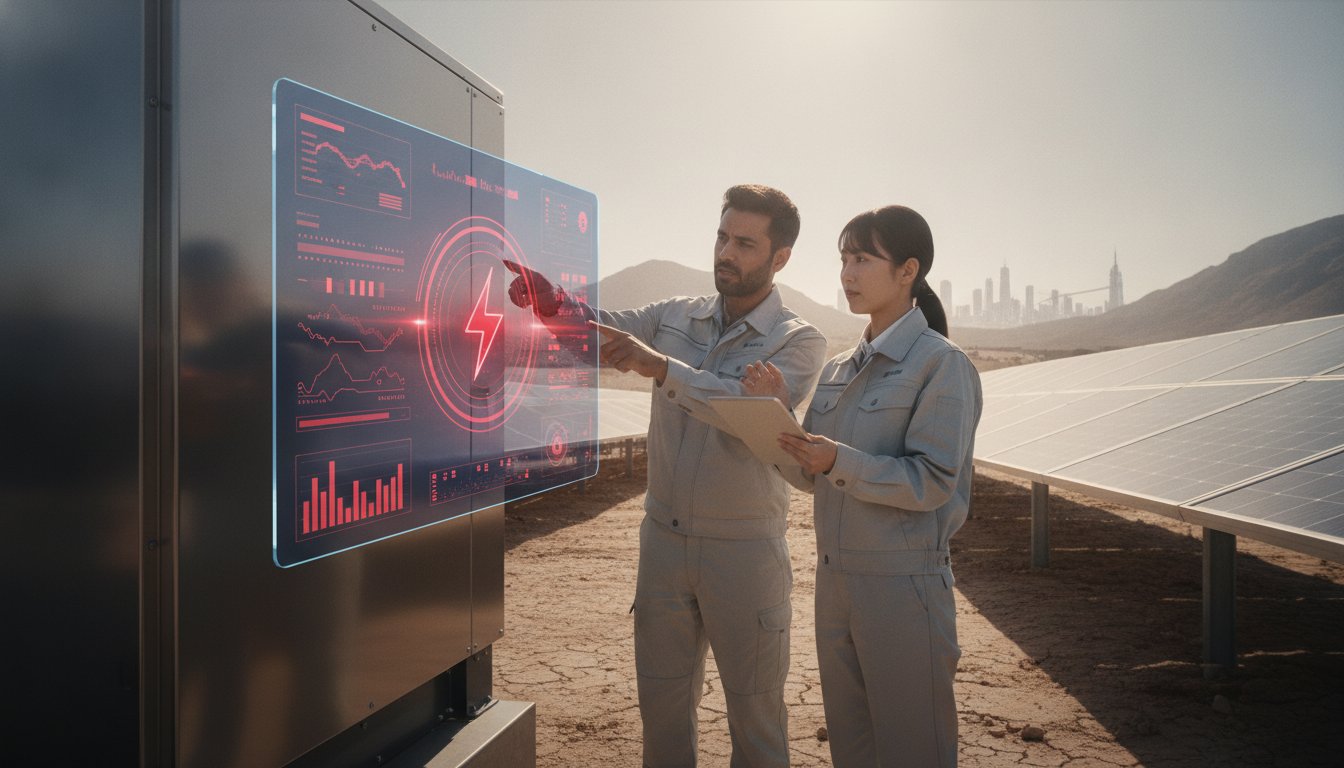
In 2026, a flashing status light on your power conversion unit is no longer just a signal for manual repair; it's a failure of predictive intelligence. You've likely experienced the frustration of unexplained system downtime and the revenue erosion that follows every hour of lost generation. Cryptic error codes and thermal shutdowns in tropical climates shouldn't be the baseline for high-performance energy systems. It's time to shift your perspective from simple repairs to total system optimization.
This guide empowers you to master solar inverter troubleshooting by integrating professional diagnostic protocols with the predictive AI insights required for modern grid stability. You'll learn how to transition from reactive maintenance to intelligent energy recovery. We'll examine the specific strategies to ensure your infrastructure remains resilient against environmental stressors while meeting the stringent May 15, 2026, NERC reliability standards for inverter-based resources. This methodical approach transforms technical obstacles into a roadmap for long-term operational excellence.
Key Takeaways
- Identify critical performance bottlenecks like isolation faults and grid overvoltage to eliminate unexplained downtime and protect revenue streams.
- Master professional solar inverter troubleshooting by utilizing integrated OLED diagnostics and app-based reporting to differentiate between minor warnings and critical hardware alerts.
- Protect internal circuitry from extreme environmental stressors through specialized cooling protocols and dust mitigation strategies designed for high-temperature zones.
- Apply standardized high-voltage isolation and hard-reset sequences to safely restore system power after a fault occurs.
- Future-proof your energy infrastructure by leveraging predictive AI diagnostics that automatically identify and mitigate grid anomalies before they lead to system failure.
Common Solar Inverter Faults: Identifying Performance Bottlenecks
High-performance energy systems require precise calibration to maintain peak efficiency. When a solar inverter fails to perform, the cause is rarely a single catastrophic event. Instead, it's often a cumulative technical bottleneck that disrupts the energy flow. Effective solar inverter troubleshooting begins with identifying these specific failure points before they compromise the entire array's structural integrity.
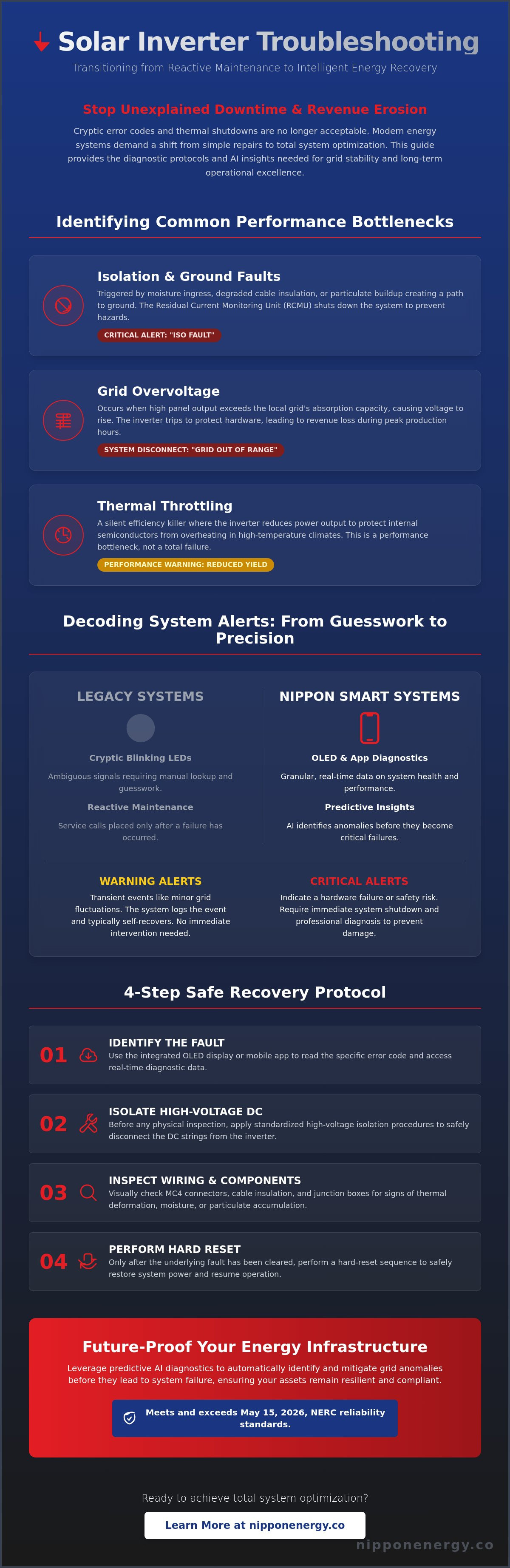
Isolation faults represent one of the most persistent challenges in humid or coastal environments. Moisture ingress into DC connectors or degraded cable insulation creates a path to ground. This triggers the Residual Current Monitoring Unit (RCMU), a critical safety component. The system shuts down immediately to prevent fire hazards or electric shock. Identifying an "ISO Fault" alert requires a methodical inspection of the DC wiring integrity and the sealing of all junction boxes.
Grid overvoltage is a paradox of success. During peak production hours, high-efficiency Nippon HJT or TOPCon panels generate maximum power. If the local grid cannot absorb this energy, the voltage at the point of interconnection rises. Once it exceeds the inverter's safety threshold, the unit trips. This overvoltage disconnect protects the hardware but results in significant revenue loss during the most productive part of the day. Modern systems must be configured to manage these voltage rises through reactive power control.
Thermal throttling is a silent efficiency killer. In 2026, as global temperatures continue to fluctuate, inverters in desert or tropical climates often reach their internal temperature limits. To protect sensitive power semiconductors, the system automatically reduces its power output. This isn't a total failure, but it's a performance bottleneck that requires advanced thermal management or active cooling solutions to maintain the promised yield of your Nippon TOPCon Solar Panels.
Isolation and Grounding Issues
Degraded cable insulation is the primary driver of "ISO Fault" alerts. When the system detects a resistance imbalance between the DC conductors and the earth, the RCMU halts operation. Diagnostic steps include a visual inspection of MC4 connectors for signs of thermal deformation and insulation resistance testing using a megohmmeter on the DC strings. You must ensure that particulate accumulation hasn't created a conductive bridge that triggers these alerts.
Grid Synchronization and Stability
Grid-tie inverters must maintain perfect synchronization with the utility frequency. Volatile energy markets often see frequency fluctuations that cause "Grid Out of Range" errors. Smart inverters manage these events through Anti-Islanding protocols. These safety measures ensure the system doesn't feed power back into a "dead" grid during maintenance. Resolving these errors often requires adjusting the inverter's reactive power settings or updating firmware to handle wider frequency tolerances without compromising safety.
Decoding Inverter Error Codes: From Basic Faults to AI Diagnostics
The architecture of energy management has moved beyond the era of ambiguous blinking LEDs. In 2026, the interface for solar inverter troubleshooting is defined by high-resolution OLED displays and integrated mobile applications that provide granular transparency into system health. This shift allows operators to move from guesswork to precision engineering. Every data point captured by the system serves as a diagnostic fingerprint, enabling a faster return to full operational capacity. Modern diagnostics don't just signal a problem; they provide the contextual data required to solve it.
High-performance systems classify events into "Critical" and "Warning" categories to streamline maintenance priorities. A warning might indicate a transient grid frequency fluctuation that requires no immediate intervention. Conversely, a critical fault signifies a hardware failure or a safety violation that necessitates an immediate shutdown. Understanding this hierarchy prevents unnecessary service calls while ensuring catastrophic failures are addressed instantly. Real-time data logging transforms these alerts into a historical record, providing the empirical evidence needed to maximize long-term ROI and asset longevity. This transparency ensures that every component performs according to its technical specifications.
Standard Error Code Classifications
Hardware Faults are internal disruptions that often indicate physical component stress. This includes insulated-gate bipolar transistor (IGBT) failures or the natural aging of electrolytic capacitors. System Faults are typically external, resulting from environmental variables like over-temperature events or DC over-voltage from the panel array. Communication Faults represent a breakdown in the digital nervous system. Issues with Wi-Fi, RS485, or CAN bus connectivity can halt data transmission even when the power conversion remains functional. If the CAN bus link fails, the inverter cannot communicate with Nippon Lithium-ion Battery Storage Systems, leading to inefficient charging cycles and potential energy loss.
AI-Enhanced Diagnostic Capabilities
Nippon Smart AI Inverters represent a paradigm shift in energy orchestration. These units utilize machine learning to perform root-cause analysis rather than merely displaying a code. By analyzing historical performance patterns and environmental context, the AI can predict a fault before it occurs. It often resolves issues through remote firmware updates, which serves as a first-line solar inverter troubleshooting solution. This proactive approach is a cornerstone of advanced solar system maintenance protocols. Integrating these intelligent diagnostics ensures that your energy infrastructure remains a resilient asset. For those seeking to upgrade their facility's intelligence, exploring Nippon Smart AI Inverters provides the necessary technological foundation for 2026 and beyond.
Environmental Impact on Inverter Reliability: Heat, Dust, and Humidity
Inverter reliability is intrinsically linked to its operational environment. In regions like the Middle East and South Asia, ambient temperatures frequently exceed 50°C, pushing power electronics to their physical limits. Effective solar inverter troubleshooting in these climates involves a deep understanding of thermal management systems. Passive cooling relies on oversized heat sinks and natural convection, while active cooling utilizes high-speed fans to force airflow. Choosing the wrong cooling architecture for a desert installation leads to chronic derating and accelerated component aging. It's a fundamental engineering choice that determines the system's decade-long viability.
The 'Dust Effect' presents a secondary but equally critical risk. Fine particulate matter accumulates on circuit boards, creating conductive bridges that lead to internal component arcing. This is especially dangerous in coastal cities like Karachi or Dubai, where high humidity and salt-mist combine with dust to form a corrosive, conductive sludge. This environmental cocktail degrades seals and compromises the dielectric strength of internal insulation. Systems paired with Nippon HJT Solar Panels must utilize inverters with specific thermal coefficients to handle the unique electrical characteristics of heterojunction technology under high-stress conditions without sacrificing yield.
Mitigating Thermal Stress
Optimal mounting orientation is the first line of defense against heat. You should install inverters in shaded areas with at least 30cm of clearance on all sides to maximize natural convection. This thermal stability is vital when managing lithium ion battery storage integration, as excessive heat from the inverter can transfer to the battery rack, reducing the total cycle life of the storage cells. For commercial-scale arrays, installing external cooling fans provides the necessary airflow to prevent the system from entering a thermal protection mode during the afternoon peak. This proactive cooling strategy preserves the integrity of the power semiconductors.
Regional Protection Standards
Enclosure ratings define the system's resilience against the elements. While IP65 is sufficient for many residential applications, IP66 ratings offer superior protection against high-pressure water jets and fine dust ingress in desert climates. Regular maintenance must include the cleaning of air intakes and heat sinks to prevent particulate buildup from choking the cooling system. The safe operating temperature for TOPCon-integrated inverters typically reaches up to 60°C before the system initiates a protective power reduction to maintain component integrity. Adhering to these standards ensures that solar inverter troubleshooting remains a rare necessity rather than a daily routine. This methodical attention to environmental variables secures the long-term ROI of the entire energy architecture.
Step-by-Step Inverter Troubleshooting: Safe Recovery Protocols
Executing a technical recovery requires more than just a power cycle; it demands a rigorous adherence to safety standards and engineering precision. Before initiating any solar inverter troubleshooting, you must equip yourself with the correct Personal Protective Equipment (PPE). This includes Class 0 rated insulated gloves and an arc-flash face shield to mitigate the risks associated with high-voltage DC systems. Professional isolation procedures ensure that the system is electrically inert before you examine internal components. Skipping these steps exposes the operator to lethal voltages that remain present even when the system appears inactive.
The Professional Reset Sequence
A structured restart often resolves transient software glitches by clearing the internal logic and discharging the DC bus capacitors. Follow this three-step protocol to ensure a safe recovery:
- Step 1: AC Side Shutdown. De-energize the AC breaker first. This stops the flow of power from the grid and prevents internal arcing when the DC side is later disconnected.
- Step 2: DC Isolation and Wait Time. Turn the DC isolator to the 'OFF' position. You must wait at least five to ten minutes. This delay is critical because it allows the high-voltage capacitors to discharge safely to a non-lethal level.
- Step 3: SPD and Fuse Inspection. While the system is powered down, inspect the Surge Protection Devices (SPD) and DC string fuses. A 'red' indicator on the SPD or a blown fuse indicates that the system successfully diverted a high-voltage surge, protecting the more sensitive power electronics.
Technical integrity also depends on physical connectivity. Use a calibrated torque wrench to verify that all terminal connections meet the manufacturer’s specifications, typically ranging from 2.5 to 5.0 Nm. Loose connections increase resistance, leading to localized heating and eventual terminal failure. Additionally, confirm that all MC4 connectors are fully seated with an audible click and no visible gaps. Finally, use a multimeter to verify that the panel string voltage is above the inverter’s specific start-up threshold, which is often 150V for residential units, to ensure the system can initiate the conversion process.
When to Call a Nippon Certified Engineer
Some failures indicate a deeper structural issue that a reset cannot resolve. If you detect a pungent 'burned' smell or observe visible scorch marks on the Printed Circuit Board (PCB), the unit has likely suffered a catastrophic component failure. Persistent 'Relay Failure' or 'Internal Comm Error' messages typically point to hardware degradation that requires professional replacement. For large-scale assets managed under solar epc services, these events should be documented through the monitoring portal to facilitate warranty claims. Attempting to repair internal circuitry without certification voids your warranty and compromises system safety. If your diagnostics reveal hardware-level instability, contact our team for Solar System Maintenance and Monitoring to restore your energy architecture to its peak performance.
Future-Proofing with Nippon Smart AI Inverters: Predictive Health Architecture
The evolution of energy infrastructure necessitates a transition from reactive maintenance to autonomous orchestration. While previous sections detailed the manual protocols for solar inverter troubleshooting, the future of grid resilience lies in a predictive health architecture. Nippon Smart AI Inverters represent this shift by utilizing machine learning algorithms to identify and mitigate potential failures before they manifest as system downtime. These units don't merely report errors; they actively self-correct grid anomalies such as transient overvoltage or frequency shifts. This level of intelligence ensures that the system remains operational without human intervention, maintaining the structural integrity of your energy investment.
Central to this architecture is the Nippon Energy Cloud, a robust platform that provides real-time performance monitoring across global assets. By aggregating data from thousands of installations, the AI refines its diagnostic capabilities, offering a level of precision that manual inspections cannot replicate. Integrating these smart ai solar inverters with NipponHev systems creates a totally autonomous energy ecosystem. This integration allows for dynamic load balancing and optimized storage cycles, ensuring that every kilowatt generated is utilized with maximum efficiency.
The ROI of Intelligent Monitoring
Adopting a predictive approach significantly reduces long-term Operations and Maintenance (O&M) costs. Remote fault isolation allows technicians to identify the exact nature of a disruption before arriving on-site, eliminating unnecessary diagnostic hours. By leveraging AI in solar energy software, operators can maximize energy yield through continuous parameter optimization. Proactive alerts regarding component aging or environmental stress ensure a 25-year system longevity. This methodical oversight protects the asset from the cumulative degradation that typically shortens the lifespan of standard power conversion units.
Engineering Excellence for 2026
The technical requirements of HJT and TOPCon panel arrays demand inverters that can handle high current densities and rapid load changes. Nippon Smart AI Inverters are engineered specifically for these high-efficiency modules, providing the stable electrical foundation required for large-scale success. Whether you are managing a residential installation or a utility-scale project, these scalable solutions offer the reliability of a global industry leader. Transitioning to an AI-managed system simplifies solar inverter troubleshooting by automating the most complex diagnostic tasks. To ensure your current infrastructure meets these 2026 standards, request a professional system audit from Nippon Energy's global technical team to evaluate your facility's path toward total energy autonomy.
Securing the Future of Autonomous Energy Reliability
The transition from manual solar inverter troubleshooting to an automated, predictive energy model is now a prerequisite for industrial and residential grid stability. We've established that the complexities of 2026 energy markets require more than reactive repairs. Success depends on rigorous safety protocols and an engineering mindset that accounts for extreme environmental stressors like thermal throttling and particulate accumulation. By integrating these professional diagnostic standards, you ensure that your energy infrastructure remains a high-performance asset rather than a liability.
Nippon Energy provides the structural foundation for this technological evolution. Our systems leverage Japanese engineering precision and AI-driven predictive maintenance to eliminate the uncertainty of system downtime. Supported by our global O&M network in Tokyo, Dubai, and Lahore, we offer the technical authority required for monumental impact. Upgrade to Nippon Smart AI Inverters for Proactive Performance Management to secure your facility's operational longevity. Your transition to a more resilient and autonomous energy future starts with the right intelligent architecture.
Frequently Asked Questions
Why is my solar inverter showing a red light but no error code?
A solid red status indicator without an alphanumeric code typically suggests a logic board freeze or a critical internal fault that prevents the display from initializing. You should check your mobile monitoring application for background logs that the physical interface might fail to show. If the application also lacks specific data, the unit likely requires a professional hard reset to re-establish the internal communication link and clear the hardware lockup.
How do I fix a 'Grid Under Voltage' fault during a heatwave?
High ambient temperatures during heatwaves often lead to increased grid demand, causing localized voltage drops across the utility infrastructure. While you cannot directly fix the utility's supply, you can adjust the inverter's operational thresholds within local regulatory limits to prevent nuisance tripping. If the voltage remains below the 2026 BEE efficiency standards' minimum requirements, the system will automatically disconnect to protect the power semiconductors from excessive current draw.
Can a firmware update resolve persistent inverter tripping?
Firmware updates frequently include revised grid-matching parameters and improved MPPT algorithms that stabilize power conversion. These digital optimizations can resolve frequent tripping caused by over-sensitive anti-islanding settings or transient frequency fluctuations. It's a non-invasive first step in solar inverter troubleshooting that ensures your hardware aligns with the latest utility-scale interconnection requirements without the need for physical component replacement or site visits.
What is the difference between a soft reset and a hard factory reset?
A soft reset reboots the inverter's operating system to clear transient software glitches while preserving your custom configuration settings. In contrast, a hard factory reset wipes all user data, including grid profiles and communication parameters, reverting the unit to its original state. You should only perform a hard reset under professional guidance, as it requires re-commissioning the unit to meet specific local compliance standards and safety protocols.
Is it safe to troubleshoot my solar inverter during a rainstorm?
Troubleshooting high-voltage equipment during precipitation is unsafe due to the significantly increased risk of electrical conductivity and DC arcing. Moisture can bypass degraded seals when enclosures are opened, leading to immediate short circuits or lethal shocks. You must wait for dry conditions and verify that all surfaces are moisture-free before performing any physical inspections of the DC isolators, wiring, or internal circuitry.
How often should a commercial solar inverter be professionally inspected?
Commercial systems require professional inspection at least once every twelve months to maintain structural and electrical integrity. In high-particulate or tropical environments, bi-annual reviews are necessary to clear heat sinks and verify MC4 connector torque settings. These scheduled assessments are a core component of solar inverter troubleshooting prevention, ensuring that minor thermal stressors don't escalate into catastrophic hardware failures that compromise your ROI.
Why does my inverter make a high-pitched buzzing noise at noon?
This sound typically originates from the high-frequency switching of internal inductors and transformers during peak solar production hours. As the unit processes maximum wattage, the magnetic components vibrate at frequencies that often become audible to the human ear. While a consistent hum is normal for high-performance units, a sudden change in pitch or volume may indicate a cooling fan failure or capacitor aging that requires technical evaluation.
Does a 'Ground Fault' mean my solar panels are damaged?
A ground fault alert indicates an unintended electrical path between the DC circuit and the earth, but it doesn't always signify panel damage. While a cracked panel backsheet can cause this, it's more commonly the result of nicked cable insulation or moisture trapped in a junction box. You should isolate the individual strings to identify if the leakage occurs in the field wiring or the module itself to ensure system safety.


