

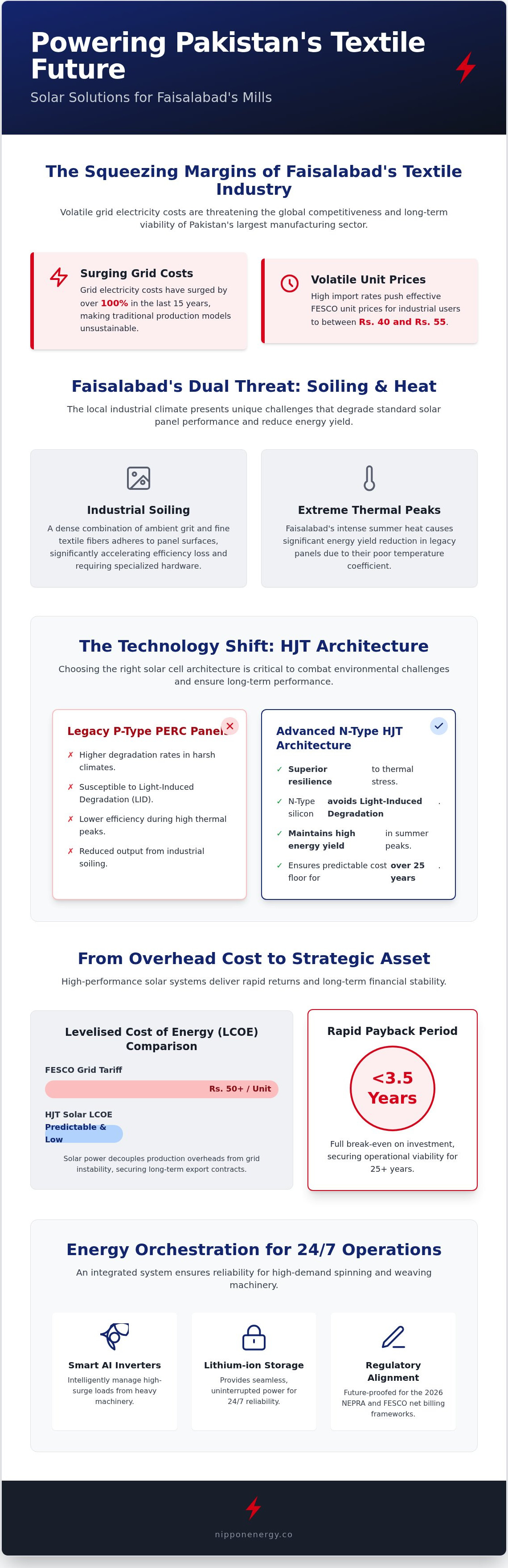
Can a textile mill in Faisalabad remain globally competitive when grid electricity costs have surged by over 100% in the last 15 years; reaching nearly 15 cents per unit? You're likely feeling the pressure as high import rates between Rs. 40 and Rs. 55 per unit; combined with the new 2026 FESCO net billing regulations; threaten your export margins. Transitioning to solar power for textile industry Faisalabad facilities isn't just about adding panels; it's a high-precision engineering requirement to secure long-term energy independence.
We agree that the transition is complex, especially with industrial soiling from textile dust reducing panel efficiency and the shift from net metering to net billing. This guide shows you how advanced HJT architecture and AI-driven energy management can stabilize your cost-of-production for over 25 years. We'll examine the technical shift toward hybrid storage systems and high-efficiency modules that ensure your mill remains a leader in the global market.
Key Takeaways
- Analyze the economic necessity of captive power to insulate textile export margins from volatile FESCO grid tariffs.
- Evaluate how solar power for textile industry faisalabad leverages HJT technology to resist industrial soiling and maintain efficiency during extreme thermal peaks.
- Discover how Smart AI Inverters and lithium-ion storage orchestrate high-surge spinning and weaving loads for 24/7 reliability.
- Navigate the 2026 industrial energy landscape by aligning your facility with the latest NEPRA SRO 892 and net billing frameworks.
- Implement a future-proof EPC roadmap that prioritizes structural integrity and long-term system performance through the NipponHev architecture.
The Economic Imperative for Solar Power in Faisalabad's Textile Industry
Faisalabad's reputation as the "Manchester of Pakistan" is currently being tested by an increasingly volatile energy market. As Pakistan's largest manufacturing sector, the textile industry faces a critical juncture where grid reliance directly correlates with export uncompetitiveness. FESCO industrial tariffs in 2026 have reached levels that make traditional production models unsustainable. Consequently, the industrial clusters along Sargodha Road and Jhang Road are transitioning from grid-dependent operations to sophisticated captive power systems. This shift represents a move toward integrated energy architecture rather than simple rooftop installations.
Grid vs. Solar: The Cost-of-Production Gap
Industrial Clusters and Capacity Requirements
Scaling solar capacity requires a methodical approach to engineering, particularly in high-density zones like M-3 Industrial City and Value Addition City. While SME units might start with 300kW systems, large-scale integrated mills often require 5MW+ deployments to offset significant baseloads. These projects demand rigorous technical feasibility studies and roof structural integrity audits to support the weight of advanced mounting structures. Engaging professional solar epc services during the early stages ensures that system design accounts for the specific load profiles of spinning and weaving machinery; which often involve high initial surge currents.
Current ROI projections for Faisalabad's textile sector remain highly compelling. High-efficiency systems utilizing HJT technology typically achieve a full break-even in under 3.5 years. This rapid payback period is driven by the widening gap between rising grid costs and the falling price of N-Type TOPCon and HJT modules. By treating solar power for textile industry faisalabad as a strategic capital investment rather than a utility expense, mills secure their operational viability for the next 25 years. The transition to captive solar power is no longer an optional upgrade; it's a structural necessity for industrial survival in the 2026 landscape. For a global perspective on the critical factors to consider before starting your solar journey, read more.
Overcoming Faisalabad's Environmental Challenges: Soiling and Heat
Faisalabad's industrial climate presents a unique set of challenges that standard photovoltaic systems often fail to navigate. While many regions deal with common dust, the textile clusters face industrial soiling; a dense combination of ambient grit and fine textile fibers that adhere to panel surfaces. This particulate layer significantly accelerates efficiency loss if not addressed through specific hardware choices. For mill owners investing in solar power for textile industry faisalabad projects, the choice of cell architecture determines whether the system meets its 25-year yield projections or succumbs to the city's intense summer peaks.
Standard p-type PERC panels are increasingly viewed as legacy technology in this environment due to their higher degradation rates. The Nippon HJT advantage lies in its superior resilience to thermal stress and humid industrial zones. By utilizing n-type silicon, these modules avoid the light-induced degradation (LID) that plagues cheaper alternatives. This technical superiority is supported by the Government of Pakistan renewable energy (RE) policy, which encourages the adoption of high-efficiency technologies to stabilize the national grid. Choosing the right technology is essential for maintaining a competitive cost-of-production in the global market.
Why topcon solar panels and HJT Lead the Market
N-type cell architecture, found in both TOPCon and HJT modules, represents a fundamental shift from traditional p-type cells. These panels feature a lower temperature coefficient; allowing them to produce more energy during the hottest hours of the day when textile mill loads are often at their peak. Bifacial gain also plays a critical role on large industrial factory roofs. Since these modules can capture reflected light from the roof surface, they generate additional power that offsets the efficiency loss caused by surface soiling. This ensures a yield of 80% or higher even after 25 years of continuous operation in harsh climates.
Soiling Mitigation and Maintenance Strategies
Maintaining peak performance requires more than just high-quality hardware. In the Sargodha Road industrial zone, automated cleaning systems are becoming the standard for 1MW+ installations to counter rapid dust accumulation. The temperature coefficient is a metric that quantifies the percentage of power output a solar panel loses for every degree Celsius the temperature rises above 25°C; making it the most critical specification for Faisalabad’s industrial yields. It directly impacts the long-term bankability of solar power for textile industry faisalabad investments.
Effective O&M necessitates rigorous solar system maintenance to prevent hot spots and ensure electrical safety across the entire array. For those seeking to architect a resilient energy future, exploring advanced industrial solar solutions is the most logical next step. Relying on professional monitoring ensures that any efficiency drop is detected and rectified before it impacts the mill's bottom line.
Energy Orchestration: AI Inverters and Storage for 24/7 Operations
Textile manufacturing is a continuous process that demands absolute power stability. For mills in Faisalabad, the primary technical challenge isn't just generating power; it's managing the high-surge requirements of spinning frames and weaving looms. These machines create complex load profiles that can cause "flicker" or voltage instability if the energy source isn't properly orchestrated. Implementing solar power for textile industry faisalabad operations requires a shift from passive generation to active energy orchestration. This ensures that sensitive electronic components and high-torque motors receive a consistent, high-quality power supply regardless of grid fluctuations.
The integration of hybrid systems is now a structural necessity. By combining solar arrays with existing gas generators and the FESCO grid, mills can create a resilient energy mix. According to research on Energy Efficiency in Pakistan's Textile Sector, adopting solar photovoltaic systems is significantly more cost-effective than relying on volatile natural gas or grid power. This transition is further supported by the 2026 shift toward net billing; which incentivizes mills to maximize self-consumption through intelligent hardware.
Managing Load Peaks with AI
Modern energy management relies on predictive analytics to handle consumption spikes. A smart ai solar inverter acts as the brain of the facility; executing real-time peak shaving to reduce demand charges. These systems interface directly with factory SCADA setups to prioritize critical loads during cloud cover or grid outages. By analyzing historical data, AI algorithms can predict production surges and adjust the energy mix accordingly. This prevents the mill from drawing expensive peak-hour power from the grid; directly protecting the cost-of-production.
Industrial lithium ion battery storage
The move toward 24/7 solar operations has rendered traditional lead-acid batteries obsolete for industrial use. High-capacity lithium-ion systems offer the cycle life and discharge depth required for heavy textile processing. These units are sized to ensure zero downtime for critical processing units; bridging the gap between daytime generation and nighttime requirements. Under the June 2026 NEPRA Prosumer Regulations, the reduced buyback rates of Rs. 10 to Rs. 13 per unit make on-site storage economically superior to exporting excess energy. Nippon Lithium-ion Battery Storage Systems provide the durability needed for the frequent cycling inherent in industrial energy architecture; ensuring a reliable ROI over decades of service. This storage capacity transforms solar power for textile industry faisalabad from a daytime supplement into a comprehensive, round-the-clock power solution.
The Industrial EPC Roadmap: FESCO Net Metering and Implementation
Executing a transition to solar power for textile industry faisalabad operations requires more than just hardware procurement; it's a multi-stage engineering and regulatory undertaking. The roadmap begins with a rigorous technical feasibility audit and a roof structural integrity assessment. Because textile mills often feature large-span steel structures, our engineers must verify that the dead load of the panels and the dynamic wind loads won't compromise the facility. Once the structural foundation is confirmed, the project moves into the NEPRA SRO 892 framework; which governs the current net billing regulations for industrial prosumers.
The FESCO application process is particularly detailed for industrial clusters. Unlike residential setups, any system exceeding a 25kW load requires a comprehensive load study. This study evaluates the impact of solar export on the local distribution transformer and feeder stability. It's a critical step to prevent grid harmonics from affecting sensitive weaving and spinning machinery. Following approval, the project enters the procurement and Japanese-standard engineering phase; culminating in the installation of a bidirectional meter and final commissioning by FESCO inspectors.
FESCO Net Metering for Large-Scale Loads
One of the most common bottlenecks in Faisalabad's industrial zones is the "Sanctioned Load" limitation. A mill's solar export capacity is generally capped at its existing sanctioned load. If a facility intends to install a 2MW system but only has a 1.5MW sanctioned load, a formal load enhancement request must be processed simultaneously. The load study requirement for systems over 25kW ensures that the local grid can absorb the surplus energy without voltage spikes. For mills on Sargodha Road or within M-3 Industrial City, this technical verification typically adds 4 to 6 weeks to the project timeline; making early submission essential for 2026 deployment targets.
Quality Assurance and EPC Standards
In the industrial sector, "Tier 1" status is merely a baseline. True system longevity depends on Japanese engineering oversight and high-voltage safety protocols. Every connection and mounting point must be architected to withstand the vibration and thermal expansion inherent in textile environments. Post-installation, the nipponhev system provides a unified monitoring platform that ensures the entire array performs to its exact technical specifications. This integrated approach allows for real-time detection of efficiency drops caused by industrial soiling or component stress. To begin your facility's transition with a professional load study, consult with our industrial EPC specialists to secure your energy future.
Future-Proofing Faisalabad's Textile Sector with Nippon Energy
Nippon Energy operates as a High-Tech Architect; focusing on the structural and electronic longevity of every industrial deployment. Our commitment to solar power for textile industry faisalabad is defined by a fusion of local operational expertise and global research and development. We recognize that spinning, weaving, and processing units each possess distinct energy signatures and load requirements. Consequently; our engineering teams design customized energy environments that address these specific technical needs. This methodology ensures that your facility moves beyond simple power generation toward a state of total energy orchestration.
The Nippon HJT and TOPCon Advantage
The core of our industrial solution lies in the direct procurement of proprietary Nippon hardware. By maintaining control over the manufacturing and supply chain; we guarantee that every module meets stringent Japanese engineering standards. Our global case studies demonstrate the resilience of Nippon HJT panels in high-temperature industrial zones; where they consistently outperform standard p-type alternatives. These standards provide the reliability necessary for Pakistan's textile infrastructure; which must withstand both environmental heat and industrial particulates. Utilizing Nippon TOPCon Solar Panels ensures a lower degradation rate; securing your energy yields for a 25-year operational lifecycle.
Partnering for Energy Independence
Securing energy independence for large-scale textile groups requires a methodical and data-driven approach. Our consultation services begin with a professional energy audit; where we analyze your facility's historical load profiles and structural capacity. This audit serves as the blueprint for an integrated energy architecture that scales with your production demands. We provide continuous O&M support to ensure that every component; from Nippon Smart AI Inverters to lithium-ion storage; functions at peak efficiency. This long-term partnership transforms your energy overhead into a predictable; high-performance asset.
To begin the transition toward a resilient production model; schedule a technical consultation with our industrial engineering team. We provide the architectural oversight needed to insulate your mill from grid volatility and secure your position in the global textile market. By integrating solar power for textile industry faisalabad with Nippon Energy's high-performance hardware, your facility achieves a level of cost-of-production stability that is essential for 2026 and beyond.
Architecting Energy Independence for Faisalabad's Industrial Future
Transitioning to solar is no longer a peripheral choice but a structural necessity for maintaining export competitiveness in a volatile energy market. By integrating proprietary HJT high-efficiency hardware and Japanese engineering standards; mills can effectively neutralize the impact of rising FESCO tariffs and industrial soiling. This strategic shift toward solar power for textile industry faisalabad ensures that your facility maintains a predictable cost-of-production while meeting global sustainability mandates. It's a move from reactive utility consumption to proactive energy orchestration that secures your mill's operational viability for decades.
Our localized EPC presence in Pakistan provides the technical oversight required to navigate complex load studies and the 2026 net billing framework. We invite you to Request a Technical Feasibility Study for Your Textile Facility to begin architecting your energy independence. Secure your facility's future with a partner dedicated to technical excellence and 25-year system reliability. Your journey toward a resilient, self-sustaining energy profile starts with a single professional technical audit.
Frequently Asked Questions
How much roof space is required for a 1MW solar plant in a Faisalabad textile mill?
A 1MW industrial solar installation typically requires between 50,000 and 65,000 square feet of unobstructed roof area. Utilizing high-efficiency Nippon HJT Solar Panels allows for greater power density; effectively reducing the total footprint compared to legacy modules. This space optimization is critical for older mills with limited structural area or complex roof orientations.
Does FESCO allow net metering for industrial loads exceeding 1MW?
FESCO currently limits standard net metering agreements to a maximum capacity of 1MW per connection. For textile mills requiring larger deployments; we implement captive power architectures or multiple-point connections under the June 2026 NEPRA Prosumer Regulations. These larger systems focus on maximizing self-consumption to offset high industrial tariffs regardless of the 1MW export cap.
How does industrial soiling in Faisalabad affect HJT vs. PERC panels?
Industrial soiling from textile particulates reduces the energy yield of standard PERC panels more aggressively due to their higher susceptibility to heat and light-induced degradation. Nippon HJT panels utilize a symmetrical cell structure that maintains higher efficiency in high-particulate environments. Their superior temperature coefficient ensures that performance remains stable even when dust accumulation and Faisalabad's 45°C summers combine to stress the system.
What is the typical ROI for a textile mill switching to solar in 2026?
Textile mills in Faisalabad typically achieve a full return on investment within 18 to 24 months. This rapid payback is driven by the high daytime energy demand of spinning and weaving units; which aligns perfectly with peak solar generation. By implementing solar power for textile industry faisalabad; facilities can avoid grid import rates that range from Rs. 40 to Rs. 55 per unit.
Can Nippon Smart AI Inverters integrate with existing gas generators?
Yes; Nippon Smart AI Inverters are specifically engineered to synchronize with existing gas generators and the FESCO grid. The AI orchestration layer manages the load sharing between sources to prioritize solar energy; only utilizing gas or grid power when demand exceeds generation. This seamless integration prevents generator hunting and maintains the high power quality required for sensitive textile machinery.
What are the maintenance requirements for industrial solar plants in Punjab?
Industrial plants in Punjab require a structured O&M schedule that includes bi-monthly panel cleaning and quarterly electrical inspections. In high-dust zones like Sargodha Road; we recommend automated cleaning systems to prevent "textile dust" from baking onto the glass surface. Professional solar power for textile industry faisalabad maintenance ensures that every string performs to its technical specification for the full 25-year lifecycle.
Is lithium-ion storage financially viable for 24/7 textile operations?
Lithium-ion storage has become financially viable in 2026 due to the significant gap between grid import costs and the reduced export buyback rates of Rs. 10 to Rs. 13. Storing excess daytime energy for use during expensive peak evening hours provides a superior ROI compared to exporting to the grid. These systems also act as a critical buffer; protecting processing units from the frequent voltage dips common in industrial clusters.
How long does the FESCO net-metering process take for commercial clients?
The FESCO net-metering process for industrial clients typically takes 10 to 14 weeks from initial application to final commissioning. This timeline includes the mandatory 25kW+ load study and technical verification of the facility's sanctioned load. While the administrative steps are rigorous; our localized EPC team manages the entire regulatory roadmap to ensure your bidirectional meter is installed without technical delays.


