
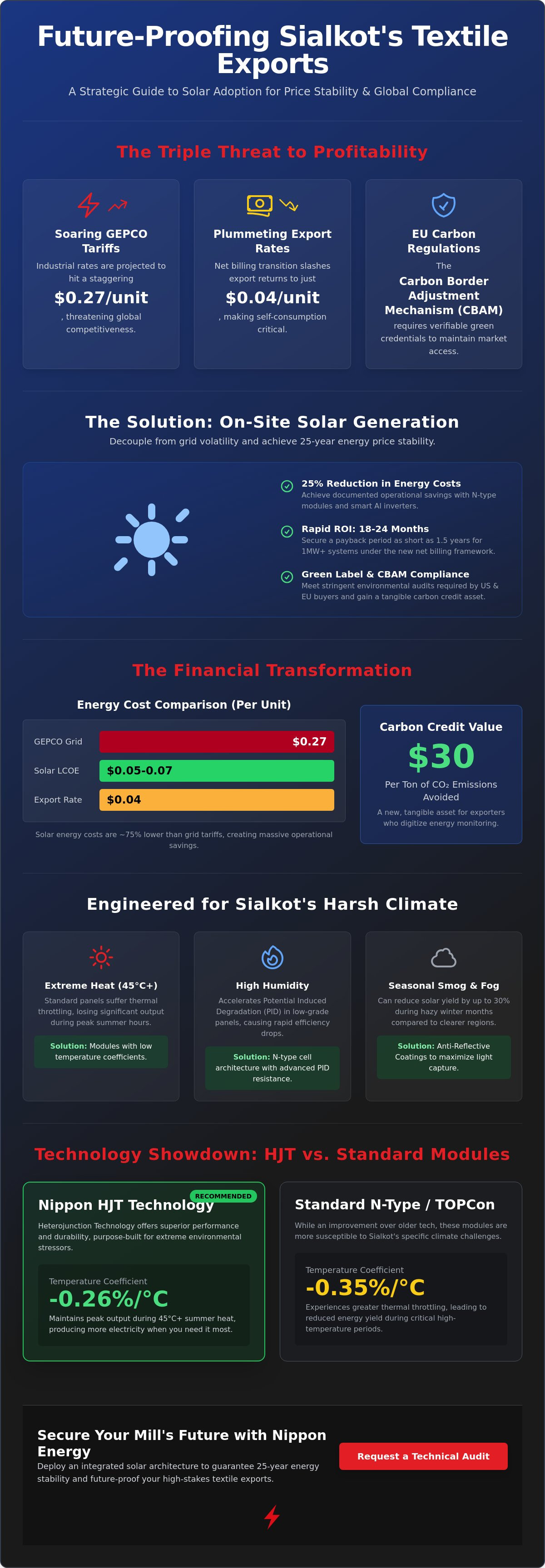
Can your Sialkot textile mill maintain its export edge when GEPCO industrial tariffs reach $0.27 per unit and international buyers require Carbon Border Adjustment Mechanism (CBAM) certification? You're already witnessing the financial pressure of Pakistan's transition to net billing, where export rates have plummeted to approximately $0.04 per unit. This shift makes it clear that the era of passive energy management is over. To protect your margins, you need a high-performance infrastructure that prioritizes immediate self-consumption over grid export. Integrating solar power for textile industry Sialkot is no longer just a way to save money; it's a strategic necessity to secure your place in the global supply chain.
This procurement guide offers a technical roadmap to achieve 25 year energy price stability and full compliance with international sustainability audits. We'll examine how HJT technology provides the thermal resilience required for Sialkot's humid climate, ensuring your system maintains peak efficiency despite extreme heat. By the end of this article, you'll understand how to deploy N-type solar modules and smart AI inverters to document a 25% reduction in operational energy costs. We'll break down the transition from outdated grid reliance to a sophisticated, carbon-neutral manufacturing model.
Key Takeaways
- Understand the 2026 GEPCO industrial tariff trajectory and how solar power for textile industry Sialkot facilitates critical compliance with the EU Carbon Border Adjustment Mechanism (CBAM).
- Evaluate the performance gap between HJT and TOPCon technologies to ensure your solar array maintains peak output during Sialkot’s extreme 45°C summer peaks.
- Analyze the financial ROI of 1MW+ systems under the 2026 net billing framework to secure a payback period as short as 18 to 24 months.
- Execute rigorous structural engineering audits and monsoon resilience planning to protect your energy infrastructure from Sialkot’s specific weather patterns and aging textile sheds.
- Discover how integrated architectures like the NipponHev system streamline industrial energy procurement and future-proof high-stakes textile exports.
The Strategic Imperative for Solar in Sialkot’s Textile Sector
The textile industry in Pakistan is undergoing a forced evolution as GEPCO industrial tariffs for 2026 stabilize between $0.20 and $0.27 per unit. For Sialkot’s export hubs, these figures represent more than just a line item; they're a direct threat to global price competitiveness. Traditional grid reliance exposes manufacturers to peak-hour surges and fuel price adjustments that fluctuate without warning. Implementing solar power for textile industry Sialkot provides a fixed-cost energy floor. For a typical 500kW+ mill, the Levelized Cost of Energy (LCOE) drops to approximately $0.05 to $0.07 per unit when calculated over a 25-year operational lifespan. This transition effectively decouples production costs from the volatility of the national grid.
Export Compliance and Green Manufacturing
International procurement standards have shifted from price-first to sustainability-first. Sialkot exporters now face the EU’s Carbon Border Adjustment Mechanism (CBAM), which penalizes high-carbon imports. Adopting solar power for textile industry Sialkot allows mills to secure 'Green Labeling' and meet the stringent environmental audits required by US and European retail giants. Transitioning from grid-heavy production to a sustainable energy mix isn't just about reducing bills; it's about maintaining market access. In 2026, the verifiable carbon credit value for Sialkot textile mills stands at approximately $30 per ton of avoided emissions, creating a tangible asset for exporters who digitize their energy monitoring.
Sialkot’s Industrial Micro-Climate Challenges
Standard solar configurations often fail in Sialkot due to the region's unique micro-climate. High humidity levels accelerate Potential Induced Degradation (PID) in low-grade panels, leading to significant efficiency drops within just three years. Sialkot’s seasonal smog and fog can reduce solar yield by up to 30% compared to clearer regions like Karachi. To counteract these losses, industrial-grade hardware must include:
- Advanced PID Resistance: N-type cell architectures that eliminate the ion migration caused by high moisture levels.
- Anti-Reflective Coatings: Specialized glass treatments that maximize light capture during hazy or overcast winter months.
- Thermal Resilience: Modules with low temperature coefficients to maintain output when ambient temperatures exceed 45°C.
Investing in higher-grade industrial hardware ensures that your mill's energy production remains consistent, regardless of Sialkot's challenging weather patterns. This technical foresight protects the long-term ROI of the installation by preventing premature component failure.
HJT vs. TOPCon: Industrial Resilience for Sialkot’s Mills
Selecting the right hardware is a technical decision that dictates the next 25 years of operational overhead. While traditional PERC panels were once the industry standard, the 2026 industrial benchmark has shifted toward N-type architectures. Nippon HJT (Heterojunction Technology) represents the pinnacle of this shift, offering superior efficiency and durability compared to standard modules. For engineers comparing Nippon TOPCon Solar Panels and HJT, the choice often hinges on the specific thermal profile of the installation site. Implementing solar power for textile industry Sialkot requires a module that can withstand extreme environmental stressors without compromising energy density.
Thermal Resilience and Yield Optimization
Sialkot’s ambient temperatures frequently exceed 45°C, causing standard panels to suffer from significant thermal throttling. Nippon HJT panels feature a temperature coefficient of -0.26%/°C. This is substantially lower than the -0.35%/°C found in traditional modules. This technical advantage ensures your system produces more electricity during peak summer production hours when cooling loads are highest. This high-efficiency transition aligns with Pakistan's renewable energy policy, which encourages industrial self-sufficiency to stabilize the national grid. By maximizing the yield per square foot, textile mills in high-density industrial estates generate more power within their existing footprint. Long-term data shows that Nippon HJT modules maintain over 90% of their original output after 30 years, significantly outperforming the 25-year lifecycle of standard PERC alternatives.
Moisture Resistance in Sialkot’s Humid Summers
The high humidity levels characteristic of Sialkot’s monsoon season create a high-risk environment for moisture ingress. In standard panels, moisture often leads to internal corrosion and Potential Induced Degradation (PID). Nippon HJT modules utilize a symmetrical dual-glass structure that provides an impermeable barrier against water vapor. This design is critical for factories located near river-fed industrial zones where high vapor pressure is a constant factor. Ensuring decades of structural integrity in these high-humidity environments prevents the premature failure of the solar array. It's a calculated move that protects your capital investment from the local climate's corrosive effects.
Most Sialkot textile sheds utilize concrete or metallic roofing that can be treated with reflective white coatings. This creates an ideal environment for bifacial modules, which capture light from both sides to provide an additional 10% to 25% yield gain through albedo. When you partner with a technical energy architect, you can verify how these bifacial gains accelerate your ROI. Integrating solar power for textile industry Sialkot with these advanced specifications ensures that your facility remains a leader in both production efficiency and global sustainability compliance.
ROI and Financial Modeling for Sialkot Industrial Net Metering
The financial architecture of industrial energy in Pakistan has shifted significantly with the 2026 transition from 1:1 net metering to a net billing framework. Under current GEPCO regulations, industrial consumers purchase grid power at rates between $0.20 and $0.27 per unit, while excess solar exported to the grid is credited at approximately $0.04 per unit. This disparity makes self-consumption the primary driver of profitability. For a 1MW+ system, the payback period for a high-efficiency installation typically ranges between 18 and 24 months. While budget-tier panels might offer a lower initial price point, their higher annual degradation rates (0.40% or more) and lower efficiency (21.5%) often extend the payback period by 12 to 18 months compared to premium N-type modules.
Securing capital for these projects involves navigating specialized green financing instruments. Sialkot manufacturers can leverage the State Bank of Pakistan (SBP) Green Finance scheme, which offers subsidized interest rates as low as 6% for renewable energy transitions. Alternatively, commercial bank loans are available with markups linked to KIBOR, typically ranging from 22% to 28%. The "Cost of Delay" is perhaps the most critical metric for exporters. Every month a facility operates without solar power for textile industry Sialkot represents a permanent loss of potential savings, directly eroding the margins needed to compete with regional textile hubs in Vietnam or Bangladesh.
GEPCO Net Metering for 100kW to 2MW Systems
Commissioning an industrial net metering system in Sialkot follows a structured regulatory path. It begins with a technical feasibility study, followed by the submission of a formal application to GEPCO for a No Objection Certificate (NOC). Once the physical installation and testing are complete, a three-phase bi-directional meter is installed to track energy flow. Managing surplus energy during factory downtimes or religious holidays requires an intelligent export strategy to maximize the $0.04 buyback credit. A Nippon solar system functions as a fixed-cost energy hedge, insulating Sialkot textile mills from the projected 15% annual escalation in GEPCO industrial tariffs.
Energy Storage: Protecting High-Precision Textile Machinery
Integrating lithium ion battery storage into your industrial energy architecture provides a critical buffer against grid instability. Sialkot’s textile mills often utilize high-precision electronic looms and surgical forging equipment that are sensitive to voltage fluctuations. A Battery Energy Storage System (BESS) mitigates these dips, preventing costly production restarts and equipment damage. By utilizing storage for peak-shaving, manufacturers can also avoid the highest GEPCO tariff brackets during evening hours. This 24/7 energy independence ensures that three-shift operations remain profitable, as the system discharges stored solar energy during expensive peak periods to maintain a flat, predictable energy cost curve.
Investing in solar power for textile industry Sialkot with an integrated storage component creates a resilient production environment. It transforms energy from a volatile operational expense into a stable, managed asset that supports long-term industrial growth.
Industrial EPC: Structural Engineering for Sialkot’s Textile Mills
Deploying solar power for textile industry Sialkot requires more than just panel placement; it demands a rigorous structural audit of the existing facility. Many of Sialkot's textile sheds were constructed decades ago and weren't designed to support the distributed load of a modern solar array. A typical 300kW installation adds approximately 12 to 15 tons of static weight to the roof structure. Professional solar epc services conduct ultrasonic thickness testing and load-bearing simulations to ensure the building's integrity isn't compromised. This engineering-first approach prevents structural failures during Sialkot’s intense monsoon season, where wind speeds can exert massive uplift forces on poorly secured modules.
Safety protocols for high-voltage industrial arrays must include rapid shutdown compliance to protect both the asset and the workforce. In the event of a thermal anomaly or grid failure, the system must automatically de-energize at the module level to prevent electrical fires. This is particularly critical in textile environments where volatile lint and fabric dust are prevalent. Implementing these fail-safes ensures that your transition to solar power for textile industry Sialkot doesn't introduce new risks to your production floor.
Advanced Mounting and Roof Integration
Choosing between ballasted and penetrated mounting systems depends on the specific roofing material and the machinery housed beneath. For metallic roofs common in Sialkot, penetrated systems with high-grade EPDM gaskets provide a secure, leak-proof attachment. However, if the facility houses heavy spinning or weaving machinery, the roof is subject to constant micro-vibrations. Engineers must design vibration-resistant mounting structures that prevent bolt loosening and mechanical stress on the cells. While South-facing arrays maximize annual yield, East-West configurations are often superior for textile mills with high morning and afternoon loads, providing a flatter, more consistent energy curve throughout the production day.
AI-Driven Operations and Maintenance (O&M)
Maximizing the ROI of an industrial solar asset depends on the precision of post-installation care. Utilizing a smart ai solar inverter allows for real-time string monitoring, identifying efficiency drops at the individual panel level before they impact the bottom line. Sialkot’s industrial zones often experience high Air Quality Index (AQI) levels, leading to rapid soiling from dust and soot. AI-driven predictive cleaning schedules analyze local weather data and real-time yield loss to trigger maintenance only when necessary. Consistent, professional solar system maintenance ensures 99% uptime, protecting the mill’s energy independence and carbon compliance status.
To ensure your facility meets these rigorous engineering standards, you should consult with our industrial EPC team for a comprehensive site assessment and structural load analysis.
Nippon Energy: Engineering Sialkot’s Industrial Energy Future
Success in Sialkot’s high-stakes export sector requires more than just energy generation; it demands technical precision and hardware longevity. As global buyers intensify their scrutiny of supply chain sustainability, Japanese-engineered Nippon HJT and TOPCon modules provide the necessary reliability for long-term compliance. These systems are designed to withstand the specific stressors of the Punjab industrial heartland, offering a resilient alternative to budget-tier components. Integrating solar power for textile industry Sialkot with Nippon’s advanced cell architecture ensures that your facility remains productive even during the most challenging weather conditions.
The nipponhev system serves as the definitive all-in-one industrial energy solution for modern textile mills. By unifying generation, storage, and intelligent orchestration into a single architecture, it eliminates the inefficiencies of fragmented systems. This holistic approach is backed by our local Punjab engineering support teams, ensuring that technical assistance is available within the province. Documented case studies in humid industrial environments have shown yield increases of up to 22% when switching from standard modules to Nippon’s high-performance HJT technology. These results are secured by global hardware warranties that reflect our commitment to industrial excellence.
The Nippon Technical Advantage
Choosing Nippon Energy gives factory owners direct access to proprietary HJT and TOPCon modules that aren't available through general importers. We manage the entire EPC lifecycle, from initial feasibility studies to the final GEPCO commissioning process. This end-to-end oversight ensures that every component is optimized for Sialkot’s micro-climate. Our 25-year performance guarantees are backed by a global corporation, providing the financial security required for large-scale capital investments. It’s a partnership built on transparency and technical prowess.
Next Steps for Sialkot Factory Owners
Transitioning to solar power for textile industry Sialkot begins with a site-specific technical feasibility study and a rigorous structural audit. These assessments identify the optimal system configuration for your specific roof profile and energy demand. Nippon Energy also helps manufacturers navigate the 2026 industrial solar financing landscape through our network of banking partners. By securing subsidized rates, you can accelerate your ROI and stabilize your operational costs. Contact our Lahore or Sialkot regional offices today to schedule a professional ROI consultation and begin your journey toward energy independence.
Securing Your Mill’s Operational Sovereignty
The 2026 transition to net billing marks the end of the legacy energy model for Pakistan’s exporters. By integrating Japanese-engineered HJT technology, your facility overcomes the thermal and humidity barriers unique to the region while ensuring full compliance with EU carbon mandates. This strategic deployment of solar power for textile industry Sialkot transforms a volatile utility expense into a stable, high-performance asset. You aren't just installing panels; you're building a resilient infrastructure that protects your margins for the next 25 years.
Future-proofing your production capacity requires an engineering-first approach that prioritizes long-term ROI over short-term savings. Our local Sialkot engineering support team is equipped to manage turnkey EPC requirements for 1MW+ textile projects, ensuring every structural and electrical specification meets global standards. Take the first step toward energy independence and Request a Professional Industrial Roof Audit & ROI Analysis to verify your mill's specific yield potential. Secure your competitive advantage in the global market and ensure your facility remains a leader in sustainable manufacturing.
Frequently Asked Questions
What is the best solar panel for a factory in Sialkot’s humid heat?
N-type HJT (Heterojunction Technology) panels are the superior choice for Sialkot’s humid-heat index. These modules feature a temperature coefficient of -0.26%/°C, allowing them to maintain peak energy production when ambient temperatures exceed 45°C. Their dual-glass architecture provides an impermeable barrier against moisture ingress. This prevents Potential Induced Degradation (PID) which often compromises standard panels in high-humidity industrial zones.
How much does a 500kW industrial solar system cost in Sialkot in 2026?
Industrial solar costs in 2026 are determined by hardware selection and structural complexity rather than a flat rate. While market prices for premium N-type HJT panels have stabilized around $0.15 to $0.19 per watt at the component level, total project costs include specialized mounting and AI-driven inverters. Factory owners should focus on the Levelized Cost of Energy (LCOE) to evaluate long-term value. This metric provides a more accurate picture of the system's 25 year financial impact.
Will solar panels meet EU CBAM requirements for Sialkot textile exports?
Implementing solar power for textile industry Sialkot is a primary mechanism for achieving EU Carbon Border Adjustment Mechanism (CBAM) compliance. By transitioning to a renewable energy mix, exporters can document a verifiable reduction in their carbon footprint. This "Green Labeling" is essential for maintaining access to European retail markets. It helps mills avoid the carbon taxes that will be levied on high-emission imports starting in 2026.
How long is the payback period for industrial solar under GEPCO net metering?
The payback period for 1MW+ industrial systems in Sialkot typically ranges between 18 and 24 months. This rapid ROI is driven by the high daytime electricity consumption of textile mills, which allows for maximum self-consumption of solar energy. Even with the 2026 shift to net billing, the disparity between GEPCO’s $0.27 import rate and the $0.04 export credit ensures that displacing grid power remains highly profitable.
Can my factory roof support the weight of a large solar array?
Most industrial textile sheds can support a solar array, but a professional structural audit is mandatory before installation. A 300kW system adds roughly 12 to 15 tons of distributed load to the roof structure. Engineers must assess the integrity of the trusses and purlins, particularly for older concrete or metallic sheds. In cases where the roof is aging, specialized lightweight mounting or structural reinforcement can be integrated into the EPC process.
What is the difference between HJT and TOPCon for industrial textile mills?
HJT panels offer slightly higher efficiency (23.5%) and better temperature resilience than TOPCon (22.5%) in extreme heat. While TOPCon modules are a robust N-type alternative with a lower upfront cost, HJT panels provide a lower annual degradation rate of 0.25%. For Sialkot textile mills with a 25 year horizon, the superior yield of HJT in humid conditions often provides a higher total ROI despite the initial premium.
How often do industrial solar panels need cleaning in Sialkot's smog?
Industrial solar panels in Sialkot generally require cleaning every 10 to 14 days during the high-smog winter months. Soiling from industrial soot and dust can reduce energy yield by up to 30% if left unmanaged. Utilizing AI-driven monitoring helps identify the exact moment when soiling begins to impact performance. This allows maintenance teams to trigger cleaning schedules based on real-time data rather than arbitrary intervals.
Is net metering still available for Sialkot industrial consumers in 2026?
Net metering has been replaced by a "net billing" framework under NEPRA’s 2026 Prosumer Regulations. This new policy allows industrial consumers to export surplus energy to GEPCO at a buyback rate of approximately $0.04 per unit. While this is lower than the previous 1:1 arrangement, solar power for textile industry Sialkot remains financially viable. The focus has simply shifted toward maximizing on-site self-consumption during peak production hours.


