
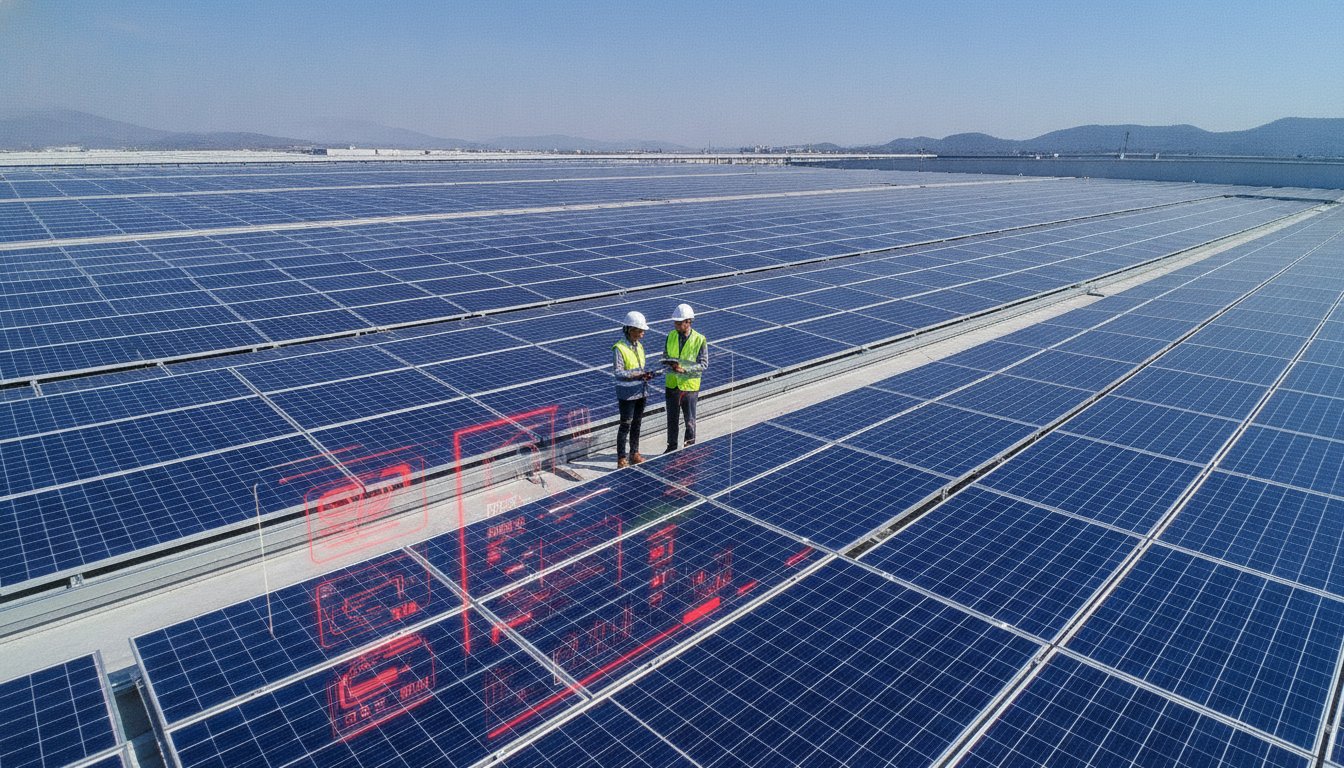
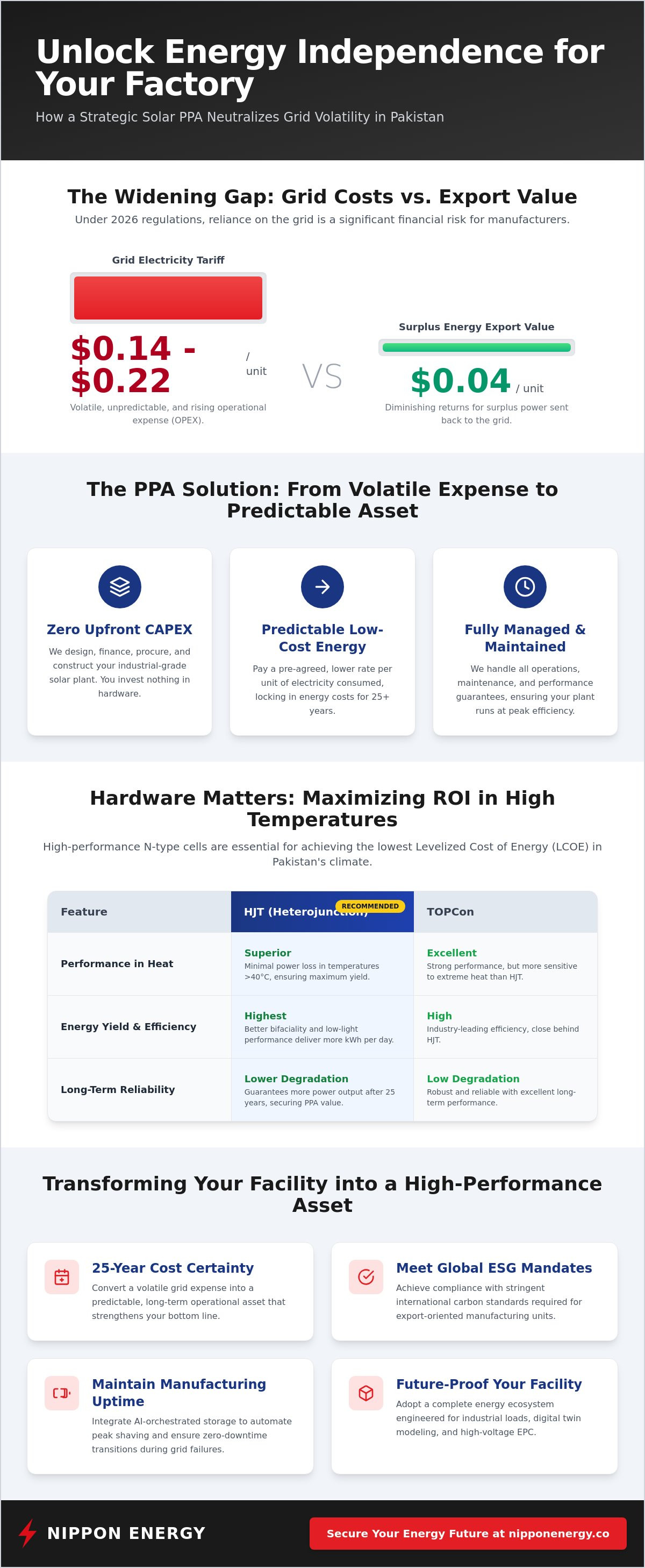
If your manufacturing facility is currently absorbing grid tariffs between $0.14 and $0.22 per unit while surplus energy exports are valued at a mere $0.04 under the 2026 net billing regulations, your energy strategy is a structural risk. Most industrial operators in Pakistan understand that the era of simple net metering has ended, leaving factories vulnerable to volatile OPEX and frequent grid instability. Establishing a sophisticated solar power purchase agreement for factories pakistan is the only viable method to decouple production from the grid's escalating costs and technical inefficiencies.
This guide explores how a strategically engineered PPA, integrated with high-efficiency HJT technology and AI-managed storage, can neutralize these tariff hikes to provide genuine energy independence. You'll discover how to secure predictable energy costs for over 25 years while ensuring zero-downtime manufacturing transitions. We'll examine the technical frameworks required to meet global ESG mandates for export-oriented units, moving your facility from a passive consumer to a high-performance energy asset.
Key Takeaways
- Learn how a strategically engineered solar power purchase agreement for factories pakistan converts volatile grid expenses into a predictable, 25-year operational asset.
- Identify why high-performance HJT technology provides the technical resilience and efficiency required to achieve the lowest possible LCOE in Pakistan's high-temperature climate.
- Understand the role of digital twin energy modeling and high-voltage EPC engineering in ensuring precise yield forecasting and seamless integration with industrial loads.
- Leverage AI-orchestrated storage and smart inverters to automate peak shaving, reduce demand charges, and maintain manufacturing uptime during grid failures.
- Future-proof your facility by adopting an integrated energy ecosystem that aligns with stringent international ESG mandates for export-oriented manufacturing units.
What is a Solar Power Purchase Agreement (PPA) for Factories?
A What is a Solar Power Purchase Agreement (PPA) functions as a sophisticated long-term energy services contract where a specialized provider, such as Nippon Energy, assumes the full responsibility for designing, financing, and maintaining a solar power plant on or near a factory site. In this model, the factory owner avoids the substantial upfront costs of hardware procurement. Instead, the facility pays for the actual kilowatt-hours consumed at a rate typically lower than the prevailing utility tariff. By 2026, the solar power purchase agreement for factories pakistan has evolved from a simple procurement tool into a comprehensive industrial energy architecture that prioritizes long-term resilience over short-term savings.
The 2026 shift represents a transition from isolated energy generation to integrated industrial power systems. Modern factory solar assets are no longer just panels on a roof; they're core components of the facility's electrical infrastructure. Selecting a solar power purchase agreement for factories pakistan allows manufacturers to bypass the technical complexity of managing large-scale solar assets while securing energy independence. Industrial units must distinguish between On-Site and Off-Site PPA structures. On-Site agreements involve installing solar arrays directly on factory rooftops or adjacent land; this provides immediate power with minimal transmission loss. Off-Site PPAs utilize wheeling regulations, where energy is generated at a remote high-yield location and transported through the national grid to the factory site.
Managing multi-megawatt factory loads requires more than standard installation. It demands industrial-grade hardware and rigorous EPC expertise to ensure the solar asset doesn't compromise the factory's electrical stability. High-load environments, such as those found in heavy manufacturing, require systems engineered to handle voltage fluctuations and peak demand without interrupting production cycles.
The Economic Architecture of a Factory PPA
Pakistan's industrial sector faces a volatile environment of rising electricity tariffs and unpredictable fuel adjustment charges. A PPA acts as a powerful financial hedge, locking in energy costs for 25 years. This transition converts a massive CAPEX burden into a manageable, predictable OPEX stream. For export-oriented sectors like textiles and cement, this architecture is essential for complying with international carbon standards and maintaining global competitiveness in markets that increasingly demand green manufacturing proofs.
Regulatory Compliance in Pakistan
Navigating the 2026 NEPRA regulations requires a deep understanding of the current net-billing framework. Industrial consumers must coordinate with regional distribution companies (DISCOs) and the Central Power Purchasing Agency (CPPA-G) to ensure seamless grid synchronization. Most large-scale projects now require tripartite agreements. These legal frameworks define the relationship between the power producer, the factory, and the utility, ensuring that every megawatt generated is accounted for within the national energy balance while protecting the manufacturer's rights to stable power.
HJT vs. TOPCon: Selecting Hardware for Maximum Industrial ROI
The Levelized Cost of Energy (LCOE) in a 25-year solar power purchase agreement for factories pakistan depends heavily on the N-type cell technology selected during the engineering phase. While older PERC modules dominated the previous decade, the 2026 industrial landscape requires hardware that can withstand extreme thermal stress without sacrificing output. High-performance N-type modules, specifically Heterojunction (HJT) and Tunnel Oxide Passivated Contact (TOPCon), offer the technical resilience needed to ensure the PPA remains financially solvent through its entire lifecycle. Choosing the wrong cell architecture can lead to accelerated degradation, directly impacting the factory's long-term energy savings.
The Turnkey EPC Lifecycle for Industrial Solar in Pakistan highlights the necessity of matching hardware to regional climatic challenges. In industrial hubs like Karachi or Lahore, where ambient temperatures often exceed 40°C, the temperature coefficient becomes the most critical metric for factory managers. A superior coefficient ensures that as the panels heat up, the drop in efficiency is minimized, protecting the facility's power supply during the most demanding summer months.
Heterojunction (HJT) Technology: The Industrial Gold Standard
HJT cells are the premier choice for high-load environments due to their symmetrical structure and superior temperature coefficient of -0.24 to -0.26%/°C. This means Nippon HJT solar panels maintain higher energy yields during peak summer months compared to other technologies. These modules deliver efficiencies of 22% to 23.5% and boast a bifaciality factor of up to 90%. This allows them to capture significant reflected light from flat factory roofs or white-coated surfaces. With an annual degradation rate as low as 0.25%, the energy production in year 25 remains remarkably close to day-one performance, securing the long-term profitability of the PPA. They perform exceptionally well in the low-light and hazy conditions frequently found in Pakistan's industrial clusters.
TOPCon: Optimized Performance for Large-Scale Arrays
As the successor to PERC, TOPCon technology has become the baseline for multi-megawatt industrial projects in 2026. Delivering efficiencies between 21.5% and 22.5%, TOPCon solar panels provide a high-efficiency alternative for specific roof layouts where space is less constrained. These modules respond well to the solar spectrum found in Pakistan, ensuring consistent harvest even when air quality is sub-optimal. When integrated with industrial tracking systems, TOPCon modules maximize the energy harvest per square meter, making them a robust choice for expansive textile or cement facilities. If you're evaluating which technology fits your specific load profile, you can consult with our engineering team for a detailed yield analysis.
The Turnkey EPC Lifecycle for Industrial Solar in Pakistan
Executing a solar power purchase agreement for factories pakistan requires a methodical, four-phase turnkey lifecycle to ensure asset longevity and financial performance. Phase 1 begins with digital twin energy modeling. This process uses historical load data to create a virtual replica of the factory’s energy environment, allowing for precise yield forecasting before a single panel is installed. Phase 2 involves the custom engineering of solar epc services. Our engineers design the system to integrate seamlessly with high-voltage factory loads, ensuring that the solar input doesn't destabilize the existing electrical infrastructure or create back-feed issues with the grid.
Phase 3 focuses on tactical on-site construction. We utilize zero-disruption protocols to ensure manufacturing lines remain active throughout the installation process. This requires precise coordination between our site supervisors and factory operations managers. Finally, Phase 4 covers commissioning and grid synchronization. This stage includes rigorous SCADA (Supervisory Control and Data Acquisition) integration, providing real-time visibility into every string and inverter across the multi-megawatt array. This level of transparency is essential for the long-term monitoring required under a solar power purchase agreement for factories pakistan.
Engineering for Heavy Industrial Loads
- Inverter Stringing: We manage the high starting currents of industrial motors through intelligent inverter stringing, preventing trip-outs during peak machinery startup.
- Structural Integrity: Our team implements structural reinforcement strategies for large-span factory roofs to support multi-megawatt arrays without compromising building safety.
- Power Quality: We ensure harmonic stability and maintain high power quality, protecting sensitive manufacturing equipment from electrical noise and voltage fluctuations.
Logistics and Supply Chain Resilience
Coordinating the delivery of multi-megawatt Nippon hardware to remote industrial parks in Sindh or Punjab demands a resilient supply chain. Every component undergoes factory-gate testing followed by on-site performance verification upon arrival. Because the choice of cell technology impacts the entire project's success, we refer to industry benchmarks like HJT vs. TOPCon: Selecting Hardware to guide our procurement strategies. Navigating import logistics for high-tech Japanese solar components ensures that our clients receive the exact specifications required for their high-performance energy architecture, regardless of local market volatility.
AI Orchestration and Storage: Future-Proofing Factory Energy
Transitioning from passive generation to active energy orchestration represents the next frontier in industrial efficiency. A solar power purchase agreement for factories pakistan no longer stops at the installation of photovoltaic arrays; it extends into the realm of algorithmic load management. By deploying smart ai solar inverters, manufacturers can automate the synchronization of solar inputs with fluctuating industrial demands. These systems analyze real-time consumption patterns to prioritize solar energy for high-torque machinery, significantly reducing the reliance on expensive grid power during peak operational hours.
The integration of lithium ion battery storage serves as a critical buffer against the volatility of Pakistan's energy market. AI-driven models predict local weather patterns and irradiance levels to optimize charging cycles, ensuring that storage is utilized when grid tariffs are at their highest. This proactive approach transforms the factory into a "Smart Factory," where energy is not just consumed but strategically deployed to maximize ROI. If you're ready to integrate these advanced systems, you can request a technical energy audit to determine your storage requirements.
Modern energy architecture requires a move away from manual monitoring toward automated intelligence. AI orchestration identifies inefficiencies in energy use that traditional SCADA systems might overlook. By anticipating production spikes, the system can pre-charge battery reserves or adjust inverter output to maintain a balanced load, preventing expensive demand charge penalties from regional DISCOs.
Intelligent Energy Management Systems (IEMS)
Nippon's IEMS utilizes remote monitoring via global command centers to maintain a target of 99% plant uptime. Predictive maintenance algorithms analyze historical performance data to detect panel micro-cracks or inverter anomalies before they lead to system failure. This software layer is particularly vital for managing the complex interface between solar arrays, the national grid, and onsite diesel generator (DG) sets, ensuring seamless transitions that protect sensitive manufacturing equipment from voltage spikes or frequency drops. To further safeguard your facility from these electrical transients, you can visit Energy Control Systems to explore specialized industrial surge suppression solutions.
Industrial Battery Energy Storage (BESS)
Industrial BESS units mitigate high peak-hour tariffs by discharging stored energy during the evening, when grid costs are most punitive. This strategic discharging provides a secondary benefit by acting as a high-speed backup for sensitive manufacturing processes during grid fluctuations or brownouts. Nippon's modular battery architecture allows for the scaling of storage capacity in direct alignment with factory load growth, providing a future-proof solution that evolves alongside the manufacturing facility's production demands.
The Nippon Energy Advantage: Japanese Precision for Pakistan
Nippon Energy bridges the gap between visionary engineering and practical industrial application. By selecting a solar power purchase agreement for factories pakistan, manufacturers gain access to a global standard of technical precision that ensures 25 years of uninterrupted performance. Our approach integrates proprietary HJT and TOPCon technologies with a deep understanding of the Pakistani grid's specific constraints, creating an energy asset that is both resilient and highly efficient. This methodology moves beyond simple installation, focusing instead on the structural integrity and future-proofing of the entire energy system.
The nipponhev system represents the pinnacle of this integrated philosophy. It functions as a unified ecosystem where hardware and software are designed to work in total synchronicity. This architectural coherence eliminates the communication failures often seen in multi-vendor systems, where inverters and battery management units struggle to exchange critical data. By centralizing the technology stack, we provide a streamlined path toward energy independence that minimizes technical friction and maximizes energy harvest.
Integrated Industrial Architecture
A single-vendor ecosystem reduces integration complexity and shortens the commissioning timeline for large-scale projects. Manufacturers benefit from customizable warranty packages engineered to withstand the dust and heat of Pakistan’s industrial zones. Because the system is designed as a whole, it achieves a lower Levelized Cost of Energy (LCOE) compared to fragmented energy procurement models. This financial stability is a direct result of using high-performance components that maintain their efficiency ratings under heavy industrial stress, ensuring the solar power purchase agreement for factories pakistan remains a profitable asset for its entire duration.
Operational Excellence and O&M
Long-term profitability depends on rigorous solar system maintenance. Nippon Energy provides 24/7 performance monitoring and rapid-response technical support across Pakistan's manufacturing hubs. We utilize specialized cleaning protocols and thermal imaging to identify potential hotspots or cell degradation before they impact the facility's output. This proactive O&M strategy ensures that the solar asset remains a high-yielding component of the factory's infrastructure. To initiate your facility's transition and secure a predictable energy future, you can request a comprehensive feasibility study and consultation for a turnkey solar power plant.
Architecting Long-Term Industrial Energy Independence
The transition toward a solar power purchase agreement for factories pakistan is no longer just a financial hedge; it's a structural necessity for maintaining global competitiveness in 2026. By shifting from unpredictable grid tariffs to a stabilized OPEX model, manufacturers can focus on production rather than power procurement. Success in this landscape requires the integration of high-performance HJT hardware and AI-managed storage systems that ensure technical resilience during peak summer loads and grid instability.
Nippon Energy brings Japanese engineering standards and a proven global EPC track record across Asia and the Middle East to every project. Our proprietary HJT and TOPCon technologies provide the durability required for Pakistan's specific environmental challenges, ensuring your asset performs optimally for its entire 25-year lifecycle. You can take the first step toward a secured energy future by selecting a partner who prioritizes precision and long-term asset integrity.
Request a Technical Feasibility Study for Your Factory to begin your transition toward an optimized energy architecture today. Transitioning to a smarter, self-sufficient energy model ensures your facility remains a leader in the industrial landscape.
Frequently Asked Questions
What is the typical payback period for an industrial solar PPA in Pakistan in 2026?
Under the 2026 net billing framework, self-financed industrial systems typically see a payback period of 6 to 9 years, whereas a solar power purchase agreement for factories pakistan offers immediate financial relief. Since the PPA model eliminates the initial CAPEX, the factory realizes savings on its energy bills from the first day of commissioning. The exact ROI depends on the facility's specific tariff slab and its ability to maximize self-consumption during peak daylight hours.
Can a solar power plant handle the high starting currents of large industrial motors?
Industrial solar plants are specifically engineered to manage high starting currents through advanced inverter configurations and high-surge capacity components. By utilizing intelligent stringing and coordinated power management, the system ensures that the startup of heavy motors doesn't trigger protective trip-outs. This technical precision is essential for maintaining manufacturing uptime and protecting the factory's internal electrical infrastructure from destabilization.
Is rooftop solar or a ground-mounted array better for a 1MW factory system?
A 1MW factory system is usually optimized for rooftop installation if the structural integrity of the building supports the weight, as this utilizes existing space without additional land costs. Ground-mounted arrays are often selected when roof spans are insufficient or when the facility requires easier access for specialized cleaning and maintenance. Our feasibility studies evaluate both options to determine the highest yield per square meter for your specific site.
How does Nippon Energy handle grid instability and voltage fluctuations in Pakistan?
We mitigate grid instability and voltage fluctuations through the deployment of Nippon Smart AI Inverters and localized power conditioning. These systems monitor frequency and voltage in real-time, automatically adjusting output or isolating the system to protect sensitive manufacturing equipment from surges. This proactive management is vital for industrial units operating in regions with inconsistent power quality from the national grid.
What maintenance is required for a multi-megawatt industrial solar power plant?
Multi-megawatt industrial plants require a structured maintenance regimen that includes bi-weekly specialized cleaning to combat local dust and monthly thermal imaging of the arrays. Professional solar system maintenance also involves continuous SCADA monitoring to identify string-level anomalies before they lead to system failure. This ensures the solar power purchase agreement for factories pakistan continues to deliver the promised energy yield over its 25-year lifecycle.
How long does the turnkey EPC process take from feasibility to commissioning?
The turnkey EPC process typically spans 4 to 6 months for most industrial projects in Pakistan. This timeline includes the initial digital twin modeling, structural reinforcements, procurement of Japanese-standard hardware, and the mandatory NEPRA licensing and grid synchronization protocols. Each phase is methodically organized to ensure that the transition to solar power doesn't interrupt your active manufacturing schedules.
Can I integrate a solar PPA with my factory’s existing diesel generators?
Integration with existing diesel generators is standard for modern industrial solar architectures and is managed through hybrid controllers. The system uses AI orchestration to synchronize solar, battery storage, and DG sets, ensuring that fuel consumption is minimized during grid outages. This creates a resilient microgrid that prioritizes the most cost-effective power source available in real-time.
How does AI technology improve the ROI of my factory’s solar investment?
AI technology improves ROI by automating peak shaving and optimizing battery discharge cycles to avoid the highest grid tariff periods. By predicting irradiance patterns and factory load spikes, the system reduces expensive demand charges and identifies maintenance needs through predictive algorithms. This intelligent management extends the operational life of the hardware and ensures the system operates at peak efficiency.


