
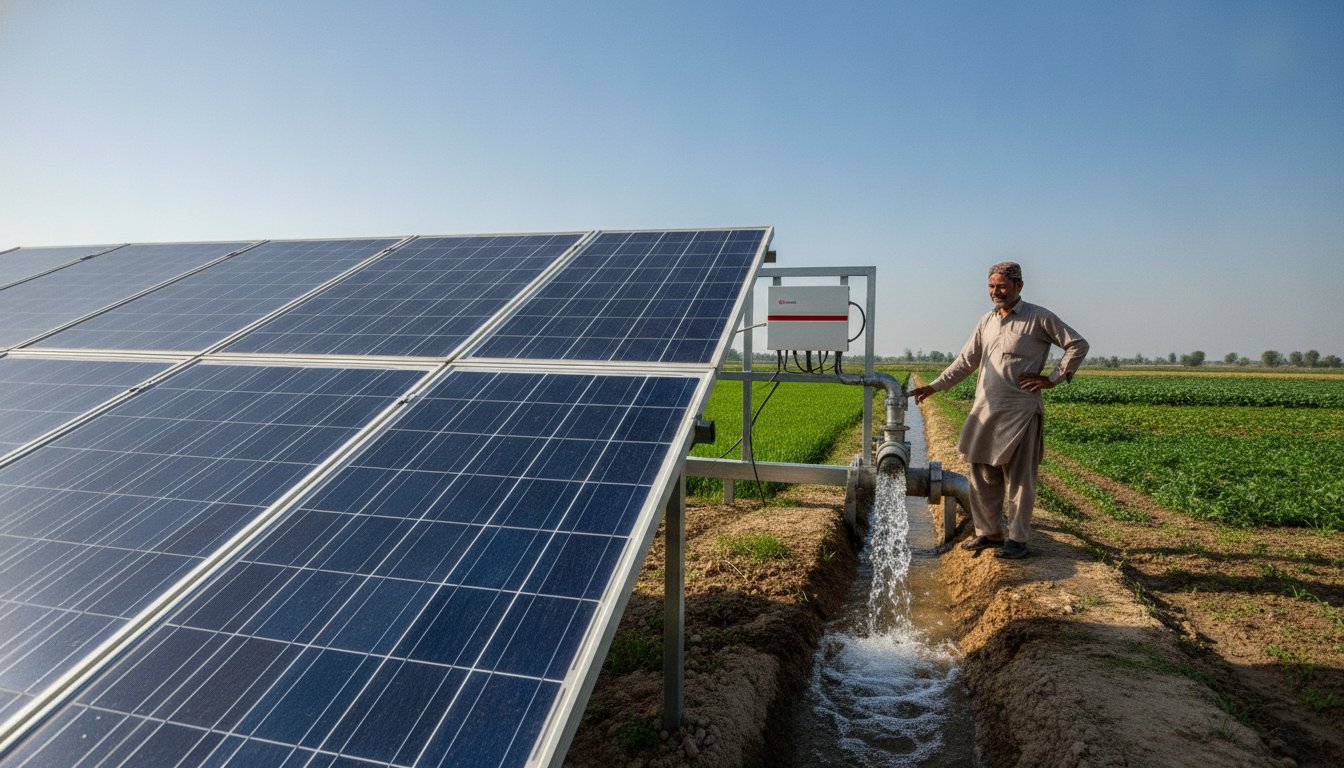
With diesel prices consistently exceeding PKR 300 per liter and rural grids failing for up to 14 hours daily, the cheapest irrigation system you buy today is often the most expensive over its lifecycle. In the current agricultural climate, traditional energy sources aren't just a burden. They're a direct threat to your farm's long-term viability. You've likely realized that relying on a volatile grid or expensive fuel is a losing strategy that leads to frequent motor burnouts and stunted crop yields.
Understanding the solar powered tube well price in pakistan 2026 is the first step toward securing your agricultural legacy. This guide provides a technical analysis of high-performance HJT and TOPCon solar technologies, ensuring your investment delivers zero-cost irrigation for more than 25 years. We'll examine the latest government subsidy frameworks, such as the CM Punjab Solar Tubewell Scheme and the Balochistan Solar Tube Well Project. You'll gain a clear ROI framework to help you transition from energy dependence to total water autonomy through automated, high-precision engineering and resilient hardware designed for the harshest environments.
Key Takeaways
- Compare Nippon HJT and TOPCon Solar Panels to understand how N-type technology maintains superior efficiency during Pakistan's extreme summer temperature peaks.
- Benchmark the solar powered tube well price in pakistan 2026 across various system sizes to align your investment with specific per-acre irrigation requirements.
- Access the latest details on 2026 provincial subsidy programs in Punjab and Sindh to reduce your initial capital outlay for solar transition.
- Integrate Nippon Smart AI Inverters for intelligent water orchestration; these systems provide automated protection against the voltage fluctuations that damage traditional motors.
- Master the ROI framework that shifts your farm from a model of energy consumption to one of permanent, zero-cost resource independence.
The 2026 Agricultural Energy Crisis: Why Solar Tube Wells Are Essential
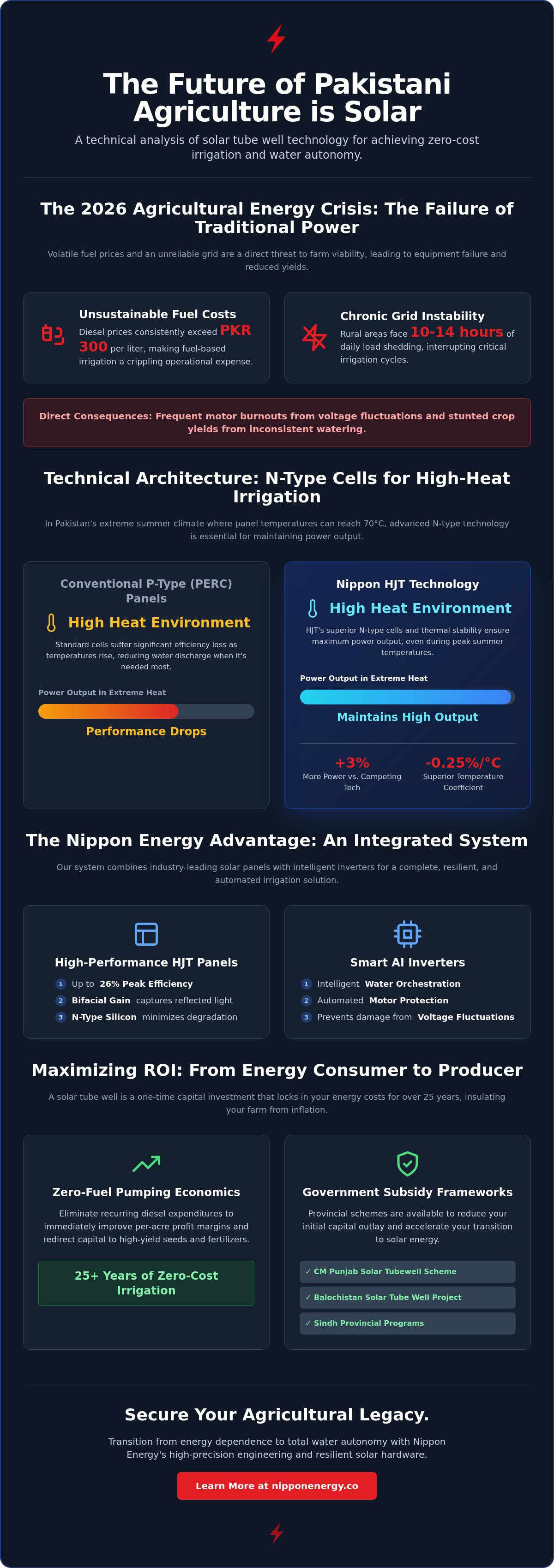
Pakistan’s agricultural sector has reached a critical juncture where energy costs dictate farm survival. As of 2026, the national power grid remains plagued by 10 to 14 hours of rural load shedding, leaving crops vulnerable during peak heat cycles. With diesel prices exceeding PKR 300 per liter, the financial burden of traditional irrigation has become unsustainable for the nation’s one million oil-operated tube wells. This systemic instability has transformed solar technology from a luxury into a mandatory operational requirement for any competitive enterprise. Understanding the solar powered tube well price in pakistan 2026 is no longer just about budgeting; it's about securing the future of food production through resilient, decentralized power.
The Failure of Traditional Irrigation Power
Grid instability isn't just a matter of downtime; it's a source of recurring capital loss. Frequent voltage fluctuations in rural areas cause frequent motor burnouts, leading to expensive repairs and delayed irrigation schedules. To understand the scale of the hardware involved, it's helpful to review what is a tube well and why its continuous operation is vital for effective groundwater extraction. By 2026, the convergence of high electricity tariffs and government subsidy programs has created a definitive tipping point for return on investment. Transitioning to a diesel-free model ensures long-term environmental sustainability and eliminates the erratic costs associated with fossil fuels.
The Economic Impact of Zero-Fuel Pumping
The shift to zero-fuel pumping offers a transformative economic advantage for modern growers. When you eliminate annual diesel expenditures, which often reach hundreds of thousands of rupees per season, you immediately improve per-acre profit margins. This redirected capital allows farmers to invest in high-yield seeds and precision fertilizers. A reliable system ensures irrigation happens during critical growth stages, preventing the yield loss typically caused by grid failures or fuel shortages. Integrating high-efficiency Nippon HJT Solar Panels provides the stability needed to maintain these cycles even in extreme heat. The solar powered tube well price in pakistan 2026 reflects a one-time capital investment that effectively locks in energy costs for three decades, insulating your farm from the volatility of global energy inflation. This transition marks the move from simple water pumping to a sophisticated, automated resource management strategy.
Technical Architecture: HJT vs. TOPCon for High-Heat Irrigation
Standard Passivated Emitter and Rear Cell (PERC) technology often fails to meet the rigorous demands of the Indus Basin's summer climate. When solar panels reach surface temperatures of 70°C, traditional P-type cells lose significant efficiency, resulting in reduced water discharge exactly when crops need it most. The Nippon HJT Solar Panels address this thermal ceiling through a superior temperature coefficient of -0.25%/°C. This technical advantage ensures that your system maintains high-output pumping even during the hottest hours of the day, delivering approximately 3% more power than competing technologies in extreme heat.
Thermal Stability and Performance Ratios
High-performance systems rely on N-type silicon to minimize light-induced degradation and maximize longevity. While the solar powered tube well price in pakistan 2026 is influenced by these premium materials, the long-term yield justifies the initial capital outlay. Heterojunction (HJT) cells offer a peak efficiency of up to 26%, which is critical for maximizing water volume from deep aquifers. These panels also leverage bifacial gain, capturing reflected light from sandy or arid farm soil to boost energy production. This resilience is supported by a case study on solar pumps in Pakistan, which highlights how sustainable technology increases crop diversity and farm profitability through reliable water access.
Optimizing Pump Synchronicity
Precision engineering requires matching the solar array wattage to the specific horsepower (HP) of your submersible pump. Utilizing Nippon TOPCon Solar Panels allows for excellent low-light performance. This extends your daily pumping window by capturing energy during the early morning and late evening, which are vital hours for avoiding midday evaporation. This extended operational time reduces the impact of cloud-cover downtime and ensures consistent reservoir levels for automated irrigation systems.
The Variable Frequency Drive (VFD) acts as the central nervous system of the installation. It regulates the motor's speed based on available solar intensity, preventing the mechanical stress and motor burnouts common with unstable grid power. Choosing a high-tier VFD ensures that your pump operates at peak efficiency across various solar irradiation levels, protecting your motor for 25 years or more. To ensure your hardware is built for decade-scale reliability, you can consult with our agricultural engineering team for a customized system design. This technical synergy between N-type panels and intelligent drives is what makes the current price framework a value-driven investment rather than a simple expense.
2026 Solar Powered Tube Well Price Framework in Pakistan
The 2026 fiscal environment significantly influences the cost structure of agricultural solar deployments. While global manufacturing efficiencies have stabilized, the solar powered tube well price in pakistan 2026 remains sensitive to local import duties and the specific technology tier selected. Investing in premium N-type cells like HJT or TOPCon represents a strategic shift from minimizing initial expenditure to maximizing energy yield per square meter. This engineering-first approach ensures that the total EPC (Engineering, Procurement, and Construction) cost accounts for high-durability mounting and intelligent system protection. By selecting higher-tier components, farmers secure a lower lifetime cost through reduced maintenance and superior power retention over three decades.
Market Average Pricing by Capacity
System sizing depends on the depth of the water table and the specific irrigation requirements of the crop cycle. Five HP systems are engineered for small-scale vegetable and fodder farming; they provide a compact footprint with high operational reliability. Ten HP to 15 HP configurations have become the industry standard for mid-sized wheat and rice acreage. These systems balance initial capital outlay with significant water discharge volumes. Twenty HP systems and larger serve commercial and utility-scale irrigation needs. These often require reinforced structural mounting and advanced power orchestration. A Punjab solar irrigation subsidy scheme analysis demonstrates that while larger systems require more capital, the economic impact and per-acre cost savings are most pronounced at these higher capacities.
Hidden Costs and Component Quality
Total investment goes beyond the panels and pump. High-heat environments necessitate galvanized iron structures rather than cheaper local steel to prevent rust and structural fatigue over a 25-year lifespan. Protective gear like DC breakers and surge arrestors is essential to prevent damage from lightning or grid-induced surges. As of early 2026, the government maintains sales tax exemptions for verified agricultural solar hardware. This policy helps offset the premium for high-efficiency components. By prioritizing hardware resilience, you reduce the risk of motor burnouts and system failures. The solar powered tube well price in pakistan 2026 reflects a value-driven framework where high-tier hardware prevents the recurring repair costs common with budget-grade alternatives.
Maximizing ROI: Government Schemes and Operational Longevity
Securing a favorable solar powered tube well price in pakistan 2026 is only the initial phase of a successful agricultural strategy. To achieve a truly accelerated return on investment, farmers must navigate the evolving landscape of federal and provincial support. The Government of Punjab continues to incentivize the solarization of tube wells, offering subsidies such as PKR 500,000 for 10-HP systems and up to PKR 1,000,000 for 20-HP configurations. When combined with the Prime Minister's initiative to solarize 28,000 tube wells in Balochistan, where the federal government covers 70% of the cost, the financial barrier to entry has significantly lowered. Integrating these solar pumps with drip irrigation systems further enhances ROI; high-precision water delivery can increase field efficiency by 40% compared to traditional flood methods.
Financing and Subsidies in 2026
The State Bank of Pakistan (SBP) maintains dedicated renewable energy refinancing schemes that allow farmers to access long-term capital at preferential rates. These programs are designed to support the provincial goal of solarizing 100,000 tube wells nationwide by the end of the 2026 fiscal year. When deciding between leasing and an outright purchase, you should evaluate your farm’s cash flow requirements. Leasing provides immediate operational savings with minimal upfront capital, while an outright purchase maximizes long-term equity and eliminates recurring financial obligations. A structured application process involves submitting technical feasibility reports and land ownership verification to participating commercial banks to ensure your project meets national engineering standards.
Performance Architecture and Upkeep
Longevity is a function of disciplined technical management. The dusty environments of rural Punjab and Sindh necessitate a rigorous Solar System Maintenance protocol to prevent soiling losses that can degrade output by 15% or more. While manual cleaning remains common, automated robotic brushes are increasingly utilized in larger 20-HP installations to maintain peak energy capture without high labor costs. Monitoring your system's output via mobile applications allows for the early detection of pump wear or electrical anomalies. This proactive orchestration ensures that your hardware remains operational for its intended 25 to 30-year lifespan. To begin your transition to energy-independent farming, you can request a detailed technical consultation and ROI analysis from our engineering team.
The Nippon Energy Advantage: Engineering Agricultural Independence
Nippon Energy serves as a premier EPC partner by applying rigorous Japanese engineering standards to the specific environmental challenges of Pakistan's agricultural landscape. While the solar powered tube well price in pakistan 2026 reflects market-wide hardware costs, the true differentiator lies in the architectural precision of the system's integration. We don't just install panels; we design resilient energy ecosystems that prioritize long-term structural integrity and high-performance output. By utilizing Smart AI Solar Inverters, we move beyond simple power conversion into the territory of intelligent water orchestration. These systems provide a level of motor protection and operational transparency that budget-grade alternatives cannot replicate.
AI-Driven Irrigation Orchestration
Modern farming requires data-driven decision-making to maximize resource efficiency. Our AI-driven systems enable predictive pumping, which analyzes local weather patterns to optimize water extraction schedules, ensuring your crops receive moisture exactly when needed. This intelligence allows you to monitor and control your tube well remotely via a smartphone, reducing the need for constant on-site supervision. For growers seeking comprehensive energy autonomy, the NipponHev System offers a unified architecture that manages both farmhouse electricity and irrigation power. This synergy eliminates the inefficiencies of fragmented systems and provides a stable, grid-independent lifestyle for the modern agriculturist.
Full-Cycle EPC Excellence
Our commitment to agricultural independence spans the entire project lifecycle. We begin with a granular feasibility study that assesses soil reflection, water table depth, and shading factors to ensure the solar powered tube well price in pakistan 2026 translates into the highest possible ROI. Following commissioning, we provide professional maintenance and 24/7 monitoring services to safeguard your investment against technical drift or environmental soiling. This methodical approach ensures that your system functions as a permanent asset rather than a temporary fix. If you're ready to future-proof your land with world-class technology, you can consult with Nippon Energy’s agricultural engineers to develop a customized irrigation roadmap.
Securing Your Agricultural Future Through Precision Engineering
Transitioning to decentralized solar power is the only sustainable response to Pakistan's ongoing energy volatility. By prioritizing Japanese HJT technology with 90% power retention over 30 years, you protect your farm from the rising costs of traditional fuels. High-performance systems that integrate Smart AI Inverters provide the essential protection your motors require against rural voltage spikes. While the solar powered tube well price in pakistan 2026 is determined by your specific acreage and water table depth, the total elimination of diesel and electricity expenditures creates an unassailable competitive advantage for your business.
Nippon Energy facilitates this transition with a dedicated national EPC presence in Lahore and Karachi, ensuring professional commissioning across the Indus Basin. Our engineering team provides the technical precision necessary to navigate government subsidy frameworks and maximize your system's daily water discharge. Take the first step toward permanent resource independence today.
Request a Custom Agricultural Solar Feasibility Study
Frequently Asked Questions
How much does a 10 HP solar tube well cost in Pakistan in 2026?
Market rates for 10 HP systems are influenced by the choice of structural mounting and the efficiency tier of the solar panels. As of early 2026, many farmers utilize government subsidies, such as the PKR 500,000 allocation provided through provincial schemes, to offset the total capital requirement. The final solar powered tube well price in pakistan 2026 depends on whether you select high-durability galvanized structures or standard frames designed for less demanding environments.
Can a solar tube well power a submersible pump at 400 feet depth?
Yes, solar systems are fully capable of powering submersible pumps at depths of 400 feet or more. This requires a precise engineering calculation of the Total Dynamic Head and the selection of an appropriately rated motor and solar array. High-efficiency N-type panels ensure that the pump maintains sufficient torque to lift water from deep aquifers even during periods of lower solar intensity.
What is the difference between HJT and standard solar panels for farming?
Heterojunction (HJT) panels provide superior thermal stability compared to standard PERC technology used in older installations. While standard panels lose significant efficiency as temperatures exceed 45°C, HJT maintains a superior temperature coefficient of -0.25%/°C. This results in higher water discharge volumes during Pakistan's peak summer months, ensuring your irrigation schedule remains uninterrupted by extreme heat.
How many acres can a 15 HP solar-powered tube well irrigate?
A 15 HP system typically irrigates between 30 and 50 acres, depending on the specific water requirements of your crops and the local water table depth. Rice and sugarcane require more frequent cycles compared to wheat or orchards. Integrating high-efficiency panels ensures the system operates for more hours per day, which maximizes the total acreage covered per season.
Do solar tube wells work during the winter or cloudy days in Punjab?
Solar systems continue to function during winter and overcast conditions, though water discharge rates are proportionally reduced. Advanced N-type cells are engineered for better low-light performance, allowing the VFD to start the pump earlier in the morning. While output is lower than on clear summer days, it's often sufficient for the reduced irrigation needs of winter crops like wheat.
Is there a government subsidy available for solar tube wells in 2026?
Yes, several provincial and federal schemes are active in 2026 to support agricultural transition. The Punjab government provides tiered subsidies ranging from PKR 500,000 to PKR 1,000,000 based on system horsepower. Additionally, the federal project in Balochistan covers 70% of the conversion costs for 28,000 tube wells to promote sustainability and reduce reliance on expensive diesel.
What maintenance is required for a solar pumping system?
Primary maintenance involves regular cleaning of the solar panels to prevent dust accumulation, which can significantly impact energy capture in rural areas. You should also conduct periodic inspections of the electrical connections and the VFD cooling fans to ensure operational safety. Smart monitoring systems help track performance in real-time, allowing you to identify potential pump wear before it leads to system downtime.
Can I use my solar tube well panels to power my farmhouse at night?
You can use your solar array to power a farmhouse at night if the system is integrated with a lithium-ion battery storage solution and a hybrid inverter. Standard tube well setups are designed for direct daytime pumping without batteries. Adding storage allows you to capture excess energy generated during the day for domestic use after sunset, creating a unified energy ecosystem for your land.


