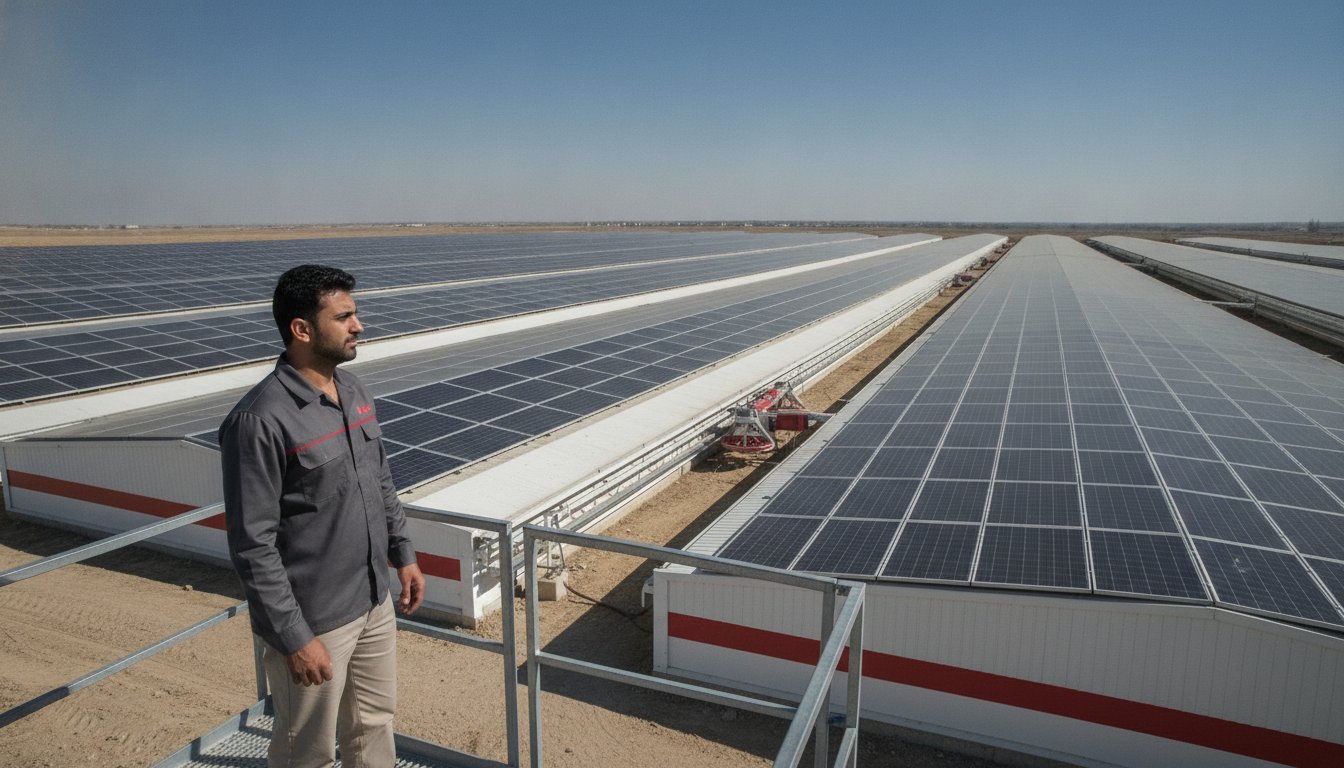
Can a poultry operation maintain its structural integrity when the national grid fails during a 50-degree Celsius Punjab heatwave? For most producers, the 2026 energy landscape has turned electricity from a standard utility into a primary risk factor due to escalating surcharges and grid instability. Integrating advanced solar power for poultry farms in pakistan is no longer a secondary consideration; it is a fundamental requirement for industrial survival.
You likely recognize that the era of cheap, reliable grid power has ended, leaving your livestock vulnerable to catastrophic thermal stress. This guide details the precise technical and financial frameworks required to transition your facility to a high-efficiency energy model. We examine the performance advantages of N-type TOPCon and HJT modules, the strategic shift toward self-consumption under the 2026 net billing regulations, and the deployment of intelligent battery storage to secure your business viability. By mastering these technical requirements, you can eliminate the volatility of diesel costs and ensure your farm operates with the precision of a modern, automated enterprise.
Key Takeaways
- Analyze the impact of 2026 grid tariff hikes and learn how to stabilize your cost per bird through long-term energy independence.
- Evaluate the technical advantages of HJT and TOPCon modules, the most efficient technologies for solar power for poultry farms in pakistan during extreme heat.
- Master the step-by-step methodology for calculating Total Connected Load (TCL) to ensure your system survives peak summer cooling demands.
- Explore the role of Nippon Smart AI Inverters and lithium-ion storage in automating energy distribution between critical ventilation and non-critical systems.
- Gain insights into selecting a turnkey EPC partner capable of engineering solar structures that withstand the unique environmental pressures of the Punjab region.
The Crisis of Grid-Dependency in Pakistan’s Poultry Sector (2026)
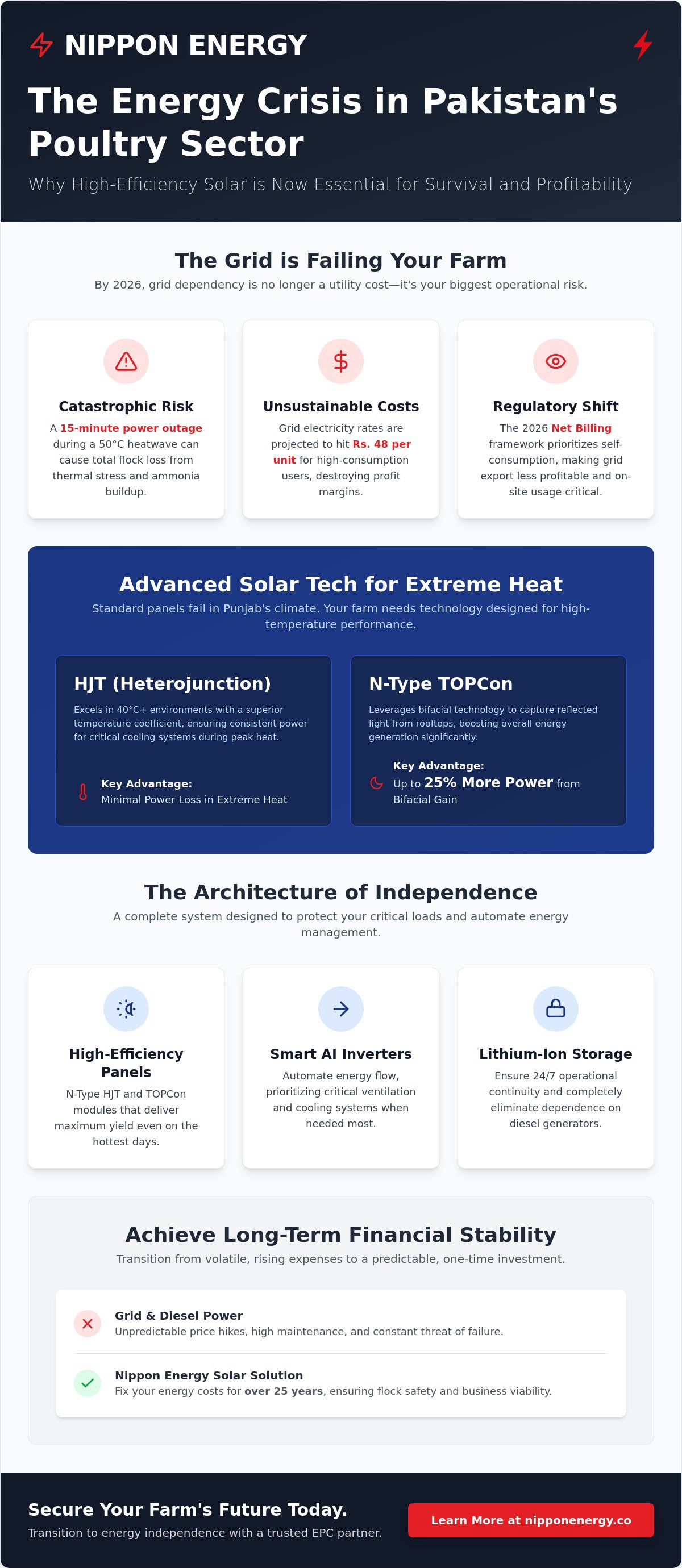
Modern poultry infrastructure requires absolute climate precision. In the high-density sheds of Punjab, electricity is the lifeblood of thermal regulation. However, the 2026 grid environment has introduced unprecedented volatility. With average grid electricity rates reaching up to Rs. 48 per unit for high-consumption users, the overhead for traditional power is cannibalizing profit margins. Transitioning to solar power for poultry farms in pakistan has shifted from a sustainable choice to a survival strategy. It represents the only viable method to decouple production costs from the national grid's erratic tariff structure.
The risk of ventilation failure remains the primary threat to flock survival. During peak summer months in regions like Faisalabad or Multan, a 15-minute power outage can result in irreparable flock mortality due to rapid ammonia buildup and heat stress. Relying on an unstable national grid or aging diesel generators creates a single point of failure that no modern commercial enterprise can justify. High-efficiency solar solutions provide the localized, resilient power needed to maintain biological equilibrium without the constant threat of grid shedding.
The Economic Impact of Energy Instability
NEPRA's 2026 Prosumer Regulations have fundamentally changed the financial landscape by replacing traditional net metering with a net billing framework. This shift prioritizes self-consumption over grid export. Current surcharges for agricultural connections have pushed the operational cost per bird to levels that threaten market competitiveness. While diesel generators were once the standard backup, their high maintenance costs and fuel prices in 2026 make them a financial liability. Solar systems provide a fixed energy cost for over 25 years, insulating farmers from the erratic price hikes seen across the broader Solar power infrastructure in Pakistan. This stability allows for precise long-term financial planning and improved business viability.
Critical Loads in Controlled Poultry Sheds
Automated sheds demand high-torque power for heavy-duty exhaust fans and evaporative cooling pads. These systems must operate continuously to manage the shed's temperature and humidity. Solar power for poultry farms in pakistan now supports these critical loads alongside the following automated systems:
- Automated Feeding and Watering: Precise delivery systems that require stable voltage to prevent motor burnout.
- Ventilation Control: High-capacity fans that must scale up immediately as ambient temperatures rise.
- Lighting Schedules: Controlled environments that dictate egg production and growth rates through specific lux levels.
By securing these loads with a dedicated solar architecture, producers ensure that their biological assets are protected from the failures of external infrastructure. This technical independence is the cornerstone of the "Net Zero" operational goal, where the farm generates the majority of its required energy on-site.
Technical Architecture: HJT vs. TOPCon for High-Temperature Sheds
In the intense thermal environment of Punjab, raw efficiency ratings are often misleading. Standard solar modules lose significant power as temperatures climb above 25°C, a phenomenon that can cripple energy production during the hottest hours when cooling fans are most active. For solar power for poultry farms in pakistan, the architecture must prioritize the temperature coefficient. Nippon HJT Solar Panels utilize a symmetrical cell structure that excels in 40°C+ environments, ensuring that the critical ventilation systems receive consistent voltage even during the summer peak.
Bifacial gain provides a secondary advantage for modern poultry infrastructure. Because poultry sheds typically feature high-reflectivity roofing materials, bifacial N-type modules can capture reflected light from the rear side. This increases the total energy yield without requiring additional mounting space. Technical analyses of Solar Irrigation in Pakistan suggest that such high-efficiency deployments are essential for maintaining agricultural productivity as grid costs rise. By leveraging this reflective yield, farmers can achieve up to 25% more power compared to monofacial installations on the same roof area.
Durability is equally critical in an agricultural context. Ammonia-rich air near poultry waste can corrode standard solar components over time, leading to premature system failure. Our modules feature advanced anti-corrosion coatings and specialized glass-to-glass encapsulation to resist chemical degradation. You can review our technical certifications to see how these systems are hardened for long-term agricultural deployment.
N-Type TOPCon vs. HJT Performance
N-type TOPCon and HJT technologies differ in their degradation profiles and low-light response. HJT modules offer a lower degradation rate over a 25-year lifecycle, maintaining higher power retention than traditional cells. Additionally, HJT's superior low-light performance ensures continued generation during the heavy dust storms and monsoons common in the Punjab region. For those requiring a balance of cost and high efficiency, Nippon TOPCon Solar Panels provide a robust alternative with efficiency ratings reaching up to 23% and excellent mechanical resilience.
Resilience in Harsh Agricultural Environments
Structural integrity is maintained through high mechanical load ratings, allowing panels to withstand the high-wind pressures often encountered in the open plains of Punjab. The temperature coefficient of HJT panels is precisely 0.26%/°C. This means for every degree above the standard test condition, the power loss is minimal compared to the 0.40%/°C seen in older P-type technology. This precision engineering ensures that your automated feeding and cooling lines remain fully powered when the environmental stakes are highest.
Sizing and ROI: Calculating Energy Needs for Automated Sheds
Precision sizing is the cornerstone of a resilient energy architecture. For commercial operations housing 30,000 birds or more, a generic estimate is insufficient. You must calculate the Total Connected Load (TCL) by auditing every active component, from high-torque exhaust fans to automated feeding lines. This data-driven approach ensures the system handles the extreme variance between winter baseloads and peak summer cooling demands. Proper sizing prevents system overloads during heatwaves, protecting your biological assets from thermal failure.
Implementing solar power for poultry farms in pakistan aligns with broader Pakistan's renewable energy goals, which target a 60% renewable share by 2030. However, the 2026 transition to net billing means your ROI is now dictated by self-consumption rather than grid export. Since the buyback rate for surplus electricity has been revised under the 2026 NEPRA Prosumer Regulations, oversizing for the sake of exports is no longer financially efficient. Instead, the focus has shifted to matching generation with the daytime cooling curve to maximize direct savings.
The "Cost of Inaction" is a vital metric for risk management. A single ventilation failure during a Punjab heatwave can result in a 100% flock loss within minutes. When compared to the CAPEX of a high-performance solar installation, the investment acts as a primary insurance policy. It eliminates the volatility of diesel prices and grid surcharges, securing the long-term business viability of the farm.
The 5-Step Sizing Framework
To ensure structural and operational success, follow this structured deployment framework:
- Audit existing machinery: Catalog the wattage and start-up currents of all fans, motors, and lighting systems.
- Determine required autonomy: Define how many hours the facility must operate on battery backup during grid outages.
- Select panel technology: Choose between HJT or TOPCon based on available roof space and local ambient temperatures.
- Size the storage system: Consult the Lithium-Ion Battery Storage guide to match capacity with critical load requirements.
- Structural Assessment: Verify that shed roofs can support the mechanical load of the mounting frames and modules.
Payback and Financial Incentives
Modern solar installations in Pakistan currently achieve a payback period of 4 to 6 years, a significant improvement over previous industry estimates. This ROI is accelerated by available green financing through the Punjab government's solar subsidies and World Bank-assisted projects like the Punjab Resilient and Inclusive Agriculture Transformation (PRIAT). Additionally, farmers can leverage tax depreciation benefits for renewable energy investments, further reducing the effective cost of the transition to solar power for poultry farms in pakistan.
Deployment Strategy: Integrating Battery Storage and AI Inverters
In 2026, the integration of advanced storage and intelligent inversion has redefined the reliability of solar power for poultry farms in pakistan. Traditional lead-acid batteries have been phased out due to their limited depth of discharge and frequent maintenance requirements. Nippon Lithium-ion Battery Storage Systems now serve as the industry standard, offering high energy density and a cycle life that exceeds ten years. These systems provide the rapid response times necessary to sustain heavy inductive loads, such as large-scale exhaust fans, during sudden grid failures. This transition ensures that the biological assets within the shed are never exposed to the risks of stagnant air or rising ammonia levels.
Managing energy requires more than just storage; it requires orchestration. Nippon Smart AI Inverters function as the central processor for the farm's energy ecosystem. These units distinguish between critical loads, such as ventilation and cooling pumps, and non-critical loads, such as administrative lighting or secondary equipment. During periods of low generation, the AI automatically sheds non-essential power to preserve battery capacity for the livestock's life-support systems. This automated decision-making process removes human error from the emergency response protocol.
Digital oversight eliminates the guesswork of system management. Through integrated IoT sensors, the AI performs predictive maintenance by identifying voltage irregularities or thermal anomalies before they lead to hardware failure. Remote monitoring capabilities allow farm managers to adjust shed parameters and monitor real-time generation via smartphone, ensuring operational continuity even when off-site. You can consult with our technical architects to design a customized storage strategy for your facility.
Intelligent Energy Orchestration
The deployment of Smart AI Solar Inverters enables sophisticated peak shaving strategies. By discharging stored energy during high-tariff evening hours, the system reduces reliance on expensive grid power. This feature directly addresses the 2026 grid tariff hikes by shifting the heaviest consumption periods to the most cost-effective times. Automated battery cycling protocols prevent over-discharge, effectively maximizing the hardware's operational lifespan through disciplined state-of-charge management.
The Hybrid Advantage for Rural Punjab
Zero-downtime reliability is achieved by combining solar generation, grid connectivity, and battery storage in a synchronized hybrid model. This architecture includes black-start capability, allowing the system to resume operations independently after a total grid collapse or extended blackout. The AI optimizes battery discharge rates by analyzing real-time weather forecasts to ensure sufficient reserves are maintained during predicted periods of low solar irradiance. This predictive capability is especially vital for solar power for poultry farms in pakistan, where monsoons or dust storms can suddenly reduce panel output.
Selecting an EPC Partner in Pakistan: The Nippon Energy Advantage
Large-scale energy transitions require more than high-performance hardware. They demand a comprehensive Engineering, Procurement, and Construction (EPC) framework to ensure that every component functions as a unified system. For those investing in solar power for poultry farms in pakistan, the choice of a partner determines the long-term structural and electrical integrity of the facility. Selecting a turnkey EPC provider like Nippon Energy eliminates the fragmentation caused by using multiple uncoordinated contractors, which often leads to misaligned specifications and compromised safety protocols.
In the specific climatic zones of Punjab and Sindh, structural engineering is a critical variable. High-wind loads and soil conditions in rural agricultural areas require custom mounting structures that standard installers often overlook. Our integrated NipponHev System provides a pre-engineered, holistic architecture that synchronizes HJT panels with intelligent storage and smart inverters. This architectural precision ensures that your shed's energy infrastructure remains resilient against both environmental stress and grid instability.
Post-installation reliability is secured through professional Solar System Maintenance. Without a disciplined maintenance protocol, dust accumulation and thermal cycles can degrade system performance by up to 15% annually in Punjab's dusty environments. We provide the technical oversight necessary to maintain peak efficiency throughout the system’s 25-year lifecycle, protecting your capital investment from premature degradation.
End-to-End Project Execution
Our process begins with detailed feasibility studies that analyze the specific thermal and electrical requirements of your poultry operation. We manage the entire regulatory workflow, including NEPRA net-billing approvals, to ensure your system is legally and technically compliant from day one. Custom mounting structures are designed specifically for high-profile poultry sheds to withstand local wind speeds. To guarantee quality, every Nippon HJT panel undergoes rigorous testing before deployment, ensuring that only zero-defect modules are installed at your facility. This methodical approach ensures that solar power for poultry farms in pakistan delivers the promised ROI without technical interruptions.
Long-Term Performance Support
Operational continuity is maintained through 24/7 remote monitoring services that track the health of your commercial solar farm in real-time. Our on-site maintenance teams are stationed across major Pakistani cities to provide rapid technical support whenever required. This localized presence ensures that any hardware issues are resolved before they impact your flock's safety. Constant data feedback allows us to optimize your system's performance based on seasonal variations. Consult with Nippon Energy for a Poultry Solar Audit to begin your transition to a high-efficiency energy model.
Future-Proofing Poultry Operations with High-Efficiency Energy
The transition to decentralized energy is the most significant structural upgrade a commercial farm can implement in 2026. By integrating Tier 1 Nippon HJT Technology, producers maintain thermal stability regardless of grid volatility or extreme ambient temperatures. This strategic move effectively secures your livestock against the risks of ventilation failure while stabilizing long-term operational costs. Mastering the technical requirements of solar power for poultry farms in pakistan ensures that your facility remains competitive in a market defined by high energy surcharges.
Reliability is further enhanced through turnkey EPC services in Lahore and Karachi, supported by AI-driven 24/7 monitoring to prevent system downtime. Our integrated approach provides the structural integrity and intelligent orchestration required for large-scale agricultural success. You can Request a Specialized Poultry Solar Feasibility Study to determine the optimal configuration for your specific shed architecture. Secure your business viability today by adopting a resilient, automated energy model that prioritizes precision and longevity.
Frequently Asked Questions
How many solar panels are needed for a 30,000-bird poultry shed?
A typical 30,000-bird controlled shed generally requires a solar system capacity ranging from 40 kW to 60 kW to sustain its total connected load. This requirement depends on the specific wattage of your exhaust fans, evaporative cooling pads, and automated feeding systems. Precise sizing ensures that peak summer cooling demands are met without over-relying on the national grid.
Is battery storage mandatory for poultry farms in Pakistan?
Battery storage is considered essential for critical loads to prevent catastrophic livestock loss during grid outages. While grid-tied systems reduce bills, only a hybrid configuration with Nippon Lithium-ion Battery Storage Systems ensures that ventilation remains active 24/7. This architecture is vital for maintaining biological safety in regions where load shedding is frequent during extreme heatwaves.
What is the average payback period for agricultural solar in Punjab?
The typical payback period for a commercial solar investment in Punjab is currently between 4 and 6 years. This ROI is driven by the high cost of grid electricity, which ranges from Rs. 33 to Rs. 48 per unit in 2026. By utilizing solar power for poultry farms in pakistan, producers can eliminate these variable costs and achieve long-term energy price stability.
Can solar panels withstand the ammonia fumes from poultry waste?
Standard panels may suffer from accelerated corrosion, but high-performance modules designed for agricultural use can withstand these environments. Nippon HJT Solar Panels feature specialized anti-corrosion coatings and glass-to-glass encapsulation that protect the cells from ammonia-rich air. This engineering ensures the system maintains its structural and electrical integrity for its full 25-year operational life.
How does net metering work for agricultural solar connections?
As of February 2026, the traditional net metering system has been replaced by a net billing framework under NEPRA Prosumer Regulations. Under this policy, surplus electricity exported to the grid is credited at a revised buyback rate, which is lower than the retail consumption rate. This shift makes it financially optimal to size systems for maximum self-consumption rather than large-scale export.
What happens to the poultry shed ventilation during a solar system fault?
Our integrated systems utilize Nippon Smart AI Inverters to manage fault conditions by automatically switching to battery or grid bypass modes. The AI monitoring system identifies potential hardware irregularities before they lead to a total shutdown, allowing for proactive maintenance. This failsafe protocol ensures that the life-support systems for your flock remain operational even during technical anomalies.
Are there specific government subsidies for solar in the poultry industry?
The Government of Punjab offers various incentives, including the Punjab Solar Tubewell Scheme which provides subsidies of up to 80% for solar installations. Additionally, the World Bank-funded PRIAT project provides financial assistance for high-efficiency agricultural infrastructure. These programs significantly reduce the initial capital expenditure for adopting solar power for poultry farms in pakistan.
Why are HJT panels recommended over standard PERC panels for farms?
HJT panels are recommended because of their superior temperature coefficient of 0.26%/°C, which minimizes power loss during Punjab's 40°C+ summers. Unlike standard PERC modules, HJT technology maintains higher efficiency in extreme heat and offers bifacial gain from reflective shed roofs. This results in a higher total energy yield per square meter, making it a more efficient choice for high-density agricultural environments.


