
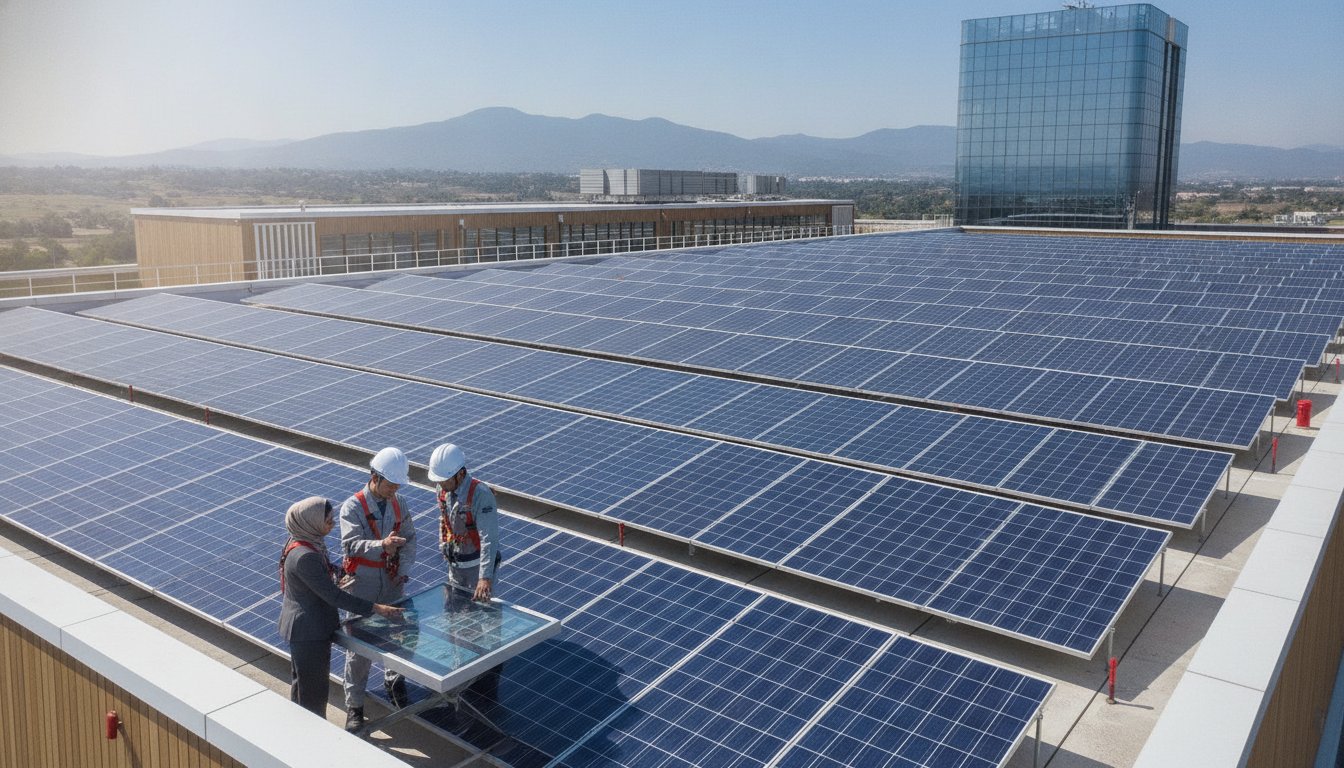
With electricity import rates now peaking at Rs. 60 per unit, the 2026 transition to the NEPRA (Prosumer) Regulations has transformed solar integration from a peripheral upgrade into a core architectural requirement for Pakistani enterprises. You likely recognize that the shift from traditional net metering to the current net billing framework has introduced a more rigorous technical landscape. The opaque bureaucratic processes and specific DISCO requirements often result in high rejection rates due to minor documentation errors. It's a challenging environment where technical precision is the only path to project approval.
This guide provides a definitive roadmap for how to apply for net metering in pakistan for commercial operations under the new five-year contract terms. We'll help you master the regulatory shift, ensuring 100 percent compliance while optimizing your system for maximum self-consumption. You'll learn the exact sequence of events from engaging an AEDB-certified installer to the final installation of your bi-directional AMI meter. This systematic approach allows you to lower operational costs through strategic energy exports at the current National Average Energy Purchase Price while future-proofing your facility's energy infrastructure through advanced engineering standards.
Key Takeaways
- Navigate the 2026 NEPRA (Prosumer) Regulations to understand how specific DISCO protocols influence your commercial approval cycle.
- Execute a precise roadmap on how to apply for net metering in pakistan for commercial facilities by aligning technical site surveys with mandatory documentation standards.
- Integrate advanced safety protocols like anti-islanding and Smart AI Inverters to meet the grid stability requirements of modern utility providers.
- Maximize your return on investment by deploying N-Type technology and self-consumption models that thrive under the new national energy purchase price.
- Simplify the complex licensing process through end-to-end EPC management and high-performance architectures like the NipponHev system.
Understanding the Net Metering Framework in Pakistan (2026)
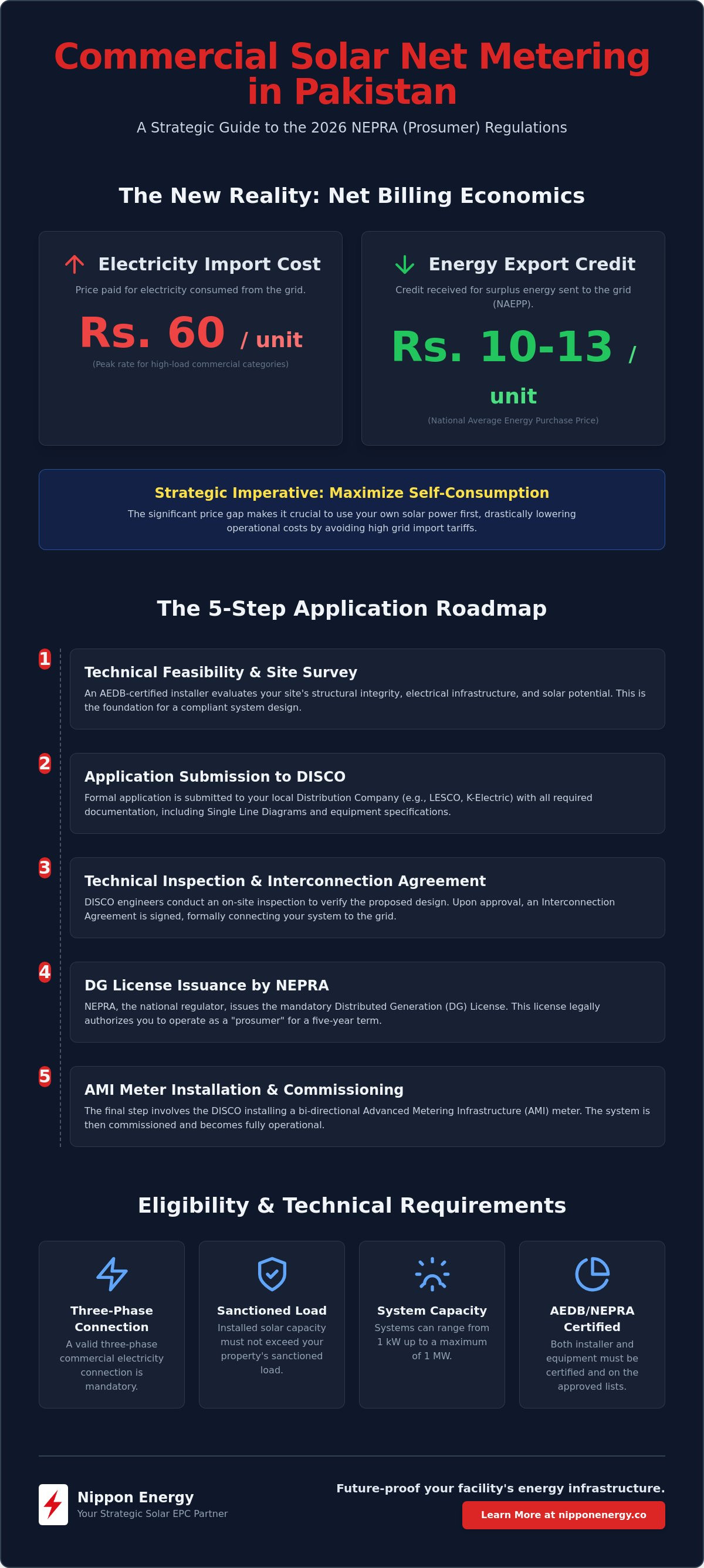
The regulatory landscape for distributed energy in Pakistan underwent a fundamental shift on February 9, 2026, with the introduction of the NEPRA (Prosumer) Regulations. This framework officially transitioned new commercial applicants from traditional net metering to a "Net Billing" model. Under this architecture, the energy you export to the grid is credited at the National Average Energy Purchase Price (NAEPP), currently valued between Rs. 10 and Rs. 13 per unit. Conversely, the electricity you import from the grid remains subject to standard retail tariffs, which can reach up to Rs. 60 per unit for high-load commercial categories. Understanding how to apply for net metering in pakistan for commercial purposes now requires a strategy that prioritizes self-consumption to offset these high import costs.
Distribution Companies (DISCOs) such as LESCO, K-Electric, and IESCO act as the primary gatekeepers in this ecosystem. They manage the local approval cycle, conduct technical feasibility studies, and oversee the installation of bi-directional Advanced Metering Infrastructure (AMI). The expansion of Solar Power in Pakistan, which now supports over 6,000 MW of rooftop capacity, has led DISCOs to implement stricter grid-tie constraints. Commercial entities in industrial zones often receive priority for capacity allocation because their high daytime demand aligns perfectly with peak solar generation, reducing the overall thermal stress on the local distribution transformers.
The Role of NEPRA and AEDB in 2026
NEPRA serves as the supreme regulatory body, issuing the Distributed Generation (DG) License required for any grid-interactive system. This license is a mandatory legal instrument that authorizes you to operate as a "prosumer" for a fixed five-year term. Simultaneously, the Alternative Energy Development Board (AEDB) maintains the certification standards for both equipment and installers. To secure approval, your system must utilize components from the NEPRA Approved Equipment List and be deployed by an AEDB-certified EPC partner. This dual-oversight ensures that every commercial installation meets national safety and synchronization standards.
Eligibility Criteria for Commercial Consumers
To qualify for net billing, a commercial facility must possess a valid three-phase electricity connection and a sanctioned load that accommodates the proposed system size. The current regulations allow for system capacities ranging from 1 kW up to a maximum of 1 MW. It's a critical technical requirement that the installed solar capacity does not exceed the property's sanctioned load. If your energy requirements surpass your current sanctioned limit, you must apply for a load enhancement before initiating the solar application. This alignment ensures that the local grid infrastructure can safely manage the potential reverse power flow during periods of peak generation.
5 Essential Steps for a Commercial Net Metering Application
The execution of a commercial solar project requires a methodical progression from site analysis to grid synchronization. Mastering how to apply for net metering in pakistan for commercial infrastructure involves navigating a five-phase pipeline that bridges engineering and law. While the foundational principles were established by the NEPRA Net Metering Regulations, 2015, the 2026 landscape demands higher technical precision to secure a Distributed Generation (DG) license.
Phase 1 initiates with a comprehensive technical feasibility study and site survey. This step evaluates structural integrity and electrical compatibility. Phase 2 involves the formal submission of the application to your local DISCO. During Phase 3, engineers conduct a technical inspection and facilitate the Interconnection Agreement. Phase 4 is the issuance of the DG License by NEPRA. Finally, Phase 5 includes the installation of the bi-directional AMI meter and system commissioning. It's a structured sequence where every technical detail determines the speed of approval.
Document Preparation and Submission
To understand how to apply for net metering in pakistan for commercial success, you must treat documentation as a technical sub-system. Required filings include detailed Single Line Diagrams (SLD), earthing reports, and proof of property ownership. Commercial entities must also provide SECP registration and NTN certificates to verify corporate eligibility. Partnering with an AEDB certified solar EPC partner is essential here. They manage the technical complexities of the filing, ensuring that every specification aligns with the latest prosumer standards. They don't just submit papers; they architect the regulatory path for your facility.
The DISCO Inspection and Approval Cycle
The field visit is the most critical juncture in the approval cycle. DISCO engineers focus on mandatory safety features such as anti-islanding and surge protection. They verify that the proposed solar capacity does not exceed the sanctioned load of the facility. They also inspect the bi-directional AMI meter's placement for accessibility and signal strength. Common reasons for application deferral include incorrect cable sizing or non-compliant earthing systems. By ensuring your infrastructure meets these grid-tie safety standards from day one, you avoid costly delays in the 2026 regulatory environment.
If you're ready to transition your facility to a high-performance energy model, exploring professional Solar Project Development and EPC services can streamline this entire regulatory pipeline.
Technical Requirements and Infrastructure Compliance
In 2026, the technical architecture of a commercial solar system is the primary determinant of regulatory acceptance. Understanding how to apply for net metering in pakistan for commercial facilities requires more than administrative knowledge; it demands a deep alignment with the grid's electrical parameters. NEPRA's current standards mandate strict compliance with harmonic distortion limits and power factor regulations to prevent industrial-scale noise from destabilizing the local network. Bi-directional Advanced Metering Infrastructure (AMI) serves as the critical interface, precisely tracking energy flow to ensure that exports are accurately credited at the National Average Energy Purchase Price.
Inverter and Hardware Standards
The selection of power electronics is a high-stakes decision in the current regulatory cycle. Only hardware on the NEPRA-approved list qualifies for a Distributed Generation license. Nippon Smart AI Solar Inverters are increasingly preferred by DISCOs because they provide intelligent energy orchestration and real-time grid stabilization. These systems utilize advanced algorithms to manage voltage fluctuations, ensuring that your facility remains a reliable node on the utility network. Similarly, integrating Nippon TOPCon solar panels maximizes the energy export ratio by delivering superior low-light performance and higher bifaciality. For Pakistan's diverse climate, all hardware must maintain an IP65 or IP66 rating to ensure long-term resilience against dust ingress and monsoon humidity.
Grid Stability and Safety Protocols
Safety protocols are non-negotiable for commercial-scale arrays. Every system must feature an automatic disconnect mechanism, known as anti-islanding, which instantly shuts down the solar feed if the utility grid fails. This prevents hazardous feedback that could endanger DISCO maintenance crews. Additionally, surge protection devices (SPDs) must be installed on both the AC and DC sides to safeguard the infrastructure from transient overvoltages.
Grid stability is further maintained by adhering to strict voltage and frequency variation tolerance levels. Inverters must synchronize with the grid's 50Hz frequency within a tight margin, typically +/- 1 percent. Comprehensive earthing and lightning protection systems are also mandatory for large-scale commercial arrays to mitigate the risk of catastrophic failure during atmospheric discharges. Mastering how to apply for net metering in pakistan for commercial operations means designing a system that treats these safety requirements as foundational engineering blocks rather than optional add-ons.
Maximizing Commercial ROI: Beyond the Application
The financial viability of a commercial solar project in 2026 is determined by the strategic delta between high retail tariffs and the National Average Energy Purchase Price. While understanding how to apply for net metering in pakistan for commercial use is the initial requirement, the long-term ROI is a product of technical execution. With grid import rates now reaching Rs. 60 per unit, a single kilowatt-hour consumed directly at the source is worth nearly five times more than a kilowatt-hour exported at the Rs. 10 to Rs. 13 rate. This economic landscape necessitates the integration of Lithium-Ion Battery Storage systems to facilitate peak-shaving. By capturing surplus generation during the day and discharging it during expensive peak hours, businesses can effectively bypass the highest billing slabs while maintaining their regulatory compliance.
Optimizing Export with HJT Technology
Nippon HJT Solar Panels provide the thermal resilience required for Pakistan’s industrial corridors. Heterojunction technology maintains a superior temperature coefficient, which allows the system to sustain high output levels even as ambient temperatures surpass 40 degrees Celsius. This thermal stability prevents the power fades common in older technologies, directly protecting your 25-year investment. In commercial rooftop settings, HJT panels leverage bifacial gain to capture reflected irradiance from concrete or reflective membranes, significantly increasing the total energy yield per square meter. These panels also feature industry-leading low degradation rates, ensuring that your export capacity remains robust throughout multiple five-year contract cycles.
Performance Monitoring and O&M
Rigorous monitoring is the only mechanism available to validate the accuracy of DISCO credit statements. Real-time data acquisition allows facility managers to audit their generation against the export figures reported by the utility. Because even minor technical faults can lead to significant credit losses, professional Solar System Maintenance is a fundamental requirement for net billing accuracy. AI-driven diagnostics now allow for the early detection of string-level underperformance, preventing export drops before they manifest as financial deficits on the utility bill. This level of technical oversight ensures that the infrastructure you worked hard to license continues to perform as a high-yield asset.
If you aim to maximize the energy density and financial performance of your facility, exploring our specialized Solar Project Development and EPC services will ensure your system is engineered for the 2026 billing regime.
Strategic Solar EPC: Why Nippon Energy is the Preferred Partner
Nippon Energy operates at the intersection of Japanese engineering precision and local regulatory expertise. While the previous sections detailed the technical prerequisites and ROI calculations, the actual execution of a commercial solar project requires a partner capable of managing these variables simultaneously. We provide end-to-end management of the NEPRA and DISCO application process, transforming a complex bureaucratic exercise into a streamlined engineering milestone. Our approach ensures that the question of how to apply for net metering in pakistan for commercial facilities is answered through a turnkey solution that prioritizes grid stability and long-term asset performance.
The deployment of proprietary NipponHev integrated systems represents our commitment to commercial excellence. These systems aren't merely assemblies of components; they're synchronized energy architectures designed for the 2026 net billing regime. By integrating high-efficiency panels with intelligent storage and AI-driven inverters, we provide a unified platform that maximizes self-consumption and export yield. Our proven track record across utility-scale and industrial projects serves as evidence of our ability to navigate the most challenging grid-tie environments in Pakistan.
The Nippon Advantage in Regulatory Compliance
Our dedicated legal and technical teams specialize in the granular requirements of Distributed Generation licensing. We eliminate the risk of application rejection by conducting pre-submission audits that ensure every technical drawing and earthing report exceeds AEDB and NEPRA standards. This proactive methodology significantly reduces the application-to-commissioning timeline, allowing businesses to activate their energy savings faster. By utilizing pre-vetted hardware, we ensure your facility meets all DISCO-specific synchronization protocols on the first inspection. We don't just follow the rules; we set the standard for compliance.
Future-Proofing Your Commercial Energy
Energy requirements evolve, and our scalable system designs anticipate this growth. We architect solar arrays that allow for future load enhancement without requiring a complete overhaul of the existing electrical infrastructure. Integration with Smart AI management tools ensures your facility maintains optimized grid interaction, automatically adjusting to frequency variations and tariff changes. Nippon’s commitment extends beyond the initial installation through a lifecycle approach to Solar Project Development and EPC. We provide the structural integrity and technical oversight necessary to ensure your energy independence remains secure for decades. This methodical focus on excellence transforms your rooftop into a high-performance power plant.
Advancing Toward Commercial Energy Autonomy
The 2026 regulatory shift has transformed solar integration from a financial option into a strategic necessity for Pakistani industries. You've seen that mastering the technical requirements and documentation is essential for grid synchronization. Success in how to apply for net metering in pakistan for commercial facilities depends on a methodical approach that prioritizes high-efficiency hardware and rigorous safety compliance. By aligning your facility's infrastructure with NEPRA's latest standards, you secure a resilient energy foundation that offsets rising retail tariffs.
As an AEDB Certified Category 1 Installer, Nippon Energy provides the architectural expertise needed to navigate this complex landscape. We deploy proprietary HJT and TOPCon technology alongside 24/7 AI-driven performance monitoring to ensure your facility maintains its competitive edge. Consult with Nippon Energy’s EPC Experts for your Net Metering Application to secure your energy future with Japanese engineering precision. It's time to convert your rooftop into a high-performance asset that delivers measurable results for decades. Your transition to energy independence starts with a single, calculated step toward technical excellence.
Frequently Asked Questions
How long does it take to get a net metering license in Pakistan for a business?
The typical timeline for securing a commercial net billing license ranges from 4 to 8 weeks. This duration includes the initial technical feasibility study, DISCO application processing, site inspection, and the final issuance of the DG license by NEPRA. Engaging an AEDB-certified EPC partner ensures that documentation errors are minimized, which prevents administrative delays and accelerates the commissioning of your bi-directional meter infrastructure.
Can I apply for net metering if my commercial connection is on a 11kV feeder?
Commercial entities on 11kV feeders are eligible for net billing provided they maintain a three-phase connection and meet standard prosumer regulations. The application process remains consistent with low-voltage consumers, though the technical inspection focuses heavily on transformer compatibility and grid protection settings. Mastering how to apply for net metering in pakistan for commercial sites on high-voltage lines requires precise engineering to ensure your inverter synchronization aligns with DISCO grid-tie requirements.
What is the maximum solar capacity I can install for net metering in 2026?
The maximum allowable solar capacity for a commercial net billing system is 1 MW (1,000 kW) under current NEPRA regulations. Additionally, the system size cannot exceed the sanctioned load of your electricity connection. If your facility requires a larger array to meet energy demands, you must first apply for a load enhancement through your local DISCO before initiating the solar synchronization process to ensure infrastructure compliance and grid safety.
Do I need to pay any fees to NEPRA or the DISCO for a DG license?
NEPRA mandates a non-refundable application fee of Rs. 1,000 per kilowatt for commercial systems exceeding 25 kW in capacity. For smaller commercial installations of 25 kW or less, this application fee has been waived as of April 2026. You should also account for the cost of the bi-directional AMI meter, which typically ranges from Rs. 18,000 to Rs. 28,000 depending on your specific distribution company's procurement standards and local requirements.
What happens to my exported units if the grid goes down?
If the national grid experiences an outage, your solar system will immediately stop exporting units due to mandatory anti-islanding protection. This safety feature prevents hazardous feedback into dead utility lines during maintenance. To maintain operational continuity during such periods, you should integrate Nippon Lithium-ion Battery Storage Systems, which allow your facility to utilize solar power in an islanded mode without relying on the utility network for synchronization.
Is net metering still profitable with the 2026 export tariff adjustments?
Net billing remains highly profitable in 2026 due to the significant delta between high import tariffs and the national average energy purchase price. While export rates are currently set between Rs. 10 and Rs. 13 per unit, the primary financial gain stems from offsetting grid imports priced up to Rs. 60 per unit. Businesses that align their heavy machinery usage with peak daylight generation hours achieve the fastest payback periods under this framework.
Can I use any solar panel brand for a net metering application in Pakistan?
You must select hardware from the NEPRA Approved Equipment List to qualify for a commercial Distributed Generation license. This regulation ensures that all inverters and panels meet national grid stability and safety standards. Utilizing high-performance Nippon HJT or TOPCon Solar Panels ensures compliance while maximizing your energy density, which is a critical factor when calculating how to apply for net metering in pakistan for commercial ROI on limited industrial rooftop space.
How do I track how many units I have exported to the DISCO?
You can track your energy flow through the bi-directional AMI meter and your inverter's digital monitoring platform. The AMI meter displays separate registers for total energy imported from the grid and total energy exported. For more granular data, Nippon Smart AI Inverters provide real-time analytics and historical logs, allowing you to audit DISCO billing statements and optimize your self-consumption ratios for maximum financial efficiency and credit accumulation.


