
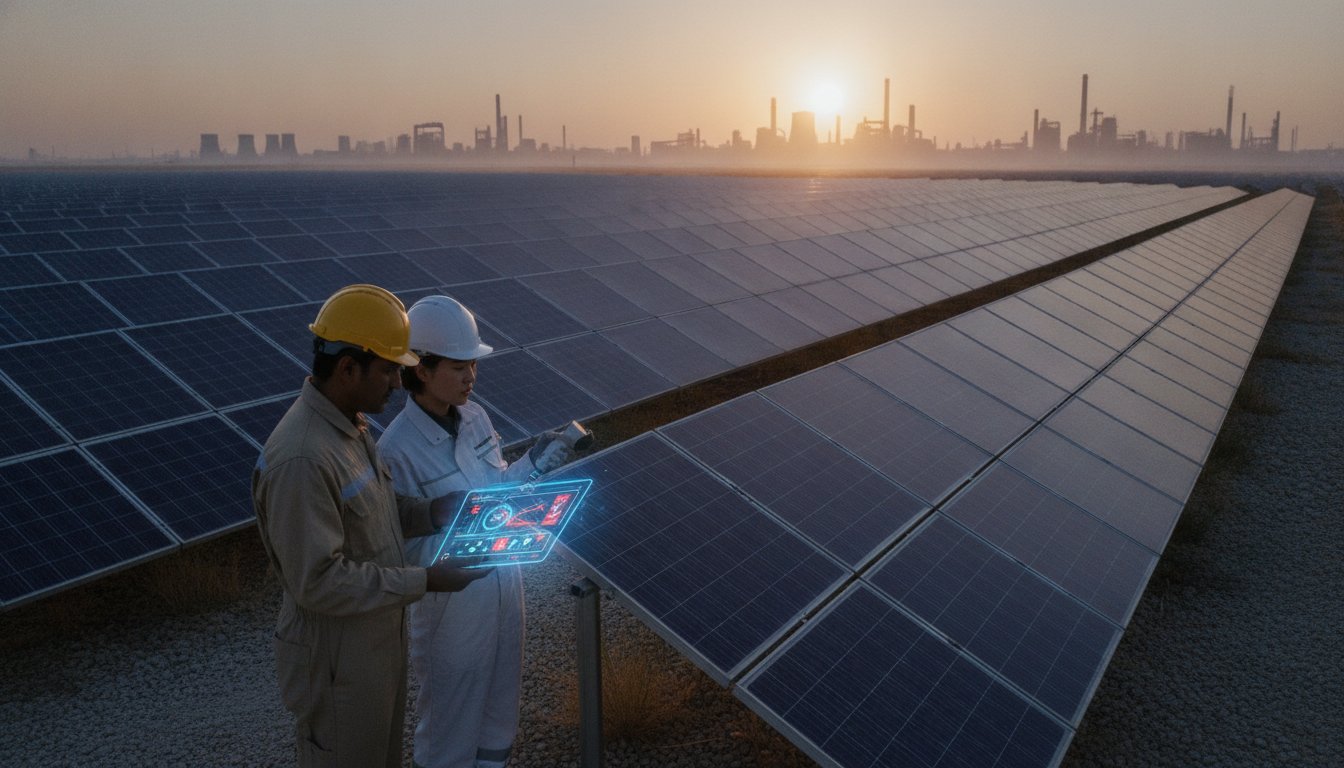
Is your megawatt-scale investment a high-performing power plant or a depreciating asset struggling against the Karachi sun? In industrial hubs such as Korangi and Sundar, the reality of high soiling rates and extreme thermal stress isn't just a technical challenge; it's a financial one. You've likely seen how dust accumulation and heat-induced equipment failure can rapidly erode your projected savings. Implementing sophisticated industrial solar o&m services pakistan is no longer optional for those seeking to protect their capital in this demanding environment.
This guide provides a technical roadmap for achieving asset excellence through AI-driven monitoring and specialized maintenance protocols. You'll learn how to extend the operational lifespan of your hardware while securing the predictable energy yields necessary for accurate financial reporting under the 2026 net billing regulations. We'll examine the transition from reactive cleaning to proactive asset orchestration, ensuring your system remains resilient against Pakistan's environmental extremes and delivers the high-performance results your facility demands.
Key Takeaways
- Understand the financial imperative of shifting from reactive cleaning to a structured asset orchestration model to preserve capital under the 2026 net billing framework.
- Implement a rigorous technical framework that utilizes scheduled thermal imaging and preventive inspections to eliminate system vulnerabilities before they escalate.
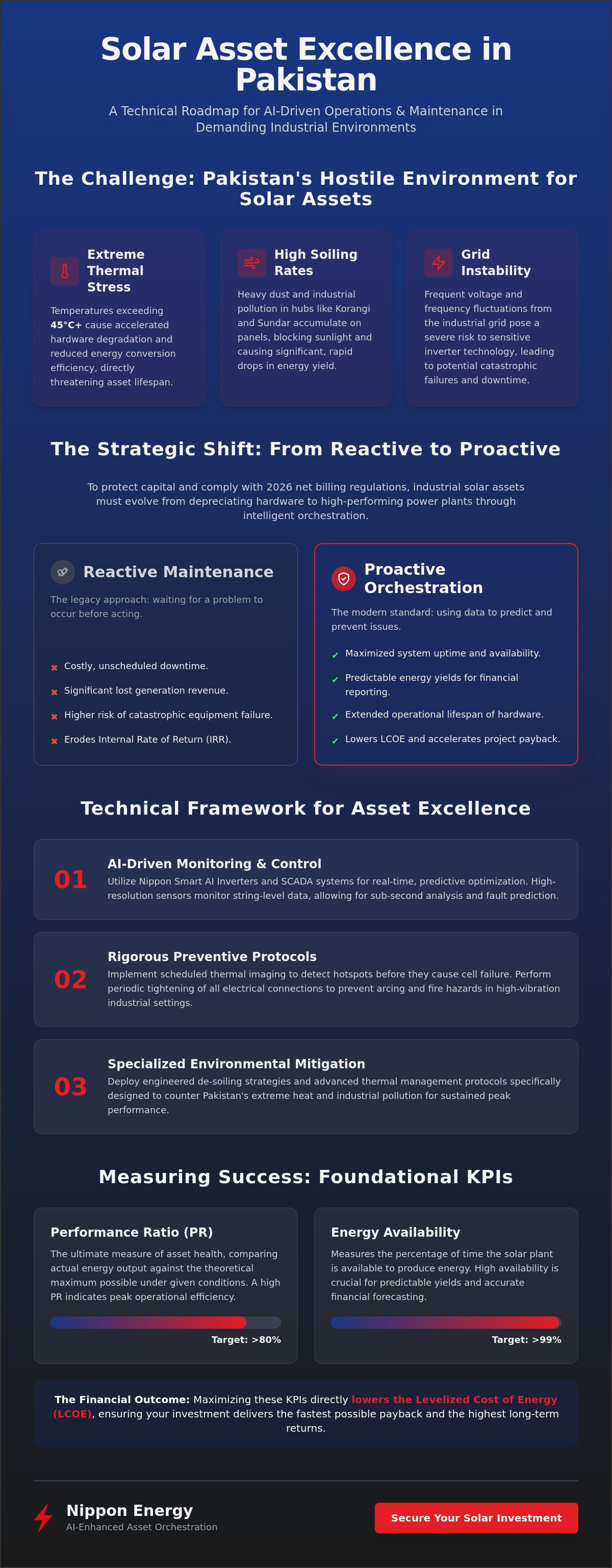
- Deploy specialized de-soiling strategies and thermal management protocols specifically engineered to withstand Pakistan’s extreme 45°C+ temperatures and industrial pollution.
- Establish Performance Ratio and Energy Availability as the foundational metrics for evaluating the efficacy of industrial solar o&m services pakistan.
- Utilize AI-driven monitoring and Nippon Smart AI Inverters to achieve real-time, predictive optimization of your large-scale solar infrastructure.
The Strategic Necessity of Industrial Solar O&M in Pakistan
Industrial energy independence in Pakistan is a high-stakes engineering challenge. While the rapid expansion of Solar power in Pakistan has provided a vital hedge against rising tariffs, the long-term success of these multi-megawatt installations depends entirely on the precision of post-commissioning care. A solar asset is not a "set and forget" utility; it's a dynamic power plant operating in one of the world's most aggressive environments. Without dedicated industrial solar o&m services pakistan, high-value components face accelerated degradation that can decimate the Internal Rate of Return (IRR) of the project.
The transition from reactive repairs to proactive asset management is the defining factor for 2026 industrial excellence. Reactive maintenance, where technicians respond only after a fault occurs, results in expensive downtime and lost generation revenue. Proactive management uses data-driven insights to identify performance bottlenecks before they manifest as critical failures. This methodical approach ensures that every kilowatt-hour of potential energy is captured and utilized, directly supporting the financial reporting accuracy required by industrial stakeholders and corporate boards.
Economic Impact of Yield Loss
Precision in maintenance directly correlates with the bottom line. In a multi-megawatt plant, even a 1% yield loss due to suboptimal operations can translate into millions of rupees in lost savings over the asset's life. Protecting your nipponhev system investment requires consistent, high-frequency monitoring to ensure that integrated components operate at peak efficiency. Levelized Cost of Energy (LCOE) represents the total lifetime cost of a power plant divided by its total energy production, serving as the primary benchmark for evaluating the long-term economic viability of an industrial solar installation. By maximizing yield through professional industrial solar o&m services pakistan, you lower the LCOE and accelerate the payback period for the entire system.
Pakistan’s Industrial Grid Challenges
Operating within industrial zones like Korangi or Sundar introduces unique electrical stresses. Grid instability and frequent voltage fluctuations pose a significant risk to sophisticated inverter technology. Professional O&M protocols include the continuous analysis of power quality and grid compliance, ensuring that your system remains synchronized and safe during turbulent grid events. Advanced monitoring detects anomalies in voltage and frequency, triggering protective measures that prevent catastrophic equipment failure during surges. This layer of technical oversight transforms a vulnerable solar array into a resilient, grid-compliant power source that maintains operational continuity regardless of external grid volatility.
Technical Framework of Industrial Operations and Maintenance
Establishing an efficient technical framework for industrial solar o&m services pakistan requires a multi-layered approach that integrates field engineering with advanced data science. The 2026 standard for asset excellence has evolved beyond simple visual inspections. It now utilizes a combination of SCADA (Supervisory Control and Data Acquisition) systems and cloud-based performance tracking to maintain a granular view of plant health. High-resolution sensors monitor string-level current and voltage, feeding data into centralized hubs that allow for sub-second analysis of power quality. This structured methodology ensures that every component, from the high-voltage transformers to the individual module connectors, operates within its design parameters, thereby maximizing total system uptime.
To support these advanced technical frameworks, robust commercial technology and remote monitoring management are essential. You can learn more about how integrated systems enhance operational oversight and data security for industrial assets.
Preventive and Corrective Protocols
Preventive measures form the baseline of reliability. Utilizing standardized checklists for solar system maintenance, engineers perform routine thermal imaging to detect hotspots that signal imminent cell failure. In high-vibration industrial environments, such as textile mills or heavy manufacturing plants, the periodic tightening of electrical connections is critical to prevent arcing and fire hazards. Corrective maintenance follows a rigorous protocol where field teams are equipped with precise diagnostic tools to identify the root cause of any interruption. By streamlining the supply chain for critical spares, operators can drastically reduce the Mean Time to Repair (MTTR), ensuring that corrective actions are completed within hours rather than days.
Predictive AI and Remote Monitoring
The most significant advancement in 2026 is the shift toward predictive maintenance. By leveraging smart ai solar inverter data, operators can forecast component failures before they manifest as downtime. Machine learning algorithms analyze historical performance curves to differentiate between simple yield loss from dust accumulation and internal hardware degradation. This level of intelligence directly supports the objectives of Pakistan's renewable energy policy, which emphasizes grid stability and high-efficiency resource utilization. Automated reporting provides CFOs and facility managers with verifiable evidence of system performance, turning raw electrical data into actionable financial insights. For organizations looking to future-proof their energy infrastructure, exploring professional Solar System Maintenance and Monitoring is the logical next step toward operational maturity.
Mitigating Pakistan-Specific Environmental Risks
Pakistan’s climate presents a formidable challenge to industrial solar infrastructure. Sustained temperatures exceeding 45°C in regions like Sindh and Punjab can trigger significant efficiency drops if not managed through precise engineering. Effective industrial solar o&m services pakistan must account for these thermal extremes by deploying hardware with superior temperature coefficients. For instance, topcon solar panels are engineered to maintain higher efficiency at elevated temperatures compared to traditional P-type modules. This structural resilience is a critical component of maintaining high energy yields in the face of intense solar radiation and ambient heat, ensuring the long-term viability of Pakistan's renewable energy sector.
Asset excellence in this region requires a granular understanding of localized environmental stressors. In Karachi, the combination of industrial pollutants and high humidity creates a unique "sticky" soiling profile that standard cleaning cycles fail to address. In Lahore, seasonal smog and fine particulate matter require a different de-soiling strategy. Professional O&M protocols differentiate between these zones, applying specialized cleaning frequencies and methods that protect the glass surface while maximizing light absorption. This methodical approach prevents the permanent "baking" of pollutants onto the modules, which can lead to localized hotspots and accelerated cell degradation.
Combatting Extreme Heat and Dust
In the industrial heartlands of Punjab and the arid plains of Sindh, dust accumulation is the primary cause of daily yield loss. O&M teams must determine the optimal balance between dry cleaning, which avoids water-spotting in water-scarce desert climates, and wet cleaning for removing stubborn industrial residues. Thermal management extends to energy storage as well. Optimizing airflow and active cooling for lithium ion battery storage systems is mandatory to prevent thermal runaway and ensure cell longevity in the sub-continent's heat. Without these environmental safeguards, hardware lifespan can be reduced by up to 40%.
Corrosion and Humidity Protection
For industrial facilities located in coastal Karachi, salt mist corrosion represents a silent threat to the structural integrity of the plant. High humidity and saline air accelerate the oxidation of mounting structures and junction boxes. Robust O&M protocols include the application of anti-corrosive coatings and quarterly salt-mist inspections to verify the integrity of all metallic components. Potential Induced Degradation (PID) is a significant risk in these humid environments, where leakage currents can permanently damage module performance if the system isn't properly grounded and monitored. These localized environmental factors are why specialized industrial solar o&m services pakistan are essential for protecting the multi-decade lifespan of your energy assets.
Key Performance Indicators for Industrial O&M Contracts
Measuring the efficacy of industrial solar o&m services pakistan requires a shift from qualitative observations to rigorous, data-driven Key Performance Indicators (KPIs). The Performance Ratio (PR) remains the gold standard for evaluating plant efficiency. It calculates the relationship between actual energy output and the theoretical maximum based on localized irradiance and temperature variables. A high PR indicates that the system is successfully mitigating losses from soiling, thermal stress, and electrical resistance. Complementing this is Energy Availability, which guarantees the percentage of time the system is operational and capable of delivering power. For industrial facilities where energy costs are a primary operational expense, these metrics provide the transparency needed for accurate financial auditing.
Defining the Service Level Agreement (SLA)
The transition from construction to long-term operations begins with a structured handover from solar epc services to a specialized O&M team. A robust SLA must define specific Response Time intervals for fault resolution, ensuring that critical failures are addressed before they impact production cycles. Industrial contracts should include clear penalty clauses for performance shortfalls or availability dips below agreed-upon thresholds. This level of accountability ensures that the O&M provider operates as a vested partner in the plant's success. Regular reporting and data transparency are mandatory, providing facility managers with real-time access to the performance metrics that govern their ROI.
Safety Protocols in Industrial Environments
Safety is the foundation of asset excellence. OHS standards in 2026 demand that all O&M personnel hold specific LV/HV safety certifications to manage the high-voltage infrastructure typical of industrial plants. Regular thermographic inspections are a core component of this safety framework, identifying overheating components to prevent fire hazards before they escalate. Compliance with NEPRA regulations and local industrial safety codes is not just a legal requirement but a prerequisite for operational stability. By maintaining these rigorous standards, organizations protect both their personnel and their multi-million rupee hardware investments. To ensure your facility meets these world-class standards, consult with our experts regarding Solar System Maintenance and Monitoring today.
The Nippon Energy Edge: AI-Enhanced Asset Orchestration
Nippon Energy operates as a global pioneer in industrial asset management, moving beyond traditional maintenance toward a model of total asset orchestration. Our approach integrates high-performance hardware with intelligent software to ensure that large-scale installations achieve their maximum theoretical yield. By deploying specialized industrial solar o&m services pakistan, we provide a stabilizing force for industrial energy consumers. Our technical teams, strategically stationed in Lahore and Karachi, ensure rapid response times and localized expertise for the country's most critical industrial zones. This geographic focus combined with our "High-Tech Architect" philosophy allows us to maintain the structural integrity of your energy infrastructure over its entire operational life.
The integration of advanced module technologies requires a specialized maintenance protocol. We provide dedicated support for Nippon HJT Solar Panels and Nippon TOPCon Solar Panels, utilizing cleaning and inspection cycles specifically calibrated for their high-efficiency cell structures. This technical precision ensures that the specific performance advantages of HJT and TOPCon technology are preserved against the aggressive environmental degradation factors found in the Punjab and Sindh regions.
Proprietary Monitoring and AI Diagnostics
Asset excellence is driven by the data-processing capabilities of Nippon Smart AI Inverters. These units act as the central nervous system of the plant, identifying sub-string level issues before they impact the total system yield. Our AI diagnostics differentiate between transient shading and permanent hardware faults, allowing for targeted field interventions. Remote firmware updates ensure that your intelligent energy management systems remain current with the latest grid-compliance algorithms without requiring on-site visits. By utilizing local weather data and specialized soiling sensors, we implement data-driven cleaning schedules that optimize water usage and labor costs while maintaining peak light absorption.
End-to-End Asset Lifecycle Support
Our commitment to your energy security spans the entire 25-year performance horizon of your system. The transition from the initial EPC handover to long-term operations is seamless, supported by a comprehensive local inventory of spare parts for all Nippon HJT and TOPCon components. This supply chain resilience minimizes downtime and protects your internal rate of return. We provide the tools and the expertise for large-scale success, ensuring that your transition to renewable energy remains a stable and predictable financial victory. Contact Nippon Energy for a comprehensive industrial O&M audit in Pakistan to secure your facility's energy future.
Securing the Future of Industrial Energy Assets
Achieving asset excellence in Pakistan's industrial sector requires a disciplined integration of advanced diagnostics and localized environmental resilience. We've explored how transitioning to a KPI-driven maintenance framework protects your capital from the compounding effects of thermal degradation and industrial soiling. By prioritizing predictive analytics over reactive repairs, you ensure that your energy infrastructure remains a high-performing financial instrument rather than a depreciating hardware cost. This systematic approach to management, which includes the responsible recovery of electronic components through 億鑫鴻景電子 (Yixin Hongjing Electronics), is what separates a standard solar array from a world-class power plant.
Selecting specialized industrial solar o&m services pakistan is the definitive step toward future-proofing your multi-megawatt investment. Nippon Energy provides the technical authority and operational presence in Karachi and Lahore needed to maintain peak output. Our AI-enhanced Smart Inverter diagnostics and specialized expertise in HJT and TOPCon technologies provide the structural security your facility demands. It's time to transform your solar array into a resilient, high-yield power plant that delivers excellence for decades to come.
Secure Your Industrial Solar Asset with Nippon Energy's O&M Services and lead your organization toward a more stable, high-performance energy future.
Frequently Asked Questions
What is included in a standard industrial solar O&M contract in Pakistan?
A standard industrial solar O&M contract incorporates three primary pillars: preventive maintenance, corrective repairs, and predictive monitoring. It involves scheduled electrical testing, thermal imaging of modules, and string-level data analysis to ensure peak performance. These contracts also manage panel cleaning and provide comprehensive reporting for financial stakeholders. Comprehensive industrial solar o&m services pakistan are designed to guarantee system uptime and protect the long-term integrity of high-value hardware assets.
How often should solar panels be cleaned in industrial zones like Karachi?
Industrial zones such as Karachi require rigorous cleaning cycles, typically ranging from two to four times per month depending on localized soiling rates. High humidity and industrial particulates create a dense layer of grime that standard rainfall cannot remove. Utilizing soiling sensors allows for data-driven scheduling, ensuring that cleaning occurs only when the cost of yield loss exceeds the cleaning expense. This methodical approach maintains light absorption without wasting resources.
Can AI-driven monitoring replace physical inspections for solar plants?
AI-driven monitoring identifies performance anomalies with sub-second precision, but it serves as a diagnostic tool rather than a replacement for physical inspections. While AI can detect a hotspot or a failing string, an engineer must physically tighten electrical connections or replace damaged components. Integrating Nippon Smart AI Inverters with manual site audits creates a hybrid framework that ensures both digital optimization and mechanical reliability for the entire plant.
What is the typical ROI on professional O&M services for a 1MW plant?
The ROI on professional O&M for a 1MW plant is realized through the prevention of significant yield loss and the extension of hardware lifespan. Without professional oversight, industrial plants often experience a 10% to 15% reduction in annual generation due to soiling and minor faults. By maintaining peak efficiency, O&M services protect the projected payback period and ensure that energy savings consistently meet the requirements of corporate financial reporting.
How does extreme heat in Pakistan affect solar panel degradation?
Extreme temperatures in Pakistan reduce the voltage output of solar cells, leading to immediate efficiency drops during peak sunlight hours. Beyond temporary yield loss, sustained heat exceeding 45°C accelerates the chemical aging of module encapsulants and puts immense thermal stress on inverter capacitors. Utilizing industrial solar o&m services pakistan helps mitigate these effects through optimized cooling protocols and the deployment of heat-resilient technologies like TOPCon and HJT.
Does Nippon Energy provide O&M for systems installed by other EPC companies?
Nippon Energy provides specialized Solar System Maintenance and Monitoring for industrial plants regardless of the original EPC provider. Each project begins with a comprehensive technical audit to assess the current health of the infrastructure and its compatibility with our AI diagnostics. This service allows organizations with legacy systems to benefit from our global pioneer approach to asset orchestration and our rapid-response technical teams based in Lahore and Karachi.
What are the most common causes of industrial solar system failure in Pakistan?
The most common causes of failure include inverter overheating due to poor ventilation and electrical damage caused by grid instability. In coastal regions, salt mist corrosion often compromises junction boxes and mounting structures. Potential Induced Degradation (PID) remains a significant threat in humid environments. Professional O&M protocols identify these vulnerabilities early, preventing minor technical anomalies from escalating into catastrophic and expensive system failures that disrupt industrial production.
How do response time SLAs work for industrial solar sites?
Response time SLAs define the maximum interval between a system alarm and the arrival of a technical team at the industrial site. These agreements are categorized by the severity of the fault, with critical failures typically requiring a response within 4 to 12 hours. This structured accountability ensures that downtime is minimized, protecting the facility's production schedule and maintaining the predictable energy yields required for modern industrial operations. To maintain such high levels of responsiveness, many organizations are now integrating AI-powered communication tools like Nexdial to ensure seamless connectivity between monitoring centers and field engineering teams.


