
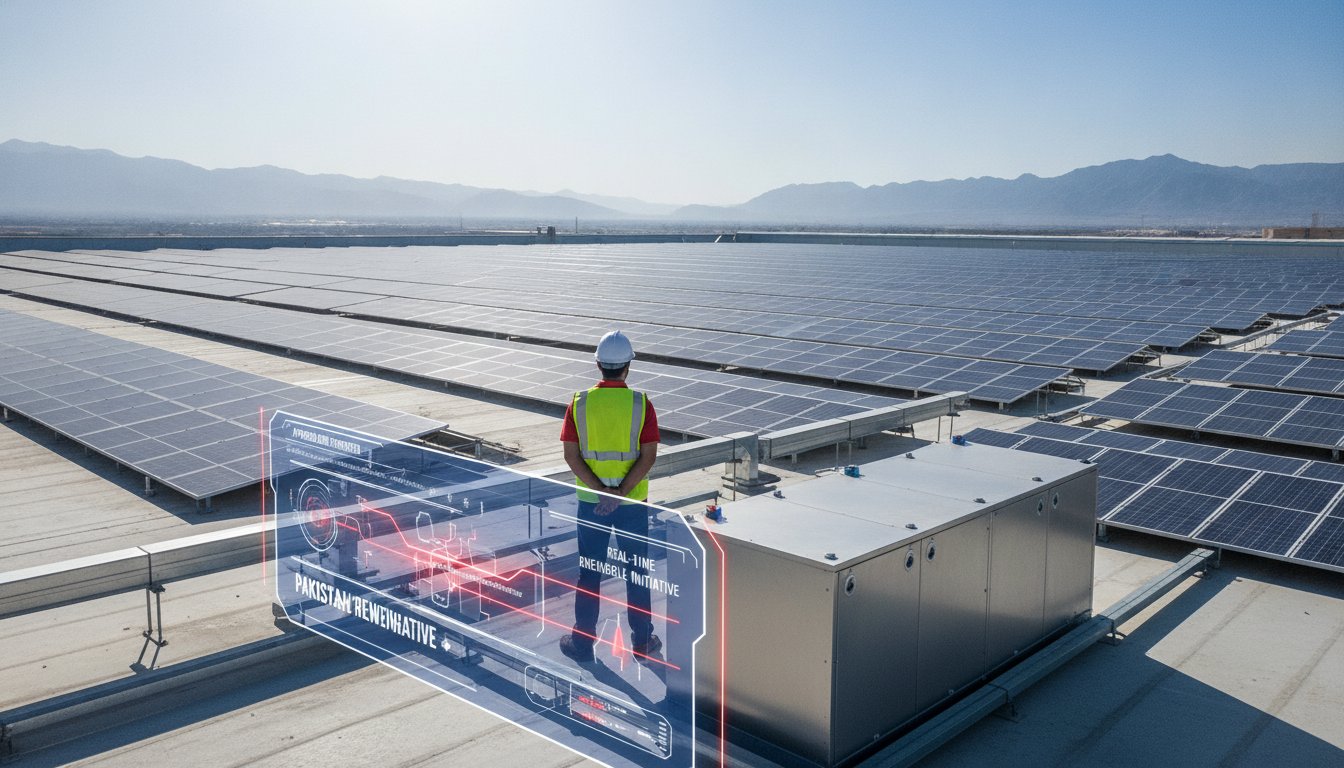
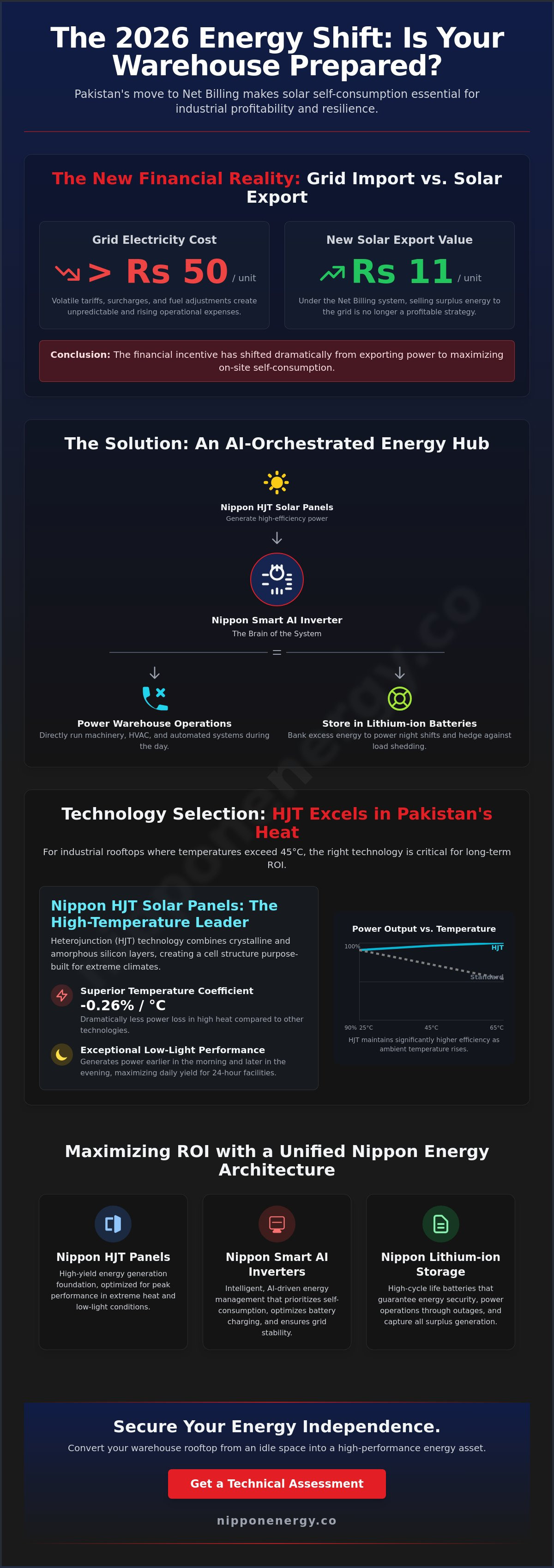
With the 2026 shift from net metering to net billing, warehouse operators now face an export value of just Rs 11 per unit against grid costs that can exceed Rs 50. It's clear that the traditional model of selling surplus energy is no longer a viable strategy to protect your bottom line. To maintain a competitive edge, you need advanced solar solutions for warehouses in pakistan that prioritize self-consumption and technical resilience over simple grid exports.
You likely recognize that unpredictable tariff hikes and the threat of premature panel degradation in Pakistan's extreme heat are risks your logistics infrastructure cannot afford. This guide provides the technical roadmap to secure energy independence and maximize ROI through high-efficiency HJT technology and intelligent storage. We'll explore how Nippon HJT Solar Panels and Nippon Lithium-ion Battery Storage Systems work together to stabilize automated operations. We also examine how AI-driven orchestration and Nippon Smart AI Inverters mitigate the impact of the latest fiscal adjustments, ensuring your facility remains powered regardless of grid instability or shifting government policies.
Key Takeaways
- Analyze the 2026 industrial energy landscape to understand how grid volatility impacts your warehouse's operational expenses and bottom-line profitability.
- Compare the temperature coefficients of HJT and TOPCon architectures to select the technology that maintains maximum efficiency in Pakistan's extreme heat.
- Discover how modern solar solutions for warehouses in pakistan are evolving from simple backup systems to intelligent, AI-orchestrated energy management hubs.
- Master the critical phases of a professional EPC roadmap, including structural load assessments and electrical string optimization for large-scale industrial rooftops.
- Evaluate the ROI benefits of unified architectures that integrate high-performance HJT panels, AI inverters, and lithium storage into one resilient system.
The Economic Case for Solar Solutions for Warehouses in Pakistan
Pakistan's industrial energy sector has reached a critical inflection point. As of June 2026, while minor quarterly adjustments offer temporary relief, the long-term trajectory of base tariffs remains upward, currently averaging approximately Rs 31.59 per unit before surcharges. For logistics providers, this volatility isn't just a line item; it's a threat to structural profitability. Deploying solar solutions for warehouses in pakistan converts a volatile operational expense into a predictable, high-performance asset. This shift stabilizes the bottom line by insulating the business from the frequent fuel charge adjustments that characterize the national grid.
Beyond immediate cost mitigation, the adoption of renewable infrastructure is now a prerequisite for global trade. Export-oriented warehouses must align with international carbon-neutrality mandates to retain high-value contracts in the EU and North American markets. Integrating Solar power in Pakistan allows these entities to satisfy stringent ESG criteria through measurable carbon reduction. Most warehouse rooftops in industrial hubs like Karachi or Lahore represent underutilized real estate. Transforming these expansive surfaces into power-generating zones turns idle square footage into a primary driver of energy independence.
Combating Rising Grid Tariffs and Load Shedding
The financial gap between utility power and on-site generation has never been more pronounced. While the average base tariff is substantial, the addition of the IMF-linked surcharge of Rs 3.82 per unit further increases the burden on industrial consumers. On-site solar generation provides a permanent hedge against these escalations, delivering a levelized cost of energy that remains far below grid rates. This infrastructure also reduces reliance on diesel generators during peak load shedding hours. Eliminating the fuel and maintenance costs of industrial gensets directly improves the facility's net margin, ensuring that automated sorting and climate-control systems remain operational without the high premium of fossil fuels.
NEPRA Net Metering and Regulatory Incentives
The regulatory framework is currently transitioning from traditional net metering to a net billing system for new industrial entrants. While existing users are grandfathered into previous rates, new installations must focus on the "banking" of units to offset peak-time consumption effectively. Under the net billing model, exported surplus energy is valued at a lower rate, typically around Rs 11 per unit, which makes maximizing self-consumption the most profitable strategy. NEPRA regulations currently restrict the allowable capacity of a net-metered solar system to the sanctioned load of the industrial connection.
Technology Selection: HJT vs. TOPCon for Industrial Rooftops
When evaluating solar solutions for warehouses in pakistan, the choice of cell architecture determines the long-term viability of the investment. For industrial rooftops in regions like Sindh or Punjab, ambient temperatures frequently exceed 45°C. Standard modules suffer significant power loss under these conditions. HJT and TOPCon technologies address this through advanced passivation layers, but their performance profiles differ in high-heat environments. Selecting the correct technology requires a balance between initial capital expenditure and the total energy harvested over the system's 25-year lifespan.
Nippon HJT Solar Panels: The High-Temperature Leader
Nippon HJT Solar Panels: The Future of High Efficiency utilize a symmetrical cell structure that combines crystalline silicon with amorphous silicon layers. This architecture results in a superior temperature coefficient, typically around -0.26%/°C. In the extreme heat of a Pakistani summer, HJT modules maintain higher output compared to traditional P-type or even early N-type technologies. These panels also offer exceptional low-light performance, ensuring energy generation begins earlier in the morning and continues later into the evening, which is vital for facilities with 24-hour operational cycles.
Nippon TOPCon Solar Panels: Industrial Versatility
Nippon TOPCon Solar Panels provide a high-efficiency alternative that balances upfront CAPEX with robust energy density. TOPCon technology utilizes a tunnel oxide layer to reduce recombination losses, achieving efficiency benchmarks that are ideal for large-scale commercial arrays. While HJT offers the lowest degradation, TOPCon remains a highly resilient choice for expansive warehouse rooftops where maximizing peak output per square meter is the primary objective. Regarding long-term reliability, HJT panels typically exhibit a degradation rate of approximately 0.25% per year, whereas TOPCon modules generally degrade at a slightly higher rate of 0.4% per year over a 20-year period.
Logistics infrastructure often features reflective roofing materials that allow for significant bifacial gain. By capturing light from both the front and rear surfaces, these modules can increase total energy yield by 10% to 25% depending on the roof's albedo. Adhering to technical standards outlined in the Alternative Energy Development Board (AEDB) policies ensures that these high-tech components are integrated into a system that meets national safety and performance benchmarks. If you're unsure which technology fits your specific load profile, you can consult with our technical architects to model your expected ROI based on your facility's unique geographic location.
Energy Independence: Storage and AI Orchestration
The paradigm of industrial energy in Pakistan has shifted from simple grid-tied generation to comprehensive on-site orchestration. Effective solar solutions for warehouses in pakistan now require more than just panels; they demand a sophisticated layer of storage and intelligence to navigate a volatile energy market. According to current reports on Pakistan's renewable energy landscape, an increasing number of industrial organizations are adopting captive solar systems to insulate themselves from grid unreliability and escalating utility costs. This transition is driven by the need for 'Energy Management' rather than mere 'Backup'. While older systems focused on surviving outages, modern architectures use storage to actively manipulate load profiles and reduce dependency on high-tariff grid periods.
Nippon Lithium-ion Battery Storage Systems
Lead-acid and VRLA batteries are no longer viable for 2026 industrial projects due to their limited cycle life and high maintenance requirements. Nippon Lithium-ion Battery Storage Systems offer a superior alternative with thousands of discharge cycles; they ensure the system outlasts the initial payback period. These high-discharge systems are designed for the high-density requirements of warehouse electrical rooms. Their compact footprint allows for significant space-saving, which is critical for facilities where floor space is optimized for inventory. For a deeper technical breakdown of these technologies, refer to The Definitive Guide to Lithium-Ion Battery Storage.
Nippon Smart AI Inverters for Industrial Control
The intelligence of a solar plant resides in its ability to predict and respond to external variables. Nippon Smart AI Inverters serve as the central nervous system of the facility. They optimize energy flows between solar arrays, battery banks, and the grid in real time. These units provide predictive fault detection, identifying potential issues before they cause downtime in automated warehouse operations. A critical feature for industrial users is peak shaving. By discharging stored solar energy during the grid's peak hours, businesses can significantly reduce their maximum demand charges. These inverters can also integrate with existing Warehouse Management Systems (WMS). This allows for energy-aware operations where high-energy tasks are scheduled during periods of peak solar generation. Explore the full capabilities in our guide on Smart AI Solar Inverters: Intelligent Energy Orchestration.
By combining high-cycle storage with AI-driven control, warehouse operators can achieve a level of energy autonomy that was previously impossible. This integrated approach doesn't just provide power during load shedding; it creates a resilient, cost-optimized energy microgrid that protects the facility from external economic shocks. Precision in energy orchestration is the hallmark of a future-proofed logistics infrastructure, and organizations can look to international specialists like Zonnepanelen Brabant B.V. for benchmarks in high-performance storage implementation.
The Solar EPC Roadmap: From Feasibility to Commissioning
Deploying commercial solar solutions for warehouses in pakistan is a multi-stage engineering endeavor that requires rigorous oversight from inception to commissioning. A fragmented approach often leads to structural failures or electrical inefficiencies that compromise the long-term ROI. Our EPC framework prioritizes structural integrity and electrical precision to ensure the system delivers its projected performance over a 25-year lifecycle. This systematic progression moves from theoretical modeling to a fully synchronized power plant.
Phase 1 begins with a comprehensive structural load assessment. Warehouse rooftops, particularly those with aging corrugated metal sheets, must be verified to support the added weight of Tier-1 modules and mounting hardware. Phase 2 involves electrical design and string optimization. In large-scale arrays, improper stringing leads to excessive voltage drops; we calculate precise cable runs to maintain system efficiency. Phase 3 focuses on the procurement of high-performance hardware, followed by Phase 4, which covers on-site construction under strict Health, Safety, and Environment (HSE) protocols. Finally, Phase 5 manages NEPRA licensing and net metering synchronization to ensure your facility is legally permitted to export surplus energy under the latest 2026 regulations.
Engineering Excellence in Warehouse Solar
Mounting structure quality is a non-negotiable factor for wind resistance, especially in coastal regions like Karachi where wind speeds reach critical levels during monsoon seasons. We utilize high-grade aluminum or galvanized steel structures designed to withstand localized wind loads without compromising the roof's waterproofing. Beyond structural safety, optimizing cable runs is vital to minimize DC loss across expansive warehouse footprints. Reducing resistance through precision engineering ensures that every watt generated by the HJT or TOPCon cells reaches the inverter. You can explore our full technical methodology in Solar EPC Services: The Definitive Guide.
Post-Installation: Maintenance and Performance Monitoring
Pakistan's arid climate presents a unique challenge: soiling. Dust accumulation on solar panels can reduce warehouse energy yield by up to 30% if left unmanaged. We implement data-driven maintenance schedules that balance automated cleaning systems with manual inspections. Real-time performance monitoring allows our technical teams to identify underperforming strings immediately, ensuring the system operates at its peak architecture. Detailed protocols for these operations are available in Solar System Maintenance: Performance Architecture.
To ensure your infrastructure is ready for the 2026 energy market, begin your facility’s technical feasibility study with our engineering team today.
Maximizing ROI with Nippon Energy’s Turnkey Solutions
Achieving a rapid payback period for solar solutions for warehouses in pakistan requires more than just high-performance hardware; it necessitates a unified engineering approach. Many industrial projects fail to reach their projected ROI because of fragmented procurement, where mismatched components from different manufacturers create communication bottlenecks. By choosing a single-point responsibility EPC partner, you ensure that every subsystem is optimized for collective performance. This integrated strategy eliminates the technical friction often found in piecemeal installations, resulting in a more resilient and predictable energy asset.
Warranty security is the cornerstone of protecting a large-scale industrial investment. Our systems are engineered for a 25-plus year lifespan, backed by a comprehensive support structure that covers the entire architecture. This long-term commitment provides the financial certainty required for capital-intensive logistics infrastructure. Instead of managing multiple vendors for maintenance or claims, you interact with a single authoritative partner who understands the granular details of your facility's energy profile. This streamlined accountability is what differentiates a world-class solar plant from a standard installation.
The NipponHev Integrated Advantage
The NipponHev architecture represents the pinnacle of industrial energy design. It integrates Nippon HJT Solar Panels, Nippon Smart AI Inverters, and Nippon Lithium-ion Battery Storage Systems into a single, cohesive ecosystem. This vertical integration eliminates compatibility issues that frequently plague multi-brand systems, ensuring seamless data exchange between the generation and storage layers. A unified monitoring interface provides real-time visibility into the entire energy ecosystem, allowing warehouse managers to make data-driven decisions about load scheduling and energy consumption. Detailed insights into this synchronized approach are available in our guide on the NipponHev System: Integrated Solar Architecture.
Getting Started: Your Industrial Energy Audit
Initiating the transition to advanced solar solutions for warehouses in pakistan begins with a technical feasibility study. During the initial consultation, our engineers require historical energy billing data and structural drawings of the facility to model an accurate ROI. Understanding the timeline is crucial for operational planning; the progression from contract signing to the first unit of energy generated typically follows a disciplined 12-to-16 week schedule, depending on the complexity of the NEPRA net metering synchronization. Our technical teams in Lahore and Karachi are available for site-specific assessments, providing the granular data needed to future-proof your logistics operations against the energy challenges of 2026 and beyond.
Securing Energy Autonomy for the 2026 Industrial Landscape
The transition from a volatile grid to a resilient, captive energy architecture is a strategic necessity for the modern warehouse. By integrating Tier-1 HJT technology with AI-driven storage, you secure a levelized cost of energy that remains immune to the tariff fluctuations of the national grid. This guide has detailed how technical precision in component selection and a structured EPC roadmap transform underutilized rooftops into high-performance assets. Investing in solar solutions for warehouses in pakistan is no longer just a sustainability goal; it's a fundamental requirement for operational stability in an increasingly complex energy market.
Nippon Energy provides the engineering authority and global scale needed to execute these large-scale transitions. With a presence in Lahore, Karachi, and Dubai, our teams deliver end-to-end EPC services and comprehensive NEPRA licensing support to ensure your facility is fully synchronized with the latest regulations. Our commitment to high-efficiency TOPCon and HJT architectures guarantees that your logistics infrastructure remains competitive for decades. Take the first step toward energy independence and Request a Professional Warehouse Solar Feasibility Study today. We look forward to architecting your facility's sustainable future.
Frequently Asked Questions
What is the typical payback period for warehouse solar solutions in Pakistan?
The typical payback period for industrial solar installations ranges from 4 to 6 years. This duration is influenced by the facility's specific energy consumption patterns and the prevailing utility tariffs. High-efficiency systems, such as those utilizing HJT technology, accelerate this return on investment by reducing the levelized cost of energy over the asset's 25-year lifecycle. This makes the transition to renewable power a mathematically sound capital expenditure for logistics providers.
Can my warehouse roof handle the weight of a large-scale solar installation?
Most industrial warehouse roofs are designed to support the dead load of a solar array, but a formal structural load assessment is essential. Our engineering team evaluates the integrity of the existing purlins and rafters to ensure the mounting hardware can withstand localized wind speeds. This rigorous assessment prevents structural deformation and ensures the long-term safety of the logistics infrastructure during extreme weather events common in Pakistan.
How does net metering work for industrial consumers in 2026?
In 2026, Pakistan has transitioned to a net billing system for new industrial consumers. Under this regulatory framework, any surplus energy exported to the grid is valued at a lower rate, approximately Rs 11 per unit. This shift makes maximizing on-site self-consumption the primary driver for financial viability in solar solutions for warehouses in pakistan. Existing net-metered licenses are grandfathered in, preserving their original terms until contract expiration.
Is HJT or TOPCon better for the extreme heat in Sindh and Punjab?
HJT technology is technically superior for the extreme ambient temperatures of Sindh and Punjab due to its lower temperature coefficient of approximately -0.26%/°C. While TOPCon modules are highly efficient, HJT panels maintain higher power output when ambient temperatures exceed 45°C. This thermal resilience ensures consistent energy generation during peak summer months when warehouse cooling loads are at their highest, providing a more stable power supply.
Do I need battery storage for my warehouse if I have net metering?
Integrating battery storage is highly recommended under the 2026 net billing policy to capture surplus generation for use during high-tariff peak hours. Beyond financial optimization, lithium-ion storage systems provide critical protection against grid instability and load shedding. This ensures that automated warehouse management systems and climate-control units remain operational without interruption, preserving the integrity of stored inventory regardless of grid status.
What maintenance is required to keep solar panels efficient in dusty industrial areas?
Maintaining efficiency in dusty industrial zones requires a disciplined cleaning schedule combined with real-time performance monitoring. Dust accumulation can reduce energy yield by up to 30% if left unmanaged; therefore, we recommend automated or semi-automated cleaning systems for large warehouse footprints. Regular inspections of electrical connections and inverter heat sinks are also necessary to prevent premature component degradation caused by high ambient dust levels.
How long does the EPC process take from design to grid connection?
The end-to-end EPC process typically spans 12 to 16 weeks from the initial feasibility study to final grid synchronization. This timeline accounts for structural modeling, Tier-1 hardware procurement, and the regulatory approval process with NEPRA. Efficient project management ensures that the construction phase is executed with minimal disruption to existing warehouse logistics, allowing for a seamless transition to on-site power generation.
Are there any tax incentives for commercial solar investments in Pakistan?
Commercial solar investments in Pakistan currently benefit from accelerated depreciation allowances, which significantly improve the project's net present value. While tax policies for imported equipment are subject to budget adjustments, the long-term savings on utility bills remain the primary fiscal driver for solar solutions for warehouses in pakistan. Businesses should consult with their financial advisors to maximize the specific tax benefits associated with renewable energy capital expenditures in their region.


