

What if the primary threat to your 2026 energy project isn't the hardware itself, but the technical gaps created by a fragmented supply chain? You likely recognize that achieving maximum ROI from high-efficiency solar infrastructure requires more than just purchasing premium components. Many developers face the frustration of inter-vendor finger-pointing when systems underperform or when Smart AI Inverters fail to sync perfectly with advanced HJT panels. These hidden costs in multi-contractor management can erode the financial viability of even the most ambitious utility-scale installations.
Understanding why choose a full-service solar epc company is essential for those seeking a turnkey solution with guaranteed performance. By consolidating Engineering, Procurement, and Construction under a single technical architect, you eliminate the friction of incompatibility and secure a lower Levelized Cost of Energy (LCOE). This integrated approach ensures that every component, from Nippon TOPCon panels to lithium-ion storage, functions as a unified NipponHev system. We will explore how this disciplined model provides the structural integrity and future-proofing necessary to lead the global energy transition with precision and confidence.
Key Takeaways
- Understand the transition from fragmented vendor management to a unified energy architecture that provides single-point accountability for your 2026 infrastructure project.
- Discover why choose a full-service solar epc company to ensure high-efficiency Nippon HJT and TOPCon panels achieve their full theoretical yield through precise electrical modeling.
- Learn how global supply chain integration eliminates installation risks and secures the latest 2026-standard components through rigorous factory-to-site quality protocols.
- Analyze how the EPC model reduces Levelized Cost of Energy (LCOE) by streamlining project management and eliminating the soft costs associated with multi-contractor friction.
- Identify the critical criteria for selecting an EPC partner, focusing on technical expertise in Nippon Smart AI Inverters and a proven global execution footprint across Japan, Pakistan, and the UAE.
What is a Full-Service Solar EPC Company?
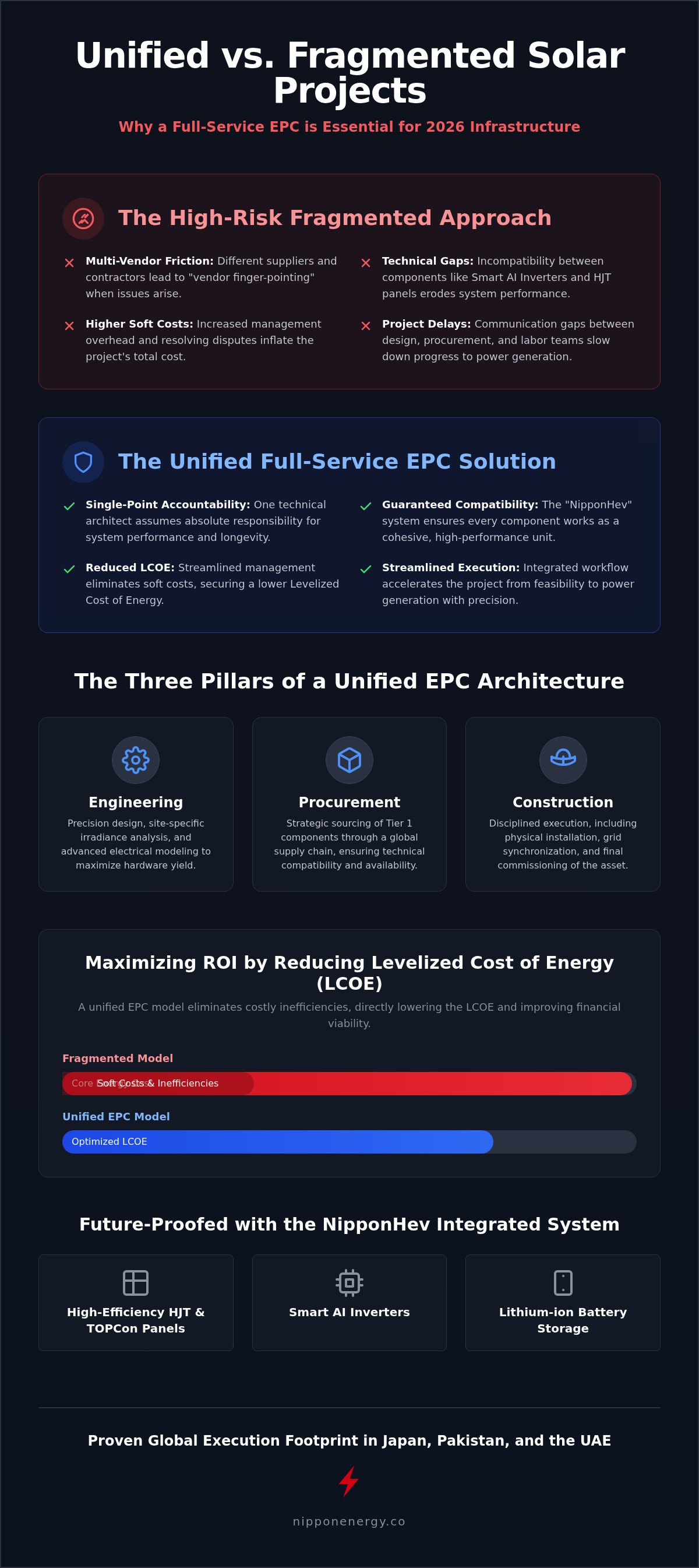
A full-service Solar EPC (Engineering, Procurement, and Construction) company functions as the single technical architect for an energy asset. In the 2026 energy market, this model has evolved from a simple project management framework into a sophisticated, unified energy architecture. It replaces the traditional fragmented approach, where separate entities handle design, hardware sourcing, and site labor. By consolidating these phases under one roof, the EPC provider assumes absolute responsibility for the system's performance and longevity. This single-responsibility contract model is now the global standard for utility-scale and industrial projects. It provides the structural security required to deploy high-efficiency technologies like Nippon HJT Solar Panels and Smart AI Inverters without the risks associated with multi-vendor integration.
The transition toward a unified model reflects the increasing complexity of modern solar infrastructure. As systems incorporate advanced Nippon Lithium-ion Battery Storage Systems and predictive AI, the margin for error in technical compatibility has narrowed. A full-service partner ensures that the "NipponHev" integrated system operates as a cohesive unit rather than a collection of disparate parts. This holistic oversight is the foundation of high-performance energy projects.
The Three Pillars of the EPC Model
The efficacy of a full-service provider rests on three foundational pillars that ensure theoretical designs translate into real-world yields. These pillars work in tandem to eliminate technical gaps.
- Engineering: This phase involves rigorous site-specific irradiance analysis and electrical load modeling. Engineers design the system to maximize the specific performance characteristics of Nippon TOPCon or HJT modules.
- Procurement: Strategic sourcing leverages global supply chains to secure Tier 1 components. A full-service EPC ensures that every piece of hardware is technically compatible and available for the project timeline.
- Construction: Professional teams manage the physical installation, grid synchronization, and final commissioning. This phase transforms the engineered design into a high-performance asset through disciplined execution.
Fragmented Contractors vs. Unified EPC
When you evaluate why choose a full-service solar epc company, the primary factor is the elimination of technical friction. In a fragmented model, the hardware supplier might blame the installer for low output, while the installer points to the inverter manufacturer. This "vendor finger-pointing" often leaves the asset owner with an underperforming system and no clear path to resolution. A unified EPC model removes this risk by providing a single point of accountability. Projects managed by unified teams often move from the feasibility stage to power generation faster because they eliminate the communication gaps between design and labor. This streamlined workflow ensures your 2026 project is built with precision and zero compatibility errors.
The Engineering Edge: Precision Design for High-Efficiency Hardware
Engineering precision determines whether high-efficiency hardware reaches its theoretical yield or falls victim to site-specific losses. Understanding why choose a full-service solar epc company becomes clear when analyzing the synergy between hardware selection and system layout. The engineering team works in direct coordination with procurement specialists to ensure that structural designs account for every technical nuance of the selected modules. In 2026, standard design protocols have been replaced by advanced shadow analysis and electrical load modeling that utilize sub-hourly irradiance data. This level of detail is critical when deploying infrastructure in extreme climates, such as the high-heat environments of the Middle East or the monsoon-prone regions of South Asia, where thermal management and structural resilience are paramount.
Optimizing for HJT and TOPCon Technologies
Nippon HJT and TOPCon solar panels offer superior efficiency, but their performance is sensitive to environmental variables. Engineering for HJT technology requires a deep understanding of its lower temperature coefficient, which allows for higher output in extreme heat compared to traditional PERC cells. Our engineers design mounting structures to maximize bifacial gain, ensuring that rear-side energy capture is optimized based on the specific albedo of the site surface. HJT cell architecture necessitates precise impedance matching and string configuration to mitigate potential-induced degradation and maximize bifacial power conversion. By aligning the physical rack design with the electrical characteristics of TOPCon modules, we eliminate mismatch losses that often plague multi-contractor installations.
AI-Driven Energy Orchestration
Modern energy assets are no longer passive generators; they are intelligent systems that require sophisticated control layers. A full-service EPC integrates Smart AI Inverters into the initial structural design to enable real-time energy orchestration. This process begins with the creation of a "digital twin" during the engineering phase, allowing us to simulate performance under thousands of variables before the first panel is installed. This foresight ensures total compatibility with Lithium-Ion Battery Storage systems from day one. When you partner with a technical architect who understands these synergies, you secure a future-proofed asset that adapts to grid demands. If you are ready to stabilize your energy future, explore our integrated solar solutions for industrial scale success.
Procurement and Construction: Eliminating Supply Chain and Installation Risk
Execution is the stage where engineering plans are validated by physical performance. A primary reason why choose a full-service solar epc company is the mitigation of supply chain volatility and installation errors. By managing the transition from factory to the final grid connection, a unified partner ensures that the hardware's integrity remains uncompromised. This lifecycle management includes navigating complex government approvals and grid synchronization protocols, which are often the most significant bottlenecks in 2026 energy projects. A turnkey service handles the bureaucratic friction of utility-scale development, allowing the asset owner to focus on financial outcomes rather than regulatory paperwork.
Strategic Hardware Sourcing
The advantage of proprietary sourcing lies in the technical synergy between components. When Nippon HJT panels and Smart AI Inverters are sourced together, they undergo rigorous pre-integration testing. This ensures all components meet international standards such as IEC and UL. Our global footprint across regions like Pakistan and the UAE allows us to leverage scale, protecting your project from the price volatility currently impacting the solar market. Unlike fragmented contractors who source from various third-party vendors, a full-service EPC provides a verified chain of custody. This control extends from factory inspections to on-site delivery, ensuring that every module arrives with its efficiency ratings intact. We don't just buy parts; we procure a synchronized energy system.
Construction Excellence and Safety
Specialized solar construction teams outperform general electrical contractors because they understand the unique structural requirements of high-efficiency arrays. Proper installation is a prerequisite for maintaining manufacturer hardware warranties. General labor often lacks the specialized training required for high-tension DC wiring or the specific mounting torque required for bifacial panels. Our teams adhere to rigorous safety and structural standards across diverse geographies, from Tokyo to Pakistan. The final stage of construction is commissioning, where we conduct rigorous testing to ensure the "as-built" system matches the "as-designed" digital twin. This precision confirms that the system is ready for decades of high-performance operation. This level of execution is the definitive answer to why choose a full-service solar epc company for industrial energy security.
Financial Performance: Maximizing ROI Through Single-Point Accountability
Financial viability in solar infrastructure is measured by the Levelized Cost of Energy (LCOE). This metric accounts for every dollar spent over the system’s lifecycle relative to the total kilowatt-hours produced. One primary reason why choose a full-service solar epc company is the direct reduction of LCOE through the elimination of technical friction. When a single entity manages the entire lifecycle, they assume the financial risk of underperformance. This single-point accountability ensures that the project’s theoretical financial models align with actual revenue generation. By removing the hidden costs of multi-vendor coordination, the EPC model transforms a complex engineering project into a predictable financial asset. This structural security is essential for large-scale developers who prioritize long-term fiscal stability over short-term savings.
Lowering LCOE and Soft Costs
Soft costs, including project management, permitting, and labor inefficiencies, often account for a substantial portion of a solar project’s total expenditure. Unified engineering reduces these costs by minimizing material waste and optimizing labor hours through a standardized installation protocol. The use of high-efficiency Nippon HJT panels further enhances financial performance by maximizing land and roof space utilization. This allows for a higher power density per square meter, reducing the cost of mounting structures and cabling. A 1% increase in annual energy yield achieved through precision engineering can result in a significant compound ROI improvement over a 25-year system lifecycle. This efficiency ensures that every photon captured contributes directly to the asset’s bottom line without the leakage caused by mismatched components.
Accountability and Warranty Management
Warranty management is often a logistical nightmare in fragmented projects where multiple vendors are involved. A full-service partner serves as the one point of contact for all warranty claims, whether they involve Nippon TOPCon panels, Smart AI Inverters, or structural racking. This centralized oversight provides the financial security of a turnkey performance guarantee that protects your investment from day one. Comprehensive Solar EPC Services facilitate easier financing and insurance because lenders perceive lower risk when a reputable technical architect manages the entire project lifecycle. Integrating long-term Solar System Maintenance into the EPC contract ensures that the asset remains at peak efficiency for decades. If you’re ready to maximize your energy yield, contact our team to request a technical ROI analysis for your 2026 project.
Selecting Your EPC Partner: The Nippon Energy Standard for 2026
Selecting a partner for a 2026 energy project requires a shift from vendor evaluation to architectural assessment. The primary reason why choose a full-service solar epc company is the assurance that the provider possesses the technical prowess to manage the convergence of hardware and software. A partner's got to demonstrate a deep understanding of HJT cell characteristics and AI-driven energy orchestration to be effective. Fragmented contractors often lack the specialized knowledge required to synchronize Nippon HJT panels with Smart AI Inverters. This technical depth ensures that the theoretical design translates into a high-performance asset. Moving from feasibility studies to final commissioning requires a technical architect who manages every variable with Japanese-standard precision. This transition ensures that your 2026 energy project isn't just a collection of parts, but a high-performance engine for growth.
A Global Vision with Local Expertise
Nippon Energy applies a Japanese heritage of precision engineering to diverse global markets. Our footprint across Tokyo, Dubai, Riyadh, and Pakistan provides the regional expertise necessary to navigate local grid requirements and extreme climatic conditions. Regional success stories in high-heat and high-humidity environments prove our ability to customize infrastructure for resilience. This global presence is supported by 24/7 remote monitoring and predictive maintenance protocols. These services ensure that your system remains operational and efficient long after the initial construction phase. Local execution teams ensure that international standards are met on every site, regardless of geographic complexity. Our engineers don't just follow blueprints; they refine them based on real-time data from our global fleet to ensure your ROI remains secure.
The Future of Solar Integration
AI-managed systems are set to dominate the 2026 energy landscape, making integrated architecture more critical than ever. The NipponHev System represents the pinnacle of this integration, combining generation, storage, and intelligence into a single platform. A hardware-agnostic contractor cannot match the technical synergy of an integrated provider who designs both the components and the system architecture. This synergy is the definitive answer to why choose a full-service solar epc company for your next utility-scale project. By choosing a partner with end-to-end control, you secure a future-proofed energy asset that adapts to evolving grid demands. You're not just buying a solar plant; you're investing in a long-term energy strategy. To begin your transition toward energy independence, Consult with Nippon Energy for your turnkey EPC project today.
Leading the 2026 Global Energy Transition
The complexity of modern energy infrastructure demands a shift from fragmented vendor management toward a unified energy architecture. Consolidating engineering precision, strategic procurement, and construction excellence eliminates the technical gaps that often compromise high-efficiency solar assets. This integrated model ensures proprietary Nippon HJT and TOPCon technologies operate at their peak theoretical yield while maintaining structural resilience in diverse climates. Understanding why choose a full-service solar epc company is the first step toward securing a lower Levelized Cost of Energy and long-term financial stability. It's a transition that replaces vendor finger-pointing with single-point accountability and technical synergy.
Nippon Energy brings Japanese-standard precision engineering to global project execution across Japan, the Middle East, and Pakistan. Our end-to-end oversight transforms complex technical requirements into a streamlined reality for industrial and utility-scale developers. It's a methodical approach that provides the structural integrity and quiet power necessary for large-scale success. We invite you to Secure Your Energy Future with Nippon Energy’s Full-Service EPC Solutions. The path to sustainable, intelligent power begins with a partner who prioritizes excellence at every stage of the project lifecycle.
Frequently Asked Questions
What is the main difference between a solar EPC and a solar installer?
A solar EPC manages the entire project lifecycle from design to commissioning, whereas an installer typically executes physical labor based on third-party plans. The EPC model provides a single technical architect responsible for the system's performance. This end-to-end oversight is a primary reason why choose a full-service solar epc company for complex 2026 projects. It ensures that hardware like Nippon HJT panels is perfectly synced with the electrical architecture.
Is a full-service EPC company more expensive than hiring separate contractors?
While the upfront contract may seem larger, the EPC model is often more cost-effective when accounting for the total lifecycle. It eliminates the hidden expenses of technical friction, vendor finger-pointing, and project delays. By streamlining procurement and construction, you reduce soft costs and secure a lower Levelized Cost of Energy (LCOE). This financial predictability is essential for maximizing the ROI of high-efficiency infrastructure when you understand why choose a full-service solar epc company.
How does an EPC company handle government permits and grid approvals?
Turnkey EPC providers manage all bureaucratic requirements, including grid synchronization and local utility approvals. This process involves conducting feasibility studies and submitting technical documentation to ensure the project meets regional electrical standards. By handling these regulatory hurdles, the EPC company allows asset owners to focus on their core business operations while the technical team secures the necessary permissions for power generation. This proactive management prevents costly delays in the commissioning phase.
Can an EPC company integrate battery storage into an existing solar design?
Specialized EPC companies can integrate Nippon Lithium-ion Battery Storage Systems into both new and existing solar designs. This involves re-engineering the energy orchestration layer to ensure Smart AI Inverters can manage bidirectional power flows. A unified provider evaluates your current infrastructure to determine the most efficient way to add storage without compromising the integrity of the existing HJT or TOPCon array. This integration provides essential grid stability and peak-shaving capabilities for industrial users.
What performance guarantees should I expect from a solar EPC provider?
You should expect comprehensive performance guarantees that cover annual energy yield and system uptime. These guarantees are backed by rigorous "as-built" testing and real-time monitoring. Because the EPC provider has total control over engineering and procurement, they have the confidence to offer single-point accountability for the system's output. This provides financial security for lenders and insurance providers involved in the project, ensuring the asset meets its 25-year ROI targets.
How long does a typical commercial solar EPC project take from design to commissioning?
A typical commercial project can take anywhere from six to eighteen months from the initial design to final commissioning. Unified EPC teams generally operate at a faster pace because they don't have to wait for inter-vendor approvals. This streamlined workflow allows for quicker grid connectivity and a faster transition to revenue generation. Large-scale utility projects may require longer timelines due to complex permitting and site preparation, but the unified model keeps these phases synchronized.
Why is the engineering phase considered the most critical part of the EPC process?
The engineering phase is critical because it establishes the performance ceiling for the entire energy asset. It involves advanced shadow analysis and load modeling to ensure that Nippon TOPCon panels capture maximum irradiance. Errors in the design phase can lead to permanent yield losses that cannot be corrected by installation. Precision engineering guarantees that the hardware's theoretical efficiency translates into real-world kilowatt-hours, protecting the project's structural integrity and long-term durability.
Does Nippon Energy provide EPC services for both residential and utility-scale projects?
Nippon Energy specializes in large-scale industrial and utility-scale solar project development. Our global footprint across Japan, Pakistan, and the UAE is designed to support high-capacity energy architecture. We provide integrated EPC solutions for organizations seeking to deploy advanced Nippon HJT panels and Smart AI Inverters. This focus on scale allows us to leverage proprietary technology for maximum impact in the global energy transition, ensuring every industrial asset achieves peak operational efficiency.


