

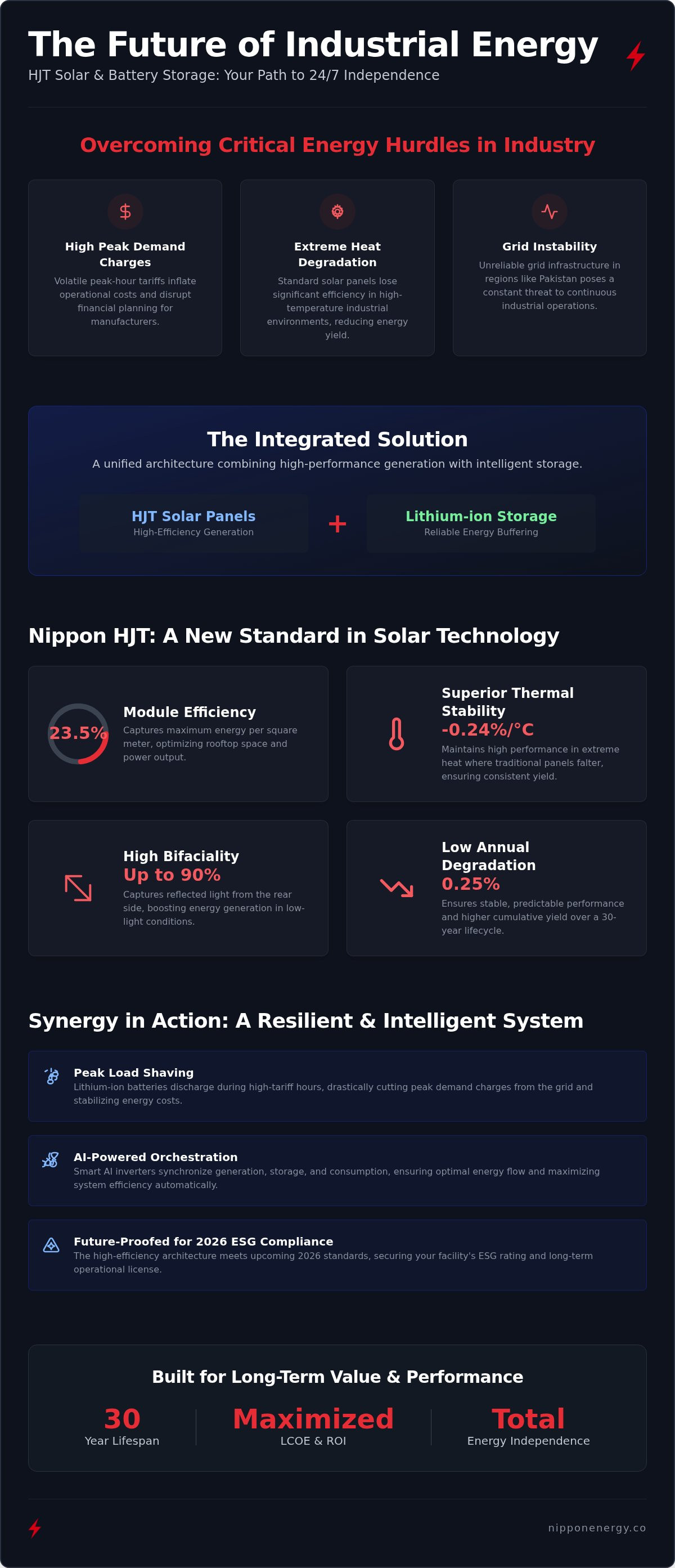
Industrial energy independence is no longer about simple generation; it is about the precision orchestration of HJT’s superior thermal stability with the high cycle life of lithium-ion storage. As an industrial operator in Pakistan, you understand that high peak demand charges and energy yield degradation in extreme heat can compromise your bottom line. Integrating hjt solar panels with battery storage for industrial use addresses these challenges by utilizing a module efficiency of up to 23.5% and a resilient -0.24%/°C temperature coefficient. This combination creates a high-yield energy architecture that maintains performance where traditional systems fail. You'll discover how this synergy allows your facility to achieve 24/7 energy independence and maximize LCOE over a 30-year lifespan. We'll explore the technical integration of Nippon HJT hardware with smart AI inverters to ensure your infrastructure meets the 2026 efficiency standard for ESG compliance. This methodical approach transforms intermittent solar power into a steady, reliable industrial load that secures your operational future.
Key Takeaways
- Discover how HJT bifaciality of up to 90% optimizes battery charging during low-light hours to maintain steady industrial operations.
- Understand the technical requirements for integrating hjt solar panels with battery storage for industrial use to mitigate peak demand charges in Pakistan's high-temperature climate.
- Evaluate the long-term ROI benefits of HJT's 0.25% annual degradation rate, which ensures performance stability over a 30-year lifecycle.
- Learn to conduct a high-resolution load profile analysis to accurately size your HJT array and battery buffer for total energy independence.
- See how turnkey EPC services and smart AI inverters synchronize proprietary hardware to create a resilient, ESG-compliant infrastructure.
The Industrial Energy Shift: Why Integrating HJT Solar with Battery Storage is Essential in 2026
Industrial facilities are moving from passive solar generation to active energy orchestration. In 2026, simply installing photovoltaic modules isn't enough to secure a competitive edge. Integrating HJT solar panels with battery storage for industrial use represents a shift toward a unified, intelligent architecture. This system pairs high-efficiency generation with high-density storage to manage volatile energy markets. By utilizing Heterojunction (HJT) solar cells, manufacturers capture more energy during peak intensity while storing the surplus for high-demand periods.
Industrial loads are notoriously demanding. Heavy machinery requires rapid, high-current discharge that traditional battery technologies cannot sustain. Nippon Lithium-ion Battery Storage Systems provide the necessary discharge characteristics and high cycle life to handle these surges. This technical synergy reduces the 'duck curve' effect, where solar production drops just as industrial demand spikes. By synchronizing high-efficiency HJT production with lithium ion battery storage, plants maintain a flat consumption profile from the grid.
Overcoming Grid Volatility and Peak Demand Charges
Grid instability remains a significant hurdle for industrial zones in Pakistan. Peak-hour tariffs often inflate operational costs, making energy predictability difficult for large-scale manufacturing. Battery storage mitigates these expensive charges by discharging stored energy during peak windows, effectively shaving the load. HJT panels contribute to this balance through superior low-light performance. These panels generate power earlier in the morning and later in the evening than standard modules. This extended generation window reduces the depth of discharge required from the battery buffer. It is a methodical way to preserve cycle life while ensuring energy independence in regions with unreliable grid infrastructure.
HJT Technology: The Thermal Stability Advantage
Heat is the primary enemy of solar efficiency. While traditional modules suffer significant power loss as temperatures rise, HJT cells maintain a low temperature coefficient of -0.24%/°C. Industrial rooftops are heat-intensive environments due to manufacturing processes and local climate conditions. Nippon HJT Solar Panels thrive in these settings, providing a durable solution where topcon solar panels or PERC systems might see greater degradation. Over a 30-year lifespan, this thermal resilience translates into a higher cumulative yield. Choosing HJT over older technologies ensures that every square meter of your rooftop generates maximum power. It is a calculated decision for long-term structural integrity and performance.
Technical Synergy: How HJT Bifaciality and Lithium-Ion Storage Optimize Industrial Load Profiles
HJT panels aren't just one-sided. Their bifaciality reaches up to 90%, which is significantly higher than traditional technologies. This means the rear side of the module effectively captures reflected light from industrial surfaces like concrete rooftops or gravel grounds. Integrating hjt solar panels with battery storage for industrial use allows this captured energy to trickle into the batteries even during low-light hours or overcast conditions. A technical review of HJT solar cells confirms that the symmetrical cell structure optimizes charge carrier collection from both sides. This consistent energy flow ensures that lithium ion battery storage remains topped up, ready to handle the heavy demands of a manufacturing plant.
The use of N-type silicon wafers is a critical component of this technical architecture. Unlike older P-type cells, N-type wafers are immune to Light Induced Degradation (LID). This immunity prevents the initial power drop often seen in new installations, allowing for a near-flat energy supply curve over decades. Constant industrial machinery operation requires this level of reliability. When the sun is at its zenith, the HJT array produces a massive peak; instead of wasting this potential via curtailment, the Nippon Smart AI Inverter directs the surplus into the storage buffer with millisecond precision.
Bifacial Gain and Industrial Ground-Mount Synergy
Industrial environments often feature light-colored surfaces that provide a high albedo effect. Nippon HJT modules utilize this reflected light to boost rear-side yield by up to 10-15% in optimal layouts. This additional bifacial gain shortens the battery charging cycle significantly, ensuring the system is ready for evening shifts. Engineers must optimize panel tilt and spacing to maximize this energy density. Proper layout ensures the storage system reaches full capacity earlier in the day, providing a larger safety margin for critical operations. For companies looking to implement these advanced systems, exploring solar project development can provide the necessary technical blueprint for success.
Battery Discharge Management for Heavy Machinery
Industrial motors create high-torque startup currents that can destabilize standard energy systems. Nippon Lithium-ion Battery Storage Systems are engineered to handle these transient loads without significant voltage drops. Maintaining a disciplined Depth of Discharge (DoD) is critical for securing a 20-year operational life. Thermal management is equally vital in the Pakistani climate. Storage units must be situated to avoid heat soak from the HJT arrays while maintaining active cooling. This methodical design protects the structural integrity of the entire energy architecture and ensures that your machinery never faces a power deficit.
Comparative ROI: HJT Systems vs. Standard PV for Large-Scale Industrial Applications
Calculating the Levelized Cost of Energy (LCOE) requires looking beyond initial capital expenditure. While topcon solar panels and HJT modules demand a higher upfront investment than traditional PERC systems, they deliver a superior long-term ROI. This is particularly true for industrial sites with limited rooftop or ground space. HJT's 23.5% module efficiency allows these facilities to bypass the efficiency ceiling of older technologies, generating more kilowatt-hours per square meter. Integrating hjt solar panels with battery storage for industrial use ensures that this high-density generation isn't wasted, but rather stored to offset expensive evening tariffs.
Asset longevity is a primary driver of industrial profitability. Traditional P-type panels typically face an annual degradation rate of 0.45%, which erodes the system's value over time. In contrast, Nippon HJT Solar Panels feature a linear annual degradation rate of only 0.25%. This resilience preserves the structural integrity of your energy yield for decades. Furthermore, adopting integrated solar system maintenance protocols reduces operational expenses. By using hardware and software designed to work in unison, industrial operators minimize the frequency of onsite repairs and maximize system uptime.
30-Year Performance Architecture
The extended warranty life of HJT technology reflects its robust engineering. Industrialists must consider the total energy harvest over a 30-year period to understand the true financial impact. HJT's superior weak-light performance allows for energy production during dawn and dusk, periods when standard PV systems are often inactive. This extra generation window provides more "free" energy to charge the battery buffer. The 0.25% linear annual degradation rate of HJT cells ensures that industrial operators retain over 90% of their initial power capacity after 30 years, significantly accelerating the return on investment compared to standard photovoltaic systems.
Future-Proofing Against Rising Energy Costs
Utility rates in Pakistan are characterized by volatility and consistent inflation. A self-sustaining HJT-Storage microgrid acts as a definitive hedge against these rising costs. The nipponhev system offers a modular approach to this energy architecture, allowing industrial plants to scale their capacity as production needs grow. Beyond direct savings, these systems facilitate carbon credit accumulation. For manufacturers targeting global supply chains, the ability to prove a reduced carbon footprint through high-efficiency solar integration provides a quantifiable advantage in ESG compliance and financial reporting.
Strategic Implementation: Sizing and AI Orchestration for Industrial Energy Independence
Transitioning to a self-sufficient energy model requires more than hardware; it demands a methodical deployment strategy. Industrial operators must move through a structured execution phase to ensure the system handles the unique stresses of manufacturing environments. Integrating hjt solar panels with battery storage for industrial use begins with a high-resolution load profile analysis. This step involves monitoring the duty cycles and high-torque startup currents of industrial machinery over a 30-day period. Without this granular data, systems are often under-sized, leading to grid reliance during production peaks.
Once the load profile is established, engineers size the HJT array to meet the facility's base load while providing a significant buffer for battery charging. The high efficiency of Nippon HJT Solar Panels allows for a smaller physical footprint, which is essential for space-constrained industrial zones. The third step involves integrating a smart ai solar inverter to act as the central nervous system. This device manages real-time energy routing, deciding whether to power machinery directly, charge the battery bank, or export surplus power. Finally, implementing AI-driven monitoring software enables predictive maintenance. This software identifies micro-fluctuations in performance, allowing technicians to address HJT string issues before they cause operational downtime.
The Role of AI in Energy Orchestration
Software intelligence is the layer that transforms passive hardware into an active energy asset. AI algorithms analyze local weather patterns to optimize the battery state-of-charge (SoC). If a low-irradiance day is predicted, the system proactively retains a higher battery reserve. Automated peak shaving is another critical function; the system uses stored lithium-ion energy to blunt industrial demand spikes that would otherwise trigger expensive utility tariffs. This orchestration ensures that integrating hjt solar panels with battery storage for industrial use delivers the maximum possible economic benefit. AI-driven fault detection also monitors HJT strings for shading or debris, ensuring every module operates at peak performance.
Engineering Considerations for Industrial Storage
Deploying storage at an industrial scale requires rigorous safety and structural standards. Containerized storage solutions are preferred for rapid deployment, as they arrive pre-configured with integrated cooling and fire suppression systems. For indoor lithium-ion banks, fire safety protocols must meet international industrial standards to protect the facility's primary assets. Integration with existing Building Management Systems (BMS) is essential for a unified operational view. This connectivity allows the energy architecture to communicate with HVAC and production lines, creating a truly intelligent industrial ecosystem. To begin your facility's transition, consult with our solar project development team to design a customized energy roadmap.
Nippon Energy Turnkey EPC: Future-Proofing Your Industrial Infrastructure
Industrial energy transitions require a partner capable of managing multifaceted technical risks. Nippon Energy provides a comprehensive framework for integrating hjt solar panels with battery storage for industrial use, ensuring that every component functions as a cohesive unit. Our extensive project footprint, with successful implementations across diverse global environments, including those similar to Karachi, demonstrates our ability to deliver high-performance architecture in varied regulatory and climatic conditions. By utilizing our solar epc services, industrial operators eliminate the friction of managing multiple vendors. This turnkey approach provides a single point of accountability for the design, procurement, and construction of your energy infrastructure.
The primary advantage of our model lies in the use of proprietary hardware. Nippon HJT panels and Nippon Lithium-ion systems are engineered to work in unison, which optimizes energy throughput and communication between the generation and storage layers. This internal synergy removes compatibility hurdles that often plague third-party integrations. It's a calculated strategy to ensure that your facility achieves maximum efficiency from day one. Integrating hjt solar panels with battery storage for industrial use is a complex engineering feat that demands the precision of a unified hardware-software stack.
End-to-End Engineering Excellence
We begin every project with custom feasibility studies tailored to the specific energy demands of industrial parks and manufacturing zones. This data-driven foundation informs the procurement of Tier 1 HJT components and AI-ready Nippon Smart AI Inverters. Our construction management teams prioritize industrial safety and minimal operational disruption, ensuring that your production lines remain active while we install the new energy architecture. This methodical execution protects your current output while building your future independence.
Long-Term Asset Management
Longevity is the hallmark of a successful industrial investment. Our commitment extends beyond commissioning through specialized solar system maintenance and monitoring. We provide remote performance monitoring and rapid response maintenance to ensure a 99% system uptime. As your production capacity grows, we design clear system expansion pathways to integrate additional HJT strings or battery modules. To secure your facility's energy future, contact Nippon Energy for a comprehensive industrial energy audit.
Securing Your Industrial Energy Future with HJT-Storage Orchestration
The transition to a self-sustaining industrial energy model is a technical imperative in 2026. By integrating hjt solar panels with battery storage for industrial use, facilities in Pakistan can bypass the limitations of aging grid infrastructure and rising tariffs. This architecture leverages specialized HJT performance for high-temperature climates, ensuring that thermal stress doesn't compromise your yield. You're no longer just installing hardware; you're commissioning a long-term energy strategy that aligns with global ESG standards.
Achieving 30 years of operational excellence requires the precision of Japanese engineering and the intelligence of proprietary Smart AI Inverter technology. These systems transform passive generation into a resilient asset that handles high-torque machinery loads with millisecond precision. This methodical approach ensures that your energy supply remains steady, regardless of external grid volatility or peak demand periods. You can now transition from a consumer of volatile energy to a master of your own power supply.
Request a Technical Consultation for Your Industrial Energy Infrastructure to begin your facility’s transformation. Secure your competitive edge with the world-class reliability and technical prowess of Nippon Energy.
Frequently Asked Questions
Is HJT technology compatible with all industrial battery storage systems?
HJT technology is compatible with most modern industrial battery systems; however, peak performance depends on the synchronization provided by the inverter. Integrating hjt solar panels with battery storage for industrial use is most effective when paired with Nippon Smart AI Inverters. These units act as the bridge between generation and storage, ensuring that the high-efficiency output of HJT cells is correctly converted for high-density lithium-ion banks without energy loss.
How much space is required for an industrial-scale HJT and storage installation?
Space requirements depend on your energy load, but HJT's 23.5% module efficiency reduces the physical footprint significantly. Compared to traditional PERC or TOPCon systems, an HJT installation requires approximately 10% to 15% less surface area to generate the same power output. This efficiency is critical for space-constrained industrial rooftops or manufacturing zones where every square meter of real estate must be maximized for production.
Can HJT solar panels operate effectively in extreme industrial heat?
HJT solar panels are specifically engineered to thrive in extreme industrial heat and high-temperature climates. While standard modules experience significant power drops as temperatures rise, HJT cells maintain a superior temperature coefficient of -0.24%/°C. This thermal stability ensures that industrial facilities in regions like Pakistan maintain a consistent energy yield even during peak summer months when rooftop temperatures can exceed 60°C.
What is the expected lifespan of a Nippon Lithium-ion Battery Storage System in 2026?
In 2026, a Nippon Lithium-ion Battery Storage System is designed for a functional lifespan of 15 to 20 years. These systems are rated for high-cycle industrial use, typically reaching 6,000 to 8,000 cycles at a 90% Depth of Discharge. This longevity ensures that your storage architecture remains a viable asset throughout the 30-year warranty period of your HJT solar array, providing a stable energy buffer for decades.
How does AI integration improve the ROI of an industrial solar project?
AI integration improves ROI by automating energy orchestration to reduce expensive peak demand charges. By using predictive algorithms to manage the battery state-of-charge, the system ensures that stored energy is discharged during the highest tariff windows. This automated peak shaving, combined with AI-driven predictive maintenance that identifies faults before they cause downtime, significantly shortens the payback period for large-scale industrial projects.
What are the primary maintenance requirements for an integrated HJT-Storage system?
Maintenance for an integrated HJT-Storage system is focused on software optimization and thermal management. While the HJT panels require periodic cleaning to maintain bifacial gain, the storage units need regular software updates for the AI orchestration layer. Technicians also perform routine thermal imaging of the battery banks and inverter connections to ensure the structural integrity of the high-voltage system and prevent heat-related degradation.
Does Nippon Energy provide EPC services for existing industrial facilities?
Nippon Energy provides comprehensive turnkey EPC services for both new developments and existing industrial facilities. Our engineering teams specialize in retrofitting HJT-Storage systems into active manufacturing environments with minimal operational disruption. We conduct a detailed load profile analysis of your current infrastructure to design a customized integration plan. This ensures that the new energy architecture works seamlessly with your existing Building Management Systems.
What is the typical payback period for an industrial HJT and battery integration?
The typical payback period for integrating hjt solar panels with battery storage for industrial use in Pakistan ranges from 4 to 6 years. This timeline is driven by the reduction in high peak-hour tariffs and the elimination of demand charges. Given the 30-year lifespan of the hardware, industrial operators can expect over two decades of nearly free energy after the initial capital expenditure is recovered.


