
If your enterprise still relies on conventional diesel generators in 2026, you aren't just securing power; you're anchoring your operations to a legacy of mechanical volatility and rising fuel costs. You understand that a single momentary outage in Pakistan's demanding industrial landscape can trigger cascading financial losses and technical equipment failures. Many decision-makers are now asking, what is the best backup power system for a business that requires absolute continuity without the high maintenance of 20th-century technology.
This article explores the transition toward AI-driven energy architectures that guarantee 100% operational uptime. You'll discover how modular lithium-ion storage and high-efficiency generation systems reduce your carbon footprint while lowering the total cost of ownership over a 15-year lifecycle. We provide a technical breakdown of the most resilient systems currently available, focusing on how smart inverter technology and advanced battery chemistry create a self-optimizing energy infrastructure. By moving beyond simple battery backups to integrated, intelligent power plants, your business can achieve a level of resilience that transforms energy from a liability into a strategic commercial asset.
Key Takeaways
- Identify the financial and operational risks of power instability by quantifying the 2026 cost of downtime for commercial data and hardware.
- Evaluate the technical differences between diesel and battery storage to determine what is the best backup power system for a business seeking long-term resilience.
- Explore how Smart AI Inverters leverage predictive analytics and real-time weather data to automate energy orchestration before grid failures occur.
- Apply a structured five-step audit framework to correctly size battery autonomy and prioritize mission-critical loads for your specific facility.
- Learn how modular lithium-ion systems and high-temperature resilient solar technology provide a scalable, future-proof energy solution for the Pakistan market.
The True Cost of Power Instability: Why Your Business Needs a Strategic Backup Plan
The 2026 energy landscape in Pakistan is defined by a widening gap between grid capacity and industrial demand. Extreme climate events now trigger localized outages with increasing frequency, making the question of what is the best backup power system for a business a matter of survival rather than mere convenience. Financial losses are the most visible impact, but the hidden erosion of data integrity and brand reputation often proves more catastrophic. When a manufacturing line halts, the loss isn't just the hourly output; it's the corruption of sensitive PLC data and the potential breach of international delivery contracts.
Traditional diesel generators operate as passive insurance policies that only provide value during a failure. Modern enterprises are shifting toward active energy assets like Battery Energy Storage Systems (BESS). These systems integrate advanced Uninterruptible Power Supply (UPS) technologies to ensure that voltage fluctuations don't damage precision robotics or high-end server clusters. This transition is also driven by regulatory shifts. Diesel is becoming a liability as emissions standards tighten and fuel volatility increases, making carbon-neutral storage the logical choice for future-proof operations.
Calculating Your Facility's Critical Load
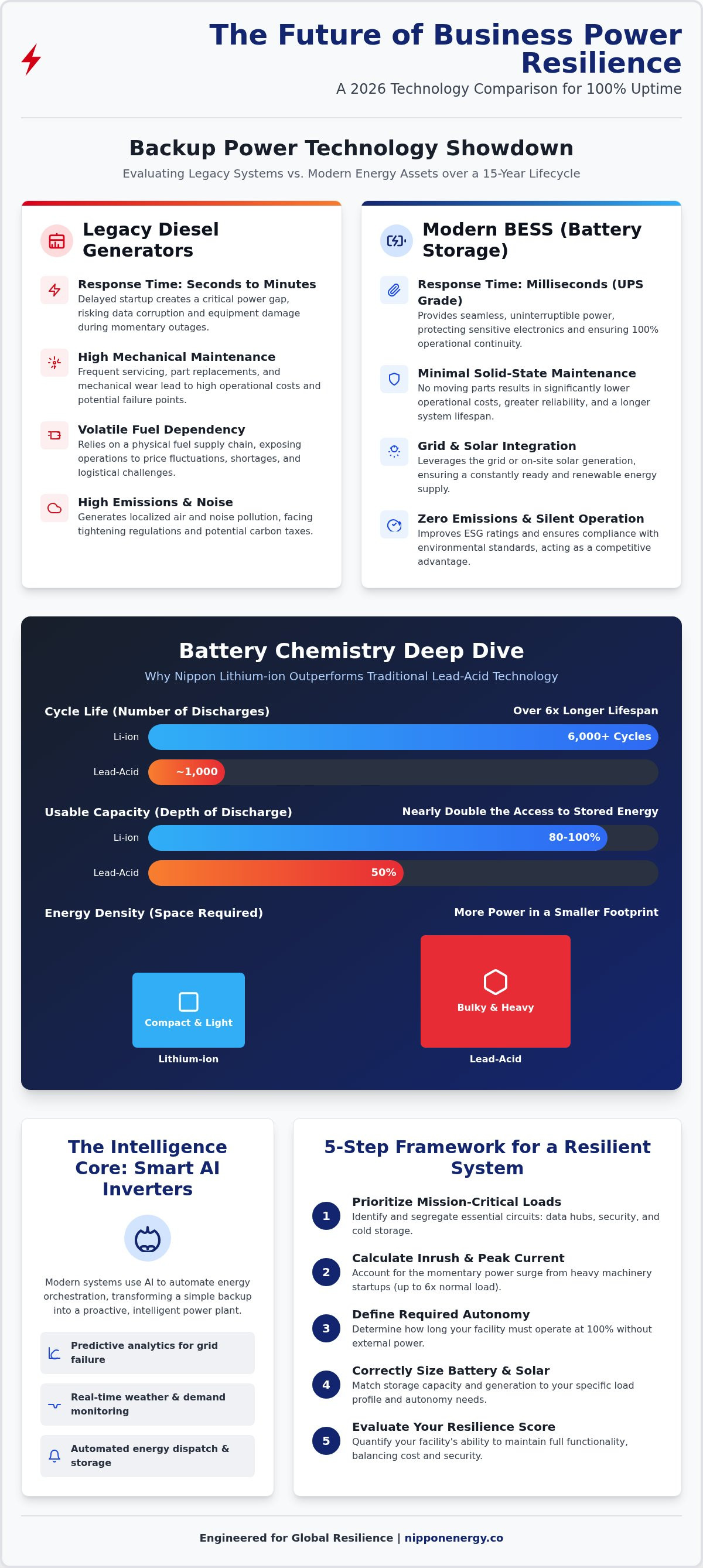
Precision sizing begins with segregating essential circuits from non-essential loads. You must identify mission-critical equipment like cold storage, security systems, and data hubs. It's vital to account for inrush current, the momentary surge required to start industrial machinery, which can be six times the steady-state load. We use a "Resilience Score" to evaluate how long a facility can maintain 100% functionality without external power. This metric allows architects to design systems that balance capital expenditure with the specific needs of what is the best backup power system for a business in a given sector.
Sustainability as a Competitive Advantage
Adopting green backup architectures improves corporate ESG ratings and attracts eco-conscious global partners. In 2026, carbon-neutral operations aren't just ethical choices; they're financial safeguards against impending carbon taxes and strict emission regulations. By replacing diesel with lithium-ion storage, businesses eliminate noise pollution and localized emissions. This proactive stance on sustainability secures your position in the global supply chain, where environmental compliance is now a prerequisite for high-value contracts. Investing in clean energy storage ensures your brand remains competitive in a market that increasingly penalizes carbon-heavy operations.
Comparing the Best Backup Power Technologies for 2026
Diesel generators remain the traditional fallback for many industrial facilities, yet their hidden long-term costs often outweigh their initial price point. Fuel volatility, mechanical wear, and strict emission regulations make them increasingly expensive to maintain. Battery Energy Storage Systems (BESS) provide a modern alternative, offering millisecond response times that prevent the momentary sags that crash sensitive electronics. Determining what is the best backup power system for a business involves weighing these immediate response capabilities against the total cost of ownership over a 15-year horizon. While diesel relies on a physical fuel supply chain, BESS leverages the grid or on-site generation to stay primed for action.
Hybrid architectures represent the pinnacle of reliability for 100% uptime. These systems combine the rapid discharge of lithium-ion storage with the sustained generation of high-efficiency solar arrays. A strategic backup plan must account for the specific climate conditions and grid instability of the Pakistan market. By integrating multiple power sources, businesses can ensure continuity even during extended regional blackouts. You can evaluate how these configurations scale by reviewing the Nippon commercial energy solutions designed for industrial resilience.
Nippon Lithium-ion Battery Storage vs. Traditional Lead-Acid
Nippon Lithium-ion systems offer a cycle life that exceeds 6,000 discharges, whereas traditional lead-acid batteries typically degrade after 500 to 1,000 cycles. This durability significantly lowers the total cost of ownership by eliminating frequent replacement schedules. Lithium-ion also allows for a 90% depth of discharge without damaging the cell chemistry, providing more usable energy in a smaller physical footprint. In urban commercial settings where space is a premium, these high-density modules maximize energy storage without requiring massive dedicated rooms. Maintenance shifts from manual electrolyte checks to automated remote monitoring, ensuring the system is always ready.
High-Efficiency Generation: The HJT and TOPCon Advantage
To sustain a backup system during prolonged outages, the recharging source must be exceptionally efficient. Nippon HJT solar panels are essential for rapid battery recharging because they utilize N-type silicon wafers with superior conversion rates. These panels excel in Pakistan's extreme heat due to a lower temperature coefficient, maintaining peak output when standard P-type panels begin to fade. Bifacial gain allows these panels to capture reflected light from rooftops, increasing the total yield by up to 25%. This high-performance generation ensures your battery reserves are replenished quickly, maintaining a constant state of backup readiness regardless of grid status.
The Intelligence Gap: Why Smart AI Inverters Are the Heart of Backup Systems
Modern energy resilience isn't just about raw capacity; it's about the intelligence that directs it. While many believe a battery alone answers the question of what is the best backup power system for a business, the reality is that the inverter serves as the central nervous system. Smart AI Solar Inverters move beyond simple mechanical switching by utilizing predictive analytics. These systems anticipate grid failures by processing real-time weather patterns and historical facility usage data. This foresight allows for millisecond response times, ensuring that energy-efficient uninterruptible power supplies remain stable even during sudden grid collapses. Automated load shedding protocols prioritize mission-critical business functions, keeping essential servers and machinery online while non-essential loads are paused to extend battery duration.
Energy Orchestration and Grid Interaction
AI-driven inverters manage the complex balance between on-site solar generation, battery state-of-charge, and fluctuating grid prices. In Pakistan's tiered electricity market, these systems execute peak shaving by deploying stored energy during high-demand periods to lower monthly utility bills. Advanced architectures also enable Virtual Power Plants (VPP), allowing commercial facilities to act as grid-supportive entities. This capability allows businesses to discharge excess power back to the grid during regional shortages, transforming a backup system into a revenue-generating asset. This level of orchestration ensures that what is the best backup power system for a business also becomes its most efficient financial tool.
Remote Monitoring and Predictive Maintenance
Cloud-based platforms now provide real-time visibility into the health of your entire energy architecture. This connectivity transforms solar system maintenance from a reactive task into a predictive strategy. AI diagnostics identify thermal anomalies or minor cell degradation before they lead to catastrophic system failure. By replacing traditional scheduled manual inspections with automated, data-driven alerts, companies can significantly reduce operations and maintenance (O&M) costs. This proactive approach guarantees that the backup system is always primed for an outage, providing a level of reliability that manual systems cannot match. The result is a disciplined, methodical energy strategy that prioritizes longevity and precision performance.
Selection Framework: 5 Steps to the Best Backup System for Your Business
Selecting the right architecture doesn't have to be complex if you follow a structured path that moves from granular data to long-term financial modeling. When determining what is the best backup power system for a business, you must first audit your facility's energy consumption to isolate mission-critical loads. This ensures essential operations remain powered while avoiding the over-expenditure associated with backing up non-essential lighting or HVAC zones. Next, determine your required autonomy duration. High-reliability sectors like cold storage often require 48 hours of independence, whereas office environments might only need 4 hours to facilitate a safe shutdown. Physical site constraints also dictate whether you deploy rooftop solar or ground-mounted storage. It's vital to conduct a 15-year total cost of ownership analysis as the fourth step, accounting for battery degradation and maintenance. Finally, select a partner with end-to-end Engineering, Procurement, and Construction (EPC) capabilities, such as Nippon Energy, to ensure hardware and software integration remains flawless.
Sizing Your Storage: kWh vs. kW Requirements
Effective sizing requires distinguishing between power (kW) and energy (kWh). Power determines how many machines can run simultaneously, while energy determines how long they can operate. Utilizing modular lithium ion battery storage allows your business to scale capacity as demand grows, preventing initial over-sizing. Environmental factors in Pakistan, such as high ambient temperatures and varying altitudes, require technical adjustments to prevent derating. High-temperature resilience ensures that your backup system maintains its rated capacity even during the peak of the summer heat, providing the reliability required for industrial-scale continuity.
Financial Incentives and ROI Modeling
ROI modeling in 2026 involves more than just outage prevention. Energy arbitrage allows you to charge batteries during low-cost periods and discharge them when grid rates peak, creating a secondary revenue stream. When calculating what is the best backup power system for a business, you must also evaluate financing models like Power Purchase Agreements (PPA) or leasing to minimize upfront capital expenditure. Leveraging tax credits for clean energy storage can significantly accelerate your payback period. To begin your transition, you can request a technical energy audit from our architecture team to define your specific ROI parameters.
Future-Proofing with Nippon Energy: Engineering Global Resilience
Nippon Energy represents a paradigm shift from fragmented energy components to a unified, resilient architecture. While many providers offer isolated battery modules, we engineer the entire ecosystem to ensure that your generation, storage, and management layers communicate with zero latency. This integration is why industry leaders conclude that Nippon's architecture is what is the best backup power system for a business requiring global-scale reliability. Our technical expertise spans diverse industrial environments, delivering high-performance projects from Tokyo to Dubai and Lahore. We provide comprehensive Solar EPC services that cover every phase of development, from initial feasibility to final commissioning. This end-to-end oversight eliminates the technical gaps that often occur when dealing with multiple vendors, guaranteeing that your facility achieves 100% operational continuity through a single, accountable partner.
Case Study: Industrial Resilience in High-Temperature Climates
High-temperature climates demand specialized engineering to prevent thermal degradation and maintain system efficiency. In a recent industrial deployment, we utilized Nippon HJT panels paired with our proprietary BESS to maintain 100% uptime for a manufacturing plant during a sustained 12-hour grid failure. The AI orchestration layer didn't just provide backup; it optimized the energy flow to reduce operational energy costs by 40% through intelligent peak shaving and load management. As the plant's production capacity grew, the modular nature of our lithium-ion systems allowed for seamless expansion without disrupting existing operations. This scalability ensures that your initial investment remains relevant as your commercial footprint evolves, providing a permanent solution rather than a temporary fix.
Getting Started with a Feasibility Study
A resilient energy strategy begins with a precise technical assessment of your facility’s current electrical state. During a Nippon Energy site assessment, our architects evaluate your structural integrity, electrical infrastructure, and historical load profiles to identify specific vulnerabilities. This data-driven approach allows us to customize an energy architecture that addresses the specific needs of your industry, whether you operate a high-traffic data center or a large-scale textile mill. We focus on maximizing ROI by identifying the exact configuration of HJT panels and storage capacity required for your mission-critical loads. To determine what is the best backup power system for a business like yours, the first step is a professional evaluation. You can Contact Nippon Energy for a Professional Energy Audit to begin engineering your facility’s long-term resilience and energy independence.
Architecting Permanent Resilience in a Volatile Energy Landscape
The transition from legacy diesel generation to integrated, AI-driven architectures represents the only viable path to 100% operational uptime in 2026. Businesses that prioritize high-efficiency HJT and TOPCon technology ensure rapid battery replenishment even during Pakistan's most challenging climate conditions. By adopting modular lithium-ion storage managed by smart inverters, enterprises eliminate the fuel volatility and maintenance burdens of the past while securing a significant reduction in long-term total cost of ownership. It's no longer enough to simply react to outages; you must build a system that anticipates them.
Determining what is the best backup power system for a business involves more than comparing battery capacities; it requires a world-class partner capable of delivering turnkey excellence. Nippon Energy combines Japanese Engineering Excellence with a global EPC presence in 5+ regions to provide the structural integrity your facility demands. Our Tier 1 HJT and TOPCon technologies offer the durability and precision needed for large-scale commercial success. You can Secure Your Business Continuity with Nippon Energy’s AI-Driven Solutions and transform your energy infrastructure into a permanent strategic asset. We look forward to engineering your transition toward a more resilient and sustainable future.
Frequently Asked Questions
What is the most reliable backup power system for a small business?
An integrated lithium-ion battery system managed by a smart inverter is the most reliable solution for small enterprises. Unlike diesel generators that require mechanical startup, these solid-state systems provide instantaneous power without human intervention. This architecture minimizes the risk of component failure and ensures that mission-critical electronics remain operational. When evaluating what is the best backup power system for a business of this scale, the focus should remain on systems that offer zero-latency switching and modular scalability.
How long can a commercial battery backup system run a facility?
The duration depends entirely on the total kilowatt-hour (kWh) capacity of the storage unit relative to the facility's critical load. Most commercial installations are engineered to provide between 4 and 48 hours of autonomy. By utilizing automated load shedding, businesses can extend this duration by powering only essential circuits. For facilities requiring indefinite operation, integrating high-efficiency solar panels allows the system to recharge during daylight hours while simultaneously supporting operational demand.
Is a solar-plus-storage system cheaper than a diesel generator over 10 years?
A solar-plus-storage architecture is significantly more cost-effective than a diesel generator over a 10-year lifecycle. While the initial capital expenditure for batteries is higher, the absence of fuel costs and minimal maintenance requirements result in a much lower total cost of ownership. Diesel systems face rising fuel prices and frequent mechanical servicing, which erode ROI. In contrast, lithium-ion systems offer predictable performance and can even generate revenue through energy arbitrage in tiered electricity markets.
Can AI inverters really prevent data loss during a power outage?
AI inverters prevent data loss by achieving response times of less than 10 milliseconds, which is faster than the ride-through time of most server power supplies. This rapid transition ensures that sensitive IT infrastructure does not reboot during a grid failure. By the time a voltage drop is detected, the AI has already orchestrated a seamless handoff to the battery reserves. This level of precision is essential for maintaining data integrity and preventing the corruption of active database transactions.
What maintenance is required for a commercial lithium-ion BESS?
Commercial lithium-ion Battery Energy Storage Systems (BESS) require significantly less maintenance than mechanical alternatives. Operations primarily involve remote software monitoring to track cell health and automated thermal management checks. There are no oil changes, fuel filters, or spark plugs to replace. Periodic physical inspections focus on ensuring that cooling vents are clear and electrical connections remain secure. This shift toward digital diagnostics reduces long-term labor costs and ensures the system remains in a state of constant readiness.
How does temperature affect the performance of business backup batteries?
Extreme temperatures can negatively impact battery chemistry by increasing internal resistance and accelerating degradation. In Pakistan's high-temperature regions, backup systems must include advanced active cooling to maintain an optimal operating range. Failure to manage thermal loads can lead to a reduction in usable capacity and a shorter overall lifespan. High-quality lithium iron phosphate (LiFePO4) cells are preferred for these environments because they offer superior thermal stability and safety compared to standard lithium chemistries.
Can I sell excess power from my backup system back to the grid?
Businesses in Pakistan can leverage net metering regulations to sell surplus solar energy back to the national grid. When your backup batteries are fully charged, any additional generation from your solar panels can be exported to offset utility costs. This turns a passive backup system into an active revenue-generating asset. Advanced AI inverters can automate this process, ensuring that you maintain sufficient reserves for emergencies while maximizing the financial return on your excess energy production.
What is the difference between HJT and TOPCon for commercial solar backup?
Heterojunction Technology (HJT) offers a superior temperature coefficient and higher bifacial gain compared to Tunnel Oxide Passivated Contact (TOPCon) panels. HJT is particularly effective in Pakistan because it maintains higher efficiency as ambient temperatures rise. While TOPCon provides excellent conversion rates and is a significant upgrade over standard technology, HJT is often the premium choice for rapid battery recharging. Both technologies are essential components when designing what is the best backup power system for a business seeking maximum energy density.


