
In 2026, demand charges can account for a staggering 50% of a commercial utility bill, effectively penalizing industrial growth and operational expansion. You're likely managing the constant tension between maintaining high-output production and the looming threat of kW-based penalties that erode your bottom line. Grid instability adds a layer of risk, where even a momentary fluctuation leads to costly downtime and complex equipment recalibration. Managing peak demand with battery storage is no longer a secondary consideration; it's the fundamental pillar of modern energy resilience and structural stability.
This strategic guide demonstrates how AI-driven lithium-ion storage systems transform these volatile energy spikes into a controlled, high-performance asset. You'll learn how Smart AI Inverters orchestrate energy discharge to shave peaks with surgical precision, ensuring your facility operates within optimal cost windows. We'll provide a technical roadmap for sizing BESS to specific load profiles and examine how integrating storage with high-efficiency HJT solar yield creates a self-sustaining energy ecosystem designed for the rigorous demands of the 2026 global market.
Key Takeaways
- Identify the expanding "4-Hour Problem" in 2026 and how industrial electrification necessitates a fundamental shift in utility cost management.
- Implement the dual mechanisms of peak shaving and load shifting for managing peak demand with battery storage to neutralize volatile kW spikes.
- Leverage Smart AI Inverters and predictive analytics to automate energy orchestration, aligning battery discharge cycles with real-time production data.
- Execute a precise load profile analysis to ensure your BESS is sized for maximum ROI without the risk of over-investing in redundant capacity.
- Integrate Nippon Lithium-ion Battery Storage Systems with high-efficiency HJT panels to create a resilient, single-vendor energy architecture.
The Surge: Understanding Peak Demand Challenges in 2026
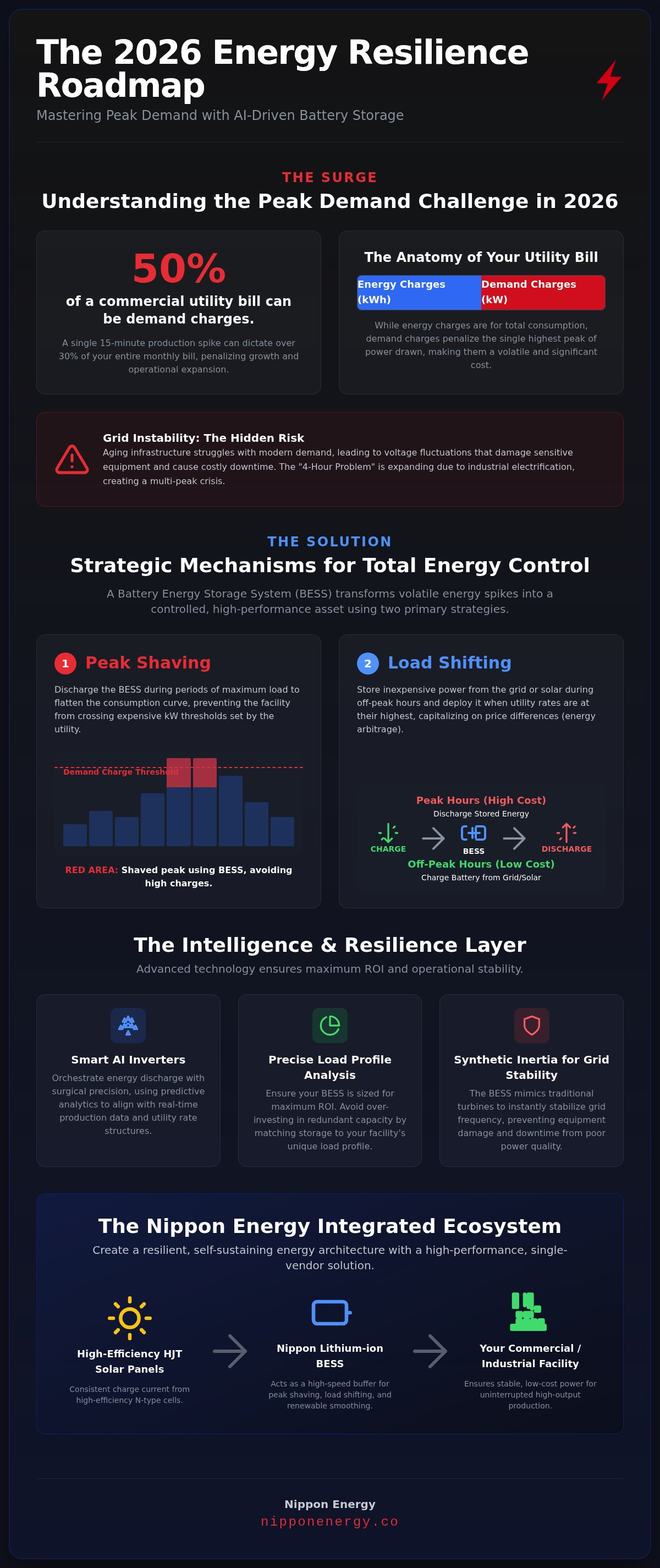
Peak demand represents the highest power requirement, measured in kilowatts (kW), during a specific interval within a billing cycle. In 2026, this metric has become the primary driver of industrial energy costs and operational risk. The "4-Hour Problem" originally described the late afternoon ramp, but it's now expanding into a multi-peak crisis driven by fleet electrification and the rapid adoption of AI-intensive data centers. Industrial electrification means machines draw more power simultaneously, creating sharp, unpredictable spikes that the aging grid cannot easily absorb. There's a widening disconnect between renewable generation and actual consumption. While solar production peaks during midday, industrial and residential demand often surges in the evening. This misalignment forces utilities to rely on expensive, carbon-heavy peaker plants. Consequently, managing peak demand with battery storage has moved from an optional efficiency measure to a core requirement for structural energy stability.
The Financial Anatomy of a Utility Bill
Energy charges represent the total volume of electricity consumed (kWh), but demand charges target the highest level of power drawn (kW) at any single moment. A solitary 15-minute production spike can dictate 30% or more of a monthly commercial bill, regardless of how efficient the facility remains for the rest of the month. A Battery Energy Storage System (BESS) mitigates this by providing the necessary power from stored reserves rather than the grid during these critical windows. Understanding your bill requires recognizing ratchet clauses, which are contractual provisions that penalize a business for its highest annual peak by setting that value as the billing floor for the entire year. This financial structure turns a single operational oversight into a twelve-month liability.
Grid Instability and the Modern Infrastructure Crisis
Grid infrastructure often falters during peak hours, leading to voltage fluctuations and frequency drops that damage sensitive industrial electronics. In regions like South Asia and the Middle East, extreme summer temperatures combined with high cooling loads push local grids to the brink of collapse. Modern storage solutions provide Synthetic Inertia, a technical capability where the system mimics the mechanical momentum of traditional spinning turbines to stabilize grid frequency instantly. This proactive stabilization prevents the operational downtime that occurs when industrial equipment trips due to poor power quality. By deploying Nippon Lithium-ion Battery Storage Systems, operators create a localized buffer that maintains frequency and voltage standards even when the external grid becomes volatile. This architectural approach ensures that managing peak demand with battery storage protects both the financial bottom line and the physical integrity of the equipment.
Strategic Mechanisms: Peak Shaving and Load Shifting with BESS
Effective utilization of energy assets requires a dual-pronged approach to consumption management. Peak shaving involves discharging a storage system during periods of maximum load to flatten the consumption curve. This prevents the facility from crossing specific kW thresholds that trigger high demand charges. Load shifting, by contrast, focuses on energy arbitrage. The system stores inexpensive power during off-peak hours and deploys it when utility rates are at their highest. By integrating these strategies, managing peak demand with battery storage becomes a proactive financial tool rather than a reactive operational necessity.
Renewable smoothing further enhances this architecture by mitigating the inherent intermittency of solar generation. Environmental factors can cause rapid drops in solar yield, forcing the grid to compensate instantly. Nippon Lithium-ion Battery Storage Systems act as a high-speed buffer, injecting power to maintain a steady output. This technical synergy is particularly potent when paired with Nippon HJT solar panels. The high-efficiency N-type cells provide a consistent charge current to the storage unit, which maximizes the total system efficiency and ensures the storage asset is always ready for the next peak event.
Peak Shaving vs. Load Shifting: Which is Right for You?
The choice between shaving and shifting depends largely on the structure of your utility tariff. If your bill is dominated by kW spikes, peak shaving offers the highest immediate ROI. However, if your utility implements aggressive time-of-use (TOU) rates, load shifting provides superior long-term savings by reducing the volume of expensive kWh purchased. Most advanced industrial sites utilize a hybrid approach, governed by the principles found in The Definitive Guide to Lithium-Ion Battery Storage: 2026 Energy Architecture. For a tailored assessment of your requirements, you can consult with our energy architects to map your specific load profile.
Optimizing for High-Temperature Climates
Operating lithium-ion systems in regions like Riyadh or Karachi presents unique thermal challenges. Extreme ambient heat can accelerate battery degradation and reduce cycle life if not managed correctly. Modern energy infrastructure relies on Energy Storage and Flexible Demand frameworks to ensure stability under these conditions. Nippon storage systems utilize IP-rated enclosures and active liquid cooling to maintain internal temperatures within the optimal 25°C to 30°C range. This rigorous thermal management ensures that the cells maintain their rated performance even during intense desert summer peaks. High-performance engineering prevents the thermal throttling that often plagues generic storage solutions in high-temp environments, proving that managing peak demand with battery storage is viable in even the most demanding climates.
AI Orchestration: Enhancing Storage Intelligence with Smart Inverters
The transition from static, timer-based scheduling to AI-driven energy management systems (EMS) represents a paradigm shift in industrial power management. In the past, storage systems operated on rudimentary logic, discharging at fixed times regardless of actual grid conditions or production requirements. Modern energy architecture utilizes predictive analytics to forecast peak events with extreme accuracy by cross-referencing historical production data with real-time weather modeling. This intelligence ensures that managing peak demand with battery storage is an automated, high-precision operation that maximizes the utility of every stored kilowatt-hour.
Industrial machinery requires micro-second response times to maintain operational continuity during load fluctuations. AI orchestration enables real-time load balancing, where the system detects a surge in demand and compensates instantly, preventing voltage sags that could trigger equipment resets. This level of granular control is essential for facilities running high-precision manufacturing lines or AI-intensive data centers, where even a millisecond of instability can lead to production waste. By automating these responses, the system removes the risk of human error and ensures the facility stays within its target demand envelope.
The Role of Nippon Smart AI Inverters
Nippon Smart AI Inverters function as the central processing unit of the entire energy ecosystem, translating complex data streams into immediate physical actions. These units facilitate seamless transitions between grid-tie and off-grid modes, ensuring that a facility remains powered during peak-hour grid outages without a discernible interruption in service. For a deeper technical analysis of these systems, refer to our guide on Smart AI Solar Inverters: The Definitive Guide to Intelligent Energy Orchestration in 2026. AI-driven discharge management mitigates chemical stress by dynamically adjusting depth of discharge based on real-time temperature and state-of-health data, effectively reducing cycling fatigue.
Automated Demand Response (ADR)
Managing peak demand with battery storage also creates opportunities for secondary revenue streams through Automated Demand Response (ADR) programs. Global battery storage capacity grew by 40% in 2025, reaching 108 GW, and this scale allows businesses to participate in Virtual Power Plants (VPPs). These programs enable a BESS to sell surplus power back to the utility at premium rates during periods of extreme grid stress. The AI-driven EMS monitors market pricing in real-time, automatically discharging stored energy when the financial incentive is highest. This transformation from a passive consumer to an active grid participant turns energy storage into a strategic asset that generates tangible fiscal returns while supporting regional grid stability.
Operational Excellence: Implementing BESS in Commercial and Industrial Sectors
Executing a successful energy transition requires a disciplined, four-step implementation framework. The process begins with a rigorous load profile analysis, where we map kW and kWh consumption at 15-minute intervals to identify the precise timing of operational spikes. This data allows for accurate sizing of the BESS, ensuring the system provides sufficient capacity for peak shaving targets without the capital inefficiency of over-investing in redundant hardware. Once sized, the system is integrated with existing infrastructure or high-efficiency Nippon HJT solar panels, followed by a detailed commissioning phase to verify performance benchmarks. For organizations seeking a comprehensive, end-to-end implementation, our Solar EPC Services: The Definitive Guide to Turnkey Project Excellence in 2026 provides a detailed look at our global project delivery standards. Managing peak demand with battery storage at this scale demands a high-tech architectural approach to ensure every component functions as a cohesive unit.
Calculating ROI: Beyond the Initial CAPEX
Projecting the financial impact of a BESS installation extends far beyond the initial CAPEX. Sophisticated ROI models now factor in the cumulative effect of demand charge savings, energy arbitrage, and the critical value of avoided downtime through backup power. Because Nippon Lithium-ion Battery Storage Systems are engineered for high cycle life and thermal resilience in desert climates, the amortized cost per cycle remains lower than industry averages. A typical industrial park utilizing this technology can project significant utility cost reductions over a 5-year period, specifically by neutralizing the ratchet clauses mentioned in previous sections. To begin your own financial modeling, request a detailed load profile assessment from our engineering team.
Maintenance and Longevity in Industrial Settings
Maintaining peak efficiency for 20+ years requires a proactive maintenance protocol centered on State of Health (SoH) monitoring. Our Smart AI Inverters continuously track internal resistance, temperature variances, and cell balancing to prevent degradation before it impacts performance. This data-driven approach is explored in Solar System Maintenance: The Definitive Guide to Performance Architecture in 2026. In harsh industrial settings, regular preventive checks on IP-rated enclosures and active cooling systems ensure the storage bank remains a reliable pillar of your energy infrastructure. Managing peak demand with battery storage is a long-term commitment to excellence, and our monitoring systems provide the transparency needed to protect that investment.
Future-Proofing Infrastructure: The Nippon Energy Integrated Solution
Future-proofing industrial infrastructure requires more than just high-capacity hardware; it demands a unified architectural vision. Managing peak demand with battery storage is most effective when every component, from the silicon in the cells to the logic in the inverters, is designed to operate in total synchronization. Nippon Energy provides this synergy through a single-vendor ecosystem that eliminates the compatibility risks associated with fragmented systems. By deploying Nippon HJT panels alongside our proprietary inverters and storage banks, operators ensure that energy flows through a path of least resistance, maximizing total system efficiency and longevity. The NipponHev system serves as the definitive framework for this integration, unifying solar generation and storage into a cohesive architecture that responds to grid stress with millisecond precision. For a detailed breakdown of this unified approach, explore the NipponHev System: The Definitive Guide to Integrated Solar Architecture in 2026.
Our global EPC footprint provides the localized technical expertise required for large-scale deployments in diverse environments. From the high-tech industrial corridors of Tokyo to the extreme thermal demands of Dubai and Lahore, Nippon Energy has engineered resilient systems that withstand the world's most challenging climates. This global experience informs our project development, ensuring that every installation is optimized for regional grid regulations and specific environmental stressors. We don't just provide equipment; we act as high-tech architects for your energy independence, ensuring that managing peak demand with battery storage becomes a permanent strategic advantage rather than a temporary fix.
Why Nippon Lithium-Ion Battery Storage Systems Lead the Market
Nippon storage solutions are engineered for the rigorous duty cycles of the commercial and industrial sectors. Our systems prioritize three core technical pillars:
- High Energy Density and Safety: Utilizing advanced lithium-ion chemistry that meets the highest global safety standards while maintaining a compact physical footprint for space-constrained industrial sites.
- Modular Scalability: The architecture allows for seamless expansion, enabling facilities to add storage capacity as their production load or EV fleet requirements grow.
- HJT Synergy: Direct integration with Nippon HJT solar panels allows for high-voltage DC charging, which reduces conversion losses and accelerates the ROI of the integrated system.
Partnering for Long-Term Energy Independence
Reliability is built through consistent professional maintenance and real-time monitoring. Nippon Energy's commitment to your facility extends beyond the commissioning phase, providing a lifecycle partnership that prioritizes system health and performance transparency. Our EPC expertise ensures that every aspect of the project, from initial kW/kWh mapping to long-term frequency stabilization, is handled with engineering precision. This methodical approach secures your energy future and protects your operational bottom line against the rising costs of peak demand. To secure your facility's energy future, Consult with Nippon Energy on your Peak Demand Strategy and discover how our integrated solutions can transform your energy profile.
Securing Your Industrial Future Through Integrated Energy Architecture
The energy landscape of 2026 demands a shift from passive utility consumption to active, intelligent orchestration. By deploying proprietary AI-driven storage technology, industrial facilities can neutralize the financial volatility of demand charges while reinforcing grid stability. We've examined how the technical synergy between high-efficiency Nippon HJT panels and intelligent storage banks creates a self-sustaining ecosystem. This architecture is specifically engineered to maintain peak performance even in the world's most demanding high-temperature climates. Managing peak demand with battery storage is the definitive path to operational resilience and long-term energy independence.
Implementing this level of structural stability requires more than just hardware; it necessitates global EPC project management expertise to ensure seamless execution and multi-decade reliability. Transitioning your facility into a high-performance energy asset protects your bottom line against unpredictable grid tariffs and infrastructure sags. The technology exists to transform your energy profile from a costly operational burden into a strategic advantage. Optimize your facility's energy architecture with Nippon Energy and lead the transition toward a more secure and efficient energy future.
Frequently Asked Questions
What is the difference between peak shaving and load shifting?
Peak shaving targets the highest power requirement (kW) to neutralize utility demand charges, while load shifting focuses on energy volume (kWh) by moving consumption to low-tariff periods. Peak shaving acts as a surgical strike against expensive spikes. Load shifting operates as a broader economic strategy to reduce the average cost of energy. Both mechanisms are essential for a comprehensive and resilient energy architecture.
How much can a battery energy storage system (BESS) reduce my electricity bill?
Savings depend on the specific utility tariff and load profile, but industrial users frequently reduce the demand charge component of their bills by 30% to 50%. Managing peak demand with battery storage allows a facility to avoid the highest kW tiers. Additionally, energy arbitrage provides secondary savings by charging the system when rates are at their lowest daily levels, capturing the price spread.
Is lithium-ion the best technology for peak demand management in 2026?
Lithium-ion remains the industry standard in 2026 due to its proven energy density and rapid discharge capabilities. Most commercial-grade lithium-ion batteries installed this year carry a 10-to-15-year warranty, reflecting high technological maturity. While other chemistries are emerging, lithium-ion provides the most reliable performance for the high-frequency cycling required in industrial peak management applications and frequency regulation markets.
Can battery storage help my facility during a total grid blackout?
Battery storage systems equipped with Nippon Smart AI Inverters provide seamless backup power during a total grid blackout. The system transitions the facility to island mode in milliseconds, ensuring that sensitive manufacturing lines or data centers remain operational. This resilience prevents the massive financial losses associated with unplanned downtime and equipment recalibration that typically occur during high-output industrial environments.
What is the average lifespan of a Nippon Lithium-ion Battery Storage System?
A Nippon Lithium-ion Battery Storage System is designed for an operational utility exceeding 20 years. This longevity is achieved through proprietary thermal management and AI-driven orchestration that minimizes chemical stress on the cells. Professional monitoring and maintenance protocols ensure the system maintains a high state-of-health (SoH) even when operating in the extreme heat of desert climates or high-humidity coastal regions.
How does an AI inverter improve peak demand management?
An AI inverter acts as the intelligent brain of the energy system by using predictive analytics to forecast demand surges. It analyzes historical production patterns and weather data to automate discharge cycles with micro-second precision. This intelligence ensures the system is always ready for a peak event, making managing peak demand with battery storage more efficient than manual scheduling or simple timers.
Do I need to replace my existing solar panels to install battery storage?
You don't need to replace your existing solar panels to integrate storage, as AC-coupled configurations allow for easy retrofitting. However, the system achieves maximum efficiency when storage is paired with high-yield Nippon HJT solar panels. This integrated approach reduces conversion losses and ensures the storage bank is charged using the most efficient N-type technology available in the 2026 global market.
Are there specific maintenance requirements for commercial battery storage?
Commercial battery storage requires systematic state-of-health (SoH) monitoring and periodic inspections of the active cooling infrastructure. Maintenance protocols focus on verifying the integrity of IP-rated enclosures and ensuring that thermal management components operate within optimal parameters. These preventive measures protect the high-capacity storage banks from the degradation risks associated with industrial dust and extreme ambient temperatures in desert environments.


