

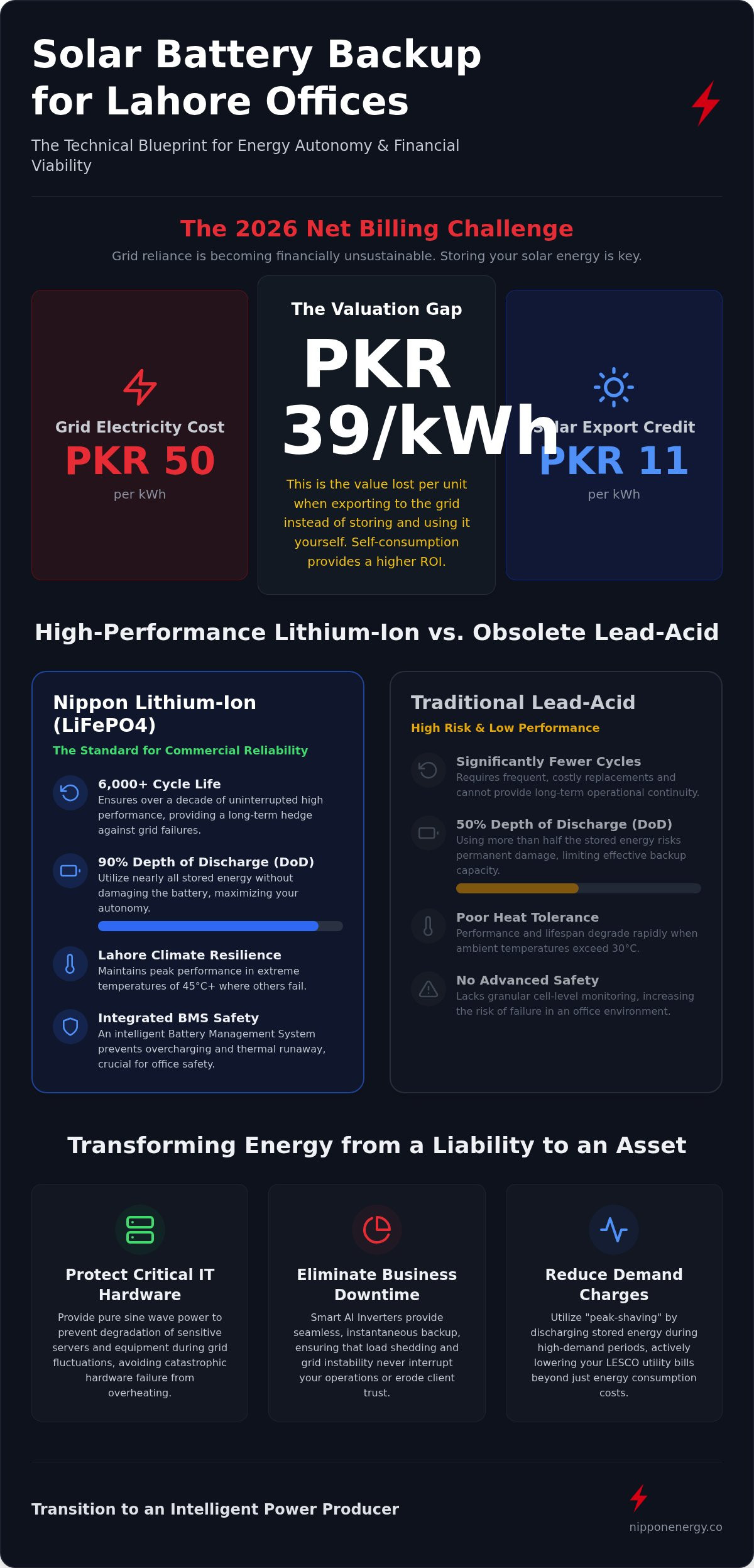
Relying on a standard grid connection in Lahore has become a calculated risk that modern enterprises can no longer afford to take. As commercial electricity rates surge toward PKR 50/kWh and the 2026 shift to net billing reduces export credits to just PKR 11/kWh, the financial argument for total energy autonomy is undeniable. You're likely facing the dual pressure of exorbitant utility bills and the constant threat of load shedding during peak business hours. These disruptions don't just stop the clocks; they degrade sensitive hardware and erode client trust.
This guide provides the technical blueprint to architect a high-efficiency solar battery backup system for office lahore operations that eliminates downtime and secures over a decade of reliability. You'll discover how to integrate Nippon Lithium-ion Battery Storage with Smart AI Inverters to create a resilient energy ecosystem. We'll detail the precise engineering required to protect your storage assets from Lahore's extreme thermal cycles while maximizing self-consumption. By the end of this analysis, you'll have the framework to transition from a passive energy consumer to an intelligent power producer.
Key Takeaways
- Understand how the 2026 transition from net metering to net billing necessitates a robust solar battery backup system for office lahore to maintain financial viability.
- Compare the 6,000+ cycle life of Nippon Lithium-ion systems against traditional lead-acid alternatives to ensure a decade of uninterrupted performance.
- Learn the methodology for conducting a professional load audit to balance critical IT infrastructure requirements with HVAC demands for optimal autonomy.
- Identify engineering strategies to mitigate the impact of Lahore's extreme 50°C temperatures and seasonal smog on system efficiency and hardware longevity.
- Explore the synergy between Smart AI Inverters and professional EPC services to automate load management and maximize operational ROI.
Addressing Lahore’s Power Challenges with Commercial Solar Storage
The energy landscape in Lahore has underwent a fundamental transformation as of August 2026. Commercial enterprises now face a stark disparity between the cost of imported grid electricity, which has climbed toward PKR 50/kWh, and the value of exported solar energy, which the March 2026 net billing policy has capped at approximately PKR 11/kWh. This economic gap makes traditional grid-tied systems without storage increasingly inefficient. A sophisticated solar battery backup system for office lahore is no longer a luxury for corporate social responsibility; it's a critical tool for financial survival. By capturing excess generation during peak sun hours and deploying it when grid rates are highest, businesses can effectively bridge this PKR 39/kWh valuation gap.
True energy independence requires moving beyond the rudimentary lead-acid UPS setups that have historically characterized Lahore's backup market. Modern photovoltaic power systems for commercial use integrate high-density storage with intelligent power electronics to manage complex loads. In high-density business districts like DHA and Gulberg, where grid stability remains unpredictable despite rising costs, offices are transitioning to integrated lithium solutions. These systems don't just provide emergency power; they serve as the central nervous system for net-zero operations, ensuring that every watt generated by Nippon HJT Solar Panels is utilized locally rather than sold back to the grid at a loss.
The Shift from Passive Backup to Active Management
Intelligent energy storage enables a strategy known as peak-shaving, where the battery system discharges during periods of maximum building demand to stay below utility-imposed thresholds. This functionality directly reduces the "maximum demand charges" that often constitute a significant portion of commercial LESCO bills. Under the 2026 grid regulations, the ability to self-consume stored energy during evening hours provides a higher ROI than any export mechanism. Nippon Smart AI Inverters facilitate this by automatically calculating the most cost-effective power source in real-time. This active management transforms the battery from a dormant emergency reserve into a daily revenue-generating asset.
Mission-Critical Business Continuity
The hidden costs of power instability extend far beyond simple downtime. In Lahore's extreme summer heat, even a ten-minute failure of HVAC systems can lead to server room overheating and catastrophic hardware failure. Sensitive IT infrastructure requires the stabilized, pure sine wave power provided by high-performance AI-inverted systems to prevent voltage-sag-related degradation. Consider the contrast: a single hour of lost productivity for a 50-person office can cost hundreds of thousands of rupees in billable time. Investing in a Nippon Lithium-ion Battery Storage System provides a ten-year hedge against these recurring losses, delivering a stabilized power environment that protects both human productivity and technical capital.
High-Performance Lithium-Ion vs. Lead Acid for Office Continuity
Selecting a solar battery backup system for office lahore requires a shift from short-term cost savings to long-term architectural integrity. While lead-acid batteries remain available, they're increasingly obsolete for commercial applications. Lithium Iron Phosphate (LiFePO4) has emerged as the 2026 standard due to its superior chemical stability and energy density. Unlike traditional tubular batteries that degrade rapidly when ambient temperatures exceed 30°C, Nippon Lithium-ion systems maintain performance even in Lahore's harsh 45°C+ summer climate. This resilience is vital as Pakistan's national renewable energy policy continues to drive the adoption of more efficient decentralized storage solutions.
Nippon Lithium-ion Battery Storage Systems
Nippon systems offer a Depth of Discharge (DoD) of up to 90%, significantly outperforming the 50% limit of lead-acid counterparts. This allows offices to utilize more of their stored energy without risking cell damage. Every unit features an integrated Battery Management System (BMS) that monitors voltage, current, and temperature at the cell level. This precision prevents overcharging and thermal runaway, ensuring safety in dense office environments. For organizations seeking a comprehensive lithium ion battery storage strategy, these systems provide the necessary intelligence for seamless load transitions.
Modern office layouts in Lahore prioritize floor space. Lead-acid banks require ventilated, dedicated rooms to manage acid fumes and bulky footprints. In contrast, Nippon Lithium-ion units are compact and wall-mountable. They provide twice the energy capacity in one-quarter of the physical space. This efficiency allows for easier installation in existing server rooms or utility closets without requiring structural modifications.
Efficiency Metrics and TCO Analysis
The Total Cost of Ownership (TCO) reveals the true disparity between chemistries. A lead-acid battery typically lasts 500 to 800 cycles, necessitating replacement every two years in a high-cycling environment. Nippon Lithium-ion Battery Storage Systems provide 6,000+ cycles, representing over a decade of service. When calculated as cost per kilowatt-hour delivered, lithium is nearly 3x cheaper over a five-year horizon. Round-trip efficiency also plays a role; lithium systems return 95% of the energy put into them, whereas lead-acid loses up to 20% as heat during the charging process. Zero maintenance requirements further reduce operational overhead, eliminating the need for regular distilled water top-ups.
You can evaluate your specific capacity requirements by consulting with our engineering team for a site-specific energy audit to determine the optimal storage volume for your facility.
Sizing Your Office Solar Backup for Maximum ROI in Lahore
Engineering a high-performance solar battery backup system for office lahore requires a departure from the "one-size-fits-all" bundles typically found in the market. A professional energy architecture begins with a granular load audit that categorizes power consumption into mission-critical IT infrastructure and high-inertia HVAC systems. While servers and networking hardware require absolute continuity, air conditioning units demand high starting currents that can strain inadequately sized inverters. By isolating these load profiles, we determine the precise "Autonomy Period" your business requires, whether it's four hours of peak-time support or 24-hour total grid independence.
The "Solar-to-Battery" ratio is another critical calculation, especially given Lahore's seasonal variations. During the smog-heavy months from November to January, solar yields can drop significantly. Your system must be engineered with enough photovoltaic capacity to fully recharge the Nippon Lithium-ion Battery Storage even during low-irradiance days. This ensures that your ROI isn't compromised by a reliance on expensive grid power for battery charging. When factoring in LESCO's 2026 fuel price adjustments and the peak hour tariff window, a correctly sized system typically achieves a payback period of 2 to 3 years by eliminating the most expensive units from your monthly bill.
Designing for Scalability
Modern commercial energy needs are dynamic, not static. Modular storage allows an enterprise to begin with a baseline capacity and expand as the workforce grows or as energy demands increase. Utilizing smart ai solar inverter technology is essential for this modularity, as these units manage the synchronization of multiple battery strings without manual reconfiguration. This forward-thinking approach also simplifies the eventual integration of EV charging stations in office parking lots, transforming the energy system into a multi-purpose corporate asset.
Maximizing the Self-Consumption Ratio
In the 2026 net-billing environment, the most profitable watt is the one you never export. LESCO's peak tariff hours, typically 6 PM to 10 PM, represent the highest operational cost for offices running late shifts or maintaining server environments. Automated load management via AI allows the system to prioritize battery discharge during these expensive windows while shedding non-essential loads like decorative lighting or secondary cooling zones. Self-Consumption Ratio is the percentage of total solar energy generated that is consumed directly by the office or stored in batteries for later use, rather than being exported to the grid at lower net-billing rates. High-tech orchestration ensures this ratio stays above 90%, shielding the business from fluctuating utility costs and grid instability.
Engineering for the Lahore Climate: Heat and Dust Resilience
Lahore’s environmental conditions present a rigorous test for any solar battery backup system for office lahore. During the peak summer months, rooftop temperatures frequently reach 50°C. This extreme heat can lead to thermal throttling in standard power electronics if they aren't engineered for high-ambient environments. Implementing a resilient architecture requires a shift from simple passive dissipation to active thermal management. Additionally, the seasonal smog from November to January reduces irradiance, requiring the system to be highly efficient even in low-visibility conditions. To maintain operational integrity, the installation must utilize IP65 or IP66 rated enclosures to prevent fine dust ingress, which remains a primary cause of component failure in Lahore's commercial corridors.
Professional solar system maintenance is essential to mitigate these climate-induced efficiency drops. Regular technical audits prevent the formation of "hot spots" caused by uneven soiling, which can permanently damage photovoltaic cells. These audits ensure that the synergy between storage and generation remains optimized despite external stressors.
Advanced Thermal Orchestration
Nippon Smart AI Inverters are engineered to dynamically adjust their performance curves based on real-time ambient temperature data. This intelligence prevents hardware degradation during the most intense heatwaves. Selecting Nippon HJT Solar Panels provides a distinct advantage; they possess a superior temperature coefficient compared to standard mono-crystalline panels. This allows them to maintain higher power output as temperatures rise. For indoor components, commercial building designs must prioritize dedicated ventilation for battery rooms to ensure Nippon Lithium-ion systems operate within their optimal thermal window.
Combating Soiling and Particulate Matter
The accumulation of dust on panel surfaces can reduce energy output by up to 30% in high-traffic areas of Lahore. While bifacial panels offer increased yields by capturing reflected light, their performance is particularly sensitive to particulate matter on both the front and rear glass. Automated monitoring software identifies these efficiency drops in real-time. This allows facility managers to trigger cleaning protocols before energy shortages impact the business. Relying on a fixed cleaning schedule is often insufficient; a data-driven approach is required to navigate Lahore's fluctuating air quality.
Contact our engineering department to schedule a climate-resilience audit for your commercial facility.
Integrated Energy Orchestration with Nippon Energy
Nippon Energy represents the pinnacle of energy orchestration. A solar battery backup system for office lahore requires more than just high-quality hardware; it demands a unified engineering approach. By combining Japanese precision with local expertise, we deliver systems specifically hardened against regional challenges like thermal stress and grid instability. Our end-to-end solar epc services ensure every phase of the project, from feasibility to commissioning, adheres to international safety benchmarks. This turnkey methodology eliminates integration risks associated with multi-vendor setups.
For high-load commercial entities, the nipponhev system offers a pre-engineered integrated solar architecture. This system synchronizes Nippon HJT Solar Panels with proprietary lithium storage and AI inverters to create a seamless energy flow. It functions as a high-tech architect of your office power, ensuring that mission-critical servers and cooling systems remain operational regardless of grid status. This level of integration is what separates a standard backup from a future-proof energy asset.
Professional EPC Execution
Structural integrity is a primary concern for rooftop installations in Lahore's older commercial districts. Our engineering team conducts rigorous structural audits to ensure mounting structures can withstand both the weight of the system and high wind loads. We handle all regulatory compliance, including net-metering applications and LESCO safety certifications. Post-commissioning, our centralized Network Operations Center (NOC) provides remote monitoring. This allows for proactive maintenance before efficiency drops occur, ensuring your system operates at peak performance throughout its lifecycle.
Securing Your Energy Future
Investing in a high-capacity energy system is a long-term capital commitment. Nippon Energy provides warranty structures that protect your investment for 10 to 25 years, depending on the specific component. This longevity is backed by a disciplined maintenance regime that ensures the solar battery backup system for office lahore remains a high-performing asset. Commercial financing options are available to facilitate the transition to renewable autonomy, allowing businesses to offset the initial capital expenditure through immediate utility savings. The path to energy independence begins with a technical assessment of your facility current consumption and structural capacity.
Contact our Lahore office to request a tailored energy architecture proposal and begin your transition to a resilient, high-efficiency power environment.
Transitioning to an Autonomous Energy Infrastructure
Transitioning to an autonomous energy infrastructure is a strategic necessity for Lahore's commercial sector in 2026. The shift to net billing and rising utility tariffs has transformed self-consumption from a sustainability goal into a financial imperative. By prioritizing high-cycle lithium storage and climate-hardened HJT hardware, businesses can effectively eliminate the operational risks of grid instability and extreme thermal cycles. A properly engineered solar battery backup system for office lahore doesn't just provide emergency power; it functions as an intelligent asset that optimizes every generated watt for maximum ROI.
Nippon Energy integrates Japanese Engineering Standards with local EPC expertise in Lahore to deliver Tier 1 HJT and TOPCon hardware. Our AI-driven energy orchestration ensures your facility remains productive regardless of external environmental or regulatory shifts. This methodical approach to energy architecture provides the durability and precision required for large-scale success in a volatile energy market.
Design your office energy architecture with Nippon Energy's Lahore team to secure a decade of uninterrupted performance and measurable cost reduction. Future-proof your operations today with a system built for precision and longevity.
Frequently Asked Questions
How long will a solar battery backup last for a typical 20-person office in Lahore?
The duration depends entirely on the total energy load and the capacity of the storage bank. A typical 20-person office consuming 4kW per hour for essential IT and lighting would require a 20kWh system to provide five hours of total autonomy. We conduct a granular load audit to ensure the storage volume matches your specific operational requirements during peak load shedding windows.
Is lithium-ion battery storage safe for indoor office installation in high heat?
Yes, provided the system utilizes Lithium Iron Phosphate (LiFePO4) chemistry and a high-performance Battery Management System (BMS). Nippon Lithium-ion Battery Storage Systems are engineered for thermal stability and don't emit hazardous fumes like lead-acid alternatives. These units feature active monitoring that prevents thermal runaway even when ambient temperatures in Lahore's commercial corridors exceed 45°C.
What is the expected ROI for a commercial solar battery system in Lahore in 2026?
The expected payback period for a solar battery backup system for office lahore is currently between 2 to 3 years. This rapid ROI is driven by commercial grid tariffs reaching PKR 50/kWh and the 2026 net billing policy, which values exported energy at only PKR 11/kWh. Storing energy for self-consumption during peak hours maximizes your financial savings compared to traditional grid reliance.
Can the solar system run the office air conditioning during a power outage?
A correctly engineered system can support HVAC loads, provided the inverters are sized to handle high starting currents. We utilize Nippon Smart AI Inverters designed with high surge capacities to manage the initial power draw of AC compressors. For maximum efficiency, we often recommend prioritizing inverter-based cooling units to reduce the overall strain on the battery bank during outages.
How does Lahore's winter smog affect the charging of the battery backup?
Winter smog can reduce solar irradiance by up to 30% between November and January. We mitigate this yield drop by deploying Nippon HJT Solar Panels, which offer superior performance in low-light conditions. Our engineering team often over-sizes the photovoltaic array relative to the battery capacity to ensure the storage reaches a full state of charge even during low-visibility days.
What maintenance is required for a commercial-grade lithium battery system?
Commercial lithium systems require significantly less maintenance than lead-acid banks. There's no need for distilled water top-ups or specific gravity checks. Maintenance protocols focus on periodic firmware updates for the AI inverters, terminal torque inspections, and regular cleaning of the solar panels to prevent dust-related efficiency drops. Proactive monitoring through our NOC ensures the system remains at peak performance.
Can I expand my battery storage later if my office energy needs increase?
Our systems are designed with a modular architecture that facilitates future expansion. You can integrate additional battery strings as your workforce grows or as you add high-load equipment like EV chargers. The Nippon Smart AI Inverters automatically detect and synchronize new storage modules, allowing for a seamless increase in capacity without requiring a complete system overhaul.
Does the system automatically switch to battery power during load shedding?
The transition to battery power is near-instantaneous, typically occurring in under 20 milliseconds. This high-speed switching ensures that sensitive office hardware, such as servers and workstations, doesn't restart or suffer data loss during a grid failure. Your operations continue without interruption, as the solar battery backup system for office lahore provides a stabilized power environment that is completely transparent to the end user.


