

With electricity tariffs climbing by nearly Re 1 per unit this month and net-metering buyback rates dropping as low as Rs 11 per unit, the traditional grid-reliant model for Pakistani industry has reached a critical breaking point. You're likely already feeling the strain of expensive production halts and the rapid degradation of legacy lead-acid batteries in high-temperature environments. Implementing a robust industrial solar battery backup in Pakistan is no longer just an alternative; it's a strategic necessity for maintaining a competitive edge. This guide explores how advanced lithium-ion storage and smart AI integration secure your production line against grid instability and escalating energy costs.
We'll analyze the technical specifications of 6000+ cycle life batteries that ensure 24/7 operational continuity. You'll discover how to minimize reliance on both the national grid and diesel generators to achieve a superior long-term ROI. By shifting from simple backup to sophisticated energy orchestration, your facility can gain total energy independence. Let's examine the engineering standards and storage technologies defining the next era of industrial resilience.
Key Takeaways
- Analyze the economic impact of 2026 energy tariffs and discover how storage mitigates the financial burden of industrial capacity charges.
- Evaluate the technical superiority of 6000+ cycle Lithium Iron Phosphate (LFP) systems over lead-acid alternatives for a more resilient industrial solar battery backup pakistan.
- Learn to conduct a precise load profile analysis to determine the exact autonomy time your facility requires for uninterrupted 24/7 production.
- Identify the thermal management strategies, such as liquid cooling, necessary to prevent battery degradation in the high-temperature industrial hubs of Sindh and Punjab.
- Gain insights into the long-term ROI of Japanese-engineered storage solutions and the importance of localized EPC support for large-scale industrial projects.
The State of Industrial Energy in Pakistan: Why Backup is No Longer Optional
The industrial sector in Pakistan operates within a volatile energy environment where grid instability directly translates to lost revenue. As of August 2026, the National Electric Power Regulatory Authority (NEPRA) continues to implement fuel cost adjustments, adding significant pressure to already high industrial tariffs. Manufacturing facilities in Karachi and Lahore can no longer rely on a singular grid connection to sustain high-precision operations. An industrial solar battery backup pakistan has evolved from a luxury into a critical management tool. It functions as a buffer, decoupling sensitive production lines from the fluctuations of the national grid while mitigating the financial impact of peak-hour capacity charges.
Traditional backup methods, specifically diesel generators, have become economically unsustainable. The rising cost of fuel, combined with the high frequency of maintenance cycles, pushes the Levelized Cost of Energy (LCOE) to levels that erode profit margins. In contrast, modern energy storage provides a fixed, predictable cost structure over a 10 to 15 year horizon. By treating storage as a continuous energy management asset rather than a dormant backup, factories can optimize their consumption patterns and drastically reduce their reliance on an unstable utility framework.
The Economic Cost of Power Fluctuations
For industries utilizing automated assembly lines, micro-outages represent a hidden but devastating expense. These brief voltage drops, often lasting only milliseconds, are sufficient to trip Programmable Logic Controllers (PLCs) and cause immediate machine downtime. The resulting material wastage in sectors like textile spinning or plastic extrusion can reach millions of Rupees annually. By integrating Grid energy storage systems at the facility level, manufacturers achieve instantaneous voltage stabilization. These systems act as a primary defense, ensuring that high-torque industrial loads receive a clean, consistent sine wave regardless of external grid conditions.
Transitioning from Diesel to Solar Storage
The transition toward lithium-ion storage is driven by both financial logic and international compliance requirements. As global supply chains demand lower carbon footprints, Pakistani exporters must adopt cleaner energy profiles to remain competitive in European and North American markets. Nippon Lithium-ion Battery Storage Systems provide a zero-emission alternative that eliminates the noise, vibration, and logistical burden of diesel fuel management. In the industrial hubs of Karachi and Lahore, this shift provides a path to energy independence. By storing surplus generation from Nippon HJT Solar Panels during the day, factories can bridge the gap during evening peak hours. This strategy allows them to bypass the most expensive tariff brackets and secure 24/7 operational continuity without the recurring costs of fossil fuel combustion.
Lithium-Ion vs. Lead-Acid: Selecting the Right Technology for 2026
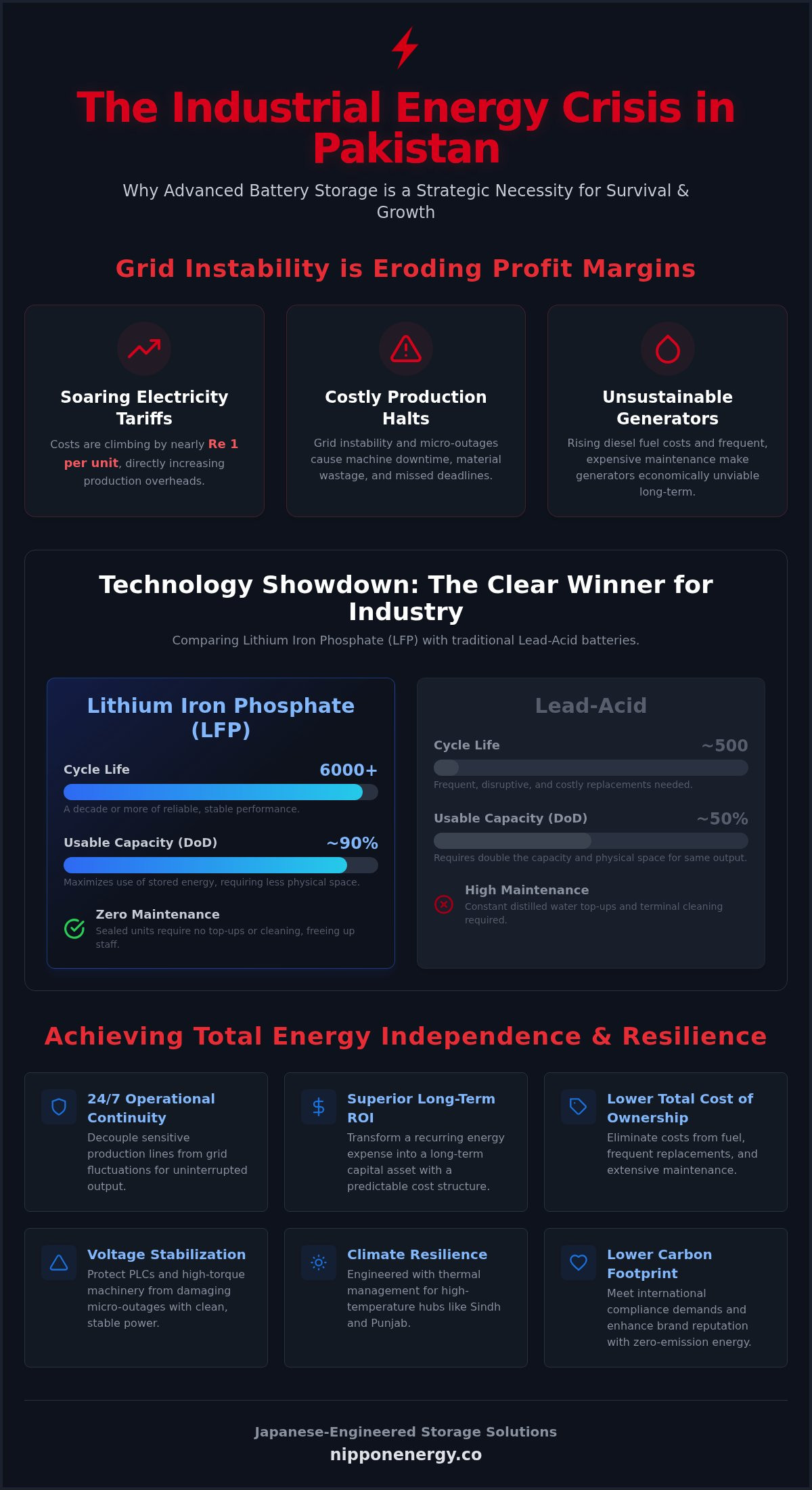
For a reliable industrial solar battery backup pakistan, the choice between Lithium Iron Phosphate (LFP) and lead-acid isn't just about cost; it's about engineering survival. Lead-acid batteries typically offer a cycle life of 500, requiring frequent replacements that disrupt industrial workflows and inflate operational budgets. In contrast, Nippon Lithium-ion Battery Storage Systems provide 6000+ cycles, ensuring a decade or more of stable performance. This longevity directly impacts the total cost of ownership, transforming energy storage from a recurring expense into a long-term capital asset. While lead-acid systems require constant distilled water top-ups and terminal cleaning, sealed lithium units operate with zero maintenance, freeing up technical staff for core production tasks; for those still managing traditional energy storage or vehicle fleets, you can explore Battery Testers and Chargers to ensure optimal reliability.
The transition to lithium technology also addresses the critical issue of usable capacity. Lead-acid batteries shouldn't be discharged beyond 50% to avoid permanent damage, effectively doubling the physical size of the bank required. Lithium-ion systems allow for much deeper discharge cycles without compromising the battery's health. This efficiency ensures that every kilowatt-hour generated by your solar array is utilized effectively, securing the production line against extended grid outages.
Technical Breakdown of LFP Chemistry
LFP chemistry is specifically engineered for thermal resilience. In regions like Sindh and Punjab, where ambient temperatures frequently exceed 40°C, traditional batteries suffer from rapid electrolyte evaporation and plate degradation. LFP maintains structural integrity up to 50°C, providing a safer, non-combustible solution for high-load factories. These systems also charge up to three times faster than lead-acid counterparts, allowing facilities to capitalize on narrow windows of solar peak or grid availability. Depth of Discharge (DoD) refers to the percentage of a battery's total capacity that has been used; a higher DoD in lithium-ion systems maximizes usable energy and accelerates the industrial ROI. Supporting Pakistan's clean energy goals requires this shift toward high-efficiency hardware that can withstand the local climate.
Space and Weight Efficiency in Industrial Plants
Industrial facilities often face spatial constraints when upgrading power infrastructure. Lithium-ion technology offers a significantly higher energy density, allowing manufacturers to reduce the physical footprint of their battery rooms by up to 70%. These systems utilize modular racks that facilitate seamless scalability as production capacity grows. Properly integrating lithium ion battery storage into existing electrical architectures ensures that expansion doesn't require massive civil works. To evaluate how these modular systems fit your specific plant layout, you can consult with experts at Nippon Energy for a technical assessment. This modularity allows for a "pay-as-you-grow" approach, where storage capacity is added in increments that match the facility's evolving load profile.
Sizing and ROI: Engineering a High-Performance Industrial Backup
Engineering a resilient energy system requires a shift from aggregate capacity estimates to granular load profile analysis. To design an effective industrial solar battery backup pakistan, technical architects must differentiate between base load requirements and intermittent peak surges. This data-driven approach ensures the system doesn't just provide power, but provides the *right* power at the right time. Precise sizing also accounts for the Thermal management of stationary batteries, as extreme Pakistani heat affects the discharge efficiency and available capacity during peak loads. By identifying the specific "autonomy time" your facility requires, you can avoid the twin pitfalls of over-capitalization and insufficient backup depth during extended grid failures.
The financial viability of industrial storage in 2026 is anchored in tariff arbitrage and the elimination of diesel operational costs. With the implementation of net billing and lower export rates, the most profitable strategy is to maximize self-consumption. Storing solar energy during the day to offset high-tariff peak hours in the evening creates a compounding ROI. This transition transforms the battery bank from a safety net into a profit-generating asset that shields the facility from the volatile fuel cost adjustments currently impacting the national grid.
The Role of High-Efficiency Panels
Optimal system balance begins at the generation stage. While standard modules may suffice for residential use, topcon solar panels are preferred for high-yield industrial rooftops due to their superior temperature coefficients and bifacial gain. These panels generate more energy per square meter, which is essential for charging high-capacity lithium-ion racks within limited daylight hours. Matching the panel’s peak output with the battery’s maximum charging rate ensures that no energy is clipped or wasted, creating a synchronized architecture that maximizes every ray of Pakistani sunlight.
Financial Architecture of Solar Storage
Large-scale energy projects are no longer viewed as simple hardware purchases; they're 10-year infrastructure assets. Modern financial models, including Power Purchase Agreements (PPAs), allow factories to adopt advanced storage with structured payments that align with energy savings. Utilizing professional solar epc services is critical for developing a bankable project feasibility study. These services provide the technical documentation and localized engineering expertise needed to secure financing and ensure that the system meets the rigorous standards of Pakistan’s industrial hubs in Karachi and Lahore.
Mitigating Thermal Stress: Ensuring Longevity in Pakistan’s Climate
Extreme ambient temperatures in the industrial corridors of Sindh and Punjab present a significant engineering challenge for energy storage. High heat accelerates the chemical degradation of battery cells, reducing both the instantaneous capacity and the overall lifecycle of the system. To maintain a resilient industrial solar battery backup pakistan, manufacturers must move beyond simple forced-air ventilation toward advanced liquid cooling. Liquid-cooled systems provide superior thermal uniformity, which prevents the localized hot spots that often trigger premature cell failure in large-scale containers. These containers utilize a closed-loop system to circulate coolant directly around the battery modules, which is significantly more efficient than moving large volumes of hot ambient air.
Outdoor industrial battery containers also require specialized IP65-rated enclosures with high-performance insulation to reflect solar radiation and maintain a stable internal environment. These enclosures are often equipped with phase-change materials or reflective coatings that minimize heat gain during peak daylight hours. By stabilizing the internal temperature at a consistent 25°C, the system avoids the voltage fluctuations and internal resistance spikes associated with thermal stress. To secure your infrastructure against thermal degradation, consult with the technical team at Nippon Energy for a site-specific cooling analysis.
Intelligent Energy Orchestration
Integrating a smart ai solar inverter ensures that the battery bank operates within its optimal thermal window. These units utilize predictive algorithms to anticipate load spikes and adjust cooling parameters before internal temperatures reach critical thresholds. AI-driven cooling algorithms modulate fan speeds and coolant flow based on real-time thermal data, which reduces auxiliary power consumption by eliminating unnecessary cooling cycles. Real-time monitoring allows plant managers to view cell-level temperature data across their entire industrial fleet, facilitating predictive maintenance before a minor thermal variance becomes a system-wide failure. This proactive energy orchestration is the cornerstone of modern industrial resilience.
Maintenance Protocols for Maximum Life
Industrial environments in Karachi and Lahore are often subject to high particulate matter, which can clog ventilation systems and lead to overheating. Adhering to professional solar system maintenance schedules is essential for ensuring that air filtration and liquid cooling loops remain unobstructed. Standard operating procedures must include monthly dust mitigation and sensor calibration to protect the system's structural integrity. Battery rooms should be maintained as controlled environments with strict access protocols to prevent the introduction of contaminants that could compromise electrical connections. Consistent maintenance transforms a vulnerable asset into a durable, high-performance energy hub that delivers consistent ROI over its 15-year lifespan.
Nippon Energy: Advanced Storage for Pakistan’s Industrial Future
Nippon Energy operates as the high-tech architect for Pakistan's evolving industrial landscape. We deliver the Nippon Lithium-ion Battery Storage System, which utilizes Japanese engineering standards to solve localized grid challenges. By combining Nippon HJT Solar Panels with proprietary Smart AI Inverters, we provide a unified energy architecture. This integrated approach ensures that your industrial solar battery backup pakistan isn't just a collection of disparate parts but a synchronized power plant. Our systems are designed to withstand the rigorous demands of heavy manufacturing while maintaining the precision required for automated assembly lines.
For facilities requiring complex hybrid energy management, the nipponhev system represents the pinnacle of integrated solar architecture. It bridges the gap between various energy sources, ensuring that your factory remains operational regardless of grid status or fuel availability. This system is specifically engineered for the high-temperature zones of Pakistan, maintaining performance where standard components often fail. By consolidating generation, storage, and intelligent management into a single framework, we empower industries to achieve total energy independence.
Why Industry Leaders Choose Nippon Energy
Our presence in the Karachi and Lahore industrial hubs allows for a rapid technical response that's critical for 24/7 manufacturing operations. We provide end-to-end EPC services, managing every phase from initial feasibility studies to long-term localized support. Nippon Energy hardware meets Tier-1 global standards, yet our engineering is deeply rooted in local industrial requirements. We've established a proven track record in high-temperature deployments across Sindh and Punjab, demonstrating that our cooling technologies and cell chemistries are built for the Pakistani climate. This combination of global expertise and local availability makes us a stable partner for large-scale energy transitions.
Next Steps for Energy Independence
The path to industrial resilience begins with a data-driven energy audit. Our engineers conduct a comprehensive analysis of your facility's load profile to identify peak-shaving opportunities and autonomy requirements. We customize storage racks to match specific manufacturing needs, ensuring that the system scales alongside your production capacity. You can contact the Pakistan team today for a site-specific feasibility report. This report provides the technical evidence and financial projections needed to secure project approval. Moving toward an industrial solar battery backup pakistan is a decisive step toward future-proofing your operations against a volatile energy market.
Securing Operational Continuity in a Volatile Energy Market
Industrial success in 2026 depends on the ability to decouple production from an unstable grid. We've explored how transitioning from legacy lead-acid systems to advanced LFP chemistry provides the thermal stability required for Pakistan's climate. By matching high-efficiency HJT generation with precise storage sizing, your facility can eliminate the financial burden of diesel backups and capacity charges. Implementing a robust industrial solar battery backup pakistan is the final step in transforming energy from a variable cost into a permanent competitive advantage.
Nippon Energy provides the technical architecture needed to navigate this transition with confidence. Our systems feature Japanese Engineered LFP Technology and a 6000+ Cycle Life Guarantee, ensuring your investment delivers value for over a decade. With local EPC support in Karachi & Lahore, we ensure rapid deployment and long-term technical reliability. Secure Your Industrial Energy Future with Nippon Energy Pakistan and take the first step toward total energy independence. The tools for a resilient, self-sustaining industrial future are available today.
Frequently Asked Questions
How long does an industrial solar battery backup last in Pakistan’s heat?
Nippon Lithium-ion Battery Storage Systems typically last between 10 and 15 years when managed by active thermal cooling. Our LFP chemistry maintains structural integrity at temperatures reaching 50°C, which is essential for the climate in Sindh and Punjab. This durability is backed by a 6000+ cycle life guarantee, ensuring that the system remains a viable asset long after traditional lead-acid alternatives have failed.
Can I run heavy machinery like motors and compressors on solar battery backup?
Heavy machinery such as industrial motors and compressors can be powered by storage provided the system's surge capacity is correctly engineered. Nippon Smart AI Inverters are designed to handle the high start-up currents associated with inductive loads. By stabilizing the voltage during these peak surges, the system prevents machinery trips and protects sensitive PLC components from electrical stress.
What is the typical ROI for an industrial lithium-ion storage system in Pakistan?
The ROI for an industrial solar battery backup pakistan is primarily driven by the elimination of diesel fuel costs and the avoidance of high-tariff peak hours. While payback periods vary based on specific energy consumption patterns, most facilities see a full return on capital through tariff arbitrage and reduced capacity charges. This transition converts a variable operational expense into a fixed, long-term infrastructure asset with predictable performance.
Is it possible to upgrade my existing solar system with a Nippon lithium-ion battery?
Upgrading an existing solar array is possible through the integration of Nippon Smart AI Inverters or AC-coupled storage configurations. This allows manufacturers to add high-performance lithium-ion capacity without replacing their current solar panels. Our engineering team conducts a compatibility audit to ensure that the new storage layer synchronizes perfectly with your existing electrical distribution network.
How much space is required for a 500kWh industrial battery backup system?
A 500kWh lithium-ion system is remarkably space-efficient and typically requires only a fraction of the area needed for lead-acid banks. Such a system can often be housed within a single 20-foot specialized outdoor container or a dedicated indoor space of approximately 150 to 200 square feet. This high energy density allows factories to maximize their production floor space while maintaining a massive energy reserve.
What safety certifications should I look for in an industrial battery system?
Industrial-grade systems must adhere to international safety standards such as IEC 62619 for cell safety and UL 1973 for stationary applications. You should also verify that the enclosure meets IP65 ratings to protect against the dust and moisture common in Pakistani industrial zones. These certifications ensure that the system includes the necessary fail-safes to prevent thermal runaway and electrical faults.
Does Nippon Energy provide O&M services for industrial solar plants in Karachi?
Nippon Energy provides comprehensive Solar System Maintenance and Monitoring services across Karachi and Lahore. Our local technical teams perform regular air filtration checks, coolant level inspections, and firmware updates for AI inverters. This proactive O&M approach ensures that your industrial plant operates at peak efficiency and avoids the degradation associated with the harsh local environment.
Can I use solar battery storage to avoid peak-hour electricity rates?
Peak-hour avoidance, known as energy arbitrage, is a primary function of modern industrial storage. You can charge your Nippon Lithium-ion Battery Storage Systems during low-tariff daylight hours using solar power or off-peak grid energy. Discharging this stored energy during expensive evening peak hours allows your facility to bypass the highest tariff brackets and significantly reduce monthly utility bills.


