
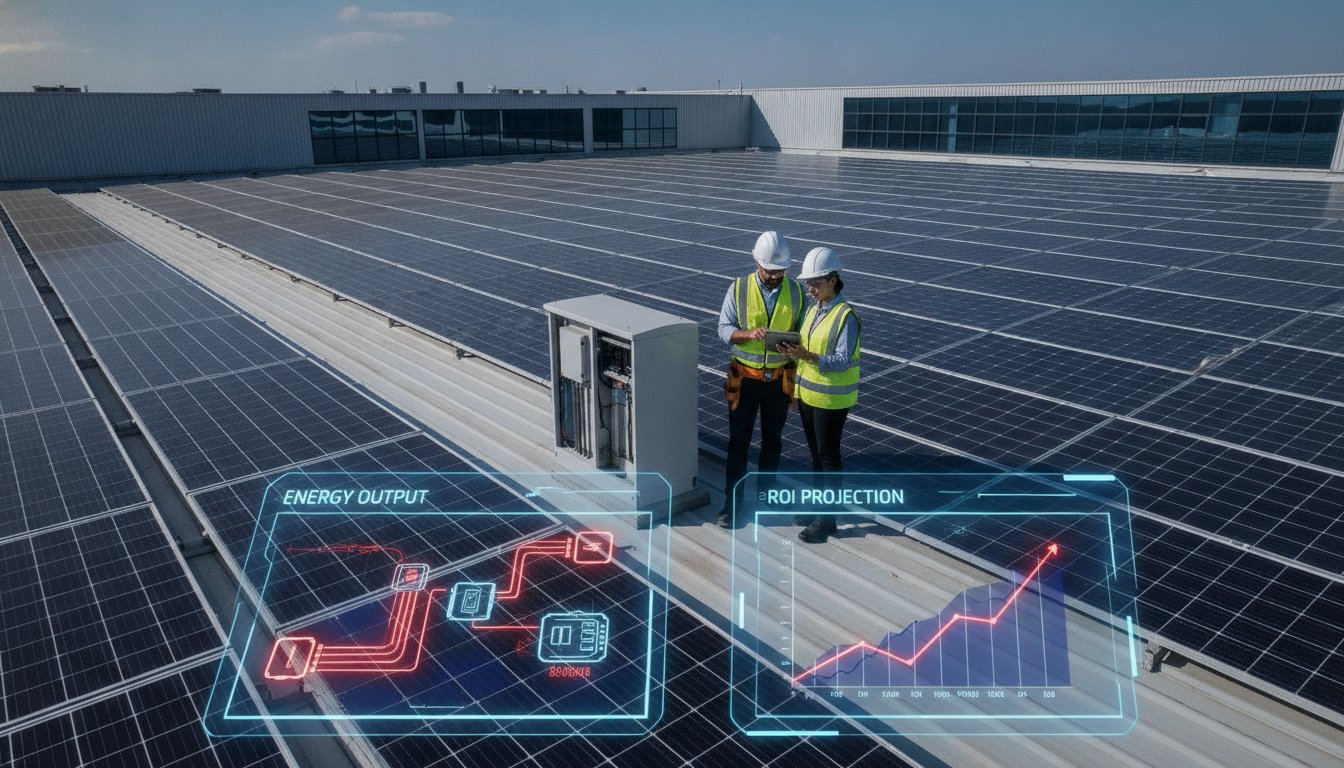
The 2026 transition from net-metering to the Prosumer Regulations 2026 has fundamentally altered the financial logic of industrial energy. Most commercial operators recognize that with grid buyback rates at approximately Rs. 11 per kWh while consumption tariffs soar toward Rs. 50, the old strategy of maximizing exports is no longer viable. You're likely facing the dual challenge of volatile electricity prices and the technical demand for hybrid systems that can manage newer HJT and TOPCon panel technologies. Understanding the current commercial solar inverter price in pakistan is only the first step; the true metric of success is how effectively your hardware orchestrates energy flows to minimize grid reliance.
This guide provides a high-level technical framework for evaluating inverter quality against long-term ROI. We'll examine how AI-driven smart management can boost energy yields and why your choice of power electronics determines your facility's resilience against grid instability. You'll gain a clear procurement strategy for identifying a reliable EPC partner capable of deploying industrial-scale systems that turn energy from a rising cost into a controlled, predictable asset. By focusing on technical precision rather than just upfront costs, you can secure a system that remains productive well beyond the current five-year contract terms.
Key Takeaways
- Analyze the impact of the 2026 Net-Billing framework on hardware selection and why intelligent energy orchestration is now mandatory for commercial viability.
- Evaluate how specific technical parameters, such as MPPT channel density and conversion efficiency, directly influence your project's Levelized Cost of Energy (LCOE).
- Access a structured framework to assess the commercial solar inverter price in pakistan by weighing upfront procurement costs against 25-year operational reliability.
- Review current State Bank of Pakistan (SBP) green financing initiatives and alternative procurement models like Leasing and PPAs to optimize capital allocation.
- Explore the technical synergy between Smart AI Inverters and high-efficiency HJT or TOPCon modules for superior industrial energy yields.
The Evolution of Commercial Solar Inverters in Pakistan’s 2026 Energy Market
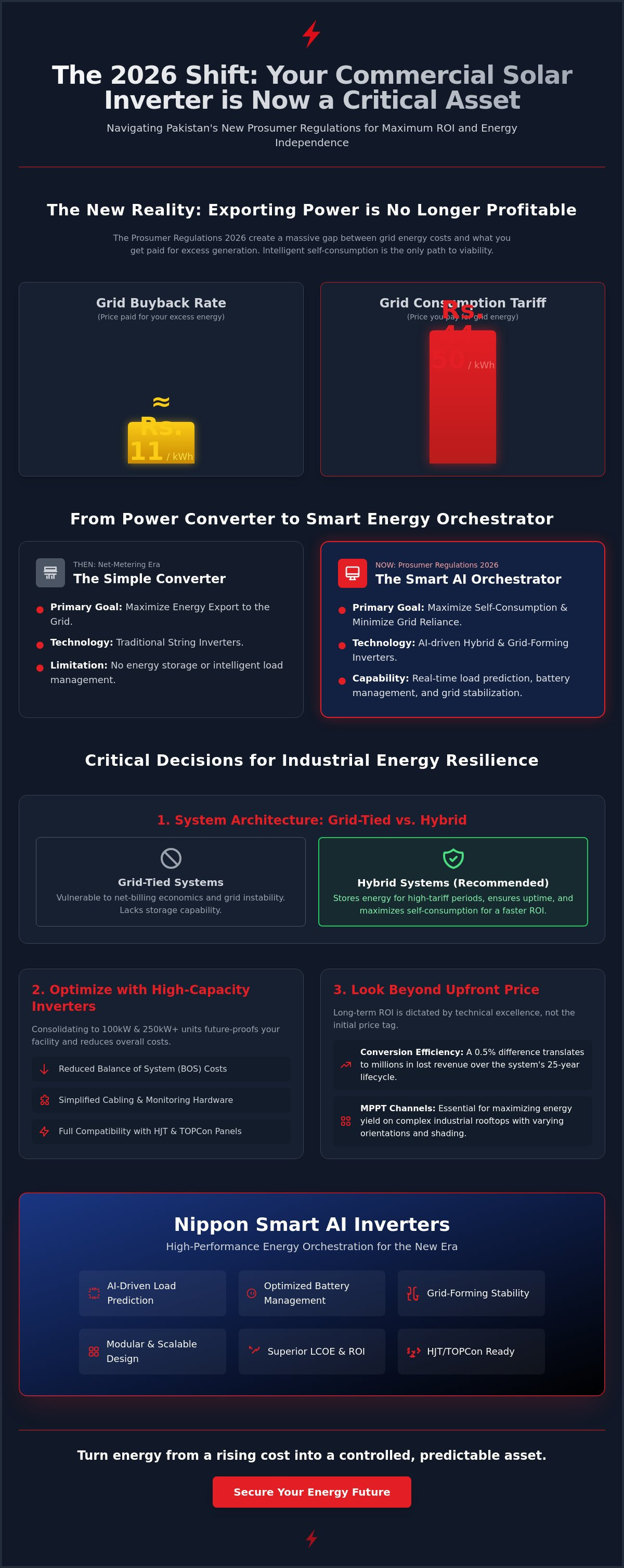
The landscape of Solar power in Pakistan reached a critical inflection point in February 2026 with the introduction of the Prosumer Regulations 2026. This policy shift replaced traditional net-metering with a net-billing framework, fundamentally changing the economic utility of commercial solar installations. Under these new rules, distribution companies purchase excess energy at approximately Rs. 11 per kWh, while industrial consumers continue to pay grid tariffs ranging from Rs. 44 to Rs. 50 per kWh. This massive price delta has transformed the role of the inverter from a simple power converter into a sophisticated energy orchestrator.
Modern industrial facilities no longer prioritize maximum export. Instead, they require intelligent systems that can synchronize generation with internal demand in real time. Traditional string inverters are being phased out in favor of smart AI solutions that predict load patterns and manage battery discharge cycles with surgical precision. For large-scale manufacturing plants, the adoption of grid-forming inverters is now a necessity rather than an elective upgrade. These advanced units provide essential voltage and frequency support, ensuring that sensitive machinery remains operational even during the frequent grid instabilities that characterize the local energy environment. When evaluating the commercial solar inverter price in pakistan, technical directors must look beyond the initial capital outlay and focus on the hardware's ability to mitigate these expensive grid-related risks.
Grid-Tied vs. Hybrid: Which Architecture Fits Your Business?
The decision between grid-tied and hybrid architectures is now driven by the necessity of 24/7 industrial uptime. While grid-tied systems remain the most affordable option, their lack of storage compatibility makes them vulnerable to the 2026 net-billing economics. Hybrid systems, though requiring a higher initial commercial solar inverter price in pakistan, allow businesses to store energy produced at peak solar hours for use during expensive evening tariff windows. This capability significantly shortens the payback period in a high-tariff environment. Scalability is also a vital factor; choosing a modular hybrid architecture ensures that as your enterprise grows, your energy infrastructure can expand without requiring a total system overhaul.
The Shift Toward High-Capacity Industrial Inverters
Industrial procurement is rapidly consolidating around high-capacity units, specifically 100kW and 250kW+ models. This shift is motivated by the need to optimize Balance of System (BOS) costs. Utilizing fewer, high-capacity inverters reduces the complexity of DC cabling, monitoring hardware, and protection devices. These larger units are designed for the rigors of Pakistan's climate, featuring enhanced thermal management and robust enclosures. Future-proofing your facility means selecting hardware that is fully compatible with high-efficiency cell architectures like HJT and TOPCon. By investing in high-capacity, AI-ready inverters today, commercial operators ensure their energy assets remain productive and relevant through 2026 and beyond.
Key Technical Specifications Determining Commercial Inverter Costs
The technical architecture of a power conversion system dictates its long-term financial performance. While the initial commercial solar inverter price in pakistan is a visible capital expenditure, the hidden costs of inefficiency are far more significant. A 0.5% delta in conversion efficiency might seem marginal on a datasheet, but for a multi-megawatt industrial facility, it translates into millions of rupees in lost revenue over a 25-year lifecycle. High-precision engineering ensures that the maximum possible energy reaches your facility's load, directly counteracting the high grid tariffs discussed in the previous section.
Complex industrial rooftops require Multiple Power Point Tracking (MPPT) channels to maintain peak performance. Industrial buildings often feature varying roof orientations, skylights, or HVAC equipment that create partial shading. Inverters equipped with a high density of MPPT channels allow each string of panels to operate at its individual peak power point. This granular control prevents a single shaded module from degrading the output of the entire array. When analyzing Pakistan's renewable energy market, it's clear that hardware capable of managing these environmental complexities offers the most resilient ROI.
Thermal management is a non-negotiable specification for the Pakistani climate. Extreme summer temperatures can cause standard inverters to derate, or throttle their output, exactly when solar irradiance is at its peak. Advanced commercial units utilize sophisticated heat dissipation technologies to maintain full power output even in 50°C environments. This resilience is particularly critical when using high-current modules like TOPCon Solar Panels and HJT modules, which demand inverters capable of handling higher input currents without overheating. If you're planning a large-scale deployment, you can consult with our technical team to ensure your inverter choice matches your specific module architecture.
The Importance of High DC/AC Ratios
Modern engineering favors high DC/AC ratios, often exceeding 1.5. This practice involves over-provisioning the DC solar array relative to the inverter’s AC capacity. It ensures the inverter operates at its peak efficiency for a longer duration of the day, particularly during early morning and late afternoon hours. While this increases the total system size, it lowers the levelized cost of energy by maximizing the utilization of the inverter's power electronics. Pakistani industrial installations must carefully balance this ratio to stay within safe operating margins while squeezing every possible kilowatt-hour from the sun.
Ingress Protection (IP) and Durability Standards
Industrial zones in Karachi and Punjab present harsh conditions characterized by high humidity, salt mist, and fine particulate matter. An IP66 rating is the gold standard for these environments, providing a hermetically sealed enclosure that protects sensitive internal components. Lower-grade units with IP21 or even IP65 ratings often suffer from premature component degradation in these zones. Choosing between passive cooling (no fans) and active cooling (intelligent fan systems) also impacts durability; passive systems reduce mechanical failure points, while active cooling is often necessary for the highest-capacity industrial units to maintain stable internal temperatures during peak loads.
Calculating the Total Cost of Ownership (TCO) and ROI for Industrial Inverters
While procurement teams often fixate on the commercial solar inverter price in pakistan, the most successful operators prioritize the Levelized Cost of Energy (LCOE). This metric accounts for the total capital and operational expenditure over a 25-year project lifecycle. An inverter is the heart of your power plant; if it fails, your entire solar array becomes a stranded asset. Therefore, calculating TCO requires a meticulous look at conversion losses, potential downtime, and the long-term reliability of the power electronics. The Future of solar growth in Pakistan hinges on this shift from low-cost procurement to high-performance asset management.
Operational expenses are frequently underestimated during the initial planning phase. A robust Solar System Maintenance strategy, integrated with remote monitoring, is essential for preserving ROI. Modern industrial inverters now include AI-driven predictive maintenance capabilities. These systems analyze electrical signatures to identify string-level anomalies or cooling fan degradation before a total shutdown occurs. By shifting from reactive to proactive maintenance, commercial facilities can significantly reduce the "hidden" costs that often erode the financial benefits of solar energy.
Warranty and Service Level Agreements (SLAs)
In the Pakistani market, the "bankability" of an inverter manufacturer is just as important as the hardware itself. You must evaluate whether the provider has a local technical presence capable of honoring a 10 or 15-year warranty. A standard warranty might cover part replacement, but a comprehensive SLA should include guaranteed response times for on-site repairs. For a manufacturing plant, 48 hours of downtime can cost more than the original commercial solar inverter price in pakistan. Ensuring your partner has a localized spare parts inventory is a critical safeguard for your capital investment.
Energy Yield Optimization Through AI
Smart orchestration algorithms can increase total energy harvest by up to 3% compared to non-AI systems. This improvement is achieved through dynamic MPPT tracking and real-time adjustment to grid voltage fluctuations. In the textile and pharmaceutical sectors, where margins are tight and energy loads are massive, this 3% gain translates into millions of rupees in annual savings. Automated fault detection also eliminates the need for manual string testing, allowing your technical team to focus on core production while the energy system optimizes itself for maximum yield.
Commercial Solar Financing and Procurement Strategies in Pakistan
The capital structure of an industrial solar project determines its ultimate ROI as much as the hardware itself. While the commercial solar inverter price in pakistan is often the focal point of initial procurement discussions, savvy operators leverage specialized financing to preserve liquidity. The State Bank of Pakistan’s green financing scheme remains a cornerstone for industrial adoption, offering mark-up rates as low as 6% per annum for installations up to 1 MW. This rate is particularly attractive when compared to the standard policy rate of 11.50%, allowing businesses to lock in low-cost capital for tenures of up to 10 years. For larger enterprises, commercial banks like HBL and MCB offer tailored solar lending products with interest rates ranging from 5% to 15%, depending on the company's credit profile and project scale.
Beyond traditional debt, the 2026 market has seen a rise in Power Purchase Agreements (PPAs) and solar leasing models. A PPA allows a facility to host a solar plant owned by a third party, paying only for the energy consumed at a rate lower than the grid tariff. This "zero-CAPEX" approach shifts the technical and operational risks to the provider. However, for companies with available capital, direct ownership typically yields the highest long-term savings. Selecting high-tier Solar EPC Services ensures that your procurement strategy aligns with international engineering standards, preventing the costly mistakes often associated with fragmented vendor management. To optimize your capital allocation for industrial solar, consult with our project development experts.
Navigating Customs and Import Duties in 2026
The "Pakistan Solar Panels & Allied Equipment Manufacturing Policy 2026-2035" has introduced new dynamics into the local supply chain. While the policy encourages local assembly, high-capacity industrial inverters still rely heavily on global supply chains. Procurement teams in Lahore and Karachi must stay updated on current tax exemptions for renewable energy hardware to avoid unexpected costs at the port. Proper documentation is essential to claim corporate solar tax credits, which can significantly offset the effective commercial solar inverter price in pakistan. Bulk procurement for multi-site operations further reduces these overheads through economies of scale in logistics and duty processing.
Technical Due Diligence in Procurement
Technical due diligence is the final safeguard against substandard hardware. Every inverter must be verified for authenticity and international certifications like IEC 62109. Third-party inspections are now a standard requirement for large-scale commercial projects to ensure that the delivered equipment matches the specified technical datasheets. Integrating Lithium-Ion Battery Storage into the initial procurement plan is now standard practice to mitigate the low buyback rates of the net-billing system. This integrated approach ensures that the inverter, panels, and storage systems are perfectly synchronized for maximum energy orchestration.
Nippon Smart AI Inverters: High-Performance Energy Orchestration
The technical architecture of Nippon Smart AI Inverters represents a departure from traditional power conversion toward active energy orchestration. While the commercial solar inverter price in pakistan for basic string inverters may appear lower on a spreadsheet, those units lack the cognitive processing required to manage the complexities of the 2026 energy market. Nippon’s systems utilize high-speed digital signal processors (DSPs) to synchronize seamlessly with Nippon HJT and TOPCon modules. This integration ensures that the high current outputs of advanced cell architectures are managed without thermal throttling, maintaining a stable energy flow even during peak irradiance periods. By investing in AI-enhanced hardware, industrial operators move beyond passive energy generation into a model of active asset optimization.
Real-time performance monitoring and AI-driven grid interaction are essential for maintaining stability in Pakistan’s industrial hubs. These inverters don't just convert DC to AC; they communicate with the grid to provide voltage support and frequency regulation. For businesses in Lahore and Karachi, Nippon provides a robust maintenance infrastructure, ensuring that technical support is localized and responsive. This local presence is vital for maintaining the 25-year operational lifecycle required to achieve the ROI targets discussed earlier in this guide. The ability to perform remote firmware updates and diagnostic sweeps ensures that your hardware evolves alongside changing grid codes and regulatory requirements.
Intelligent Energy Management Systems (EMS)
Nippon’s proprietary AI algorithms optimize load shifting by predicting facility demand and solar generation patterns. This capability is critical for peak-shaving, allowing businesses to reduce their reliance on the grid during high-tariff windows. Through the cloud-based interface of our Smart AI Solar Inverters, technical directors can access granular industrial reporting and automated yield analysis. These systems are protected by enterprise-grade cybersecurity features, ensuring that your facility’s energy data and control systems remain secure against external threats. This level of intelligence justifies the initial commercial solar inverter price in pakistan by delivering superior long-term energy yields.
The Nippon Advantage for Pakistani Businesses
Nippon Energy provides customized engineering solutions that address the specific environmental challenges of the Pakistani landscape. Our hardware is engineered for proven reliability in high-temperature and high-dust environments, utilizing advanced cooling geometries that prevent component fatigue. Unlike generic components, Nippon systems are designed as a unified architecture, ensuring perfect compatibility between our lithium-ion storage and high-efficiency panels. This holistic approach eliminates the integration risks that often plague fragmented commercial solar projects. We invite you to consult with our engineering team for a commercial solar assessment to determine the optimal technical configuration for your facility.
Securing Your Industrial Energy Future in 2026
The transition to the net-billing framework has redefined the value proposition of industrial solar. Successful procurement now requires a move away from evaluating the commercial solar inverter price in pakistan as an isolated capital cost. Instead, technical directors must prioritize energy orchestration, thermal resilience, and seamless compatibility with high-efficiency HJT and TOPCon architectures. By focusing on the Levelized Cost of Energy and AI-driven predictive maintenance, your facility can transform energy volatility into a predictable strategic advantage.
Nippon Energy combines Japanese engineering excellence with robust local EPC and maintenance support to ensure your project’s long-term viability. Our Smart AI Inverters provide the intelligent management required to navigate Pakistan’s evolving grid codes and regulatory landscape with precision. You can Explore Nippon Smart AI Inverters for Your Commercial Project to secure an energy architecture built for monumental performance. Empower your business with a system designed for resilience and technical superiority.
Frequently Asked Questions
What is the average lifespan of a commercial solar inverter in Pakistan?
High-performance commercial solar inverters typically have an operational design life of 12 to 15 years. Environmental factors in Pakistan, such as extreme ambient temperatures and high dust concentrations, can accelerate the aging of power electronics. Implementing a rigorous maintenance schedule and ensuring proper thermal management can extend this lifespan, helping the hardware last through the 25-year lifecycle of the solar array.
Can I use a string inverter with Nippon HJT solar panels?
You can use a string inverter with Nippon HJT solar panels, provided the inverter’s maximum input current rating is compatible with the high-current output of HJT cells. These high-efficiency modules often produce higher current than traditional PERC panels. Using an undersized inverter can lead to energy clipping or thermal stress, so it's vital to verify that the inverter’s MPPT specifications align with the HJT module architecture.
How does the commercial solar inverter price in Pakistan compare between 2025 and 2026?
The commercial solar inverter price in pakistan has shifted toward a value-based model in 2026 following the Solar Panels & Allied Equipment Manufacturing Policy 2026-2035. While global manufacturing efficiencies have reduced basic hardware costs, the inclusion of AI-driven orchestration and grid-forming capabilities in 2026 models has created a technical premium. Investors now prioritize hardware that maximizes self-consumption under the current net-billing regulations rather than just looking for the lowest entry price.
Is AI integration necessary for a 100kW solar system?
AI integration is highly recommended for 100kW systems to optimize the financial returns under the 2026 net-billing framework. Intelligent algorithms manage load shifting and peak-shaving, ensuring that your facility utilizes its own generated power during high-tariff periods. This smart orchestration can improve total energy yields by up to 3%, which significantly impacts the ROI for a system of this scale by reducing reliance on expensive grid energy.
What are the SBP financing requirements for commercial solar inverters?
State Bank of Pakistan (SBP) financing for commercial solar requires projects to meet specific technical and capacity criteria. For installations up to 1 MW, the green financing scheme offers a mark-up rate of 6% per annum with a maximum tenure of 10 years. Applicants must submit a technical feasibility report and ensure that all hardware, including inverters, carries international certifications like IEC 62109 to qualify for these preferential rates.
How do smart inverters help with NEPRA net metering compliance?
Smart inverters facilitate compliance with NEPRA’s Prosumer Regulations 2026 by providing advanced grid-forming and anti-islanding capabilities. These units allow for dynamic power export limits and real-time frequency regulation, which are essential for maintaining grid stability. By automatically adjusting to grid conditions, smart inverters ensure that your commercial facility remains compliant with distribution company (Disco) requirements without the need for constant manual monitoring or hardware adjustments.
What is the difference between IP65 and IP66 for industrial inverters?
IP66 enclosures provide superior protection against powerful water jets and fine particulate matter compared to the IP65 standard. In Pakistan’s industrial zones, particularly in Karachi and Punjab, fine dust and high humidity can bypass IP65 seals over time and cause internal component failure. Choosing IP66 ensures that the inverter’s sensitive electronics remain hermetically sealed, providing the resilience needed for long-term performance in harsh outdoor environments.
How often should commercial solar inverters be serviced in Pakistan?
Commercial solar inverters in Pakistan should undergo a technical inspection at least once every quarter. The high dust levels in local industrial corridors require frequent cleaning of cooling fans and heat sinks to prevent thermal derating. Regular quarterly checks, combined with annual firmware updates and deep-cleaning, ensure that the system maintains its peak conversion efficiency and remains secure against evolving cybersecurity threats.


