
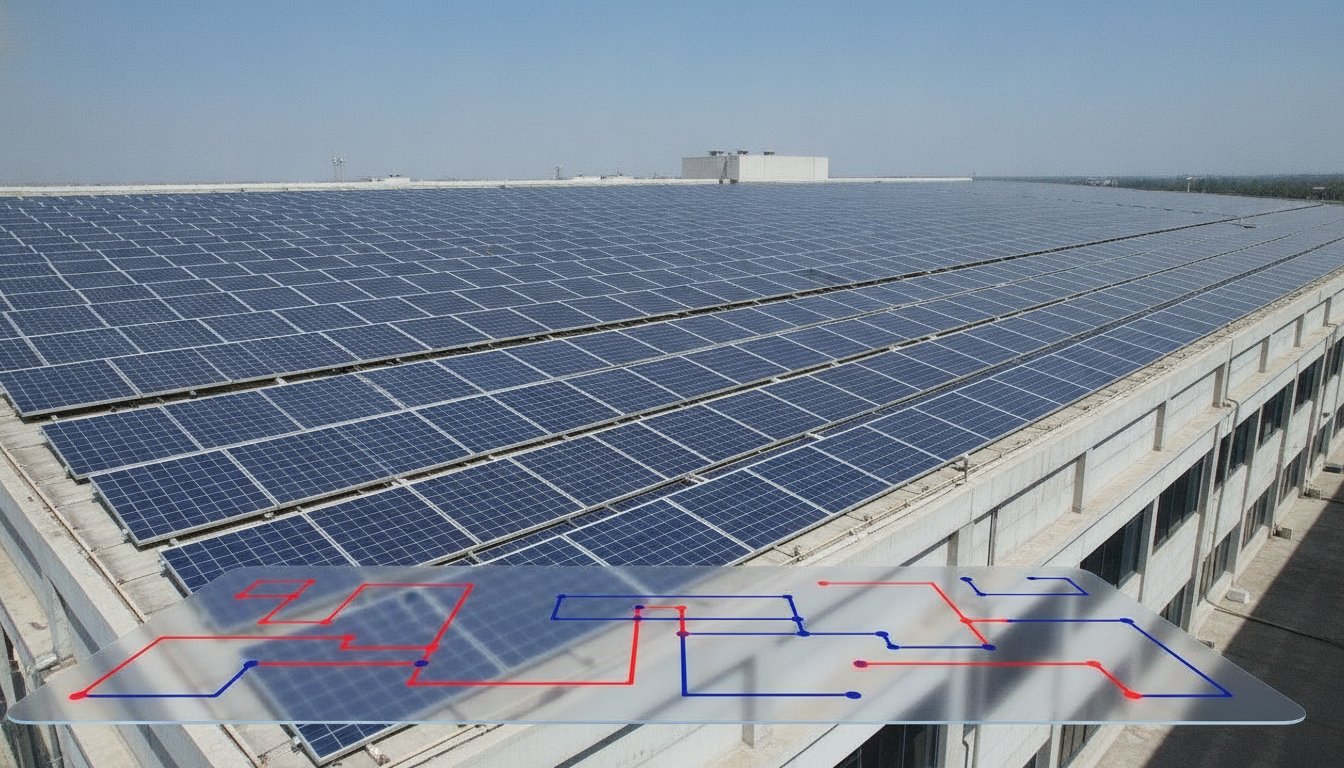
Can a textile mill in Faisalabad remain globally competitive when industrial grid tariffs have surged to Rs. 60 per unit? For the city's industrial leaders, the challenge isn't just finding a power source; it's surviving an energy crisis that demands absolute technical precision. Selecting the right solar epc for textile industry faisalabad has become the definitive factor between a failing asset and a 25-year high-performance powerhouse.
You already know that standard components often buckle under Faisalabad's 45°C+ heat, and meeting international "Clean Production" requirements is no longer optional for export growth. It's a complex landscape where unpredictable costs and shifting Net-Billing regulations threaten your bottom line every day. We promise to show you how integrated Japanese EPC standards and HJT technology are turning these challenges into a distinct strategic advantage. This guide provides a detailed look at the 2026 energy framework, AI-driven orchestration, and the specific engineering required to achieve total energy independence in Pakistan's textile heartland.
Key Takeaways
- Understand why transitioning to solar is now a mandatory requirement for maintaining international export compliance and navigating the 2026 energy crisis in Faisalabad.
- Discover why Heterojunction (HJT) technology provides superior thermal stability and higher energy yields compared to TOPCon in Faisalabad’s extreme 45°C+ temperatures.
- Master the 5-stage industrial electrification lifecycle to ensure structural integrity and maximum power density for both modern and aging mill rooftops.
- Evaluate how the right solar epc for textile industry faisalabad integrates Japanese engineering standards to significantly reduce the Levelized Cost of Energy (LCOE).
- Learn to navigate the 2026 FESCO Net-Billing framework by prioritizing self-consumption and unified architectures like the NipponHev system for maximum ROI.
The Textile Energy Crisis in Faisalabad: Why Solar EPC is No Longer Optional
Faisalabad’s status as the industrial heart of the nation is under direct threat. Escalating grid tariffs, reaching approximately Rs. 50-60 per unit for industrial consumers, have transformed energy from a utility cost into a primary risk factor. For spinning and weaving units operating on thin margins, these costs are unsustainable. Reliance on a professional solar epc for textile industry faisalabad has transitioned from a sustainability goal to a core requirement for operational survival. The volatility of the national grid makes it impossible to forecast long-term production costs without a decentralized power source.
Grid Parity and the Economic Survival of Faisalabad Mills
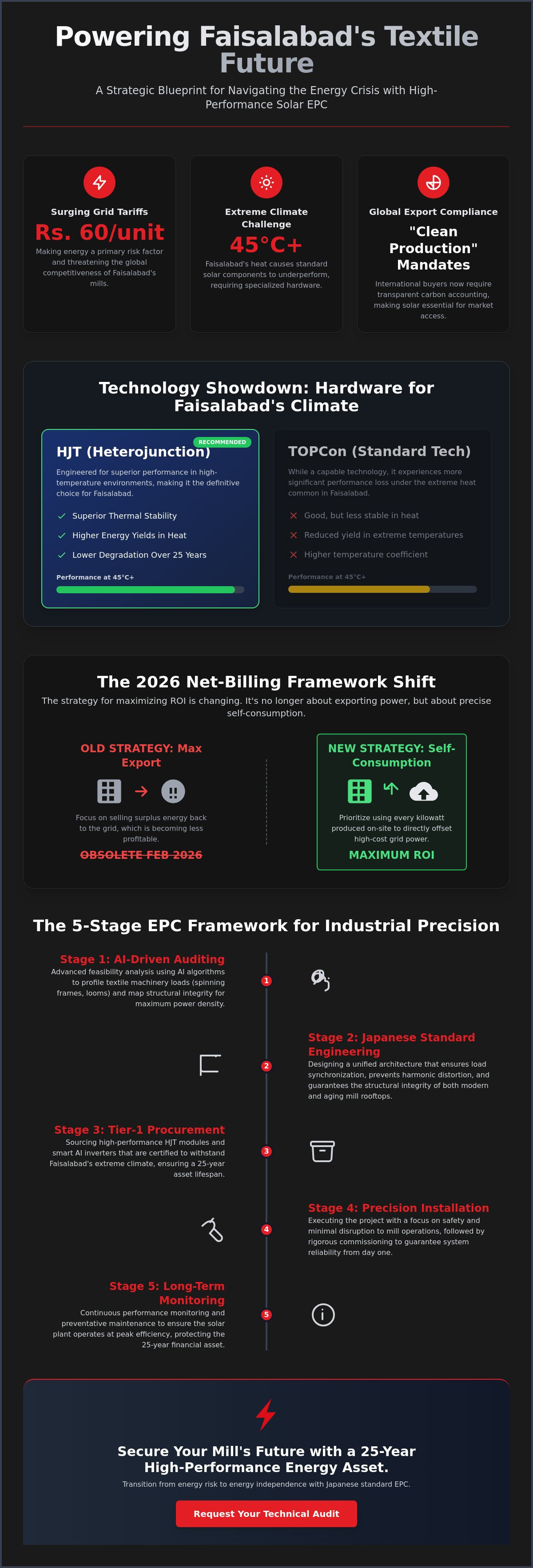
The calculation of the Levelized Cost of Energy (LCOE) is now the most critical metric in a mill’s balance sheet. Traditional captive power, once reliant on affordable gas, is failing as gas prices rise and supply becomes volatile. Solar energy now serves as the primary industrial hedge. Following the implementation of NEPRA’s Net-Billing framework in February 2026, the strategy has shifted significantly. Mills no longer aim for maximum export; they focus on high-precision self-consumption. This architectural shift ensures that every kilowatt produced directly offsets high-cost grid power, protecting the bottom line from future tariff hikes. It's a move from "supplemental" solar to a primary energy architecture that dictates the mill's economic resilience.
Export Compliance: Meeting Global 'Clean Production' Standards
International buyers in Europe and North America now demand transparent carbon accounting. As Pakistan's largest manufacturing sector, the textile industry must adapt to these "Clean Production" mandates or risk losing market share. Adopting solar isn't just about saving money. It's about securing a "Green Label" status. This certification provides a competitive advantage, allowing Faisalabad’s exporters to command better terms and ensure long-term partnerships with global brands. Transitioning to renewable energy is the fastest way to satisfy Environmental, Social, and Governance (ESG) requirements that are now mandatory for global trade.
For 1MW+ installations, the complexity of integration requires more than simple hardware assembly. It demands a sophisticated Engineering, Procurement, and Construction (EPC) approach. A professional EPC partner ensures structural integrity for massive rooftop arrays and manages the delicate balance of load synchronization. In an environment where downtime equals massive financial loss, the reliability of the energy system must be absolute. Moving beyond captive gas power requires a disciplined technical transition that only a specialized solar epc for textile industry faisalabad can provide. This isn't just a construction project; it's the installation of a 25-year financial asset.
The Nippon EPC Framework: Engineering Precision for Industrial Loads
Industrial electrification isn't a simple hardware installation; it's a structural transformation of the manufacturing environment. A robust solar epc for textile industry faisalabad must account for the unique demands of heavy machinery and the structural limitations of industrial sheds. The Nippon EPC Framework utilizes a 5-stage lifecycle designed to convert textile mills into self-sustaining energy units. This process begins with technical auditing and concludes with long-term performance monitoring, ensuring that every watt generated is utilized with maximum efficiency.
Textile machinery, particularly spinning frames and weaving looms, generates significant inductive loads that can destabilize standard solar systems. Managing these fluctuations requires precision engineering to prevent harmonic distortion and premature equipment wear. By integrating smart ai solar inverters, we enable real-time load management that synchronizes solar generation with the mill's motor-heavy operations. Academic research highlights the severe impact of power outages on textile firm productivity, making a stabilized, intelligent power supply a necessity for maintaining global competitiveness.
Phase 1: Advanced Feasibility and Load Profiling
We deploy AI algorithms to analyze mill consumption patterns across multiple shifts, identifying peak demand periods and potential energy waste. This granular data allows us to size the system based on actual operational demand rather than theoretical estimates. Our engineering teams conduct rigorous shadow analysis and structural load-bearing assessments, which is critical for the aging rooftops often found in Faisalabad’s industrial zones. Accurate industrial feasibility serves as the absolute bedrock for a 25-year return on investment.
Phase 2: Procurement of High-Performance Hardware
The selection of hardware determines the system's resilience against the local environment. We evaluate the technical trade-offs between Nippon HJT and topcon solar panels to match the specific thermal profile and dust levels of the site. Using Tier-1 components is a strict requirement for ensuring system longevity in high-heat conditions. We maintain total supply chain transparency, providing mill owners with the assurance that every module and mounting structure meets global engineering standards. For those seeking a comprehensive energy audit, our team at Nippon Energy provides the technical expertise needed to secure your facility's future.
HJT vs. TOPCon: Selecting Hardware for Faisalabad’s Climate
Faisalabad’s industrial climate presents a unique engineering challenge where ambient temperatures frequently exceed 45°C. For a solar epc for textile industry faisalabad, selecting hardware isn't merely a procurement choice; it's a thermal management strategy. Traditional PERC modules suffer significant efficiency drops in extreme heat, leading to reduced energy yields precisely when peak cooling and production loads are highest. This hardware failure contributes to the existential crisis facing the textile sector, where every lost kilowatt increases the financial burden on manufacturing units. Modern N-type technologies have replaced these legacy systems to provide the durability required for a 30-year industrial asset.
The HJT Advantage: Resilience in Extreme Heat
Nippon HJT Solar Panels utilize a remarkably low temperature-coefficient, typically around -0.26%/°C, which allows them to maintain peak performance during blistering summer afternoons. This characteristic ensures that spinning and weaving operations remain powered even as thermal stress degrades standard modules. High bifaciality factors of up to 90% enable these panels to capture reflected light from mill rooftops, significantly maximizing the energy harvest per square meter. By delivering superior energy yields in high-dust and high-heat environments, HJT technology effectively lowers the Levelized Cost of Energy (LCOE) over the system's entire lifespan. The symmetrical cell structure also reduces internal stress, preventing the micro-cracks that often plague lower-quality installations in Faisalabad.
TOPCon: The High-Efficiency Alternative for Large Arrays
For large-scale textile projects exceeding 5MW, Nippon TOPCon Solar Panels offer an optimized cost-to-performance ratio. These modules provide high initial power density and excellent efficiency, making them an ideal selection for expansive industrial sheds where rooftop surface area is abundant. While HJT excels in absolute thermal stability, TOPCon remains a dominant force for rapid capacity scaling due to its competitive price point and robust N-type architecture. N-type technology is the only viable choice for 2026 industrial projects because it eliminates light-induced degradation and offers a superior 30-year performance curve.
Long-term asset value depends entirely on the degradation curve of the selected modules. N-type technologies exhibit less than 0.4% annual degradation, ensuring that the mill's energy independence remains intact for decades. In Faisalabad’s high-dust environment, the glass-glass structure of these modules prevents moisture ingress and potential induced degradation (PID), maintaining structural integrity where older technologies fail. A disciplined engineering approach integrates these hardware advantages into a unified architecture that survives the harsh local climate while delivering consistent, export-compliant power. Selecting the right hardware is the first step in future-proofing your facility against the volatile energy market.
FESCO Net-Metering and Financing: Navigating the Logistics
The transition to the Net-Billing framework on February 8, 2026, has fundamentally restructured the economics of industrial solar in Pakistan. For a solar epc for textile industry faisalabad, the primary engineering objective is no longer maximizing grid exports but achieving high-precision self-consumption. With industrial grid purchase rates reaching Rs. 60 per unit and buyback rates set at approximately Rs. 11-13, the financial logic has shifted toward matching system output with real-time daytime loads. This regulatory change demands a more sophisticated approach to system sizing to ensure that every kilowatt produced provides the highest possible offset against expensive grid power.
Financing these large-scale assets requires a deep understanding of available fiscal mechanisms. The State Bank of Pakistan’s Financing Scheme for Renewable Energy continues to be a vital tool, offering markup rates as low as 6% per annum for eligible industrial projects. Mills can choose between a CAPEX model, where they own the asset and reap the full tax benefits of accelerated depreciation, or an OPEX/PPA model, where the EPC provider maintains the system and sells power at a discounted rate. Selecting the right model depends on the mill's capital structure and long-term electrification goals. To explore which model fits your facility, you can consult with our project development team for a detailed financial simulation.
Streamlining the FESCO Approval Process
Navigating the FESCO approval cycle requires meticulous technical documentation to avoid delays in the 10-week bidirectional meter installation timeline. Many industrial applications fail due to non-compliant inverter certifications; all equipment must meet IEC 62109 standards to be accepted by the grid operator. A professional EPC partner manages the entire bureaucratic lifecycle, from the initial feasibility report to the final commissioning certificate. This disciplined approach eliminates common pitfalls, such as incorrect transformer loading calculations or inadequate protection relay settings, which often stall projects during the final inspection phase.
Optimizing ROI through Smart Storage
The low export buyback rate has made the integration of lithium ion battery storage a strategic necessity for 2026 energy architectures. For spinning mills, storage systems provide critical peak-shaving capabilities that manage the high startup currents of heavy machinery, preventing expensive peak-hour surcharges. By storing excess midday generation rather than exporting it at a lower rate, mills can significantly accelerate their payback period. Our engineering team designs these hybrid systems to prioritize load stability and energy security, ensuring that your solar epc for textile industry faisalabad delivers a resilient, future-proof energy asset that functions independently of grid volatility.
The Nippon Energy Advantage: Japanese Standard EPC in Pakistan
Nippon Energy operates as a global pioneer in industrial electrification, bringing a disciplined Japanese engineering philosophy to Pakistan's manufacturing sector. The "Zero-Defect" approach ensures that every component in a solar epc for textile industry faisalabad is selected for its structural integrity and long-term performance. Central to this strategy is the nipponhev system, which functions as a unified energy architecture rather than a collection of disparate parts. By synchronizing high-performance hardware with intelligent software, we eliminate the technical inefficiencies that typically plague industrial-scale solar installations.
Long-term reliability is sustained through rigorous solar system maintenance and 24/7 performance monitoring. Our technical teams utilize cloud-based diagnostics to identify potential issues before they impact production schedules, ensuring that the mill's energy independence remains secure. This proactive management style has successfully transformed multiple textile units into high-efficiency powerhouses, utilizing HJT technology and AI-driven orchestration to offset volatile grid costs. The result is a stable power supply that meets the demanding requirements of international export markets.
Integrated Hardware and Software Orchestration
The synergy between Nippon HJT panels and Smart AI Inverters creates a responsive energy environment. While the panels provide superior thermal stability in Faisalabad’s extreme heat, the AI inverters manage complex load fluctuations from spinning and weaving machinery in real-time. This integration provides mill management with total transparency through a cloud-based dashboard, offering granular data on both generation and consumption. Such a modular design ensures that the facility is AI-ready and capable of integrating future storage expansions without requiring a complete system overhaul. This future-proofing is essential for maintaining a competitive edge in a rapidly evolving energy landscape.
Partnering for the Next 25 Years
Nippon Energy maintains a commitment to localized technical support through established hubs in Lahore and Karachi. We recognize that an industrial energy system is a 25-year asset that requires stable, professional oversight. Global mill owners trust our team for large-scale transitions because our engineering standards mirror the precision found in the world's most advanced manufacturing sectors. By choosing a specialized solar epc for textile industry faisalabad, you aren't just installing panels; you're architecting a future where energy costs are a controlled, predictable variable. Secure your mill’s energy future today by partnering with a world-class leader in industrial solar architecture.
Architecting Energy Independence for Faisalabad’s Industrial Future
Transitioning to solar power is no longer a choice but a technical requirement for staying competitive in the global textile market. We have explored how the shift to Net-Billing necessitates a strategy focused on self-consumption and how HJT technology maintains peak output during Faisalabad's 45°C summers. Implementing a solar epc for textile industry faisalabad requires the discipline of Japanese engineering standards to ensure a 25-year return on investment. With our regional presence in Lahore and Karachi hubs, we provide the localized technical support needed for complex, high-capacity industrial installations.
The path to energy security begins with an accurate assessment of your mill's specific load profile and structural capacity. As an HJT technology specialist, Nippon Energy integrates advanced hardware with AI-driven orchestration to future-proof your facility against grid volatility. You can Request a Technical Feasibility Study for Your Textile Mill to begin your transition toward sustainable industrial leadership. It's time to convert your energy costs into a permanent strategic asset and secure your mill's operational future.
Frequently Asked Questions
What is the typical ROI for a 1MW solar system in a Faisalabad textile mill?
The return on investment for a 1MW system typically spans 4 to 6 years under the 2026 Net-Billing framework. High industrial grid tariffs of Rs. 50-60 per unit accelerate these savings by directly offsetting expensive purchase costs. Precise system sizing ensures that self-consumption remains the primary driver of financial recovery, especially as export buyback rates remain significantly lower than grid purchase prices.
How does HJT technology perform differently than TOPCon in the Faisalabad heat?
HJT technology maintains superior energy yields during Faisalabad’s 45°C+ summer peaks due to a lower temperature coefficient of -0.26%/°C. While TOPCon modules are highly efficient, they experience slightly higher thermal degradation in extreme ambient temperatures. HJT’s symmetrical cell architecture also provides better resilience against micro-cracking, ensuring a more stable performance curve over a 30-year lifecycle.
Can a solar EPC system handle the heavy inductive loads of spinning machinery?
Yes, a professionally engineered system manages heavy inductive loads through the integration of smart AI inverters and harmonic filters. These components synchronize solar generation with the high startup currents of spinning frames, preventing voltage instability or equipment wear. This engineering precision ensures that manufacturing operations continue without the risk of harmonic distortion or power quality issues.
How long does the FESCO net-metering process take for industrial clients in 2026?
The standard FESCO net-billing application and bidirectional meter installation process typically takes 10 weeks to complete. This timeline requires the submission of exact technical documentation and verified IEC 62109 certified equipment. Partnering with an experienced solar epc for textile industry faisalabad ensures that the bureaucratic cycle is managed without technical errors or inspection delays.
What are the maintenance requirements for a large-scale industrial solar plant?
Large-scale plants require scheduled automated cleaning and quarterly electrical auditing to mitigate the impact of Faisalabad’s high dust levels. Soiling can reduce efficiency by up to 20% if not managed through a disciplined maintenance protocol. 24/7 cloud monitoring identifies string-level failures immediately, allowing technical teams to rectify performance dips before they impact the mill’s energy balance.
Is it possible to achieve 100% energy independence for a textile mill?
Achieving 100% independence is technically feasible through a hybrid architecture that combines massive solar arrays with lithium-ion battery storage systems. Most industrial units currently target 70-80% independence to optimize their initial capital expenditure and ROI. As battery costs continue to stabilize, mills can scale their storage capacity to eventually bridge the gap for 24-hour autonomous operation.
How does solar adoption affect international export compliance for Pakistani textiles?
Solar adoption provides the documented carbon footprint reduction required to meet "Clean Production" mandates from European and North American buyers. This transition satisfies Environmental, Social, and Governance (ESG) requirements, which are now mandatory for maintaining global "Green Label" status. Renewable energy usage serves as a verified trust signal that enhances the competitive advantage of Faisalabad’s textile exporters.
What financing options are available for textile industries looking to go solar?
Textile mills can utilize the State Bank of Pakistan’s Renewable Energy Financing scheme, which offers markup rates as low as 6% per annum. Industries may choose between CAPEX models to benefit from accelerated tax depreciation or OPEX/PPA models for a zero-upfront investment strategy. These financial structures allow for a customized solar epc for textile industry faisalabad approach that fits the specific capital requirements of the mill.


