

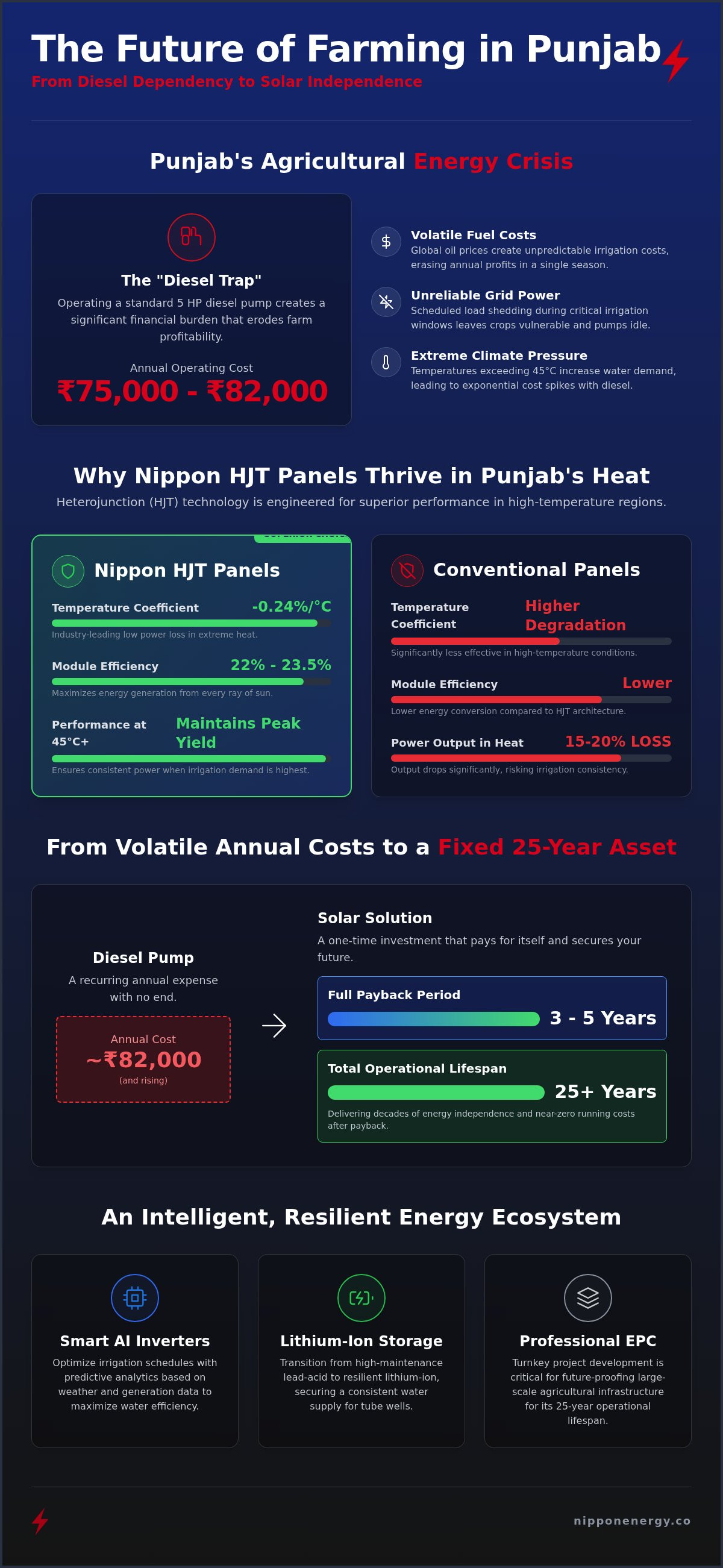
Operating a standard 5 HP diesel pump in Punjab now requires an annual expenditure of approximately ₹75,000 to ₹82,000, an overhead that directly erodes the profitability of every acre. You've likely felt the pressure as rising fuel costs and unpredictable heatwaves threaten your crop yields and water security. Relying on volatile energy markets isn't just a logistical challenge; it's a systemic risk to the long-term viability of your agricultural operations.
This 2026 guide demonstrates how agricultural solar solutions punjab are neutralizing these threats through high-efficiency HJT architecture and intelligent energy management. We'll explore how Nippon HJT solar panels, engineered with a superior temperature coefficient of -0.24%/°C, maintain peak performance during extreme heat when traditional panels lose efficiency. You'll learn how to transition from high-maintenance lead-acid batteries to resilient lithium-ion storage and Smart AI inverters, establishing a 25-year infrastructure that delivers total energy independence and secures your irrigation needs for decades to come.
Key Takeaways
- Understand why HJT technology is the superior choice for Punjab’s extreme temperatures, offering higher efficiency and lower power degradation during 45°C+ summer peaks.
- Calculate the financial transition from volatile diesel costs to fixed infrastructure by implementing agricultural solar solutions punjab that typically achieve a full payback within 3 to 5 years.
- Discover how Smart AI inverters integrate predictive analytics and remote monitoring to optimize irrigation schedules based on real-time weather patterns and generation data.
- Evaluate the long-term reliability of lithium-ion storage systems compared to traditional lead-acid batteries for securing consistent water resources for tube wells.
- Learn why professional EPC project development is critical for future-proofing large-scale agricultural infrastructure with a 25-year operational lifespan.
The Energy Crisis in Punjab’s Agricultural Heartland
Punjab serves as the primary engine for Pakistan's food security, yet its foundational infrastructure is currently tethered to an obsolete and failing energy model. Agriculture contributes approximately 19% to the national GDP, but the sector's reliance on diesel-powered tube wells has created a systemic vulnerability. This "Diesel Trap" occurs when the rising cost of fuel outpaces the market value of the harvest, effectively turning productive land into a financial liability. For many growers, the volatility of global oil prices means that irrigation costs are no longer a predictable line item but a volatile risk that can erase annual profits in a single season.
The transition toward decentralized energy is accelerating as traditional methods become economically unviable. While the national grid remains an option, it's often plagued by scheduled load shedding during critical irrigation windows, leaving crops vulnerable during peak growth stages. This instability has forced a shift toward agricultural solar solutions punjab, where the focus moves from simple subsistence to a sophisticated, technology-driven energy architecture. By localized power generation, farms can bypass the logistical hurdles and high costs associated with fuel transport and grid instability.
Diesel Dependency and Farm Profitability
Operating a traditional 5 HP diesel pump has become a significant burden on farm budgeting. Beyond the literal price at the pump, farmers face hidden costs including the time and transport required to move fuel to remote fields. These logistics often fail during peak demand periods, leading to delayed watering and reduced crop yields. Grid-tied systems don't offer a reliable alternative; the intermittent nature of the power supply in rural areas means pumps often sit idle when they're needed most. Implementing agricultural solar solutions punjab solves this by providing a dedicated, high-availability power source that functions independently of the national energy crisis.
Climate Resilience in the Indus Basin
The Indus Basin is currently facing extreme thermal pressures, with summer temperatures regularly exceeding 45°C. These heatwaves increase water demand through higher evapotranspiration rates, requiring more frequent and intensive irrigation cycles. When energy costs are tied to diesel, these increased requirements lead to exponential cost spikes. Solar infrastructure thrives in this environment, converting the very source of the heat into the power required to mitigate its effects.
As the landscape of Solar Power in Pakistan expands, the integration of advanced energy systems is becoming the benchmark for climate resilience. Securing the future of staple crops like wheat and cotton requires an energy strategy that isn't affected by fuel shortages or price hikes. By adopting a resilient energy framework, Punjab’s agricultural sector can maintain consistent output and protect the livelihoods of millions against the dual threats of economic volatility and climate change.
Technical Architecture: Why HJT Panels Rule the Punjab Heat
Heterojunction (HJT) technology represents the current apex of photovoltaic engineering for high-temperature regions. By combining N-type crystalline silicon with amorphous thin-film silicon layers, Nippon HJT solar panels achieve module efficiencies of 22% to 23.5%. This specific architecture is vital for agricultural solar solutions punjab, where summer peaks often exceed 45°C. The hybrid design allows for superior light absorption and energy conversion, outperforming traditional mono-PERC modules in every measurable metric of agricultural productivity.
Standard solar panels suffer significant power loss as ambient temperatures rise. Nippon HJT panels feature an industry-leading temperature coefficient of -0.24%/°C, which is significantly lower than the industry average. While conventional modules might lose 15% to 20% of their rated output in the midday sun, HJT architecture maintains a higher energy yield. This ensures that tube wells receive consistent power when irrigation demand is highest. Such technical precision aligns with the goals of the World Bank agricultural transformation project, which prioritizes climate-resilient infrastructure to secure regional food supplies.
Punjab’s specific geography offers a unique advantage through high soil albedo. The reflective nature of the ground in central and southern Punjab allows bifacial modules to capture sunlight from both sides. Nippon’s bifacial HJT panels utilize this reflected light to provide a "bifacial gain," potentially increasing total energy generation by up to 25% without expanding the physical footprint of the array. These systems also offer extreme resistance to Potential Induced Degradation (PID), a common failure point in humid agricultural zones where moisture and high voltage can lead to rapid power loss over time.
HJT vs. TOPCon: Selecting the Right Module
Choosing between high-efficiency technologies requires a calculation of long-term ROI. While Nippon TOPCon solar panels offer a robust and cost-effective solution for many growers, HJT provides a higher efficiency ceiling for large-scale, 25-year projects. The N-Type architecture in both technologies ensures lower annual degradation rates, but HJT's superior performance in extreme heat makes it the definitive choice for the Indus Basin. You can explore our full range of high-performance solar modules to determine which technical profile suits your specific land requirements.
Dust and Soiling Mitigation in Rural Zones
Central Punjab’s arid environment introduces high levels of airborne dust, which can settle on panels and reduce output. Nippon solar panels utilize advanced anti-reflective coatings and high-durability glass to minimize these soiling losses. Implementing a structured maintenance strategy, combined with the panels' smooth surface tension, ensures that dust accumulation does not compromise the efficiency of your agricultural solar solutions punjab. Regular automated cleaning or simple manual rinsing can maintain the 25-year infrastructure at peak performance levels.
Solar Pumping vs. Diesel: A 2026 Economic Comparison
Transitioning to agricultural solar solutions punjab represents a fundamental shift from recurring operational expenditure (OPEX) to a strategic capital investment (CAPEX). Traditional diesel irrigation requires a constant, unpredictable cash flow for fuel, lubricants, and frequent engine overhauls. In contrast, solar infrastructure effectively "pre-pays" for 25 years of energy. Current economic data for Pakistan indicates that most medium-to-large agricultural operations achieve a full payback on their solar investment within 3 to 5 years. Once this threshold is crossed, the marginal cost of water drops to near zero, which significantly expands the net profit margins of every acre under cultivation.
Remote farm locations often face a "logistics tax" that isn't always captured on a standard balance sheet. Transporting large volumes of diesel through rural Punjab introduces risks of theft, fuel adulteration, and mechanical delays during critical watering windows. By installing a localized energy hub, you eliminate these supply chain dependencies entirely. This modernization does more than just reduce overheads; it increases the underlying asset value of the land. A farm equipped with autonomous, high-performance energy infrastructure is a more resilient and valuable property than one tethered to the volatility of the national fuel market.
ROI Analysis for Large-Scale Tube Wells
A granular analysis of return on investment reveals the stark inefficiency of internal combustion engines. Diesel generators produce electricity at a significantly higher cost per unit compared to the leveled cost of solar energy. Furthermore, diesel engines require intensive maintenance schedules, whereas solar hardware is solid-state with no moving parts to wear down. The integration of Lithium-Ion Battery Storage is a critical component for farms requiring 24/7 irrigation. Unlike traditional lead-acid alternatives, lithium-ion systems provide the high discharge depth and cycle life necessary to maintain water pressure through the night, ensuring that crop hydration isn't limited by daylight hours.
Grid-Parity and Excess Energy Monetization
Modern agricultural solar solutions punjab allow farms to function as decentralized power plants. Through net-metering, excess energy generated during peak summer months can be exported back to the national grid, creating a secondary, passive revenue stream for the farm. The 2026 regulatory framework in Punjab has streamlined the approval process for agricultural net-metering, making it easier for large estates to monetize their unused capacity. This diversification of income provides a financial buffer during lean harvest seasons, transforming the agricultural operation from a heavy energy consumer into a productive energy producer.
Implementing Smart Agriculture with AI Inverters
The effectiveness of modern energy architecture depends on its ability to orchestrate power with precision. While high-efficiency panels provide the raw generation capacity, Smart AI Solar Inverters serve as the central processor for agricultural solar solutions punjab. These systems use machine learning to analyze local weather patterns and forecast energy availability. By integrating predictive analytics, the inverter decides the optimal time to activate high-load tube wells. This ensures irrigation happens exactly when solar generation is at its peak. It's a level of technical orchestration that eliminates the manual guesswork that often leads to inefficient energy use or system strain.
Managing multiple farm sites across the Indus Basin traditionally required significant travel and manual oversight. Smart AI architecture changes this by centralizing control into a single smartphone application. You can monitor generation levels, battery health, and pump status across various locations in real-time. The system also performs automated load shifting. It prioritizes essential irrigation during the day while managing lithium-ion storage levels for nighttime requirements. This intelligent energy distribution maximizes self-consumption and reduces reliance on external power sources.
Intelligent Water Management
Smart AI inverters provide a critical layer of protection for expensive pumping equipment. Rural power environments in Punjab are often prone to voltage fluctuations that can burn out traditional motors. The inverter acts as a sophisticated buffer. It regulates the flow of electricity to ensure a stable and clean power supply. By syncing pump operation with peak solar hours automatically, the system reduces mechanical wear. It optimizes water delivery based on data-driven irrigation schedules that account for real-time soil and moisture conditions.
Predictive Maintenance for Zero Downtime
Reliability is the cornerstone of 25-year infrastructure. Effective Solar System Maintenance in rural zones is often reactive. It usually occurs only after a hardware failure has already disrupted operations. AI-enabled systems shift this to a proactive model. The software identifies performance deviations, such as unusual degradation or heavy soiling, before they lead to failure. This reduces the need for frequent on-site technical visits and ensures your energy supply remains uninterrupted during the most critical stages of the crop cycle. To learn more about integrating these technologies into your estate, explore the Nippon Energy product portfolio.
Nippon Energy: Turnkey EPC for Punjab’s Agriculture
Large-scale agricultural projects require more than just hardware; they demand a rigorous engineering framework. A professional Solar EPC Service ensures that every component, from the HJT modules to the AI inverters discussed previously, functions as a unified, high-performance asset. Nippon Energy manages this entire lifecycle, providing a seamless transition from diesel dependency to total energy independence. Our localized presence in Lahore and Karachi facilitates rapid response times and on-site technical support, which is a critical requirement for rural operations where downtime directly impacts crop health.
Central to our approach is the NipponHev System. This pre-engineered solution is designed specifically for the unique demands of high-yield farming in the Indus Basin. It integrates our most resilient hardware into a standardized architecture, reducing installation timelines while maximizing energy density. By deploying these optimized agricultural solar solutions punjab, estates can secure their water resources with infrastructure built to withstand the region's specific environmental stressors.
Feasibility and Site Engineering
The structural integrity of a solar array begins with precise site engineering. We perform exhaustive soil stability assessments to design mounting structures capable of withstanding Punjab’s specific wind loads and seasonal dust storms. Our engineers create custom string designs that maximize tube well efficiency, ensuring that voltage drop is minimized across large distances. This process includes the procurement of Tier-1 Nippon HJT and TOPCon modules, selected based on the specific thermal and reflective profile of your land. Precision in the planning phase prevents the mechanical failures that often plague less sophisticated installations.
Financing and Commissioning
Navigating the financial landscape is a primary hurdle for agricultural modernization. We assist Punjab farmers in evaluating solar financing options that align with the 3 to 5-year payback periods typical of these systems. Once the physical installation is complete, our commissioning phase involves rigorous testing to verify 25-year performance reliability. We don't simply exit the site after installation. Our ongoing asset management and monitoring services ensure that your agricultural solar solutions punjab continue to operate at peak efficiency, protecting your capital investment for its entire operational lifecycle. Our goal is to provide the technical foundation for a permanent, cost-free energy supply.
Securing Punjab’s Agricultural Future Through Energy Autonomy
The transition from volatile diesel dependency to fixed-cost infrastructure is a strategic necessity for regional food security. By integrating high-efficiency architecture and predictive intelligence, farms can neutralize the impact of rising fuel costs while maintaining consistent irrigation during extreme thermal events. These agricultural solar solutions punjab provide the technical foundation required to move beyond the limitations of the traditional energy grid and secure a 25-year operational lifespan.
Nippon Energy remains a global leader in HJT technology, providing turnkey EPC excellence and proprietary Smart AI management to future-proof your estate. Our systems are engineered specifically to withstand the unique environmental pressures of the Indus Basin, ensuring that your investment delivers maximum returns. Request a Technical Feasibility Study for Your Punjab Farm to evaluate how advanced energy orchestration can transform your operational efficiency. Establishing energy independence is the most effective way to protect your harvest and ensure the long-term viability of your land.
Frequently Asked Questions
Is solar power enough to run a large tube well in Punjab?
Modern solar infrastructure is engineered to power large-scale tube wells by matching the array capacity to the specific horsepower of the motor. By utilizing high-efficiency modules, these systems provide the consistent torque required for deep-well extraction. This ensures that even high-load agricultural operations can maintain full water pressure during peak irrigation windows without relying on the national grid or diesel generators.
What is the difference between HJT and standard solar panels for farming?
HJT panels utilize a hybrid architecture that offers significantly higher efficiency and thermal stability compared to standard mono-PERC modules. While traditional panels lose substantial power as temperatures exceed 25°C, HJT technology maintains peak performance in the extreme heat of the Indus Basin. This resilience makes them the superior choice for long-term agricultural infrastructure where maximum energy yield during summer peaks is critical for crop survival.
How long does it take for an agricultural solar system to pay for itself?
Most agricultural solar solutions punjab reach the point of grid-parity and full payback within 3 to 5 years. This calculation accounts for the elimination of diesel fuel costs and the reduction in mechanical maintenance for internal combustion engines. Once the initial capital investment is recovered, the cost of irrigation becomes virtually zero, providing a permanent hedge against future energy price volatility in Pakistan.
Can I use solar energy at night for irrigation?
Nighttime irrigation is fully supported through the integration of Nippon Lithium-ion Battery Storage Systems. These high-capacity units capture excess energy generated during daylight hours for use during the night. Unlike traditional lead-acid batteries, lithium-ion technology offers the deep discharge cycles and longevity required to power heavy pumping loads reliably after sunset, enabling 24/7 water management.
Do I need a special permit for net-metering on my farm in Punjab?
You must obtain a net-metering license from the National Electric Power Regulatory Authority (NEPRA) to sell excess power back to the grid. The application process is typically managed through your local distribution company, such as LESCO or MEPCO. The 2026 regulatory framework has simplified these requirements for agricultural estates, allowing farmers to diversify their income by exporting surplus energy during the off-season.
How do Nippon Energy's AI inverters protect my pumping equipment?
Nippon Smart AI Inverters provide active protection by monitoring and regulating the power flow to prevent damage from voltage surges or frequency instability. These intelligent systems use machine learning to detect anomalies in the electrical signature of the pump motor. By providing a clean, stable current, the inverter extends the operational lifespan of your pumping equipment and reduces the risk of expensive mechanical failures.
What happens to solar panels during a dust storm or heavy monsoon?
High-quality solar modules are engineered with tempered glass and robust frames to withstand the physical impact of dust storms and heavy monsoon rains. Professional EPC services ensure that mounting structures are anchored to meet regional wind load specifications. While dust accumulation can temporarily reduce output, the panels' anti-reflective coatings allow for easy cleaning, and their IP68-rated enclosures protect sensitive electronics from moisture ingress.
Are there any government subsidies for agricultural solar in 2026?
The Punjab government frequently offers various solarization incentives to manage the rising cost of agricultural power subsidies. These programs can include concessional financing or direct support for solar pump installations. Farmers should consult the latest 2026 guidelines from the Punjab Agriculture Department to verify current eligibility, as these initiatives are designed to accelerate the adoption of agricultural solar solutions punjab across the province.


