

How much of your facility's net profit is currently being eroded by the escalating cost of diesel and the instability of the national grid? For industrial operators, the 2026 energy landscape presents a critical choice between mounting operational overheads and technical independence. You likely recognize that frequent load shedding and high peak-hour tariffs aren't just inconveniences; they're direct threats to the thermal integrity of your perishable inventory. Implementing solar energy for cold storage pakistan is no longer a peripheral sustainability goal but a core requirement for long-term commercial survival.
We understand that maintaining a precise temperature around the clock requires more than just standard panels. This guide details how advanced HJT solar technology and AI-driven lithium-ion storage systems can eliminate your grid dependence and provide a path to zero-bill operations. We'll analyze the technical specifications of high-resilience hardware and the strategic shift toward self-consumption under the latest net-billing regulations. By the end of this article, you'll have a clear roadmap for securing a 25-year lifespan of uninterrupted, cost-effective cooling that protects your goods and your bottom line.
Key Takeaways
- Analyze the 2026 industrial tariff landscape and learn how solar energy for cold storage pakistan addresses the critical challenge of maintaining cold chain stability.
- Identify why Nippon HJT panels are the engineered choice for high-temperature environments, providing superior energy yield in conditions exceeding 40°C.
- Discover how Nippon Lithium-ion Battery Storage Systems and Smart AI Inverters manage heavy compressor inrush currents to ensure uninterrupted 24/7 cooling.
- Understand the essential phases of the industrial EPC lifecycle, from precision thermal loss analysis to the structural reinforcement of cold storage facilities.
- Explore the NipponHev integrated energy architecture to achieve a turnkey solution for energy independence and long-term operational cost reduction.
The Economic Imperative: Solar Energy for Cold Storage in Pakistan
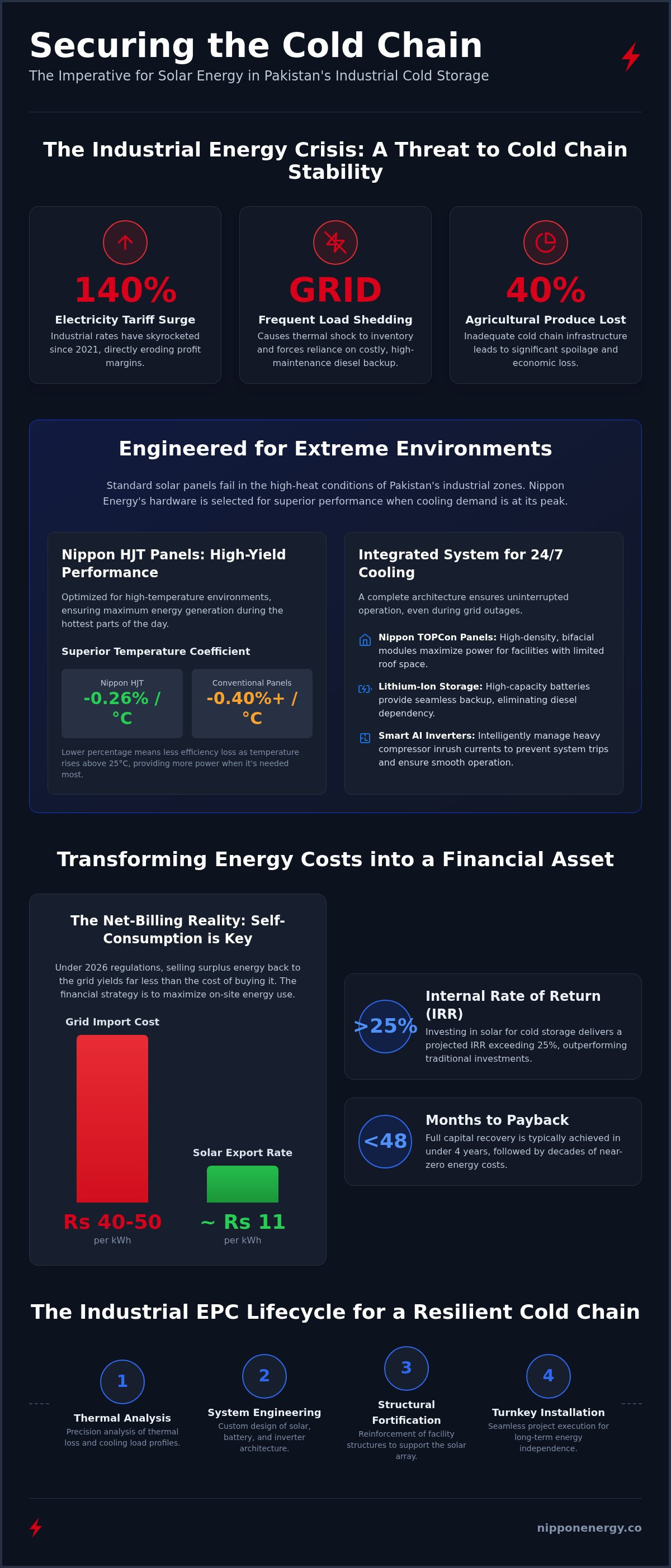
The 2026 industrial landscape in Pakistan demands a fundamental shift in how temperature-sensitive facilities manage power. With electricity tariffs having surged by nearly 140% since 2021, the financial burden on cold storage operators is no longer a manageable variable; it's a direct threat to solvency. Relying on the national grid means absorbing an import rate of Rs 40-50 per kWh while facing the persistent risk of thermal shock to inventory. Implementing solar energy for cold storage pakistan transforms a facility from a passive consumer into an energy-independent asset. This transition is critical for stabilizing a sector where an estimated 40% of agricultural produce is lost due to inadequate cold chain infrastructure. High energy costs directly diminish the global competitiveness of Pakistani food exports, making technical modernization a prerequisite for market expansion. Several factors define this new economic reality:
- Import vs. Export Gap: The massive delta between the Rs 50 import rate and the Rs 11 export rate under current net-billing regulations.
- Grid Reliability: The persistent frequency of load shedding in major industrial hubs like Karachi and Lahore that forces reliance on expensive backup.
- Fixed Charges: Proposed increases in fixed charges for industrial consumers with low grid consumption, necessitating higher self-generation efficiency.
Combating Grid Instability and Load Shedding
The hidden cost of industrial load shedding extends far beyond the price of diesel, which remains volatile in 2026. Frequent power transitions cause mechanical wear on cooling compressors and risk catastrophic spoilage during prolonged outages in industrial zones. Traditional grid-tie solar systems offer no relief during these periods because they're engineered to shut down during grid failure for safety. A sophisticated hybrid energy architecture is the only viable solution for maintaining absolute thermal consistency. By integrating high-capacity battery storage, facilities ensure that cooling cycles continue without a millisecond of interruption, bypassing the high maintenance costs and fuel expenses of diesel backup.
Leveraging Net Metering for Industrial ROI
NEPRA's February 2026 regulations have transitioned the market from traditional net-metering to a net-billing framework. Under this system, the export rate for surplus power is approximately Rs 11 per kWh, which is significantly lower than the cost of drawing power from the grid during peak hours. This policy shift makes self-consumption the primary driver of financial performance. Industrial systems must now be designed with precision load profiling to ensure maximum utilization of generated power on-site, proving that solar energy for cold storage pakistan is a strategic hedge against future tariff hikes. Based on 2026 energy pricing and the five-year buyback agreement terms, industrial solar installations for cold storage are projected to deliver an internal rate of return exceeding 25%, with full capital recovery typically achieved within 48 months.
Selecting High-Efficiency Hardware: HJT vs TOPCon in Extreme Heat
Ambient temperatures in industrial hubs like Karachi and Lahore frequently exceed 40°C, a threshold where standard photovoltaic modules experience significant power drop-off. For an effective deployment of solar energy for cold storage pakistan, selecting hardware based on the temperature coefficient is the most critical technical decision. This metric defines the percentage of efficiency lost for every degree the cell temperature rises above 25°C. While conventional panels may lose 0.4% or more of their rated power per degree, Nippon HJT Solar Panels maintain a superior coefficient of approximately 0.26%. This ensures higher energy yields during the hottest hours of the day when cooling demand is at its peak.
For facilities with limited roof space, Nippon TOPCon Solar Panels offer a high-density alternative that maximizes power generation per square foot. These modules leverage bifacial technology, which is particularly effective in the dusty environments of Pakistani industrial zones. By capturing reflected irradiance from the roof surface, bifacial modules can achieve a power gain of up to 25%. This increased energy output is vital for stabilizing the cold chain, especially considering that 30–40% of fruits and vegetables are lost annually due to thermal instability. You can explore our full range of high-performance industrial solar solutions to find the right technical fit for your facility.
HJT Technology: The High-Temperature Champion
HJT technology utilizes a symmetrical cell structure that combines crystalline silicon with amorphous silicon thin films. This architecture eliminates Light-Induced Degradation (LID) and significantly reduces the annual power loss common in older technologies. Compared to traditional PERC modules, which may degrade by 0.7% annually, HJT panels offer a more resilient degradation curve of approximately 0.25%. This ensures that your investment maintains its performance over a 25-year operational lifespan, providing the long-term reliability required for industrial cooling.
Durability Standards for Industrial Environments
Industrial roofs in Pakistan often consist of corrugated metal sheds that require panels with high mechanical load ratings to withstand wind pressure and maintenance traffic. Nippon modules are engineered to exceed standard load requirements while maintaining high resistance to Potential Induced Degradation (PID), which is a common failure point in humid coastal regions like Karachi. HJT panels produce more energy per square metre in Pakistans climate because their symmetrical cell structure minimizes internal resistance and maximizes electron flow even under intense thermal stress. This technical resilience makes them the logical choice for future-proofing your energy infrastructure.
Achieving 24/7 Thermal Stability with Lithium-Ion and AI
Maintaining a constant -20°C environment requires more than just generation; it demands the intelligent orchestration of stored energy. For facilities deploying solar energy for cold storage pakistan, the integration of Nippon Lithium-ion Battery Storage Systems is the only way to bridge the gap between daylight production and nighttime demand. Many existing cooling infrastructures in the region remain outdated and energy-intensive, which complicates the transition to renewable sources. A primary technical hurdle is the "Inrush Current"—the massive surge of electricity required when large cooling compressors initiate their cycles. Without the high-discharge capabilities and precise regulation provided by Smart AI Solar Inverters, these surges can destabilize the local microgrid or cause premature hardware failure. AI solves this by smoothing power delivery and ensuring the battery bank handles the heavy lifting without grid assistance.
Lithium-Ion: The Industrial Standard for 2026
Nippon Lithium-ion systems provide a transformative advantage over traditional lead-acid batteries through superior cycle life and Depth of Discharge (DoD). While lead-acid units are typically limited to a 50% DoD to prevent rapid degradation, our lithium-ion architecture allows for a 90% DoD without compromising the 6,000+ cycle lifespan. This efficiency is critical for heavy industrial use where the battery bank must discharge deeply every night. Our systems also include advanced thermal management protocols to ensure safety in high-temperature warehouses. You can find more technical benchmarks in The Definitive Guide to Lithium-Ion Battery Storage.
AI-Enhanced Load Management
The core of a resilient solar energy for cold storage pakistan strategy is predictive cooling. AI-driven inverters analyze historical weather data and cooling load patterns to pre-chill inventory during periods of peak solar production. This strategy increases the "thermal inertia" of the facility, reducing the energy required from batteries during the night. By utilizing peak shaving, the system automatically draws from stored energy during high-cost peak grid hours, protecting the operator from the most expensive industrial tariffs. Real-time remote monitoring provides performance alerts that prevent thermal shock, ensuring that the transition from grid to battery remains seamless and the cold chain remains unbroken.
The Solar EPC Lifecycle for Industrial Cold Storage
Deploying a large-scale energy system requires a methodical, engineering-led approach to ensure the structural and electrical integrity of the facility. The lifecycle of solar energy for cold storage pakistan begins long before the first panel is mounted. It involves a rigorous transition from macro-level energy goals to micro-level technical specifications. A standardized EPC (Engineering, Procurement, and Construction) framework is essential for managing the complexities of industrial cooling loads and high-voltage grid synchronization. This disciplined progression ensures that every component, from the HJT cells to the AI inverters, performs at its peak theoretical efficiency for decades. The process follows five definitive stages:
- Step 1: Detailed Load Profiling: We conduct a granular analysis of your facility's energy consumption, identifying compressor startup surges and thermal loss variables in the warehouse insulation.
- Step 2: Structural Assessment: Engineering teams evaluate the load-bearing capacity of industrial roofs, ensuring they can support high-density TOPCon or HJT arrays against seismic and wind stresses.
- Step 3: Tier-1 Procurement: Sourcing of Nippon hardware, including high-resilience panels and proprietary Lithium-ion storage, ensures a unified energy architecture.
- Step 4: Professional Construction: Installation is executed according to international safety standards, followed by seamless synchronization with the local DISCO grid under net-billing regulations.
- Step 5: Commissioning and Validation: The system undergoes rigorous stress testing to verify that real-world energy yields match our initial performance projections.
Engineering for Longevity
Coastal regions like Karachi demand specialized mounting structures with high-wind resistance and anti-corrosive coatings to prevent structural fatigue. We adhere to strict electrical safety standards, utilizing industrial-grade DC cabling, comprehensive earthing systems, and multi-stage surge protection to safeguard your cooling equipment. For a deeper understanding of how we manage complex industrial deployments, review our comprehensive guide on Solar EPC Services. These protocols ensure that the hardware remains operational through extreme weather events and grid fluctuations.
Feasibility and Financial Modelling
Before any capital expenditure occurs, a technical feasibility study is mandatory to calculate the projected internal rate of return (IRR) and payback period. We analyze the fiscal impact of current NEPRA tariffs and the five-year net-billing agreement to provide a transparent financial roadmap. Precision load profiling for industrial cooling ensures that the solar array and battery bank are sized to handle peak compressor startup demands without over-investing in unnecessary capacity. This data-driven approach transforms your roof into a high-yield financial asset. To begin your facility's transition to energy independence, consult with our industrial project team for a customized technical assessment.
Nippon Energy: Engineering Resilient Cold Chain Infrastructure
Nippon Energy operates as a world-class partner for industrialists seeking technical sovereignty and long-term operational security. By deploying solar energy for cold storage pakistan, we provide the tools required for large-scale success in a volatile energy market. Our presence in Lahore and Karachi operational hubs ensures that technical support is localized and responsive, bridging the gap between global engineering standards and regional environmental challenges. We don't just provide components; we architect permanent solutions that withstand the test of time and climate. This methodical approach ensures that your facility transitions from a grid-dependent cost center to a self-sustaining industrial asset.
The NipponHev Integrated System
The NipponHev System represents the pinnacle of integrated solar architecture. It simplifies industrial energy management by unifying generation, storage, and AI-driven load balancing into a single, cohesive platform. This fully integrated approach eliminates the compatibility issues often found in piecemeal systems, ensuring that cooling compressors receive stabilized power even during rapid grid transitions. Across Pakistan, industrial facilities that have transitioned to this architecture report significant reductions in operational overhead and improved thermal stability for sensitive inventory. By consolidating all power functions into one intelligent system, we provide the quiet power needed to run complex cooling cycles without manual intervention. To begin your facility's technical transformation, you should consult with Nippon Energy engineers for your cold storage project.
Post-Installation Excellence
Long-term reliability is maintained through professional Solar System Maintenance and rigorous performance monitoring. We implement predictive maintenance strategies that utilize real-time data to identify potential component fatigue before it results in system failure. In high-dust agricultural zones of Punjab and Sindh, specialized cleaning protocols are essential to prevent soiling loss, which can reduce panel efficiency by over 20% if left unmanaged. The deployment of our monitoring systems ensures 99.9% uptime for critical cooling infrastructure, establishing a layer of security that traditional energy sources cannot match. As your business grows, our modular battery systems allow for seamless expansion. This ensures your energy capacity scales alongside your storage requirements, future-proofing your investment against both rising tariffs and increasing demand.
Securing Industrial Resilience Through Technical Sovereignty
The transition to solar energy for cold storage pakistan represents a critical pivot from operational vulnerability to long-term financial stability. By integrating Tier-1 HJT and TOPCon hardware with AI-managed lithium-ion storage, facilities can maintain precise thermal control despite the escalating grid tariffs and load shedding of 2026. This technical architecture ensures that cooling compressors operate with 24/7 consistency, protecting perishable inventory and maximizing export potential. Nippon Energy brings Japanese engineering standards to the local market, providing the precision required for the extreme climates of Sindh and Punjab.
Our turnkey EPC services in Lahore and Karachi offer a streamlined path to energy independence, covering everything from structural load assessments to grid synchronization. We've designed our systems to be modular, allowing for future battery expansion as your facility scales. Establishing a resilient energy infrastructure today secures your competitive edge for the next 25 years. To begin your facility's technical transformation, Request a Technical Feasibility Study for Your Cold Storage Facility and take the first step toward zero-bill operations. Your journey toward a self-sustaining, high-performance cold chain starts with an engineering-led vision.
Frequently Asked Questions
How much solar capacity does a typical cold storage in Pakistan require?
Capacity requirements are determined through precise load profiling and thermal loss analysis of the specific facility. A typical industrial cold storage unit in Pakistan often requires between 100kW and 500kW of solar capacity to achieve a significant grid offset. Exact sizing depends on the insulation quality, compressor efficiency, and the total volume of perishable inventory being managed.
Can solar energy run cold storage compressors during the night?
Solar energy can power cold storage compressors at night when integrated with high-capacity battery storage. By utilizing Nippon Lithium-ion Battery Storage Systems, facilities store surplus energy generated during peak daylight hours. This stored power is then discharged to maintain required thermal setpoints throughout the night without drawing from the national grid.
What is the payback period for industrial solar in Pakistan in 2026?
The projected payback period for industrial solar energy for cold storage pakistan in 2026 is approximately 48 months. This rapid return on investment is primarily driven by high industrial electricity tariffs and the current net-billing framework. These factors make self-generation and self-consumption significantly more cost-effective than relying on utility power.
How do HJT solar panels perform in Pakistans 45°C summer heat?
Nippon HJT solar panels are specifically engineered for extreme thermal resilience, maintaining a low temperature coefficient of approximately 0.26%. This technical advantage allows them to produce more energy than conventional modules during 45°C summer peaks. They experience significantly less power drop-off under intense heat, ensuring consistent cooling performance when it's needed most.
Is lithium-ion storage better than lead-acid for industrial cooling?
Lithium-ion storage is technically superior for industrial cooling due to its 90% Depth of Discharge and a lifespan exceeding 6,000 cycles. Lead-acid batteries often degrade quickly under the heavy, frequent discharge cycles required by cooling compressors. Lithium-ion systems provide the high discharge rates and long-term durability necessary for maintaining 24/7 thermal stability.
What maintenance is required for a large-scale solar plant in a dusty environment?
Large-scale plants in dusty agricultural zones require a structured cleaning protocol and real-time performance monitoring. Regular cleaning is essential to prevent soiling losses, which can otherwise reduce energy yield by over 20%. Professional maintenance ensures that the electrical balance of the system and all safety protocols remain optimized for a 25-year operational lifespan.
Does the Pakistani government offer incentives for solar-powered cold storage?
The Pakistani government supports solar adoption through a 0% customs duty on solar panel imports and exemptions from General Sales Tax. Tax benefits for the production of eco-friendly batteries, including lithium-ion, have been extended until June 2030 to bolster local manufacturing. These regulatory frameworks are designed to encourage industrial energy independence while reducing the national grid's load.
How does AI improve the efficiency of solar energy for cooling?
AI improves efficiency by executing predictive cooling cycles that align compressor operation with peak solar production hours. By utilizing Nippon Smart AI Inverters, the system performs intelligent load orchestration and manages inrush currents. This optimization reduces battery wear and ensures the facility maximizes the use of its own generated solar energy for cold storage pakistan.


