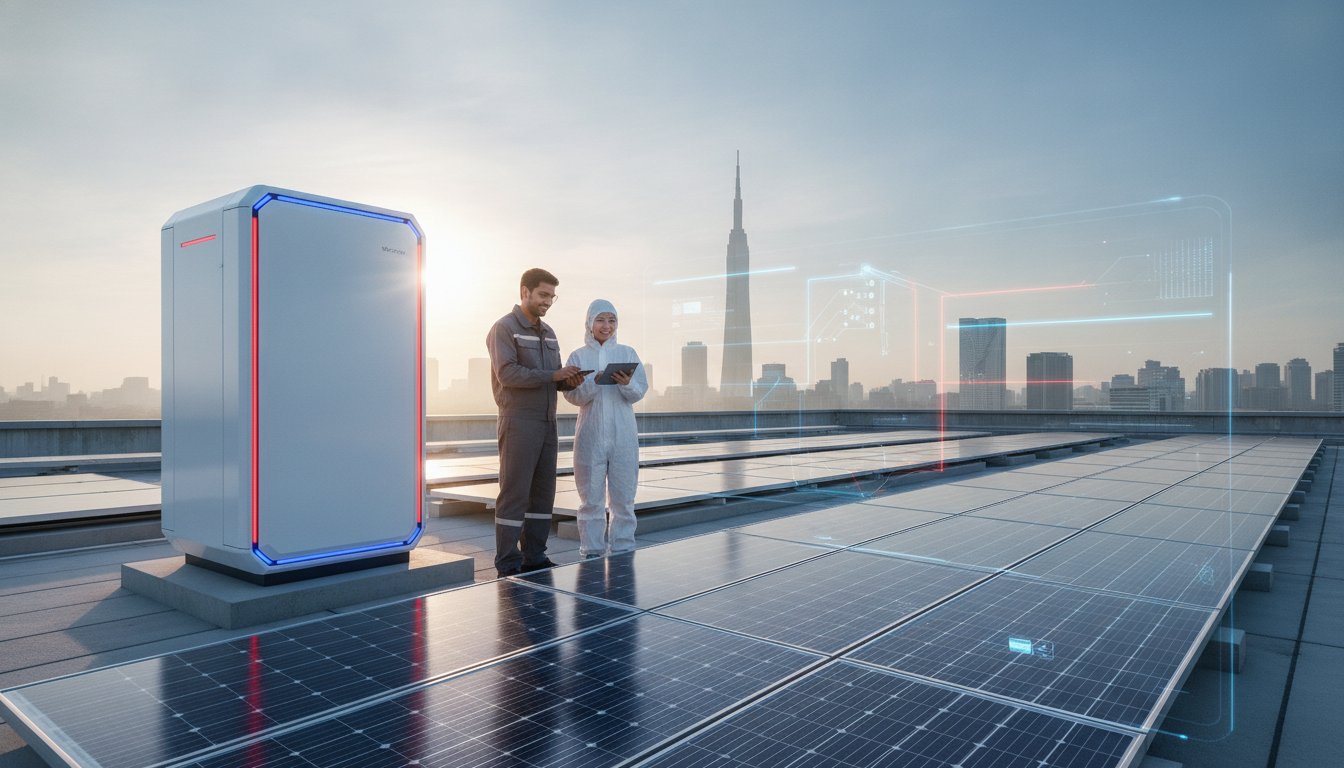
A diesel generator is no longer a strategic asset for a modern enterprise; it's a legacy liability that erodes your competitive edge. You've experienced how sudden production halts and rising peak demand charges undermine your operational growth. Achieving reliable business continuity with solar and battery storage pakistan is the only path to decoupling your success from an unstable grid. With commercial tariffs reaching approximately $0.16 per unit, the financial necessity of energy independence has never been more urgent.
We understand that your priority is maintaining 100% uptime without the maintenance headaches of lead-acid batteries or the volatility of fuel costs. This guide details how to build a high-efficiency energy architecture using Nippon HJT solar panels and AI-managed lithium-ion storage. You'll discover how to achieve a zero-second power transition for critical loads and secure predictable operational expenditure. We'll examine the 2026 regulatory landscape, including the shift to net billing, to ensure your infrastructure remains future-proof and high-performing.
Key Takeaways
- Understand why traditional lead-acid systems fail under high-frequency load shedding and how a modern energy architecture provides a permanent solution for industrial stability.
- Identify the technical advantages of Nippon HJT and TOPCon panels, which maximize energy generation in space-constrained urban environments through superior high-temperature resilience.
- Discover how integrating AI-driven lithium-ion systems ensures business continuity with solar and battery storage pakistan by providing a zero-second power transition for critical loads.
- Learn how Nippon Smart AI Inverters employ peak shaving and predictive load balancing to manage energy as a strategic asset rather than a fluctuating operational cost.
- Master the implementation process through professional EPC services that replace generic system sizing with precision engineering tailored to your facility's unique load profile.
The Crisis of Continuity: Navigating Pakistan’s 2026 Energy Landscape
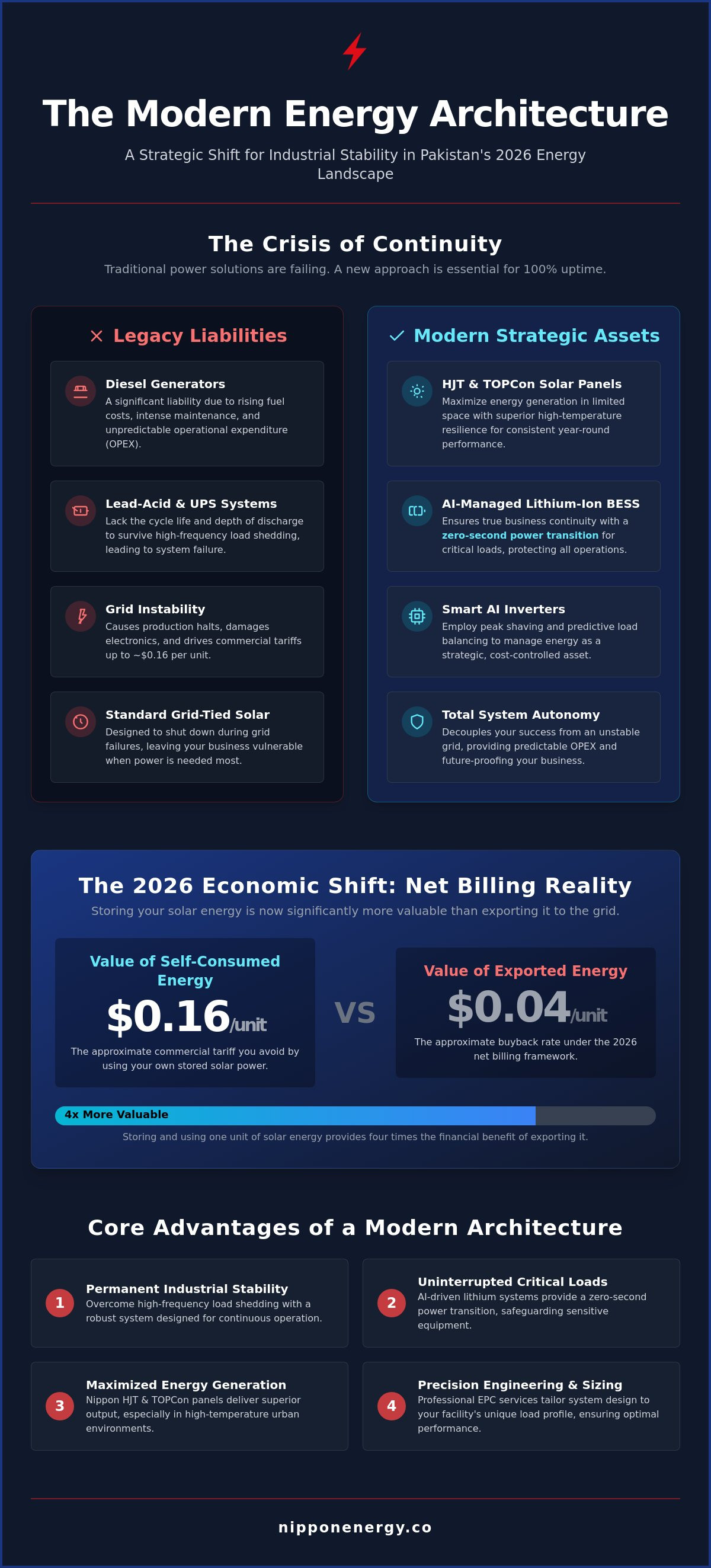
In the current industrial environment, business continuity with solar and battery storage pakistan represents the threshold between operational growth and systemic stagnation. The 2026 energy sector is defined by a fundamental shift in how power is valued and managed. Following the February 2026 transition from net metering to a net billing framework, the focus for manufacturers in Karachi and Lahore has moved from simple cost offset to total system autonomy. Traditional backup solutions like Uninterruptible Power Supplies (UPS) and lead-acid batteries are failing to meet these modern demands. These legacy systems lack the cycle life and depth of discharge required to survive the high-frequency load shedding cycles now common in Pakistan's industrial zones.
Diesel generators, once the standard for reliability, have become a significant liability. Rising fuel costs and the maintenance intensity of mechanical engines make them an expensive primary backup option that erodes profit margins. In contrast, an integrated energy architecture provides a predictable operational expenditure (OPEX) that diesel simply can't match. Understanding Pakistan's solar energy landscape is essential for any executive seeking to insulate their facility from these systemic risks and fluctuating utility costs.
The Hidden Cost of Power Instability
Power instability manifests as more than just dark factories; it creates a cascade of financial losses through ruined raw materials and damaged precision electronics. Voltage fluctuations often lead to equipment failure that requires costly repairs and results in extended downtime. In Karachi's textile hubs and Lahore's manufacturing clusters, the gap between grid supply and industrial demand continues to widen, driving commercial tariffs toward $0.16 per unit. Energy Resilience is the strategic capacity of a business to maintain uninterrupted operations through autonomous, high-performance power generation and storage systems.
Why Standard Solar Isn't Enough for Continuity
Standard grid-tied solar installations are insufficient for true continuity because they're designed to shut down during a grid failure to protect utility workers. Without intelligent lithium-ion storage, these systems leave businesses vulnerable exactly when they need power the most. The 2026 net billing regulations, which offer a buyback rate of approximately $0.04 per unit, make exporting energy less profitable than storing it for internal use. This economic reality necessitates a transition from a 'Solar-First' mentality to a 'Resilience-First' architecture. By prioritizing behind-the-meter storage, businesses ensure their solar investment serves as a primary power source that remains active regardless of the grid's status.
High-Efficiency Generation: The Role of HJT and TOPCon Technology
The foundation of any resilient energy architecture is its ability to generate maximum power within limited physical footprints. In the dense industrial zones of Karachi and Lahore, roof space is a finite resource that dictates the total capacity of your backup system. Nippon HJT and TOPCon panels serve as the primary engine for this architecture, delivering the high-wattage density required to support heavy industrial loads. Securing business continuity with solar and battery storage pakistan requires an uncompromising focus on this generation threshold, as every square meter of panel must contribute to the rapid replenishment of the battery bank.
Thermal stability is a critical factor for performance in the extreme climates of Sindh and Punjab. Standard PV modules often suffer from significant efficiency drops when ambient temperatures exceed 40°C. Nippon HJT panels feature a superior temperature coefficient, allowing them to maintain high output during peak summer months when cooling loads are highest. This consistent yield ensures that your Pakistan's renewable energy market investment remains productive even during the harshest weather conditions. By maximizing generation during limited daylight hours, these high-efficiency modules ensure that the lithium-ion storage system reaches a full state of charge before the evening peak demand window begins.
HJT vs TOPCon: Selecting the Right Engine
Choosing between HJT and TOPCon technology involves analyzing specific site conditions and bifacial gain potential. HJT technology offers a symmetrical cell structure that captures reflected light from the roof surface more effectively, increasing total energy harvest. These panels also exhibit lower degradation rates, which preserves the system's ability to provide 25-year continuity. For a deeper technical breakdown of these architectures, you can explore the specifications of Nippon HJT Solar Panels to understand how they integrate with industrial storage. Selecting the correct cell chemistry ensures that the generation profile matches the discharge requirements of your critical machinery.
Maximizing ROI Through High-Yield Generation
High-efficiency generation directly impacts the overall project economics by reducing the balance-of-system (BOS) costs. When you utilize panels with higher conversion rates, you require fewer modules, less mounting hardware, and reduced labor for installation. This efficiency is especially vital during winter or monsoon seasons when cloud cover limits solar irradiance. Nippon's 2026 panel technology accelerates system payback by ensuring the battery bank stays charged even during low-light periods, preventing the need for expensive grid-based charging. If you're ready to optimize your facility's roof space, you can consult with our engineering team to map your generation potential.
Lithium-Ion BESS: The Heart of Uninterrupted Industrial Operations
The transition from generation to storage marks the most critical phase in securing business continuity with solar and battery storage pakistan. While high-efficiency panels capture energy, Nippon Lithium-ion Battery Storage Systems act as the strategic reservoir that ensures this energy is available during grid failures or peak tariff periods. This technology replaces the unreliable nature of traditional backup with a disciplined, high-performance solution designed for the rigors of industrial use. Modern facilities require more than just power; they demand a zero-second transition that protects sensitive IT infrastructure and precision medical equipment from the micro-interruptions that often precede a total blackout.
Integrating a high-capacity BESS allows a facility to perform several strategic functions:
- Peak Shaving: Discharging stored energy during high-tariff windows to reduce utility bills.
- Load Leveling: Balancing the power draw to prevent equipment-damaging surges.
- Autonomous Operation: Maintaining full production capacity during extended grid outages.
By implementing peak shaving, businesses can intelligently discharge stored solar energy during high-tariff windows, effectively bypassing the most expensive utility rates. This proactive management transforms the battery from a passive backup unit into an active financial tool. Scalability is another core attribute of the Nippon architecture. Modular BESS designs allow industrial facilities to expand their storage capacity in alignment with production growth, ensuring that the energy infrastructure evolves alongside the business.
Lithium-Ion vs. Lead-Acid: A Technical Comparison
The technical disparity between lithium-ion and lead-acid chemistries is vast, particularly regarding longevity and usable capacity. Nippon systems provide over 6000 cycles at high depths of discharge, whereas lead-acid alternatives typically fail after 500 cycles under similar stress. This 12-fold increase in cycle life significantly lowers the total cost of ownership by eliminating frequent replacement cycles. For a comprehensive analysis of these technical advantages, consult The Definitive Guide to Lithium-Ion Battery Storage. High Depth of Discharge (DoD) ensures that almost all stored energy is accessible, providing a much higher energy density within a smaller physical footprint.
Thermal Management in Pakistan’s Climate
Operating high-capacity batteries in the 45°C+ heat of Sindh and Punjab requires sophisticated thermal regulation to prevent degradation. Nippon BESS units incorporate redundant cooling systems that maintain optimal internal temperatures even during extreme external heatwaves. Dust protection is equally vital for facilities located in the Korangi or Sundar Industrial Estates. Our IP65-rated enclosures provide a hermetic seal against particulate matter, ensuring that internal electronics remain uncontaminated. Automated fault isolation and advanced safety protocols further enhance the system's reliability, making it a stable partner for long-term industrial operations.
AI-Driven Orchestration: Smart Management for Zero Downtime
The hardware components of a power system provide the physical capacity for resilience, but the Nippon Smart AI Inverter serves as the central nervous system that translates this capacity into operational results. In the complex energy environment of 2026, manual power management is no longer feasible for industrial operations. Achieving true business continuity with solar and battery storage pakistan requires a system that can make millisecond-level decisions without human intervention. These intelligent inverters manage the intricate flow of electricity between HJT panels, lithium-ion storage, and the utility grid, ensuring that critical machinery remains powered regardless of external fluctuations.
Predictive load balancing is a core feature of this AI-driven architecture. By analyzing historical grid patterns and real-time data from local utility providers, the system anticipates load shedding schedules before they occur. This allows the facility to proactively transition to battery power or prioritize the most sensitive loads. Remote monitoring capabilities further enhance this control, providing executives with real-time performance tracking and granular diagnostics from any location globally. Automated peak shaving functions work silently in the background, discharging stored energy during the most expensive tariff windows to maximize financial savings without disrupting production cycles.
The Role of AI in Energy Independence
Nippon AI algorithms go beyond simple switching; they optimize charging cycles by integrating local weather forecasts. If the system anticipates a period of low solar irradiance, it can adjust the battery's state-of-charge via the grid during off-peak hours to ensure a safety buffer. This level of orchestration is detailed further in our analysis of Smart AI Solar Inverters. By automating these complex variables, the system reduces the operational overhead typically associated with industrial power plants, allowing your engineering team to focus on core manufacturing tasks rather than energy management.
Predictive Maintenance and System Longevity
Intelligence is also the primary driver of the system's 20-year lifespan. The AI performs continuous health checks, identifying cell-level imbalances within the battery bank before they escalate into hardware failures. This proactive approach allows for targeted maintenance rather than reactive repairs, significantly extending the durability of the entire energy architecture. AI orchestration prevents battery over-discharge by dynamically adjusting load limits based on real-time capacity and projected demand. This methodical management ensures that every component operates within its optimal technical parameters, preserving your long-term capital investment. To evaluate the AI-readiness of your current power infrastructure, you can explore our full range of Nippon Smart AI Inverters and integrated solutions.
Implementing Your Continuity Strategy: EPC and Project Lifecycle
The successful deployment of a resilient energy system depends less on individual components and more on the precision of their integration. Professional Engineering, Procurement, and Construction (EPC) services represent the critical bridge between high-performance hardware and long-term operational stability. For enterprises in Karachi and Lahore, achieving business continuity with solar and battery storage pakistan is a multi-phase engineering challenge that requires a holistic understanding of industrial load dynamics. A fragmented approach to procurement often results in system bottlenecks, whereas a unified EPC framework ensures that every subsystem is optimized for maximum efficiency and zero-second failover.
The project lifecycle begins with a rigorous feasibility study. Generic system sizing often fails because it relies on average consumption data rather than granular load profiling. Our engineers analyze peak surges, motor startup currents, and specific duty cycles to prevent inverter tripping during grid transitions. Once the profile is established, the engineering phase focuses on structural and electrical resilience. This includes designing mounting structures capable of withstanding local wind loads and coordinating protection schemes that isolate faults without shutting down the entire facility. Finally, a dedicated Operations and Maintenance (O&M) strategy is implemented to ensure the system delivers its rated performance for the next 25 years.
- Feasibility: Detailed analysis of historical energy usage and site-specific constraints.
- Engineering: Custom electrical architecture designed for industrial-scale resilience.
- Construction: Precision installation following international safety and performance standards.
- O&M: Continuous monitoring and scheduled maintenance to preserve asset value.
Turnkey Solutions with Nippon Energy
Nippon Energy manages the entire project lifecycle for Pakistani enterprises, acting as a single-source provider for HJT panels, AI inverters, and lithium-ion storage. This integrated model eliminates the compatibility risks associated with multi-vendor installations and simplifies the technical support structure. Our expertise in Solar EPC Services allows businesses to transition to renewable energy with minimal disruption to existing production schedules. By centralizing accountability, we ensure that the finished architecture meets the exact performance specifications required for industrial energy independence.
The NipponHev Integrated Advantage
For facilities requiring the highest level of reliability, the NipponHev System represents the ultimate continuity solution. This integrated architecture pre-configures generation and storage components to work in perfect synergy, reducing commissioning time and enhancing system response. Industrial hubs across Pakistan have already utilized this model to decouple their growth from grid instability and rising utility costs. If you're ready to secure your facility's future, you can consult with Nippon Energy’s High-Tech Architects to secure your business continuity and begin your transition to a resilient energy model.
Transitioning to an Autonomous Energy Future
The evolution of Pakistan's industrial sector demands a transition from legacy power systems to a sophisticated, autonomous energy architecture. Achieving true business continuity with solar and battery storage pakistan requires the synergy of HJT high-temperature resilience and the high-cycle performance of Nippon Lithium-ion Battery Storage Systems. This integration provides a calculated defense against rising commercial tariffs and persistent grid instability, transforming energy into a predictable strategic asset.
Nippon Energy provides full EPC project management in Pakistan, ensuring that every technical specification, from structural integrity to AI-driven load balancing, is engineered for maximum durability. By prioritizing precision in the project lifecycle, you insulate your operations from the hidden costs of production downtime and equipment failure. This is the foundation of a modern, future-proof enterprise that values longevity and technical excellence above all else.
Secure Your Business Continuity with Nippon Energy Architecture to empower your facility with the tools for large-scale success. Your journey toward total energy independence starts with a single, methodical step.
Frequently Asked Questions
How long can a battery storage system power my business during load shedding?
The duration depends on the total capacity of your storage bank relative to your facility's critical load. A properly sized Nippon Lithium-ion Battery Storage System can provide 4 to 12 hours of backup during extended load shedding events. Our engineers calculate the required kilowatt-hours based on your specific operational demand to ensure your machinery remains active until grid stability is restored.
What is the lifespan of Nippon Lithium-ion batteries in Pakistan's climate?
Nippon Lithium-ion Battery Storage Systems are engineered for a service life of 15 to 20 years, delivering over 6000 cycles at a high depth of discharge. These systems incorporate advanced thermal management and IP65 enclosures to withstand ambient temperatures exceeding 45°C. This durability is significantly superior to lead-acid alternatives, which typically require replacement every two years in Pakistan’s harsh climate.
Can I integrate a battery storage system with my existing solar panels?
Yes, existing solar installations can be retrofitted with storage via AC-coupling or by replacing the current inverter with a Nippon Smart AI Inverter. This integration is essential for achieving business continuity with solar and battery storage pakistan, as it allows your existing generation to charge the batteries during grid outages. Our EPC team evaluates your current infrastructure to ensure seamless electrical compatibility and safety.
How does AI improve the ROI of a solar and battery system?
AI improves ROI by automating complex energy decisions that maximize savings and hardware life. Nippon Smart AI Inverters use predictive algorithms to prioritize battery charging during off-peak hours and discharge during high-tariff windows. This intelligent orchestration reduces utility costs and prevents battery over-discharge, effectively shortening the payback period of your energy investment to approximately four to six years.
What maintenance is required for an industrial BESS?
Industrial Lithium-ion BESS requires minimal physical maintenance due to its solid-state design and hermetically sealed enclosures. Unlike diesel generators or lead-acid batteries, there's no need for fuel refills or electrolyte checks. Maintenance primarily involves remote software updates and periodic visual inspections of electrical connections. Nippon Smart AI Inverters perform continuous digital health checks to identify potential issues before they require on-site intervention.
Is it possible to go completely off-grid for a commercial facility in Pakistan?
It's technically possible to go completely off-grid, although a hybrid energy architecture is generally more cost-effective for commercial facilities. A hybrid system utilizes the grid as a secondary backup while maintaining energy independence through solar and storage. This approach ensures 100% uptime without the excessive capital expenditure required to size a system for the worst-case winter irradiance scenarios.
How does peak shaving reduce my monthly electricity bill?
Peak shaving reduces electricity bills by discharging stored solar energy during the specific hours when utility tariffs are at their highest. By using battery power instead of the grid during these windows, businesses avoid the expensive peak demand charges that significantly inflate industrial energy costs. This strategy is particularly effective for business continuity with solar and battery storage pakistan, as it leverages stored energy as a financial asset.
What is the difference between TOPCon and HJT panels for business continuity?
The primary difference lies in thermal resilience and generation efficiency. Nippon HJT panels offer a superior temperature coefficient, meaning they lose less power in the extreme heat of Sindh and Punjab compared to TOPCon modules. HJT technology also features higher bifaciality, capturing more reflected light from industrial rooftops. Both technologies provide high-efficiency generation, but HJT is the preferred choice for maximizing yield in high-temperature environments.


