

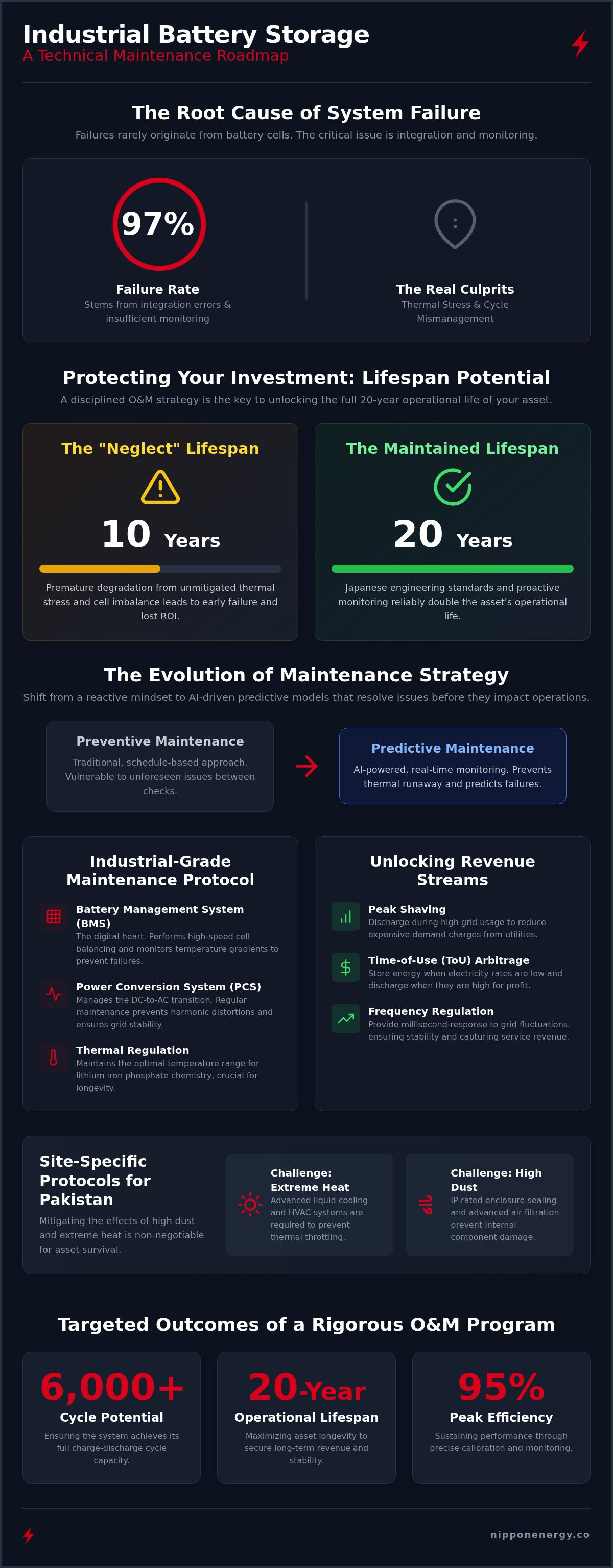
While battery cell technology has reached unprecedented levels of reliability, 97 percent of system failures in 2026 stem from integration errors and insufficient monitoring rather than the cells themselves. For industrial operators in Pakistan, managing these high-value assets requires more than a reactive approach to maintenance. You likely understand that unpredictable cell degradation in high-temperature environments can quickly erode your expected ROI. This commercial battery storage maintenance guide bridges the gap between hardware installation and long-term performance, offering a technical roadmap to protect your industrial energy assets.
By mastering the protocols outlined here, you can ensure your system achieves its 6,000-cycle potential and maintains a 20-year operational lifespan. We will explore the integration of Smart AI Inverters and Battery Management Systems (BMS) to automate predictive alerts and prevent thermal runaway. This guide provides a structured preventive maintenance schedule, a deep dive into 2026 safety standards like UL 9540, and the calibration strategies needed to sustain 95% peak efficiency. You will gain the precision required to transform complex energy storage into a stable, high-performing pillar of your infrastructure.
Key Takeaways
- Shift from a reactive mindset to a value-protection strategy by understanding how rigorous maintenance protocols directly lower the Levelised Cost of Storage (LCOS).
- Identify the critical role of the Battery Management System and thermal regulation in maintaining the optimal temperature range for lithium iron phosphate chemistry.
- Utilize this commercial battery storage maintenance guide to transition from traditional preventive schedules to AI-driven predictive models that resolve issues before they impact operations.
- Implement site-specific environmental protocols for the Pakistan market, focusing on advanced filtration and enclosure sealing to mitigate the effects of high dust and extreme heat.
- Discover how integrating turnkey O&M services and Japanese engineering standards can secure a 20-year lifespan for industrial-scale energy assets.
The Financial Imperative of Commercial Battery Storage Maintenance
Industrial energy assets represent a monumental capital expenditure that requires a rigorous value-protection strategy. Viewing maintenance as a mere cost center is a strategic error that overlooks the direct correlation between operational discipline and the Levelised Cost of Storage (LCOS). In 2026, modern battery energy storage systems (BESS) function as sophisticated electrochemical power plants. This commercial battery storage maintenance guide provides the technical framework necessary to transition from reactive repairs to proactive asset management. Without a structured protocol, lithium-ion systems often face a premature "neglect" lifespan of approximately 10 years. Conversely, systems governed by Japanese engineering standards and precise monitoring can reliably achieve a 20-year operational lifespan.
System failures in the current landscape are rarely the result of manufacturing defects. Instead, they originate from thermal stress and cycle mismanagement. When cells operate outside their optimal thermal window or endure inconsistent depth-of-discharge patterns, degradation accelerates exponentially. A disciplined O&M approach mitigates these risks, ensuring that the initial investment delivers its projected internal rate of return (IRR) over two decades.
ROI and the Total Cost of Ownership (TCO)
The financial health of an industrial energy project is dictated by its degradation curve. Reducing the annual degradation rate by just 5% can significantly enhance long-term profitability by preserving nameplate capacity for late-stage revenue generation. Professional solar system maintenance and integrated battery monitoring are also essential for maintaining insurance compliance and warranty validity. The Performance Gap represents the measurable deficit in energy throughput and revenue that occurs when unmaintained systems suffer from unmitigated cell imbalance or thermal throttling.
Operational Continuity for Industrial Parks
For critical facilities such as data centers, hospitals, and large-scale industrial parks in Pakistan, energy storage isn't just a luxury; it's a requirement for survival. Maintenance ensures that these systems are ready to perform during emergency backup scenarios or grid instabilities. Furthermore, a well-calibrated system is vital for executing complex financial strategies like:
- Peak Shaving: Reducing expensive demand charges by discharging during periods of high grid usage.
- Time-of-Use (ToU) Arbitrage: Storing energy when rates are low and discharging when they peak.
- Frequency Regulation: Providing rapid response to grid fluctuations to maintain stability.
If the system isn't maintained to respond with millisecond precision, these revenue-generating strategies fail. Regular inspection of AI inverters and thermal management hardware guarantees that your asset remains an active contributor to the bottom line rather than a dormant liability.
Key Components of an Industrial-Grade Maintenance Protocol
A comprehensive commercial battery storage maintenance guide must treat the installation as a synergistic ecosystem rather than a collection of isolated parts. The reliability of an industrial energy asset depends on the precise coordination between its electrochemical cells, digital intelligence, and environmental controls. In 2026, the focus has shifted toward maintaining the digital integrity of the system as much as its physical hardware. This holistic approach ensures that every kilowatt-hour stored is protected by multiple layers of redundancy and monitoring.
The Battery Management System (BMS) serves as the digital heart of the installation. It performs high-speed cell balancing and monitors temperature gradients across thousands of individual cells. Beyond the BMS, the Power Conversion System (PCS) manages the critical transition between DC storage and the AC grid. If the PCS isn't maintained, inverter health declines, leading to harmonic distortions that can destabilize sensitive industrial machinery. Physical infrastructure, including fire suppression systems and high-voltage cable integrity, forms the final line of defense against operational hazards in high-capacity environments.
BMS Calibration and Firmware Optimization
Regular firmware updates for Nippon Lithium-ion Battery Storage Systems are essential for refining the algorithms that govern energy throughput. These updates often include patches for sensor drift, which can cause State of Charge (SoC) and State of Health (SoH) readings to become inaccurate over time. Precise sensor calibration is the only way to detect "cell imbalance" before it escalates into a localized thermal event. Industry research on Predictive Maintenance for BESS Safety highlights that early detection of voltage deviations is the most effective method for preventing thermal runaway. Maintaining data accuracy allows the BMS to execute micro-adjustments that extend the cycle life of the entire pack.
Thermal Management and Cooling Systems
Lithium iron phosphate (LFP) chemistry requires a specific "Goldilocks Zone" of 15°C to 25°C to function with maximum efficiency. In the demanding climate of Pakistan, thermal management systems must be inspected every three months to ensure cooling loops or forced-air fans are operating at peak capacity. Cleaning heat exchangers and verifying coolant levels prevents thermal throttling, which can otherwise reduce system output during peak demand periods.
High-performance charging sources also play a role in thermal stability. The synergy between cooling efficiency and the low temperature coefficient of Nippon HJT solar panels reduces the "ripple current" stress placed on the batteries during high-noon charging cycles. This integrated approach to energy architecture preserves the chemical integrity of the cells. To ensure your system architecture meets these rigorous 2026 standards, you can consult with our technical EPC team for a comprehensive site audit.
Predictive vs. Preventive: Leveraging AI for Asset Longevity
The 2026 landscape of industrial energy management has shifted from calendar-based checklists to data-driven foresight. While a commercial battery storage maintenance guide traditionally focused on scheduled physical inspections, modern requirements demand a more sophisticated approach. Preventive maintenance remains the foundation, involving routine tasks like cleaning filters and tightening high-voltage connections every six months to prevent wear. However, predictive maintenance represents the new standard for industrial reliability. This model uses continuous data streams to identify potential failures before they occur, allowing for surgical interventions that minimize downtime and maximize asset life.
In this high-tech architecture, Smart AI Solar Inverters act as the primary diagnostic engine. These units monitor the electrochemical health of the system at a granular level. Machine learning algorithms analyze "micro-trends" in voltage fluctuations and temperature gradients. By detecting a 0.5% deviation in cell resistance weeks before it triggers a system fault, AI allows operators to resolve issues during low-demand periods. This transition from "fixing what's broken" to "maintaining what's optimal" is what secures a 20-year operational lifespan.
Real-Time Performance Monitoring
Moving beyond monthly manual logs, industrial parks in Pakistan now utilize 24/7 cloud-based telemetry for absolute transparency. This system sets automated "Escalation Triggers" that alert technical teams the moment a parameter drifts outside its safety envelope. These AI-driven systems don't just monitor; they optimize. By predicting local weather patterns and grid price volatility, the software adjusts the depth of discharge in real time. This ensures the battery isn't unnecessarily stressed during high-temperature days, preserving the chemical integrity of the Lithium Iron Phosphate (LFP) cells.
The NipponHev Integrated Advantage
Centralization is the key to managing complex industrial energy projects. The NipponHev system integrates maintenance data across solar panels, inverters, and storage into a single-source digital twin. This virtual replica of your physical asset allows for remote troubleshooting and performance simulation. By leveraging this integrated intelligence, industrial operators can reduce on-site maintenance visits by approximately 40%. This reduction in physical labor doesn't just lower costs; it increases safety by limiting human interaction with high-voltage DC equipment. This methodical orchestration ensures that every component of the energy system works in perfect harmony, providing a stable and predictable return on investment.
Regional Maintenance Checklist: From Riyadh to Karachi
Environmental stressors vary significantly across global markets, necessitating a localized approach to any robust commercial battery storage maintenance guide. In the industrial corridors of Karachi and Lahore, the "Dust Factor" is the most persistent threat to system longevity. Fine particulate matter can bypass standard seals, accumulating on sensitive electronics and insulating heat-producing components. Conversely, in Riyadh, the "Heat Factor" demands aggressive thermal management. Systems must often utilize night-time cooling cycles to pre-chill battery enclosures before the extreme daytime solar gain begins. These regional nuances dictate the frequency and type of maintenance required to prevent premature degradation.
Grid instability in South Asian markets adds another layer of complexity. Frequent voltage fluctuations and load shedding events force battery systems into high-frequency cycling. This "cycling stress" requires more frequent calibration of the Battery Management System to ensure that State of Charge (SoC) drift doesn't lead to capacity loss. In contrast, systems in Berlin or London face the "Humidity Factor," where condensation can lead to terminal corrosion and insulation faults. Addressing these specific environmental variables is essential for maintaining the structural integrity of your energy infrastructure.
Middle East and South Asia: Harsh Environment Protocols
For installations in high-pollution or sandy industrial zones, a bi-weekly inspection of HVAC filters is mandatory. Clogged filters force cooling systems to run longer and harder, increasing auxiliary power consumption and reducing overall efficiency. Maintaining the integrity of IP65 or IP66 rated enclosures is critical for protecting Nippon hardware from the ingress of moisture and dust. Because of these unique challenges, professional solar EPC services must include localized O&M teams who understand the specific atmospheric conditions of the region. To ensure your installation is resilient against these local stressors, you should request a regional site assessment from our engineering department.
Europe and North America: Seasonal Maintenance
In colder climates like Berlin, maintenance shifts toward managing lithium-ion performance in sub-zero temperatures. Low temperatures increase internal resistance, making it difficult for batteries to accept a charge efficiently. Annual torque checks on all electrical connections are also vital. These checks account for the thermal expansion and contraction of copper and aluminum components during seasonal shifts, preventing loose connections that could cause arcing. Finally, operators must ensure strict compliance with the latest 2026 EU battery safety and recycling regulations to maintain their operational licenses and environmental certifications.
Scaling Reliability with Nippon Energy’s Turnkey O&M
Securing a 20-year operational lifespan for industrial energy assets requires more than just technical knowledge; it demands a lifelong partnership with a global authority. Nippon Energy positions itself as the primary architect of this security, providing a bridge between advanced Japanese engineering and local operational excellence. While this commercial battery storage maintenance guide has detailed the protocols necessary for system health, the execution of these tasks at scale requires a structured O&M framework. We offer tiered maintenance contracts designed to match the complexity of your infrastructure, ranging from high-level remote monitoring to comprehensive, full-service on-site management.
The application of Japanese Engineering Standards ensures that every maintenance action is governed by precision and methodical discipline. This systematic approach eliminates the variability often found in third-party service providers. By centralizing your maintenance strategy with Nippon Energy, you ensure that your Power Conversion Systems and Lithium-ion stacks are serviced by the same experts who designed the high-tech architecture. For enterprises with existing installations, initiating a professional health audit is the most effective way to identify latent risks and recalibrate systems for 2026 performance benchmarks.
The Global Maintenance Network
Nippon Energy maintains a robust operational presence in Tokyo, Dubai, and Karachi, ensuring that specialized technical support and spare parts are always within reach. This global network is anchored by our 24/7 Remote Operations Centres (ROC), which provide a digital shield for multi-site industrial portfolios. These centres utilize real-time telemetry to oversee system performance, allowing our engineers to deploy solutions before local facility teams even detect a deviation. We prioritize the empowerment of your on-site staff, providing rigorous training programs that align their skills with Nippon Energy’s sophisticated hardware and software standards.
Future-Proofing Your Energy Asset
The lifecycle of a commercial battery system involves more than just daily operation; it requires a roadmap for long-term evolution. Our O&M services include strategic planning for system augmentation, where additional cell capacity is integrated to account for future industrial expansion or natural degradation. As systems reach their secondary lifecycle phase, Nippon Energy facilitates advanced recycling and second-life programs, ensuring your energy transition remains environmentally and fiscally responsible. This integrated lifecycle management reduces the total cost of ownership while maintaining peak performance. To secure the future of your industrial energy project, you can Consult with Nippon Energy Architects for a Commercial Maintenance Audit today.
Securing the Future of Industrial Energy Infrastructure
Mastering the protocols within this commercial battery storage maintenance guide is the final step in transitioning from a reactive operator to a high-tech architect of energy security. We've established how the integration of AI-driven diagnostics and regional environmental adaptations protects the electrochemical integrity of your assets. By shifting to a predictive model, industrial facilities in Pakistan can mitigate the risks of thermal stress and unplanned downtime. This disciplined approach transforms energy storage from a depreciating hardware cost into a resilient, high-performing pillar of your infrastructure.
Nippon Energy remains your global partner in maintaining these rigorous 2026 performance standards. Our commitment to Japanese engineering standards ensures 20-year asset longevity, supported by our strategic service hubs in Tokyo, Dubai, Riyadh, and Karachi. All our O&M contracts feature real-time, AI-driven predictive monitoring to safeguard your investment and optimize cycle life. Take the decisive step toward operational excellence and Request a Commercial Energy Storage Maintenance Audit to verify your system's structural integrity. Your path to sustainable, high-performance energy starts with precise technical orchestration.
Frequently Asked Questions
How often should a commercial lithium-ion battery system be inspected?
You should conduct a technical inspection of your commercial battery storage system every three to six months. Quarterly visits focus on cleaning HVAC filters and verifying coolant levels, while semi-annual inspections involve testing the internal resistance of individual cells and checking the torque on high-voltage terminals. Adhering to this commercial battery storage maintenance guide ensures that minor drifts in cell voltage don't escalate into system-wide failures.
What are the most common signs of commercial battery degradation?
The primary indicators of degradation include an increase in internal resistance and a measurable reduction in discharge capacity over time. You may also notice the system reaching its thermal limits more quickly during high-current charging cycles. Monitoring the State of Health (SoH) through your management software is the most accurate way to track these changes, as it provides a clear percentage of the remaining capacity compared to the original nameplate rating.
Can AI really extend the lifespan of my industrial battery storage?
AI technology extends asset life by dynamically optimizing discharge depths and preventing thermal stress before it occurs. By analyzing historical telemetry, machine learning algorithms can predict peak heat events and adjust cooling cycles accordingly. This proactive orchestration prevents the chemical wear associated with "hot spots" in the battery rack, which is a critical strategy for achieving a 20-year operational lifespan in high-demand industrial environments.
How does dust and pollution in cities like Karachi affect battery maintenance?
High levels of particulate matter in cities like Karachi can clog air intake filters and create conductive layers on electrical components if enclosures aren't properly sealed. This environmental stress requires bi-weekly filter checks in high-pollution zones to prevent the cooling system from overworking. Maintaining the integrity of IP65-rated enclosures is essential to protect the sensitive internal electronics of your commercial battery storage maintenance guide from corrosive urban atmospheric conditions.
Is it safe to perform maintenance on a high-voltage BESS while it is operational?
Maintenance is only safe for non-electrical tasks, such as external filter cleaning or visual enclosure inspections, while the system is live. Any work involving high-voltage DC terminals or internal circuitry requires a strict lock-out/tag-out (LOTO) procedure to de-energize the system. Safety protocols mandate that only certified technicians with specialized arc-flash protection gear should interact with the internal power conversion hardware to prevent catastrophic electrical incidents.
What is the difference between preventive and predictive maintenance for solar batteries?
Preventive maintenance follows a fixed calendar schedule to perform routine tasks regardless of the system's actual condition. Predictive maintenance uses real-time data and sensor telemetry to identify specific components that require attention before they fail. This data-driven approach is more efficient for industrial parks because it reduces unnecessary physical interventions and focuses labor on resolving verified anomalies in the battery management system's performance logs.
Does Nippon Energy provide O&M services for systems installed by other EPCs?
Nippon Energy provides comprehensive O&M services for third-party installations following a rigorous initial technical audit. This audit assesses the structural integrity and digital compatibility of the existing hardware. Once approved, we integrate the system into our global monitoring network, applying Japanese engineering standards to optimize performance and bring older commercial energy assets into alignment with 2026 reliability benchmarks.
How does thermal management impact the warranty of a commercial storage system?
Maintaining the system within the manufacturer's specified temperature range, typically 15°C to 25°C, is a mandatory condition for most performance warranties. If the thermal management system fails and logs show the cells operated in extreme heat, the manufacturer may void the warranty due to accelerated chemical degradation. Keeping detailed, AI-verified thermal logs is your best defense for ensuring warranty compliance and protecting your long-term capital investment.


