

Can your remote industrial operation in Pakistan survive the 2026 energy transition if it's still tethered to the volatile costs and logistical burdens of diesel fuel? Relying on legacy generators often leads to frequent downtime and mounting environmental compliance pressures that erode your bottom line. You understand that true operational security requires a shift toward self-sustaining power, yet the complexity of engineering a reliable system remains a significant barrier. Mastering the technical precision of sizing battery storage for off-grid industrial use is no longer optional; it's the foundation of a resilient energy architecture.
This guide provides the strategic framework to eliminate fuel dependency and guarantee 24/7 uptime through advanced lithium-ion integration. We'll explore how pairing Nippon Lithium-ion Battery Storage Systems with high-efficiency HJT solar modules can significantly reduce your Levelized Cost of Energy. By the end of this article, you'll possess the roadmap to deploy a system designed for 25 years of high-performance autonomy in even the most extreme Pakistani climates. We'll move from broad system requirements to the granular technical specifications that ensure your investment delivers monumental long-term impact.
Key Takeaways
- Identify the strategic shift from volatile diesel logistics to autonomous energy architectures that secure long-term operational stability in remote regions.
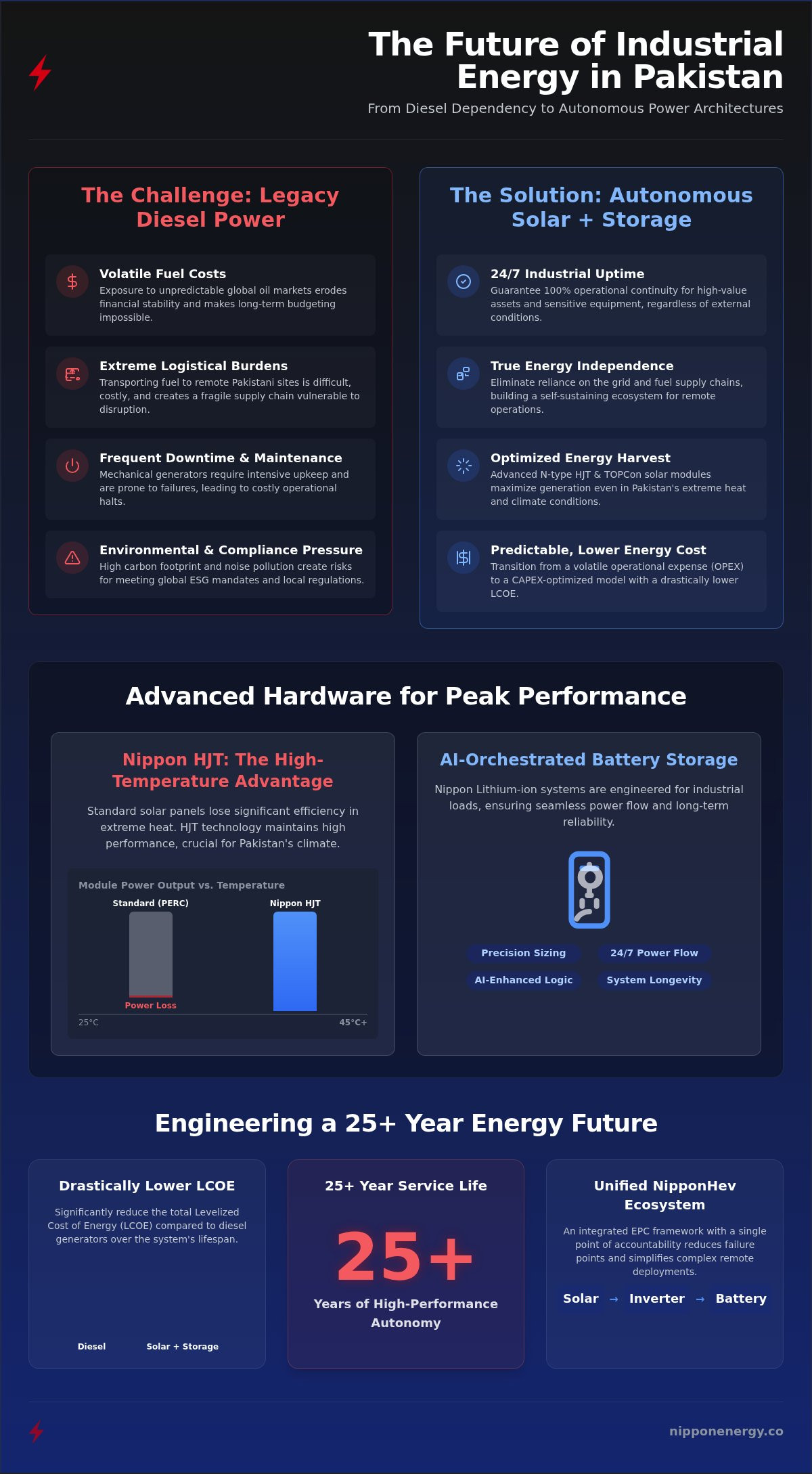
- Evaluate the performance advantages of N-type HJT and TOPCon technologies in maximizing energy harvest within Pakistan’s high-temperature environments.
- Master the engineering principles for sizing battery storage for off-grid industrial use to ensure seamless 24/7 power through AI-enhanced lithium-ion systems.
- Explore the benefits of a unified EPC framework and the NipponHev ecosystem in reducing failure points during complex remote site deployments.
- Learn how to optimize your system for a service life exceeding 25 years while significantly lowering the total Levelized Cost of Energy (LCOE).
The Strategic Imperative for Off-Grid Solar in Remote Industrial Operations
Industrial operations in Pakistan's remote terrains no longer view power as a secondary utility; it's now a core strategic asset. For facilities in regions like Balochistan or northern Sindh, an off-the-grid electricity system represents the difference between operational continuity and total stagnation. As we move through 2026, the reliance on diesel generators has shifted from a standard practice to a significant financial and logistical liability. The volatility of fuel prices, combined with the extreme difficulty of transporting diesel to un-electrified zones, creates a fragile foundation for any large-scale project. Correctly sizing battery storage for off-grid industrial use ensures that these remote facilities remain operational even during extended periods of low solar irradiance, effectively future-proofing the site against supply chain shocks.
Energy independence serves as the primary catalyst for expanding industrial footprints into regions where the national grid doesn't reach. By integrating high-performance energy architecture, engineers can build a self-sustaining ecosystem that supports high-density loads and delicate industrial IoT sensors. This transition ensures that remote monitoring and automated systems remain "always-on," providing the data transparency needed to manage assets across vast distances without the fear of sudden power loss.
Breaking the Diesel Dependency
The hidden costs of diesel are monumental. Beyond the purchase price, firms must account for fuel transport, secure storage against theft, and the intensive maintenance schedules of mechanical generators. These OPEX-heavy models are being replaced by CAPEX-optimized solar infrastructure. In 2026, global ESG mandates are putting pressure on Pakistani exporters to reduce their carbon footprint. Localized renewable generation through Nippon Lithium-ion Battery Storage Systems allows these companies to meet international standards while securing their own energy future. The transition results in a predictable cost per kilowatt-hour, removing the uncertainty of global oil market fluctuations from the balance sheet.
Industrial Uptime and Energy Security
Localized power generation is the only method to guarantee 100% reliability in zones where grid connectivity is either non-existent or highly unstable. High-value industrial assets, such as mining equipment or cold storage facilities, require consistent voltage and frequency that traditional generators often fail to provide. Energy security isn't just about keeping the lights on; it's about protecting sensitive machinery from the surges and sags common in developing infrastructure. By deploying Nippon HJT Solar Panels, which maintain high efficiency even in the intense heat of Pakistan's desert regions, and pairing them with Nippon Smart AI Inverters, operators can manage power flows with surgical precision. This combination ensures that energy is available exactly when it's needed most, preventing costly data loss and equipment wear.
Advanced Hardware Architecture: Why HJT and TOPCon Lead in 2026
The transition to N-type technology defines the 2026 industrial energy landscape. TOPCon and HJT have superseded P-type PERC as the industry standard for high-performance remote sites. Selecting the right cell architecture is a prerequisite for accurately sizing battery storage for off-grid industrial use, as the generation profile directly dictates the required capacity of the storage reservoir. These innovations in off-grid PV technology allow for higher energy density, reducing the physical footprint of the solar array while maximizing the charging potential for the battery bank during peak sunlight hours. For remote operations in Pakistan, where land preparation is costly and logistical access is limited, this increased efficiency translates to lower installation overhead and higher reliability.
Nippon HJT: The High-Temperature Advantage
In the arid regions of Pakistan, where ambient temperatures frequently exceed 45°C, thermal degradation is a critical failure point for standard modules. HJT solar cell efficiency remains stable under extreme heat due to a superior temperature coefficient of -0.24%/°C. This technical attribute ensures that a 755.50W Nippon HJT panel maintains a higher percentage of its rated output compared to traditional PERC modules. By sustaining MW-scale output through the hottest parts of the day, HJT systems deliver a superior Levelized Cost of Energy (LCOE) over a 30-year lifecycle. The lower annual degradation rate of 0.25% guarantees that the energy architecture preserves its structural integrity and performance long after the initial investment is recouped.
TOPCon Bifacial Yield in Arid Environments
For projects where space is a constraint or the terrain is particularly rocky, TOPCon solar panels offer a high-density solution with efficiencies reaching 23.8%. Bifacial TOPCon modules are engineered to capture ground albedo, leveraging the reflective properties of sandy or stony Pakistani landscapes to boost total generation by up to 20%. This increased yield is vital when sizing battery storage for off-grid industrial use, as it provides a more robust energy buffer for nighttime operations. The N-type architecture inherently resists Light-Induced Degradation (LID), ensuring that the system withstands the intense UV radiation prevalent in high-altitude or desert sites. For organizations seeking to optimize their remote power infrastructure, integrating these advanced modules is a foundational step toward achieving total energy autonomy.
Sizing Battery Storage and AI Orchestration for 24/7 Industrial Uptime
Effective sizing battery storage for off-grid industrial use requires more than a simple calculation of daily kilowatt-hour consumption. It demands a sophisticated energy architecture where lithium ion battery storage acts as the critical bridge during the 12 to 14 hours of daily solar dormancy. In an industrial context, this storage must handle significant load spikes from heavy machinery while maintaining voltage stability. Unlike basic residential systems, industrial-scale storage must be engineered to survive the high-ambient-temperature environments of Pakistan, where thermal runaway risks are exacerbated by remote locations. This predictive capability is essential when sizing battery storage for off-grid industrial use, as it allows for a leaner, more cost-effective battery bank without risking system failure.
The integration of AI for predictive maintenance and energy forecasting represents the next evolution in remote power management. By analyzing real-time meteorological data, the system can anticipate periods of low generation and adjust storage reserves accordingly. This proactive approach ensures that the energy architecture isn't just reactive but remains ahead of environmental variables. It allows for the prioritization of critical industrial processes, ensuring that essential operations never face a hard shutdown.
Nippon Lithium-Ion Battery Storage Systems
Industrial-grade lithium iron phosphate (LFP) chemistry has emerged as the 2026 standard for stationary storage due to its inherent safety and long cycle life. Nippon Lithium-ion Battery Storage Systems are designed to operate at a high depth of discharge (DoD) without compromising the 25-year system longevity promise. This allows engineers to optimize the physical footprint of the storage array. Active thermal management is integrated into every unit to ensure performance in high-heat zones like Sindh or Southern Punjab, mirroring the resilience required in Riyadh or Dubai. The modular design enables operators to scale capacity as their industrial output expands, ensuring the initial energy architecture remains relevant for decades.
Intelligent Energy Management
The smart ai solar inverter serves as the central orchestration hub for the entire microgrid. It doesn't just convert DC to AC; it acts as a predictive brain that analyzes generation patterns and consumption trends. This intelligence allows for dynamic load balancing where critical industrial processes receive priority during periods of low solar yield. Autonomous fault detection reduces the need for expensive site visits to remote locations, as the AI identifies and corrects minor anomalies before they escalate into downtime. By implementing automated load shedding and self-optimization, the system protects high-value assets and maintains 24/7 connectivity for essential IoT monitoring with minimal human intervention.
Engineering and EPC Logistics: Navigating Remote Site Deployment
Deploying energy infrastructure in Pakistan's most isolated regions demands more than superior hardware; it requires a disciplined execution of solar epc services tailored for high-stakes industrial environments. The transition from a technical blueprint to a commissioned microgrid involves a three-phase orchestration that begins long before the first panel arrives on site. For remote mining or manufacturing facilities, the EPC lifecycle is the pivot point between a theoretical energy model and a high-performance reality that guarantees 24/7 uptime. Logistics orchestration in 2026 must account for the diverse Pakistani geography, moving heavy lithium-ion racks and high-wattage modules from the maritime humidity of Karachi to the high-altitude terrains of the north.
During the technical engineering phase, sizing battery storage for off-grid industrial use becomes a rigorous data-driven exercise. Engineers don't just calculate daily consumption; they model the specific inductive load signatures of industrial motors and heavy machinery. This modeling accounts for the 2026 seasonal solar variance in regions like the Thar Desert, where dust storms can obscure solar harvest for 48 to 72 hours. By calculating these "autonomy days" with precision, the energy architecture ensures that production never halts due to environmental fluctuations. To ensure your project meets these exacting standards, you should consult with our solar project development experts to finalize your site-specific engineering requirements.
Feasibility and Site Engineering
Successful deployment starts with advanced site feasibility studies that include geotechnical and topographical surveys. In remote Pakistani regions, assessing soil stability is vital for the structural integrity of mounting systems, especially in shifting desert sands or seismic-prone mountain slopes. Engineering teams must design for extreme resilience, calculating wind loading for coastal Sindh and ensuring that battery enclosures are rated for the intense thermal cycling of the interior. This phase aligns the physical site constraints with the 2026 performance benchmarks of Nippon HJT and TOPCon modules, ensuring every square meter of the array contributes to the total energy buffer.
Remote Operations and Maintenance (O&M)
A robust solar system maintenance strategy is non-negotiable for assets with limited accessibility. Remote telemetry plays a decisive role here, utilizing satellite-linked sensors to provide predictive alerts that identify potential failures before they cause downtime. This intelligence reduces the frequency of on-site technician visits, which are often costly and logistically difficult in un-electrified zones. By establishing a local support network and maintaining a strategic inventory of spare parts across South Asia, Nippon Energy ensures that remote industrial sites maintain their monumental reliability throughout their 25-year service life.
The NipponHev Ecosystem: Integrated Solutions for Industrial Independence
The NipponHev ecosystem represents more than a collection of hardware; it's a unified energy architecture designed to eliminate the fragmentation common in remote industrial projects. When sizing battery storage for off-grid industrial use, the integration of components is just as critical as the raw capacity. The NipponHev system ensures that every link in the power chain, from high-efficiency generation to AI-orchestrated storage, is engineered to communicate within a single, optimized framework. This single-source accountability removes the technical friction often found in mixed-vendor systems, where mismatched communication protocols can lead to inefficient charging or unexpected downtime.
By adopting a holistic approach, industrial operators can future-proof their investments against the evolving demands of 2026 technology. As your facility expands, the energy architecture adapts, allowing for the seamless addition of storage capacity or generation power without compromising system stability. This resilience is essential for maintaining a competitive edge in regions where energy reliability is the primary constraint on growth.
Seamless Technology Integration
The synergy between Nippon HJT panels and Nippon Smart AI Inverters allows for a level of efficiency that standalone components can't match. In extreme environments, such as off-grid mining sites in the interior of Sindh, this integrated approach has proven its resilience. By utilizing the 24.18% efficiency of HJT modules and the predictive algorithms of the AI inverter, the ecosystem maintains a stable energy buffer even during the intense dust storms of 2026. This technical cohesion reduces failure points and simplifies the deployment process for industrial EPC projects. A case study in high-temperature mining operations demonstrated that unified systems maintain 99.9% uptime by synchronizing discharge rates with real-time load demands, a feat rarely achieved with fragmented hardware.
Partnering for Global Industrial Success
Nippon Energy's commitment extends beyond the commissioning phase into a long-term technical partnership. With a global EPC presence spanning Tokyo, Dubai, and Riyadh, we bring world-class standards to localized projects in Karachi, Lahore, and beyond. This global reach ensures that remote industrial sites in Pakistan have access to 24/7 monitoring and rapid technical support. Future-proofing is built into the architecture; as your industrial capacity grows, the modular nature of the Nippon Lithium-ion Battery Storage Systems allows for seamless expansion without redesigning the entire grid. With confirmed LFP battery production capacity in place for late 2026, our supply chain is optimized for the scale of your operations. Nippon Energy stands as the High-Tech Architect of your energy future, providing the stability and precision required for total industrial independence.
Securing the Future of Industrial Energy Autonomy
The 2026 energy transition demands a departure from the logistical vulnerabilities of fossil fuels in favor of resilient, high-performance energy architectures. By integrating the thermal stability of Nippon HJT technology with the predictive orchestration of our AI-enhanced storage systems, industrial operations can achieve total autonomy. Precise engineering in sizing battery storage for off-grid industrial use ensures that your facility maintains structural reliability and operational continuity for over 25 years. This approach doesn't just reduce emissions; it guarantees that your critical infrastructure remains immune to external supply shocks and grid instability.
Nippon Energy supports this monumental shift through an established EPC presence in Tokyo, Dubai, Riyadh, and Lahore. Our proprietary HJT cells and end-to-end project management deliver the technical prowess required to eliminate downtime and reduce the Levelized Cost of Energy. We encourage you to Consult with our Energy Architects for a Remote Site Feasibility Study to secure your facility's competitive advantage. It's time to build a future where your power is as stable as your vision.
Frequently Asked Questions
Is off-grid solar reliable enough for 24/7 industrial mining operations?
Off-grid solar is fully capable of supporting 24/7 industrial mining operations when engineered as a unified microgrid. By combining high-efficiency generation with proprietary energy management, these systems eliminate the volatility of diesel supply chains. Reliability is achieved through redundant storage architectures that ensure heavy machinery remains operational during nighttime hours or periods of high cloud cover.
How do HJT solar panels perform in extreme desert heat compared to standard panels?
Nippon HJT Solar Panels maintain higher power output in extreme desert heat because of their superior temperature coefficient of -0.24%/°C. Standard P-type panels experience significant efficiency drops as temperatures rise, whereas HJT technology remains stable in ambient conditions exceeding 45°C. This thermal resilience is critical for maintaining the MW-scale generation required to charge industrial battery banks in regions like Sindh or Balochistan.
What is the typical ROI for an off-grid industrial solar system in 2026?
The typical payback period for a commercial Battery Energy Storage System (BESS) in 2026 ranges between 3 and 7 years. This ROI is driven by the total elimination of diesel fuel costs and reduced maintenance overhead for mechanical generators. While HJT panels carry a price premium, their superior longevity and energy yield in hot climates ensure monumental long-term profitability over a 25-year lifecycle.
How does AI improve the performance of a remote solar microgrid?
AI enhances remote microgrids by providing predictive orchestration of energy flows based on real-time meteorological data. Nippon Smart AI Inverters autonomously manage load balancing and predictive maintenance, identifying potential faults before they lead to downtime. This intelligence reduces the need for human intervention and optimizes sizing battery storage for off-grid industrial use by ensuring energy is reserved for critical high-priority loads during low-generation periods.
What are the maintenance requirements for solar systems in remote, dusty environments?
Maintenance in dusty environments focuses on automated cleaning systems and rigorous remote telemetry to monitor soiling levels. While solar modules require periodic washing to maintain peak transmittance, the absence of moving parts in solid-state energy storage significantly reduces mechanical failure risks. Remote monitoring through Nippon Energy's platform allows technicians to deploy only when specific performance alerts are triggered, optimizing O&M costs in isolated Pakistani territories.
Can an off-grid system be scaled if industrial power demand increases?
Industrial off-grid systems are inherently scalable when designed with a modular energy architecture. The NipponHev ecosystem allows for the incremental addition of HJT modules and lithium-ion racks as power demands grow. This flexibility is vital when sizing battery storage for off-grid industrial use, as it permits an initial deployment that meets current needs while providing a clear pathway for future industrial expansion without a complete system overhaul.
How does Nippon Energy handle logistics for projects in extremely remote locations?
Nippon Energy manages remote logistics through a global EPC presence with strategic hubs in Tokyo, Dubai, Riyadh, and Lahore. We coordinate the transport of sensitive components, such as high-density battery racks, across challenging terrains using specialized maritime and land-based supply chains. This end-to-end project management ensures that even projects in the most un-electrified zones of Pakistan are delivered with the same technical precision as urban installations.
What is the life expectancy of Nippon Lithium-ion Battery Storage Systems?
Nippon Lithium-ion Battery Storage Systems are engineered for a service life exceeding 25 years. This longevity is achieved through advanced Lithium Iron Phosphate (LFP) chemistry and active thermal management systems that prevent cell degradation in high-heat environments. By maintaining a high cycle life and depth of discharge, these systems provide a stable energy reservoir that outlasts traditional lead-acid or mechanical backup solutions.


