
Every kilowatt your business generates independently is a kilowatt that K-Electric's fuel adjustment charges can never touch. For commercial operators across Karachi, that single calculation is reshaping how energy infrastructure gets planned, budgeted, and built. Selecting the right hybrid solar system for commercial use in Karachi isn't simply a cost-reduction exercise; it's a structural decision that determines whether your operations survive the next grid failure, the next tariff revision, or the next monsoon season intact.
You already know the pressure. Unpredictable billing cycles, corrosive coastal air degrading conventional panels ahead of schedule, and lead-acid battery banks failing precisely when summer temperatures peak during peak-load hours. These aren't isolated complaints; they're systemic vulnerabilities that a standard solar installation was never engineered to address.
This guide exists to close that gap. Drawing on the technical architecture of N-type HJT photovoltaic technology, AI-driven lithium-ion storage orchestration, and smart inverter integration, it lays out a precise framework for achieving genuine grid independence in Karachi's coastal commercial environment. What follows covers climate-resilient hardware selection, storage configuration for 24/7 continuity, and net metering compatibility built for long-term OPEX reduction.
Key Takeaways
- Selecting the right hybrid solar system for commercial use in Karachi requires matching hardware specifications to the city's coastal climate, where salt-mist corrosion and peak summer temperatures systematically degrade standard photovoltaic installations ahead of schedule.
- N-type HJT and TOPCon panel architectures deliver measurably superior temperature coefficients and humidity resistance compared to conventional modules, making them the technically defensible choice for Karachi's industrial rooftops.
- AI-driven smart inverters paired with lithium-ion battery storage eliminate the reactive failures common to lead-acid systems by automating load management and dispatch decisions in real time, sustaining 24/7 operational continuity through grid outages.
- A structured EPC lifecycle — encompassing shadow analysis, structural integrity audits, and industrial compliance protocols — determines whether a solar investment delivers its projected OPEX reduction or accumulates unforeseen maintenance liabilities.
- The NipponHev integrated energy architecture unifies photovoltaic generation, intelligent storage, and smart inverter orchestration into a single engineered system, positioning commercial operators for long-term grid independence rather than incremental cost savings alone.
The Commercial Energy Landscape in Karachi: Why Hybrid Systems are Essential in 2026
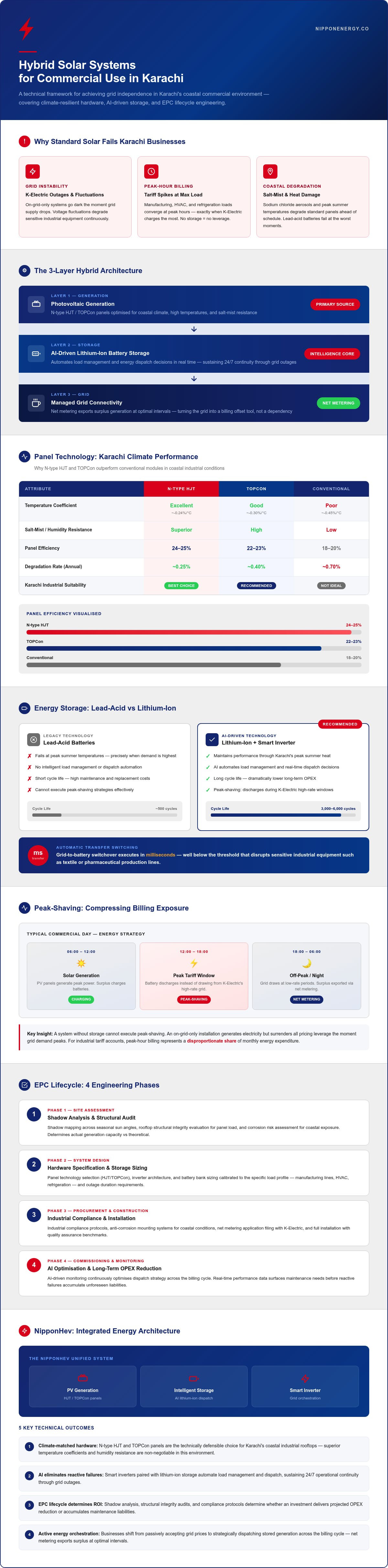
A commercial hybrid solar system integrates three distinct energy layers: photovoltaic generation, advanced battery storage, and managed grid connectivity. That integration isn't incidental; it's the architectural decision that separates a business capable of operating through a grid failure from one that simply hopes the power stays on. In 2026, that distinction carries direct financial consequences for every industrial operator in Karachi.
K-Electric's tariff structure has progressively shifted cost exposure toward peak consumption hours, the precise window when manufacturing lines, HVAC systems, and refrigeration loads converge. For commercial accounts classified under industrial tariff slabs, peak-hour billing can represent a disproportionate share of monthly energy expenditure. Peak-shaving, the practice of discharging stored energy during these high-rate periods rather than drawing from the grid, directly compresses that exposure. A system without storage cannot execute this strategy. An on-grid-only installation generates electricity but surrenders all pricing leverage the moment grid demand peaks.
Load shedding in Sindh compounds this problem structurally. Scheduled outages, when combined with unplanned faults in aging distribution infrastructure, create operational gaps that no passive grid connection can bridge. For businesses in Korangi Industrial Area or the SITE zone, a two-hour outage during a production shift isn't an inconvenience; it's measurable lost output, spoiled inventory, and compressed delivery timelines. Simple on-grid systems go dark the moment grid supply drops, by regulatory design, because they must de-energize to protect line workers. Hybrid architecture eliminates that dependency entirely.
Overcoming K-Electric Grid Instability
Hybrid systems maintain seamless operational continuity through automatic transfer switching, typically executing the transition from grid to stored power in milliseconds, well below the threshold that disrupts sensitive industrial equipment. Voltage fluctuations endemic to Karachi's distribution network, particularly in older industrial zones where transformer loading is chronically high, are actively conditioned by smart inverter architecture before that unstable supply reaches connected loads. The financial calculus is straightforward: downtime in Korangi's textile or pharmaceutical clusters carries per-hour costs that dwarf the annualized capital cost of a properly sized storage bank.
Strategic Energy Independence for Karachi Businesses
The shift a hybrid solar system for commercial use in Karachi enables isn't simply technical; it's operational. Businesses move from passive consumption, accepting whatever the grid delivers at whatever price K-Electric sets, to active energy orchestration, dispatching stored generation strategically across the billing cycle. In 2026, net metering regulations allow surplus generation to offset consumption credits, and when paired with intelligent storage, that surplus is exported at optimal intervals rather than wasted during low-demand periods.
The Hybrid Advantage for Karachi's commercial sector is precise: a correctly engineered hybrid solar system for commercial use in Karachi delivers 24/7 operational uptime by combining on-site generation, intelligent storage dispatch, and grid synchronization into a single resilient architecture that performs independently of K-Electric's reliability record.
Climate-Resilient Hardware: Why HJT and TOPCon Matter for Karachi
Karachi's coastal atmosphere isn't merely humid; it delivers a continuous aerosol load of sodium chloride, magnesium sulfate, and airborne particulates drawn off the Arabian Sea. Standard PERC modules, engineered to IEC baseline specifications, weren't designed for this operating environment. Their aluminum frames oxidize, their EVA encapsulants absorb moisture at the cell boundary layer, and their power output degrades at a rate that outpaces manufacturer warranty projections within three to five years of coastal installation. For a commercial operator planning a 20-year asset lifecycle, that degradation curve isn't a minor inconvenience; it's a structural miscalculation built into the capital plan from day one.
Temperature coefficient compounds the problem. Karachi's rooftop surface temperatures routinely exceed 65°C during peak summer months, and every degree above Standard Test Conditions (25°C) costs power output. A conventional PERC panel carrying a temperature coefficient of approximately -0.35% per °C loses a measurable share of its rated capacity during the precise hours when generation is most commercially valuable. Nippon HJT Solar Panels address this directly: the heterojunction architecture's amorphous silicon passivation layers suppress recombination losses at elevated temperatures, producing a temperature coefficient in the range of -0.24% per °C. Across a Karachi summer, that differential compounds into significant retained yield.
Bifacial construction adds another performance dimension for industrial rooftops. Reflective membrane surfaces, white-painted concrete, and polished metal cladding common in Korangi and SITE zone facilities redirect diffuse irradiance onto the panel's rear cell layer. A bifacial module captures that albedo contribution, increasing effective energy yield without increasing installed capacity. For a hybrid solar system for commercial use in Karachi, where rooftop real estate is finite and load demands are high, bifacial gain represents recoverable generation that monofacial modules simply forfeit.
Nippon TOPCon Technology for Industrial Scale
TOPCon solar panels have become the technically defensible standard for high-density commercial arrays because their N-type silicon substrate eliminates the boron-oxygen defects responsible for Light-Induced Degradation (LID) and Light and elevated Temperature-Induced Degradation (LeTID). Both failure modes accelerate in high-irradiance, high-temperature environments, precisely the conditions Karachi delivers year-round. Nippon TOPCon modules exceed 23% conversion efficiency under real-world conditions, and their N-type architecture retains a higher proportion of that efficiency across a 25-year operational period compared to P-type alternatives.
Salt-Mist and Corrosion Resistance
Hardware deployed within the Port Qasim industrial belt or along the Korangi coastal corridor requires IEC 61701 Salt Mist Corrosion certification at a minimum. Glass-glass module construction eliminates the rear polymer backsheet as a moisture ingress pathway, while anodized or powder-coated frame profiles resist chloride-driven oxidation under sustained salt spray exposure. Wind load ratings must account for Karachi's seasonal pressure events; frame rigidity and mounting torque specifications aren't secondary considerations but primary longevity determinants for any hybrid solar system for commercial use in Karachi targeting a 25-year asset life.
Specifying hardware at this certification level isn't conservative engineering; it's the baseline that separates a performing asset from a degrading liability. Explore Nippon Energy's climate-rated panel portfolio to match the right module architecture to your facility's specific coastal exposure profile.
Intelligent Energy Storage: AI Inverters and Lithium-ion Integration
The storage layer of any hybrid solar system for commercial use in Karachi is where engineering decisions either compound or erode the investment made in photovoltaic generation. Lead-acid battery banks have historically dominated commercial installations across Pakistan, largely on the basis of upfront capital cost. That calculation collapses under scrutiny. A conventional deep-cycle lead-acid bank delivers between 300 and 500 usable charge cycles before capacity degrades below commercially viable thresholds. Karachi's ambient temperatures accelerate that degradation further, compressing the effective service life well below manufacturer projections.
Nippon Lithium-ion Battery Storage Systems operating on LiFePO4 chemistry deliver a fundamentally different performance profile. LiFePO4 cells sustain in excess of 4,000 cycles at 80% depth of discharge while retaining the majority of their rated capacity, a cycle life advantage that translates directly into a longer asset replacement interval and a lower total cost of ownership across a 10-year operational horizon. The thermal stability of LiFePO4 chemistry is equally critical in Karachi's context: unlike NMC alternatives, it doesn't enter thermal runaway under the elevated ambient temperatures common in unconditioned industrial warehouses across Korangi and SITE.
Nippon Smart AI Inverters: The System Brain
Nippon Smart AI Inverters execute the orchestration logic that transforms discrete hardware components into a unified energy architecture. The inverter's AI layer continuously processes incoming data streams, including real-time irradiance levels, grid tariff signals, battery state of charge, and connected load profiles, to make autonomous dispatch decisions. During K-Electric's peak tariff windows, the system prioritizes stored energy discharge over grid draw, compressing the billing exposure that passive on-grid systems cannot avoid. When irradiance forecasts indicate reduced generation ahead, the AI pre-charges storage from available grid supply during off-peak rate periods, building reserve capacity before it's needed rather than reacting after the deficit occurs.
Cloud-based performance analytics deliver continuous visibility into system behavior, flagging efficiency deviations, cell-level anomalies, and generation shortfalls before they escalate into maintenance events. Integration with existing building management systems allows load-shedding schedules and critical circuit prioritization to be coordinated at the facility level, ensuring that production lines receive uninterrupted supply while non-critical loads are curtailed automatically during constrained periods.
Commercial Lithium-ion Storage Sizing
Correct storage sizing for industrial applications requires calculating C-rating requirements against the inrush current demands of heavy machinery. A facility running high-torque motors or compressors needs a battery bank capable of delivering sustained discharge rates without voltage sag, which eliminates undersized configurations regardless of their nominal capacity. Modular lithium-ion architecture addresses the second variable: business growth. Capacity can be expanded incrementally by adding battery modules to an existing rack configuration, avoiding the full capital replacement cycle that monolithic lead-acid banks impose.
For businesses interested in how these systems are implemented globally, European manufacturers such as greenSANE provide specialized solutions; you can explore Produkcja i sprzedaż modułowych magazynów energii NONgenerator® to understand the technical standards of modular energy storage.
Thermal management deserves explicit specification in any storage proposal for a Karachi deployment. Battery management systems must actively monitor cell temperature and adjust charge rates accordingly, protecting cycle life in environments where warehouse ambient temperatures routinely exceed safe passive operating thresholds during summer months. This isn't an optional feature for a hybrid solar system for commercial use in Karachi; it's a baseline engineering requirement for any storage system expected to perform reliably across a multi-year asset life.
EPC Lifecycle: Engineering Your Solar Investment in Karachi
Speed of installation is not an engineering credential. Competitors who lead with rapid deployment timelines are, by definition, compressing the feasibility, structural, and compliance phases that determine whether a solar asset performs as projected or accumulates maintenance liabilities from its first operational year. A professional Solar EPC partner executes every phase of the project lifecycle with documented rigor, from site assessment through commissioning, because each phase directly governs the financial performance of the system that follows it.
Feasibility and Structural Engineering
Shadow analysis is a non-negotiable prerequisite for any hybrid solar system for commercial use in Karachi installed within dense industrial zones like Korangi or SITE, where adjacent structures, water towers, and elevated exhaust stacks cast dynamic shading patterns that shift across seasons and degrade array output if unaccounted for in the design layout.
Structural integrity assessments go beyond confirming that a roof can bear panel weight. Wind load calculations must reflect Karachi's coastal pressure dynamics and monsoon-season gust velocities, which impose lateral and uplift forces that standard mounting torque specifications may not address. Rooftop age, slab composition, and parapet height all factor into the engineering brief before a single module bracket is specified.
The electrical audit runs parallel to structural review. Industrial facilities in Karachi typically operate diesel generators as backup infrastructure, and synchronizing solar generation with both generator output and the K-Electric grid requires careful relay coordination, anti-islanding protection, and load prioritization logic. This isn't configuration work; it's electrical engineering that determines whether the system is safe and compliant from day one.
Procurement integrity is the next critical variable. Nippon Energy's global supply chain delivers Tier-1 hardware with traceable manufacturing provenance, eliminating the counterfeit module risk that has compromised commercial installations across Pakistan when procurement is driven by lowest-cost tendering alone.
Project Execution and O&M
Professional project management structures installation sequences around active production schedules, ensuring that civil, electrical, and commissioning works proceed without disrupting factory operations. The net metering application process with K-Electric requires precise documentation: single-line diagrams, protection relay specifications, and generation capacity declarations must meet utility submission standards to avoid approval delays that defer the system's financial contribution.
Post-commissioning, Solar System Maintenance is the mechanism that protects the capital deployed. Predictive maintenance, driven by AI inverter analytics, identifies string-level performance deviations, cell degradation signatures, and connection resistance anomalies before they escalate into generation losses or equipment failures. Reactive maintenance is expensive and disruptive; predictive protocols convert those events into scheduled interventions that preserve both uptime and asset longevity across the full investment horizon.
Partnering with Nippon Energy for Karachi's Industrial Future
The engineering decisions outlined across this guide converge on a single practical question: which partner has the technical depth, local presence, and integrated product architecture to execute them reliably? For commercial operators in Karachi, Nippon Energy's position at Plot 14, Sector 15, Korangi Industrial Area places its team inside the same industrial ecosystem its clients operate in. That proximity isn't incidental; it means site assessments, commissioning support, and post-installation interventions don't require cross-city logistics that compress response windows during critical operational periods.
The NipponHev System represents the architectural expression of everything this guide has covered. Rather than assembling a hybrid solar system for commercial use in Karachi from discrete, independently sourced components, NipponHev unifies HJT or TOPCon photovoltaic generation, LiFePO4 battery storage, and AI inverter orchestration into a single engineered system with defined inter-component compatibility. The practical consequence is measurable: system-level performance is predictable, warranty accountability is consolidated, and optimization parameters are calibrated across the entire architecture rather than negotiated between separate vendor specifications.
The Nippon Advantage in Sindh
Japanese engineering methodology applied to Karachi's industrial context produces a specific outcome: hardware and system design that accounts for salt-mist exposure, monsoon-season structural loading, and K-Electric's tariff architecture from the specification stage, not as post-installation adjustments. Nippon Energy's Korangi office provides dedicated support for industrial parks and commercial complexes across Sindh, with technical teams that understand the electrical infrastructure constraints common to SITE zone and Port Qasim facilities. A Karachi-based manufacturing unit that transitioned to a NipponHev-integrated system reported measurable OPEX compression by eliminating peak-hour grid dependency and reducing diesel generator runtime, though operators considering similar transitions should request a facility-specific audit to establish their own baseline projections rather than extrapolating from generalized figures.
Next Steps for Your Commercial Solar Transition
A structured energy audit is the correct entry point. It establishes your facility's actual load profile, rooftop structural parameters, shading constraints, and grid synchronization requirements before any system sizing or capital commitment occurs. Nippon Energy's audit process produces a documented feasibility output that feeds directly into EPC planning, eliminating the estimation gaps that undermine ROI projections in competitively tendered installations.
For 2026 deployments, the relevant variables include net metering approval timelines with K-Electric, equipment lead times for Tier-1 hardware, and installation sequencing around active production schedules. Financing structures and ROI projection methodologies vary by facility scale and tariff classification; Nippon Energy's commercial team can model these against your specific consumption data.
Deploying the right hybrid solar system for commercial use in Karachi is a capital decision with a multi-decade horizon. The partner you select determines whether that horizon delivers its projected return or accumulates unforeseen variance. Contact Nippon Energy's Karachi team at Plot 14, Sector 15, Korangi Industrial Area to initiate your facility's energy audit and establish a technically grounded transition plan.
Engineering Karachi's Commercial Energy Future Starts Now
The variables shaping commercial energy costs in Karachi aren't stabilizing; they're compounding. Tariff revisions, grid instability, and coastal hardware degradation each erode operational margins independently. Together, they make a reactive energy strategy increasingly indefensible for any business planning beyond the current fiscal year.
A correctly specified hybrid solar system for commercial use in Karachi resolves all three simultaneously, but only when the hardware, storage chemistry, and system architecture are matched to the city's specific operating conditions from the design stage. That precision is what separates a performing 25-year asset from a depreciating liability.
Nippon Energy brings Japanese engineering methodology, proprietary HJT and AI inverter technology, and a dedicated Korangi Industrial Area presence to every commercial deployment across Sindh. The technical foundation is already built. What remains is applying it to your facility's specific load profile, rooftop parameters, and operational requirements.
Design your commercial energy future with Nippon Energy's Karachi experts and establish a technically grounded path to grid independence that performs as projected, year after year.
Frequently Asked Questions: Hybrid Solar Systems for Commercial Use in Karachi
Is a hybrid solar system better than an on-grid system for a Karachi business?
For most commercial operators in Karachi, yes. An on-grid system generates electricity but shuts down automatically during grid outages to protect line workers, meaning you lose power precisely when the grid fails. A hybrid system maintains supply through battery storage, executes peak-shaving during K-Electric's high-tariff windows, and conditions unstable grid voltage before it reaches sensitive equipment. On-grid installations offer no pricing leverage and zero outage protection.
The calculus shifts further toward hybrid architecture when you factor in Karachi's load-shedding frequency in industrial zones like Korangi and SITE. A business running production lines or refrigeration loads can't absorb unplanned two-hour gaps in supply. Hybrid architecture eliminates that exposure structurally rather than managing it reactively.
How long do lithium-ion solar batteries last in Karachi's high temperatures?
LiFePO4 lithium-ion batteries, the chemistry used in Nippon Lithium-ion Battery Storage Systems, are rated for more than 4,000 cycles at 80% depth of discharge under standard conditions. In Karachi's elevated ambient temperatures, longevity depends critically on whether the battery management system actively monitors and adjusts charge rates to protect cell integrity. Systems without thermal management degrade faster; those with active BMS controls maintain cycle life closer to rated specifications.
NMC lithium chemistries are more temperature-sensitive and carry thermal runaway risk in unconditioned industrial warehouses. LiFePO4 chemistry avoids that failure mode, making it the technically appropriate choice for Karachi deployments where warehouse ambient temperatures regularly exceed safe passive operating thresholds during summer months.
Can a commercial hybrid solar system run heavy machinery during a power outage?
Yes, but correct storage sizing is the determining factor. Heavy machinery with high-torque motors and compressors generates significant inrush current at startup, which requires a battery bank with sufficient C-rating to deliver sustained discharge without voltage sag. An undersized storage configuration will trip under that inrush load regardless of its nominal capacity. Proper system design starts with calculating the inrush and continuous current demands of every critical load before specifying battery bank size.
Smart AI inverter architecture supports this by prioritizing critical circuits automatically during constrained periods, ensuring production equipment receives uninterrupted supply while non-essential loads are curtailed. The transition from grid to stored power in a properly commissioned hybrid system executes in milliseconds, below the threshold that disrupts most industrial control systems.
What is the typical ROI for a commercial solar installation in Karachi in 2026?
ROI varies considerably based on facility load profile, tariff classification, installed capacity, and storage configuration, so any figure quoted without a facility-specific audit should be treated skeptically. The primary financial drivers are peak-shaving savings during K-Electric's high-rate windows, reduced diesel generator runtime, and net metering credits from surplus generation. Businesses on industrial tariff slabs with high daytime consumption generally see stronger returns than those with flat or off-peak load profiles.
Rather than relying on generalized projections, request an energy audit that maps your actual consumption data against your rooftop generation potential. Nippon Energy's commercial team models ROI against facility-specific consumption data and tariff classification, producing projections grounded in your operational baseline rather than industry averages.
Does the salt-air in Karachi damage solar panels over time?
Standard PERC modules with polymer backsheets and untreated aluminum frames are genuinely vulnerable to Karachi's coastal aerosol environment. Sodium chloride and magnesium sulfate deposits accelerate frame oxidation and create moisture ingress pathways at the cell boundary layer, producing degradation rates that outpace manufacturer warranty projections within three to five years of coastal installation. This isn't a minor performance variable; it's a capital planning miscalculation if the wrong module architecture is specified.
Panels certified to IEC 61701 Salt Mist Corrosion standards with glass-glass construction and anodized or powder-coated frames address this directly. Both Nippon HJT and Nippon TOPCon modules are engineered for coastal operating environments. For a hybrid solar system for commercial use in Karachi targeting a 25-year asset life, IEC 61701 certification isn't optional hardware; it's the baseline specification that separates a durable asset from a degrading one.
How does net metering work with a hybrid system in Pakistan?
Under Pakistan's net metering framework, surplus generation exported to the K-Electric grid earns consumption credits that offset future billing. A hybrid system doesn't export indiscriminately; its AI inverter layer determines when exporting surplus is more financially advantageous than retaining it in storage, optimizing the dispatch decision against prevailing tariff rates. This is a meaningful distinction from on-grid systems, which export all surplus without strategic timing.
The approval process requires submitting single-line diagrams, protection relay specifications, and generation capacity declarations to K-Electric. Documentation gaps or non-compliant protection configurations are the most common causes of approval delays. A professional EPC partner manages this submission process to utility standards, avoiding the timeline deferrals that delay the system's financial contribution from its first operational month.
What maintenance is required for a commercial solar farm in an industrial area?
Karachi's industrial zones generate elevated particulate loads from manufacturing activity, which compounds with coastal salt deposits to reduce panel transmittance faster than residential installations. Regular panel cleaning is a baseline requirement, with frequency determined by proximity to industrial emission sources. Mounting hardware should be inspected periodically for corrosion, particularly in coastal corridors like Port Qasim and Korangi, where chloride exposure is highest.
Beyond physical inspection, Nippon Energy's Solar System Maintenance service uses AI inverter analytics to identify string-level performance deviations, connection resistance anomalies, and cell degradation signatures before they escalate into generation losses. Predictive maintenance converts potential failure events into scheduled interventions, protecting both uptime and asset longevity without the operational disruption that reactive repairs impose on active production environments.
Can I expand my hybrid solar system later if my business grows?
Modular lithium-ion storage architecture is specifically designed for incremental capacity expansion. Additional battery modules can be integrated into an existing rack configuration without replacing the entire storage bank, which is a direct advantage over monolithic lead-acid systems that require full capital replacement when capacity needs change. Photovoltaic capacity can similarly be expanded if rooftop area and inverter headroom permit additional string connections.
The practical prerequisite is that the original system is designed with future expansion in mind. Inverter sizing, cable routing, protection relay capacity, and structural mounting configurations should all be specified to accommodate projected growth rather than optimized exclusively for day-one load requirements. Discussing your five-year operational trajectory during the initial feasibility phase ensures the system architecture supports expansion without costly retrofits later.


