

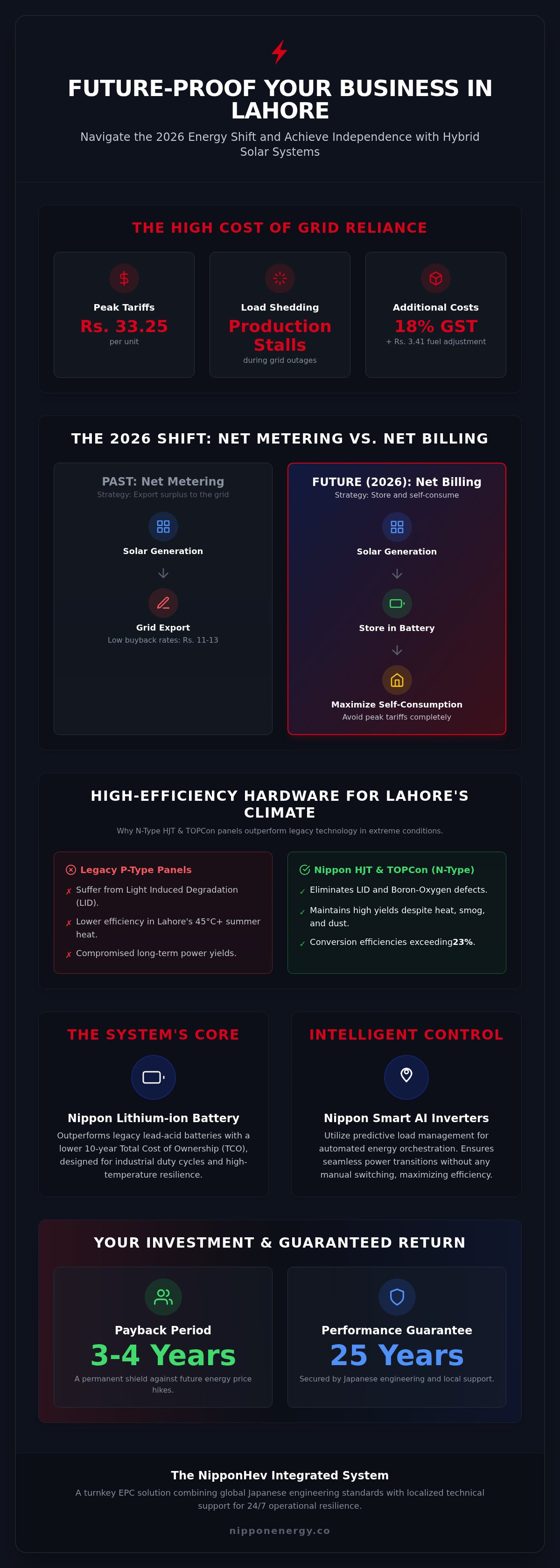
What if your business could maintain peak production capacity while the rest of the Lahore industrial zone faces mandatory load shedding and peak tariffs of Rs. 33.25 per unit? As NEPRA transitions from net metering to net billing in 2026, the financial viability of your enterprise depends on a sophisticated hybrid solar system for business lahore that prioritizes self-consumption over grid export. This shift in energy policy, combined with an 18% GST on electricity bills, necessitates a move toward integrated, high-efficiency architecture that treats power as a controlled asset rather than an unpredictable overhead cost.
We recognize the frustration of seeing production lines stall or watching low-quality batteries degrade rapidly in the intense Punjab heat. This guide provides a technical roadmap to achieving total energy independence through the deployment of Nippon HJT Solar Panels and the NipponHev integrated system. You'll learn how AI-driven energy management eliminates manual switching and secures a 25-year performance guarantee, ensuring your investment delivers a 3 to 4-year payback period despite current economic volatility. We'll examine the specific hardware configurations, including Nippon Lithium-ion Battery Storage Systems, required to stabilize your operational costs and future-proof your facility against the next decade of energy price hikes.
Key Takeaways
- Understand how the 2026 shift from net metering to net billing changes the financial architecture of a hybrid solar system for business lahore, prioritizing internal consumption to maximize ROI.
- Evaluate the performance advantages of Nippon HJT Solar Panels, which utilize N-type cell architecture to maintain high energy yields despite Lahore’s extreme ambient temperatures and urban smog.
- Analyze the 10-year Total Cost of Ownership (TCO) to see why Nippon Lithium-ion Battery Storage Systems outperform legacy lead-acid alternatives in industrial duty cycles.
- Discover how Nippon Smart AI Inverters employ predictive load management to automate energy orchestration, ensuring seamless power transitions without manual intervention.
- Learn how the NipponHev integrated system provides a turnkey EPC solution that combines global Japanese engineering standards with localized technical support for 24/7 operational resilience.
The 2026 Energy Landscape for Lahore Businesses
The industrial stability of Lahore hinges on energy predictability, yet the 2026 fiscal year presents a volatile environment for commercial consumers. LESCO commercial unit prices now peak at Rs. 33.25 per unit during peak hours, while the average fuel price adjustment adds another Rs. 3.41 to the base rate. For enterprises in the Quaid-e-Azam Industrial Estate or Sundar Industrial Estate, these costs are compounded by the persistence of scheduled load shedding. A standard on-grid setup stops producing power during these outages to prevent backfeeding into the grid. This leaves production lines idle despite clear skies and available sunlight. Transitioning to a hybrid solar system for business lahore solves this structural vulnerability by decoupling operational continuity from grid reliability.
Commercial Electricity Costs vs. Solar ROI
The cost of inaction for a Lahore SME is no longer just a high utility bill; it's the cumulative loss of machine hours and labor productivity. A Hybrid power system integrates solar generation with lithium-ion storage to bypass peak-hour surcharges entirely. Since NEPRA transitioned to net billing in February 2026, the strategy has shifted from selling surplus power at low buyback rates of Rs. 11-13 to maximizing internal consumption. Storing energy during high-generation windows allows businesses to avoid the most expensive tariff tiers during the evening. This architectural shift ensures a payback period of 3 to 4 years while providing a permanent shield against future regulatory changes or fuel cost hikes.
Lahore’s Climate Challenges for Solar Hardware
Lahore’s atmospheric conditions present unique engineering hurdles that standard solar components often fail to clear. High ambient temperatures, seasonal smog, and heavy particulate accumulation can degrade energy yields by more than 20% if the hardware isn't specifically rated for these extremes. Maintenance protocols must be rigorous to counteract the insulating effect of dust on the panel surface. The temperature coefficient represents the percentage of power output lost for every degree Celsius the solar cell temperature rises above 25°C, a metric that determines the operational resilience of arrays during Lahore’s 45°C summer peaks. High-efficiency N-type technologies, such as Nippon HJT Solar Panels, are engineered with lower coefficients to ensure stable performance when the grid is most stressed.
High-Efficiency Hardware: Why HJT and TOPCon Matter
The selection of photovoltaic hardware is the most critical decision in engineering a resilient hybrid solar system for business lahore. Legacy P-type modules often suffer from Light Induced Degradation (LID) and Boron-Oxygen defects, which compromise long-term power yields. Modern N-type architectures, specifically Heterojunction (HJT) and Tunnel Oxide Passivated Contact (TOPCon), eliminate these vulnerabilities. Nippon HJT Solar Panels utilize a crystalline silicon cell sandwiched between thin-film amorphous silicon layers. This structure creates a superior energy barrier that minimizes electron recombination, resulting in conversion efficiencies that exceed 23%. For expansive industrial facilities, TOPCon solar panels provide an optimized balance of high-voltage output and cost-efficiency, making them the preferred choice for large-scale factory electrification.
This shift toward high-performance hardware aligns with the broader objectives found in Pakistan's renewable energy policies, which emphasize the adoption of advanced technologies to stabilize the national grid. By deploying N-type modules, businesses don't just generate power; they secure a high-density energy harvest that remains consistent over a 25-year lifecycle. If you're evaluating the structural requirements for your facility, reviewing the technical specifications at nipponenergy.co can help determine which cell architecture fits your specific load profile.
Thermal Stability in Lahore Summers
Lahore’s ambient temperatures frequently exceed 40°C, a threshold where standard solar panels experience significant voltage drop. Nippon’s HJT modules feature a industry-leading temperature coefficient of -0.26%/°C, compared to the -0.35%/°C typical of conventional panels. This technical edge ensures that your system maintains peak production during the hottest hours of the day when cooling loads are highest. Lower operating temperatures also reduce the thermal stress on internal components, effectively slowing the degradation rate to less than 0.4% annually. This engineering focus on heat resilience directly protects your capital investment from the premature wear common in the Punjab climate.
Bifacial Technology and Urban Albedo
Maximizing the return on a hybrid solar system for business lahore requires capturing energy from every available angle. Nippon HJT modules are bifacial by design, meaning they generate electricity from both the front and rear surfaces. Lahore’s prevalent flat concrete roofs act as high-albedo surfaces, reflecting significant amounts of sunlight back toward the underside of the array. This "albedo effect" can provide a bifacial gain of up to 15% in total energy harvest. When combined with a highly reflective roof coating, this hardware configuration allows businesses to generate more kilowatt-hours per square foot than any single-sided alternative could achieve.
Energy Storage: The Heart of a Business Hybrid System
For a commercial hybrid solar system for business lahore, energy storage is the defining factor for operational uptime. While legacy providers often treat batteries as an optional add-on, the reality of Lahore's grid instability makes them the central nervous system of any industrial facility. Lithium ion battery storage has emerged as the only viable industrial choice due to its superior energy density and lifecycle. A 10-year Total Cost of Ownership (TCO) analysis reveals that while lead-acid batteries have lower upfront costs, they require replacement every 18 to 24 months in Lahore’s heat. In contrast, Nippon Lithium-ion Battery Storage Systems are engineered for 6,000+ cycles at 90% Depth of Discharge (DoD), providing a decade of service without the degradation common in chemical alternatives.
Investing in such advanced storage aligns with Pakistan's renewable energy goals, which aim to modernize the national energy mix by increasing the share of renewables to 30% by 2030. This modernization starts at the enterprise level, where high-performance storage allows for precise sizing of critical loads such as server rooms, automated machinery, and climate control systems. By prioritizing high-cycle lithium-ion cells, businesses transform their energy setup from a simple backup tool into a strategic financial asset.
Business Continuity and Peak Shaving
Hybrid systems utilize stored energy to execute "peak shaving," which involves discharging batteries during LESCO’s highest-tariff windows to avoid peak rates that can reach Rs. 33.25 per unit. This Time-of-Use (ToU) optimization ensures that expensive grid power is never the primary source during peak hours. For businesses currently navigating the 25 to 45-day net metering application process, we implement a "Zero Export" configuration. This allows the facility to utilize 100% of generated solar power internally without feeding back into the grid, preventing regulatory complications while immediately reducing utility expenses. The transition between grid and battery is instantaneous, eliminating the risk of data loss or production resets during a sudden outage.
Durability and Cycle Life in Pakistan
The industrial environment in Lahore demands hardware that can withstand frequent charge and discharge cycles under high thermal stress. Nippon’s integrated Battery Management System (BMS) actively monitors cell voltage and temperature to prevent thermal runaway, a critical safety feature in Pakistan's climate. Unlike lead-acid units that lose capacity if discharged below 50%, our lithium-ion systems maintain structural integrity even at high discharge rates. The return on investment for lithium-ion storage outpaces lead-acid within three years due to eliminated replacement costs and higher round-trip efficiency. This resilience ensures that your energy infrastructure remains an asset rather than a recurring maintenance liability.
Intelligent Orchestration with Smart AI Inverters
The inverter in a modern hybrid solar system for business lahore acts as the central intelligence unit rather than a simple power converter. While legacy hardware only manages the rectification of current, a smart ai solar inverter utilizes machine learning to synchronize energy production with real-time consumption patterns. These systems analyze historical load data and local weather forecasts to predict generation gaps. If the AI detects an incoming smog front or heavy cloud cover common in the Punjab region, it proactively charges the battery bank using off-peak grid power. This predictive capability ensures that critical machinery remains operational even when solar irradiance is compromised. By integrating these components into the NipponHev system, businesses achieve a unified control plane that manages HJT panels, lithium storage, and the grid with nanosecond precision.
AI-Driven Energy Cost Reduction
Automated energy orchestration is the most effective tool for neutralizing LESCO’s tiered tariff structure. The AI inverter executes automated switching between solar, battery, and grid sources to ensure the facility never pulls from the grid during high-tariff peak windows. Industrial operators can monitor the consumption of individual machines, identifying efficiency leaks that standard utility meters miss. For companies targeting international markets, the cloud-based reporting tools provide verified data for corporate ESG compliance, documenting the exact reduction in carbon footprint achieved through your hybrid architecture. This level of granular control transforms energy from a fixed overhead into a variable that can be optimized for maximum profitability.
Remote Performance Monitoring
The operational longevity of a commercial array depends on proactive oversight rather than reactive repairs. AI-driven solar system maintenance uses remote diagnostics to identify "soiling" losses caused by Lahore’s high particulate matter and urban dust. When the system detects a deviation between predicted and actual yield, it triggers an alert before the performance drop impacts your ROI. Nippon’s global monitoring center provides an extra layer of security, allowing our technical teams to troubleshoot software issues remotely. For physical hardware support, our local Lahore office ensures that specialized engineers are available for on-site inspections, maintaining the structural and electrical integrity of your investment. You can configure your intelligent energy network and request a technical audit at nipponenergy.co.
Nippon Energy: Your Commercial EPC Partner in Lahore
Executing a high-performance hybrid solar system for business lahore requires more than just procuring hardware; it demands a unified engineering approach that local retailers often lack. While commodity traders focus on the initial transaction, Nippon Energy provides comprehensive solar epc services that bridge the gap between global Japanese technical standards and the specific regulatory landscape of LESCO. This end-to-end model ensures that the HJT arrays and lithium storage banks discussed previously are not just installed, but architecturally integrated for maximum yield. Our project development team manages every variable, from structural load-bearing assessments to the precise synchronization of net billing protocols, ensuring your facility remains resilient against the 2026 energy volatility.
Similarly, international specialists like Sky High Solar and Electrical demonstrate how tailored 6.6kw and 10kw solar panel systems provide a reliable foundation for energy security in both residential and smaller commercial sectors, mirroring the high standards required for industrial success.
The EPC Lifecycle for Business Projects
- Step 1: Technical Audit and Profile Mapping: We begin with a granular analysis of your facility's consumption data, identifying peak-hour stressors and mapping the energy profile against the latest NEPRA commercial tariffs.
- Step 2: Engineering the Hybrid Architecture: Utilizing the NipponHev integrated system, our engineers design a custom configuration that prioritizes self-consumption and optimizes the discharge cycles of your Nippon Lithium-ion Battery Storage Systems.
- Step 3: Professional Installation and Grid-Integration: Our Lahore-based technical teams execute the physical deployment, ensuring all electrical connections meet international safety standards and managing the 25 to 45-day synchronization process with the local utility provider.
Securing Your Energy Future
The long-term viability of a commercial solar investment depends on the stability of the partner behind the warranty. Local traders often disappear when software glitches or hardware failures occur, leaving businesses with stranded assets. Nippon Energy provides a robust security framework backed by a 25-year performance guarantee, ensuring that your hybrid solar system for business lahore delivers the expected ROI throughout its entire lifecycle. Our professional Operations and Maintenance (O&M) services include proactive stewardship and real-time monitoring, identifying potential efficiency drops before they impact your production schedule. This commitment to technical excellence transforms your energy infrastructure into a permanent competitive advantage.
Our technical team is currently conducting site assessments across Lahore’s major industrial zones, including Sundar and Quaid-e-Azam Industrial Estates. Securing your operational continuity starts with a professional evaluation of your facility's solar potential and storage requirements. You can Request a Commercial Hybrid Solar Consultation today to receive a detailed feasibility study and a technical roadmap for your energy independence.
Securing Operational Continuity in Lahore's New Energy Era
The 2026 energy landscape in Lahore demands a transition from passive power consumption to active energy orchestration. As NEPRA's shift toward net billing reduces the financial incentive for grid export, the focus must move to maximizing self-consumption through intelligent storage and high-efficiency hardware. Deploying a hybrid solar system for business lahore is no longer just a sustainability initiative; it's a strategic necessity to bypass peak tariffs and ensure 24/7 industrial uptime. By integrating Japanese-engineered HJT technology with AI-driven energy management, enterprises can secure a predictable energy floor while insulating themselves from future tariff hikes and grid instability.
Nippon Energy provides the technical infrastructure and local expertise required to navigate this transition. Our full-cycle EPC services, supported by our dedicated Lahore team, ensure that every system is engineered for maximum thermal resilience and long-term durability. We don't just install panels; we build resilient energy architectures that empower large-scale success. It's time to transform your utility costs into a permanent competitive advantage.
Architect Your Business Energy Independence with Nippon Energy
Frequently Asked Questions
Is a hybrid solar system better than an on-grid system for a business in Lahore?
A hybrid solar system for business lahore is superior to on-grid alternatives because it ensures operational continuity during scheduled load shedding. While on-grid systems deactivate during grid failures to prevent backfeeding, a hybrid configuration utilizes battery storage to bridge power gaps. This resilience is critical for maintaining production schedules and protecting sensitive electronic equipment from voltage fluctuations common in LESCO's distribution network.
How long do lithium-ion solar batteries last in Lahore’s heat?
High-quality lithium-ion systems, such as Nippon Lithium-ion Battery Storage Systems, are engineered to last over 10 years even in Lahore’s extreme thermal environment. These units typically provide 6,000 charge cycles at a 90% depth of discharge. Integrated battery management systems actively monitor cell temperatures to prevent degradation, ensuring that the return on investment outpaces legacy lead-acid batteries that often fail within two years.
Can a hybrid solar system run heavy industrial machinery during a power cut?
Industrial machinery can be powered during grid outages provided the hybrid inverter and battery bank are sized to handle the starting current and continuous load requirements. We design systems with high-surge capacity to accommodate heavy inductive loads like motors and compressors. This architectural precision prevents production resets and allows facilities to maintain peak output regardless of external grid stability or LESCO outages.
What is the typical ROI for a commercial hybrid solar system in Pakistan in 2026?
Commercial enterprises in Lahore typically achieve a full return on investment within 3 to 4 years. This payback period is driven by the avoidance of high peak tariffs, which reach Rs. 33.25 per unit, and the mitigation of losses associated with production downtime. By maximizing self-consumption under the 2026 net billing regulations, businesses significantly accelerate their break-even point compared to relying solely on utility power.
Does Nippon Energy handle the net metering application process in Lahore?
Nippon Energy manages the entire net metering and net billing synchronization process as part of our turnkey EPC services. Our technical team handles the documentation, PEC-registered engineering diagrams, and coordination with LESCO to secure your connection. This process typically requires 25 to 45 days, during which we can implement a zero-export configuration to provide immediate energy savings before final grid approval.
What maintenance is required for a commercial-scale hybrid solar system?
Maintenance requirements focus primarily on mitigating soiling losses caused by Lahore's urban dust and smog. Regular cleaning of the HJT or TOPCon panels ensures maximum irradiance capture, while our AI-driven monitoring systems handle software updates and remote diagnostics. Annual physical inspections of electrical connections and battery terminal integrity are also performed to maintain the 25-year performance guarantee and system safety.
How much rooftop space is needed for a 100kW business hybrid system?
A 100kW system utilizing Nippon HJT Solar Panels requires approximately 6,000 to 7,500 square feet of unobstructed rooftop space. The high conversion efficiency of N-type cell architecture allows for a higher energy density per square foot compared to standard modules. This spatial efficiency is particularly beneficial for urban Lahore businesses where roof area is often limited by HVAC equipment or structural constraints.
Can I expand my hybrid solar system as my business grows?
Our systems are designed with a modular architecture that allows for seamless scalability as your operational energy demands increase. You can integrate additional PV strings or expand the lithium-ion battery bank without replacing existing core components. This future-proof approach ensures that your initial investment remains a functional part of a larger, more powerful energy infrastructure as your business scales in the Lahore market.


