

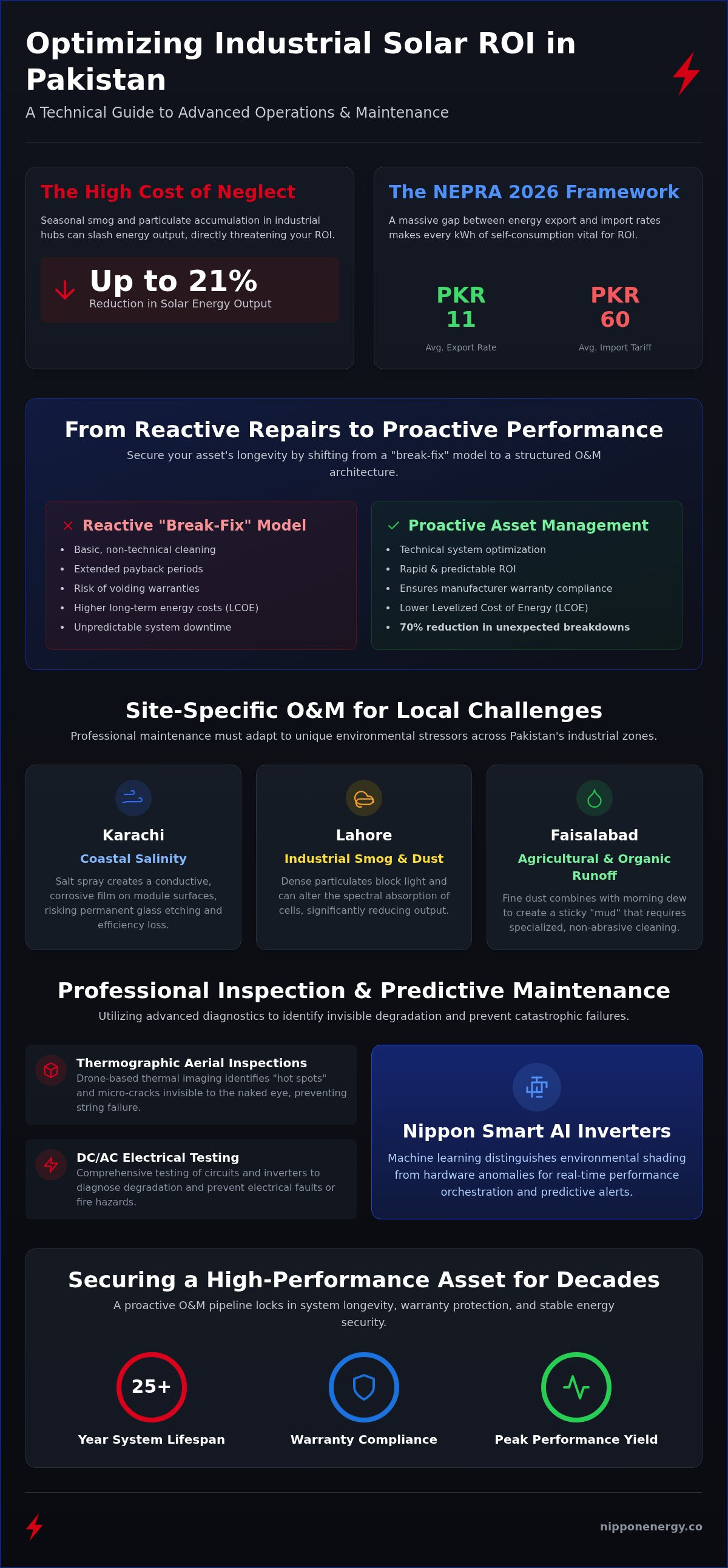
In industrial hubs like Lahore and Karachi, seasonal smog and particulate accumulation can reduce solar energy output by as much as 21 percent. This efficiency drop represents a direct threat to your ROI, especially under the NEPRA 2026 net billing regulations where the gap between the PKR 11 export rate and the PKR 60 import tariff makes every kilowatt-hour of self-consumption vital. You've likely realized that standard cleaning is no longer sufficient to protect a high-value asset. Effective commercial solar panel maintenance pakistan requires a shift from reactive repairs toward a structured, technical performance architecture.
We'll show you how professional O&M protocols and AI-driven monitoring secure the 25-plus year longevity of your energy infrastructure. You'll discover how Smart AI Inverters and predictive analytics can reduce unexpected breakdowns by 70 percent while maintaining consistent yields in extreme heat. This guide previews the essential maintenance standards for high-efficiency HJT and TOPCon systems that ensure your industrial transition remains a stable, high-performance asset for decades. By moving from manual labor to automated intelligence, you can lock in the energy security your facility requires.
Key Takeaways
- Understand why technical system optimization, rather than simple cleaning, is the primary driver of industrial ROI under Pakistan’s 2026 net billing framework.
- Quantify the impact of regional stressors like Karachi’s coastal salinity and Lahore’s smog to implement more effective commercial solar panel maintenance pakistan strategies.
- Learn how thermographic aerial inspections and DC/AC electrical testing protocols identify invisible degradation and prevent catastrophic hardware failures.
- Discover how Nippon Smart AI Inverters utilize machine learning to distinguish between environmental shading and hardware anomalies for real-time performance orchestration.
- Establish a long-term O&M pipeline that secures a 25-plus year system lifespan through localized technical support and predictive maintenance architectures.
The Economic Imperative: Why Maintenance Dictates Commercial ROI in Pakistan
Commercial Operations and Maintenance (O&M) represents a departure from basic janitorial services toward a specialized engineering discipline focused on technical system optimization. In the context of Pakistan's industrial sector, commercial solar panel maintenance pakistan serves as the primary safeguard for a multi-million rupee CAPEX investment. Performance Architecture is the integration of hardware durability and proactive service. This approach ensures that the theoretical efficiency of solar panel technology translates into actualized energy yields over decades of operation.
The financial consequences of neglect are exacerbated by the NEPRA 2026 prosumer regulations. Under the new net billing framework, the national average energy purchase price for surplus electricity is approximately PKR 11 per unit, while the retail tariff for grid consumption ranges from PKR 40 to PKR 60 per unit. This pricing delta makes maximizing self-consumption the only viable path to rapid ROI. When industrial dust or thermal stress reduces system output by 20 percent, the facility is forced to purchase high-tariff grid power to bridge the gap. This inefficiency directly extends the payback period beyond the projected 3-5 year window.
Protecting the CAPEX of High-Efficiency Systems
Advanced modules like Nippon HJT Solar Panels utilize bifacial cells to maximize light absorption. These systems require specific cleaning protocols to maintain rear-side gains that can be easily neutralized by ground-level debris or improper mounting maintenance. By transitioning from a reactive "break-fix" model to proactive asset management, industrial operators can maintain a lower Levelized Cost of Energy (LCOE). This shift ensures that the high-efficiency hardware performs at its technical limit throughout its 25-plus year lifespan.
Warranty Compliance and Long-Term Reliability
Maintaining a rigorous O&M schedule is a prerequisite for manufacturer warranty compliance. Documented maintenance logs serve as the technical evidence required to process claims for hardware failure or premature degradation. For Nippon TOPCon Solar Panels, professional inspections identify potential "hot spots" or micro-cracks before they compromise the entire string. Beyond financial protection, these protocols prevent industrial fire hazards and electrical faults, securing both the personnel and the structural integrity of the facility.
Mitigating Pakistan’s Environmental Stressors: Soiling, Heat, and Smog
Pakistan’s diverse geography introduces a complex array of environmental stressors that demand site-specific O&M strategies. In Karachi’s industrial zones like Port Qasim, coastal salt spray creates a conductive, corrosive film on module surfaces. In contrast, Lahore’s industrial dust and cement particulates form a dense layer that significantly alters the soiling ratio. Research into Solar Energy Development in Pakistan indicates that these local factors are primary drivers of system degradation. Professional commercial solar panel maintenance pakistan must address these variables to prevent permanent glass etching and efficiency loss.
The "Smog Factor" in Punjab presents a technical challenge often overlooked in standard maintenance plans. Winter particulate matter doesn't just block light; it acts as a spectral filter, shifting light absorption toward the infrared spectrum and reducing the output of standard photovoltaic cells. Cleaning maintains the Albedo effect by ensuring that both the modules and their surrounding reflective surfaces remain free of dark, light-absorbing soot. This practice is essential for bifacial systems where rear-side irradiance is highly sensitive to ground-level cleanliness.
Industrial Zone Challenges: Karachi to Faisalabad
Industrial hubs require specialized cleaning protocols to combat chemical residues. In Korangi, corrosive particulates from nearby manufacturing can bond with the glass surface, necessitating specific pH-neutral cleaning agents. In the agricultural-industrial belts of Faisalabad, fine dust and organic runoff create a sticky "mud" when combined with morning dew. Using deionized water is a technical requirement for these regions; it prevents mineral scaling, which creates a permanent insulation layer that is nearly impossible to remove without damaging the anti-reflective coating. If you're managing a large-scale array, you can consult with our technical team to establish a localized cleaning schedule.
High-Temperature Performance Optimization
Managing thermal stress is critical in regions like Sindh and Southern Punjab, where ambient temperatures frequently exceed 45°C. While advanced HJT technology provides a superior temperature coefficient, it remains a baseline that requires proactive management. Comprehensive commercial solar panel maintenance pakistan also involves monitoring inverter derating during peak summer months to ensure that thermal protection limits aren't artificially throttling production. Structural integrity checks are equally vital; extreme thermal expansion and contraction cycles can weaken mounting fasteners and stress cable management systems. Regular inspections verify that thermal gaps and ventilation paths remain unobstructed, allowing the system to shed heat as designed.
Technical O&M Framework: Professional Inspection Protocols
As Pakistan's solar boom accelerates, the complexity of industrial arrays requires a shift from superficial checks to a rigorous, multi-tiered technical framework. A structured O&M protocol ensures that every component of the energy architecture performs at its peak design specification. This methodical approach to commercial solar panel maintenance pakistan involves four critical phases of technical verification.
- Step 1: Visual and Thermographic Aerial Inspections. Utilizing drone technology equipped with high-resolution infrared sensors allows technical teams to identify cell-level anomalies. These thermographic maps reveal "hot spots" caused by internal shunts or localized soiling that are invisible to the naked eye.
- Step 2: DC/AC Electrical Testing. Comprehensive testing of insulation resistance and grounding checks prevents leakage currents and potential electrical hazards. These diagnostics ensure the structural safety of the electrical balance of system (BOS).
- Step 3: IV Curve Tracing. This diagnostic tool identifies sub-module degradation and Potential Induced Degradation (PID). By comparing actual performance curves against the manufacturer's STC (Standard Test Conditions) data, engineers can pinpoint underperforming strings with absolute precision.
- Step 4: Mechanical Audits. Regular verification of trackers and mounting structures ensures wind-load resilience. In regions prone to monsoon storms, checking the torque of fasteners and the integrity of rail alignments is vital to prevent structural failure.
The Cleaning Science: Frequency and Methodology
Determining the "Economical Cleaning Frequency" is a data-driven process that balances the cost of water and labor against the revenue lost to soiling. For large-scale industrial roofs, robotic cleaning systems often provide a superior ROI compared to manual labor by ensuring uniform pressure and water distribution. A critical rule in commercial solar panel maintenance pakistan is the total prohibition of walking on modules. Improper walking paths create micro-cracks in the silicon cells, which eventually lead to inactive areas and permanent power loss that no amount of cleaning can rectify.
Inverter and Battery Health Diagnostics
The reliability of the system depends on the health of the power conversion and storage layers. Routine servicing of Nippon Smart AI Inverters includes firmware optimization to refine MPPT (Maximum Power Point Tracking) algorithms for local conditions. Similarly, maintaining Lithium-Ion Battery Storage requires precise thermal management checks and state-of-health (SoH) calibrations. These diagnostics include testing emergency shutdown systems to guarantee rapid-shutdown compliance, ensuring the facility remains protected during grid instabilities or site emergencies.
Predictive Maintenance: The Role of AI in Performance Orchestration
The transition from scheduled to predictive maintenance represents the highest tier of commercial solar panel maintenance pakistan. While traditional O&M relies on fixed calendars, AI-driven orchestration utilizes real-time data to identify anomalies before they result in system downtime. This shift moves the industrial operator away from a "fail-and-fix" cycle toward a state of continuous optimization. AI-driven analytics significantly reduce "Truck Rolls" by providing precise remote diagnostics that eliminate unnecessary service visits to industrial sites, saving both time and operational costs.
Nippon Smart AI Inverters serve as the primary intelligence layer in this architecture. These units employ sophisticated machine learning algorithms to analyze voltage and current signatures with high granularity. This allows the system to distinguish between transient environmental shading, such as a passing cloud or localized smog, and internal hardware failures like a blown fuse or a degraded string. Centralized remote monitoring centers provide oversight for multi-site industrial portfolios, ensuring that performance benchmarks are met across geographically dispersed assets in Karachi, Lahore, and Islamabad.
Data-Driven Decision Making
Effective commercial solar panel maintenance pakistan requires the integration of historical yield data with localized environmental variables. By analyzing past performance during Punjab’s smog season or Sindh’s peak summer, the system can predict the exact "Economical Cleaning Window" where the cost of cleaning is fully offset by the projected yield increase. Automated alerts for string-level underperformance allow technical teams to address specific issues without auditing the entire array. Integrating on-site weather station data further refines these models, correlating performance shifts with local Pakistani climate patterns like humidity spikes or dust storms.
Digital Twins for Solar Assets
Advanced O&M strategies now utilize "Digital Twins," which are virtual replicas of the physical solar farm. These models simulate various maintenance scenarios to predict how different cleaning frequencies or component replacements will impact the 25-year ROI. The system can accurately predict the end-of-life for critical wear-and-tear components, such as inverter cooling fans or capacitors, allowing for pre-emptive replacement during scheduled downtime. The NipponHev System integrates these hardware and software layers into a unified architecture, ensuring that the physical durability of the panels is matched by the intelligence of the monitoring platform.
If you're ready to upgrade your facility's energy oversight with AI-integrated monitoring, contact our industrial O&M specialists today.
Strategic Partnership: Nippon Energy’s Turnkey O&M Solutions
Nippon Energy positions itself as a technical partner rather than a mere service provider. Our local presence in Karachi, Lahore, and Islamabad ensures that specialized teams are always within reach of major industrial clusters. This regional anchoring is vital for executing commercial solar panel maintenance pakistan with the precision required by high-capacity arrays. By establishing a direct Solar EPC Services to O&M pipeline, we ensure that the engineering intent of the original design is preserved through the entire operational lifecycle. Maintaining a high-tech approach to commercial solar panel maintenance pakistan allows us to resolve technical discrepancies before they impact your bottom line.
Our partnership model is built on Customizable Service Level Agreements (SLAs) tailored to the specific uptime requirements of industrial and commercial sectors. These agreements move beyond basic checklists to provide comprehensive reporting that serves the executive suite. We deliver transparent ROI analysis and verified carbon-offset data; these metrics are essential for corporate Environmental, Social, and Governance (ESG) compliance in the modern global market. This data-driven transparency ensures that every rupee spent on maintenance is a documented contribution to the facility’s long-term profitability.
Localized Expertise for the Pakistani Market
Managing energy assets in Pakistan requires a deep understanding of local grid dynamics and the frequent voltage fluctuations common in industrial feeders. Nippon Energy technical teams are trained to navigate these instabilities, ensuring that your system’s protection parameters are calibrated for maximum resilience against grid surges. We prioritize rapid response times for critical system failures in major industrial hubs, minimizing potential revenue loss during peak production hours. Additionally, we provide structured training and development for on-site facility staff, empowering your internal teams to follow Nippon Energy protocols for daily oversight and safety.
Future-Proofing Your Energy Infrastructure
The rapid evolution of energy technology necessitates an O&M framework that supports continuous improvement rather than static upkeep. We offer specialized services for upgrading legacy systems with Nippon Smart AI hardware, immediately enhancing monitoring capabilities for older installations that lack modern diagnostics. This scalability allows for the seamless integration of additional Nippon Lithium-ion Battery Storage or array expansions within your existing O&M framework as your facility’s energy needs grow. Secure your industrial energy future with Nippon Energy’s technical O&M solutions to ensure your investment remains a high-performance asset for the next 25 years.
While technical maintenance secures the hardware, business owners must also consider the legal structures protecting these high-value assets. To ensure your broader estate and tax strategies are as robust as your energy infrastructure, you can explore Professional Legal and Notarial Fees for expert guidance.
Securing Industrial Energy Autonomy through Technical Excellence
The transition toward a sustainable industrial future in Pakistan depends on the precise orchestration of energy assets. Achieving a 25-plus year lifespan requires moving beyond rudimentary cleaning toward a comprehensive technical framework. Professional commercial solar panel maintenance pakistan ensures that high-efficiency HJT and TOPCon systems remain resilient against regional stressors like Lahore's smog and Karachi's coastal salinity. By integrating AI-driven predictive monitoring, industrial operators can transform their solar arrays from static hardware into intelligent, self-optimizing energy plants.
Nippon Energy provides the specialized technical authority required to safeguard these monumental investments. With localized teams in Karachi and Lahore, we deliver SLA-backed performance guarantees and real-time data oversight through our Smart AI Inverters. This methodical approach to O&M is the final step in securing the rapid ROI promised by modern solar technology. It's time to transition from simple asset ownership to high-performance energy architecture.
Optimize Your Commercial Solar Performance with Nippon Energy
Frequently Asked Questions
How often should commercial solar panels be cleaned in Pakistan?
Cleaning frequency is determined by the specific soiling ratio of your industrial zone. In high-pollution areas like Lahore or Faisalabad, a bi-weekly schedule is often necessary to prevent output drops of up to 21 percent. Sites in Karachi may require monthly rinsing to remove corrosive coastal salt deposits that can permanently etch the glass surface if left unmanaged.
What is the typical cost of commercial solar maintenance in Lahore vs. Karachi?
Technical O&M costs are primarily dictated by system capacity and the sophistication of the service level agreement rather than geography. While basic cleaning is a baseline expense, comprehensive commercial solar panel maintenance pakistan involves specialized electrical testing and AI-driven monitoring. These technical services are priced based on the depth of diagnostic reporting and the frequency of professional engineering audits required.
Can I use tap water to clean my industrial solar panels?
No, untreated tap water is unsuitable for cleaning because it contains minerals that lead to scaling and permanent glass etching. Deionized or reverse-osmosis water is the industry standard for maintaining high-efficiency modules. Using hard water creates a calcium layer that acts as an insulator, reducing light absorption and potentially compromising the manufacturer’s performance warranty over time.
How does smog in Punjab affect solar panel performance during winter?
Smog acts as both a physical barrier and a spectral filter that significantly reduces the irradiance reaching your silicon cells. This particulate matter shifts light absorption toward the infrared spectrum, which standard photovoltaic technology is less equipped to convert into electricity. Frequent cleaning during winter is essential to maintain the Albedo effect and ensure that bifacial modules continue to capture reflected light.
What are the signs that my commercial solar inverter needs maintenance?
Critical indicators include frequent thermal derating, unexpected system shutdowns, or significant deviations in MPPT efficiency on your monitoring dashboard. If the internal temperature of the unit remains high despite moderate ambient conditions, it's a sign of cooling fan failure or dust accumulation. Professional technical servicing is required to optimize firmware and ensure the power conversion layer remains stable during grid fluctuations.
Does professional maintenance affect the manufacturer's warranty?
Yes, regular professional maintenance is a mandatory prerequisite for keeping most hardware warranties valid. Manufacturers require documented logs of inspections and specialized cleaning to process claims for premature degradation or hardware failure. Without these technical records, it's difficult to prove that an issue resulted from a manufacturing defect rather than environmental neglect or improper handling.
What is the difference between preventive and predictive maintenance for solar farms?
Preventive maintenance relies on fixed schedules for routine checks, while predictive maintenance uses real-time data to identify anomalies before failures occur. Predictive O&M utilizes machine learning to analyze performance signatures, allowing technical teams to intervene only when hardware data suggests a component is nearing its end-of-life. This approach is the gold standard for commercial solar panel maintenance pakistan because it maximizes uptime.
Is thermographic drone inspection necessary for roof-top commercial solar?
Yes, thermographic drone inspections are essential for identifying internal cell defects like "hot spots" that are invisible during standard visual checks. This technology provides a comprehensive thermal map of the entire array, allowing engineers to pinpoint high-resistance areas or micro-cracks. Identifying these issues early prevents localized overheating, which can lead to permanent module damage or even industrial fire hazards on the roof.


