

Industrial power in 2026 is no longer a matter of simple utility procurement; it's a strategic architectural asset. For factory owners, the persistent threat of grid instability and escalating peak-demand charges makes traditional energy models a liability. You likely recognize that standard rooftop installations often fall short of meeting the rigorous energy density required for heavy manufacturing, especially when roof space is at a premium. Mastering solar power system design for factories requires moving beyond basic panel placement toward a sophisticated integration of high-efficiency modules and intelligent load management.
This guide provides the technical blueprint to achieve energy independence through advanced infrastructure. We'll examine how certified HJT modules, reaching over 25% efficiency in 2026, allow for maximum power generation within constrained footprints. You'll learn to navigate the complexities of 2026 regulatory shifts, including FEOC sourcing requirements and the latest NEC compliance standards. We'll also detail the strategic deployment of AI-driven inverters and lithium-ion storage to ensure your facility maintains a scalable, high-performance power architecture that delivers a predictable, long-term return on investment.
Key Takeaways
- Transition from passive energy generation to active load orchestration to manage heavy motor startup currents and continuous 24/7 manufacturing cycles.
- Maximize energy density in constrained spaces by integrating high-efficiency Nippon HJT modules and AI-driven inverters into your solar power system design for factories.
- Mitigate thermal degradation by addressing the 'Heat Island' effect and specific roofing dynamics unique to high-temperature industrial environments.
- Ensure long-term structural and financial security through a rigorous EPC lifecycle that utilizes LiDAR shadow analysis and precision industrial engineering.
- Future-proof your facility with a unified energy architecture like the NipponHev system to achieve seamless grid integration and predictive performance monitoring.
The Strategic Architecture of Solar Power System Design for Factories
Industrial energy strategy has evolved beyond simple decarbonization. In 2026, successful solar power system design for factories focuses on load orchestration rather than basic energy offset. This shift is necessary because industrial facilities operate with high-torque machinery and continuous 24/7 cycles that create volatile demand spikes. Designing a system that only covers average consumption often leads to grid instability during heavy motor startup events. These events require instantaneous surges of current that standard solar configurations might not handle without sophisticated inverter management. It's a strategic shift that moves energy from a passive utility to an actively managed industrial asset.
For businesses seeking to implement this active management approach through small-scale, turnkey power solutions, you can visit SolarPorts Development for specialized guidance on property-wide transitions.
Modern industrial standards now prioritize N-Type architectures, specifically HJT and TOPCon technologies, over legacy P-type PERC modules. These advanced photovoltaic system components provide superior temperature coefficients and lower degradation rates. These traits are essential in high-heat industrial zones where efficiency usually drops as temperatures rise. By focusing on the Levelized Cost of Energy (LCOE) rather than just the initial CAPEX, manufacturers can secure a more resilient financial profile. A lower LCOE reflects the system's ability to produce more power over a 25 year lifecycle, effectively lowering the cost per kilowatt-hour despite a higher upfront investment in premium hardware.
Load Profiling and Demand Analysis
Precision is the foundation of industrial solar. Engineers must analyze 15-minute interval data to map the relationship between base loads and variable machine cycles. This granular data helps in identifying peak demand periods where grid charges are highest. Predictive modeling then uses this data to future-proof the facility. It ensures the solar power system design for factories can accommodate planned production line expansions or the addition of automated machinery without requiring immediate hardware overhauls.
Space vs. Efficiency: The Industrial Rooftop Challenge
Industrial rooftops present unique structural challenges. High power density is mandatory when roof space is limited by existing HVAC units and industrial ventilation systems. Utilizing high-efficiency panels like Nippon HJT Solar Panels ensures maximum energy yield per square meter. A comprehensive structural assessment of industrial sheds or reinforced concrete roofs is vital to verify the roof supports static and dynamic loads. Proper integration ensures the solar array doesn't obstruct critical maintenance access.
Technical Engineering Components: Harmonizing HJT Modules and AI Orchestration
Precision engineering at the component level defines the resilience of a modern industrial energy plant. While basic installations rely on standard hardware, sophisticated solar power system design for factories integrates high-performance modules with adaptive software layers. This synergy transforms a static array into a dynamic power plant capable of responding to the high-load demands of heavy machinery. By selecting hardware that matches the specific electrical profile of a facility, engineers can eliminate the inefficiencies that typically plague large-scale industrial solar projects.
The integration of storage is the final piece of this technical puzzle. Scaling with Nippon Lithium-ion Battery Storage Systems provides the necessary buffer for critical load backup. These systems are designed to meet 2026 FEOC compliance standards, with a 55% non-FEOC sourcing threshold for battery components. This ensures that your facility not only achieves technical excellence but also maintains eligibility for the 30% commercial investment tax credit. Industrial leaders looking to optimize their technical architecture can explore our full range of industrial solar solutions to begin their transition.
The Superiority of HJT and TOPCon in 2026
In 2026, the choice between N-Type TOPCon and Heterojunction (HJT) cell structures is a critical design decision. Nippon HJT Solar Panels achieve certified module efficiencies exceeding 25%, offering a superior bifaciality factor that captures reflected light from industrial roof surfaces. This is especially effective on flat roofs treated with high-albedo coatings, where bifacial gain can increase total yield by up to 30% compared to monofacial designs. These modules exhibit minimal degradation, ensuring that the factory’s energy production remains stable over a 30-year operational lifespan. This longevity is critical for solar for industrial applications where consistent uptime is the primary metric of success.
Intelligent Energy Management Systems (IEMS)
The inverter no longer functions as a simple converter; it serves as the central intelligence of the facility. Our smart ai solar inverters actively manage harmonic distortion, which is a common issue in grids supporting large industrial motors. By utilizing AI-driven peak shaving, the system automatically draws from stored energy during high-tariff periods. This reduces expensive demand charges without manual intervention. Real-time performance monitoring provides predictive maintenance alerts, allowing engineers to address potential hardware issues before they cause production downtime.
Navigating Industrial Constraints: Roof Integrity and Thermal Dynamics
Industrial facility roofs operate under significantly harsher conditions than residential structures. The sheer scale of factory rooftops, combined with the "Heat Island" effect common in industrial parks, creates a microclimate where ambient temperatures often exceed 45°C. For standard photovoltaic modules, these elevated temperatures trigger a sharp decline in energy conversion efficiency. Effective solar power system design for factories must account for these thermal dynamics by selecting hardware specifically engineered for high-heat environments. In many cases, dark metal roof temperatures can soar to 70°C, requiring a robust thermal management strategy to prevent premature component degradation.
Structural integrity is equally critical for commercial and industrial solar systems. Large-scale factory arrays act as massive sails, creating substantial wind lift forces during storms. Engineering teams must conduct rigorous wind load calculations to ensure the mounting hardware can withstand localized pressure zones, especially at the roof edges and corners. In coastal regions or zones with high chemical activity, corrosion resistance becomes a primary requirement. Utilizing industrial-grade racking with specialized coatings protects the system from salt spray and acidic industrial exhaust, ensuring the structural safety of the asset for decades.
Temperature Coefficient and Industrial Yield
N-type HJT technology is the ideal solution for high-temperature factory environments. While traditional panels lose significant output as they heat up, Nippon HJT Solar Panels maintain a superior temperature coefficient. This ensures higher energy harvest during peak sun hours when factory loads are often at their highest. Design teams optimize this performance through passive cooling strategies, such as increasing the mounting height above the roof surface to facilitate airflow. The design must also address industrial dust and particulate matter. Specific tilt angles and regular maintenance schedules help mitigate the "soiling" effect, which can otherwise reduce yield by over 10% in high-pollution industrial zones, such as those where JAS Global Industries provides chemical solutions for the fertilizer and mining sectors.
Mounting and Structural Safety
The choice between penetrating and non-penetrating mounting systems depends on the roof's underlying material, such as metal sandwich panels or reinforced concrete. For older facilities, weight distribution is a priority. Engineers use light-weight rail configurations or specific ballast patterns to avoid exceeding the roof's structural capacity. Fire safety is another non-negotiable standard. Large-scale industrial PV installations require rapid shutdown capabilities and fire-resistant materials to protect the facility's interior operations. Integrating these safety protocols at the design stage ensures the solar plant enhances rather than compromises factory safety.
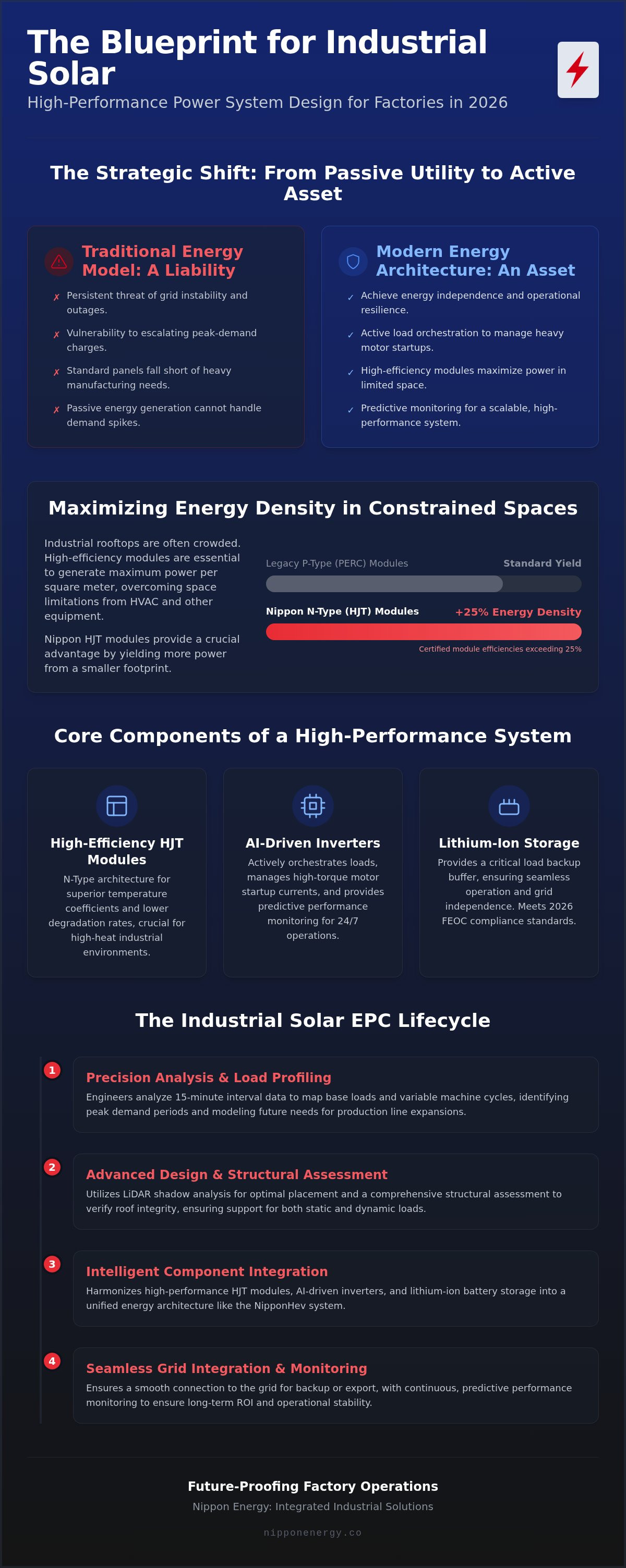
The Industrial Solar EPC Lifecycle: From Feasibility to Grid Integration
Industrial solar implementation follows a rigorous four-phase lifecycle. This methodical approach transforms the complex solar power system design for factories into an operational reality. It begins with high-resolution data acquisition and ends with a synchronized connection to the utility infrastructure. The Engineering, Procurement, and Construction (EPC) process must be seamless to ensure that factory production remains uninterrupted during the transition to renewable energy. A disciplined execution strategy is the only way to convert a technical blueprint into a high-yield financial asset.
Phase 1 involves detailed feasibility studies where engineers use LiDAR technology for precision shadow analysis. This identifies obstructions from chimneys, ventilation units, and nearby structures that could compromise efficiency. Phase 2 moves into precision engineering and the procurement of industrial-grade hardware, ensuring all components meet the 2026 non-FEOC sourcing requirements. During Phase 3, construction management prioritizes Health, Safety, and Environment (HSE) compliance. This ensures on-site safety while maintaining the structural integrity of the facility. Finally, Phase 4 focuses on commissioning and grid-tie synchronization. This final step requires rigorous testing of protection relays to ensure the system interacts safely with the utility provider. To ensure your project meets these exacting standards, consult our industrial EPC services for an end-to-end technical evaluation.
Feasibility and Financial Modeling
A comprehensive solar project development study is the foundation of any industrial investment. Stakeholders must evaluate the Internal Rate of Return (IRR) and the Payback Period against current utility tariffs. In regions like Pakistan and the Middle East, navigating local net-metering regulations is essential for maximizing ROI. The financial model must account for these regulatory nuances to ensure the system provides a predictable hedge against rising energy costs over its 30-year lifespan.
Grid Synchronization and Stability
Grid stability is a primary concern for high-consumption facilities. Industrial motor startups create significant voltage fluctuations that the solar power system design for factories must manage through advanced inverter settings. Many jurisdictions now require zero-export compliance, which necessitates real-time monitoring and rapid response from the energy management system. Integrating lithium ion battery storage provides the necessary stabilization, acting as a buffer that absorbs excess generation and discharges it during demand spikes. This architecture ensures the factory remains a stable load on the national grid while maximizing self-consumption.
Nippon Energy’s Integrated Industrial Solutions: Future-Proofing Factory Operations
Achieving true energy independence requires more than just high-quality hardware; it demands a unified architectural vision. While many providers offer fragmented, mix-and-match components, this approach often creates monitoring gaps and system inefficiencies. A cohesive solar power system design for factories must ensure that every element, from the photovoltaic cells to the AI-driven management software, operates as a single, high-performance entity. Nippon Energy provides this through end-to-end accountability, managing everything from the initial feasibility study to long-term operations and maintenance.
The NipponHev system serves as the definitive framework for this integrated approach. It combines our proprietary HJT modules with intelligent energy orchestration to eliminate the technical friction that typically occurs between disparate hardware brands. Our track record in high-demand zones demonstrates the efficacy of this model. In Karachi's industrial sector, facilities utilizing our integrated design have achieved a verified 40% reduction in energy costs. This success stems from the system's ability to optimize self-consumption while mitigating the high peak-demand charges prevalent in the region.
Unified System Architecture
Single-source hardware and software integration significantly reduces industrial downtime by simplifying the troubleshooting process. The synergy between Nippon HJT Solar Panels and our Smart AI Inverters allows for granular, panel-level data analysis that third-party combinations can't replicate. This unified architecture is also inherently scalable. As factory operations grow, adding additional capacity or Nippon Lithium-ion Battery Storage Systems becomes a seamless process rather than a complex engineering overhaul. This modularity ensures your energy infrastructure evolves alongside your production requirements.
Long-Term Asset Management
Industrial solar assets must deliver performance for 25 years or longer to maximize ROI. We implement specialized solar system maintenance protocols designed for high-soiling environments where dust and industrial particulates are constant challenges. Our remote monitoring teams provide real-time oversight and rapid response support to ensure every kilowatt of potential yield is captured. This proactive management strategy protects the technical integrity of the system and secures your long-term financial objectives. To begin your facility’s transformation, consult with Nippon Energy’s Industrial Design Team to develop a tailored energy blueprint.
Securing Your Industrial Energy Future
The transition to renewable energy is a structural evolution that requires technical precision and visionary planning. In 2026, successful solar power system design for factories demands a shift from passive generation to active load orchestration. You must prioritize high-efficiency HJT technology to overcome thermal constraints while ensuring your system complies with the latest grid-tie and sourcing regulations. By integrating AI-driven management with robust industrial-grade hardware, your facility can transform energy from a volatile expense into a predictable, high-performance asset.
Nippon Energy brings Japanese engineering standards and proprietary HJT efficiency technology to every project. Our global industrial EPC experience ensures that your system is built for longevity and maximum yield in the harshest environments. It's time to future-proof your operations with a partner that values precision as much as you do. Take the first step toward achieving total energy independence and securing your competitive advantage in the global market.
Request a Technical Feasibility Study for Your Factory
Frequently Asked Questions
How much roof space is required for a 1MW factory solar system?
A 1MW system typically requires between 5,000 and 6,500 square meters of roof area when using high-efficiency modules. Utilizing Nippon HJT Solar Panels allows for a more compact footprint because their certified efficiency exceeds 25%. The exact space depends on your roof's orientation, structural obstructions, and the specific tilt angle required for optimal energy harvest.
Can solar power handle the high startup currents of heavy industrial machinery?
Solar systems manage high startup currents through advanced inverter technology and integrated battery storage. Modern Smart AI Inverters are engineered to handle the instantaneous surges required by heavy industrial motors without causing system trips. This capability ensures that production lines remain stable and operational even during high-torque machine activation periods.
What is the typical ROI for a factory solar power system in 2026?
The typical ROI for a factory solar power system in 2026 ranges from three to five years depending on local utility tariffs and available tax incentives. Financial performance is significantly bolstered by the 30% commercial investment tax credit for systems that meet compliance standards. Over a 25-year operational lifespan, these systems provide a predictable hedge against escalating grid costs.
How does HJT technology perform on hot industrial roofs compared to PERC?
HJT technology significantly outperforms PERC on hot industrial roofs because it possesses a superior temperature coefficient. While PERC panels lose efficiency rapidly as temperatures exceed 25°C, Nippon HJT modules maintain higher power output even when roof temperatures reach 70°C. This resilience makes HJT the preferred choice for solar power system design for factories in high-temperature industrial zones.
Is battery storage necessary for a grid-tied factory solar system?
Battery storage isn't strictly mandatory for a grid-tied system, but it's highly recommended for peak shaving and grid stabilization. Storing excess energy allows you to avoid high peak-demand charges during expensive tariff periods. It also provides a critical buffer that protects sensitive industrial equipment from voltage fluctuations on the national grid, ensuring consistent power quality.
What are the maintenance requirements for solar panels in dusty industrial zones?
Maintenance in high-soiling industrial zones requires a structured cleaning schedule and real-time performance monitoring. Industrial dust and particulate matter can reduce energy harvest by 10% or more if left unmanaged. We recommend quarterly professional cleaning and utilizing automated alerts from an intelligent management system to identify and address sudden drops in panel performance.
How does AI improve the performance of industrial solar inverters?
AI enhances inverter performance by automating load orchestration and managing harmonic distortion within the industrial grid. These intelligent systems use predictive algorithms to shave peak demand and alert maintenance teams to potential hardware failures before they cause downtime. This level of automation is a foundational element of modern solar power system design for factories.
Can we install solar on an older factory roof with structural limitations?
You can install solar on older roofs by utilizing lightweight mounting systems and strategic weight distribution patterns. Engineering teams conduct structural assessments to determine if the roof requires reinforcement or if a non-penetrating, ballasted system is more appropriate. Precision design ensures that the solar array doesn't compromise the existing structural integrity of your facility.


