
In the 2026 regulatory environment, a solar system is no longer just a collection of panels; it's a high-precision financial asset where a single technical mismatch can extend your payback period by years. Understanding the key stages of a solar epc project in pakistan is essential for stakeholders who want to avoid the common pitfalls of inter-vendor finger-pointing and technical incompatibility between inverters and high-efficiency panels. You've likely realized that simply buying components piecemeal doesn't guarantee a lower Levelized Cost of Energy (LCOE) or a smooth NEPRA approval process. This friction often compromises the structural integrity of your energy architecture before the first kilowatt is even generated.
Discover how the integrated Engineering, Procurement, and Construction (EPC) model eliminates these technical hurdles and maximizes the ROI of high-efficiency solar infrastructure. This guide provides a strategic roadmap for deploying 2026-standard technology, such as HJT and TOPCon modules, within a unified framework. We'll preview the transition from advanced feasibility studies to the final commissioning of the NipponHev system. By adopting this methodical approach, you'll secure a turnkey solution with a guaranteed energy yield that remains resilient against shifting market conditions and regulatory updates.
Key Takeaways
- Adopting a single-responsibility model centralizes accountability, ensuring that your energy architecture remains technically cohesive from design to execution.
- Advanced engineering protocols maximize the performance of Nippon HJT and TOPCon technology by aligning system design with high-efficiency hardware requirements.
- Mastering the key stages of a solar epc project in pakistan is critical for navigating the 2026 regulatory landscape and securing timely NEPRA approvals.
- Integrated project management reduces the Levelized Cost of Energy (LCOE) by eliminating inter-vendor friction and optimizing supply chain logistics.
- Future-proofing your investment requires an EPC partner who can seamlessly integrate Smart AI Inverters and provide predictive maintenance at a global standard.
What is a Full-Service Solar EPC Company? The Single-Responsibility Model
In the 2026 energy market of Pakistan, the shift toward sophisticated solar infrastructure has made the traditional fragmented vendor relationship obsolete. High-performance systems require more than just assembly; they demand a unified energy architecture. The Engineering, Procurement, and Construction (EPC) model provides a single-responsibility framework where a partner manages the entire project lifecycle. This approach eliminates the technical friction that occurs when hardware and installation are decoupled. For industrial leaders in Karachi and Lahore, this model ensures that the key stages of a solar epc project in pakistan are executed with technical precision, moving from initial feasibility to grid synchronization under one roof.
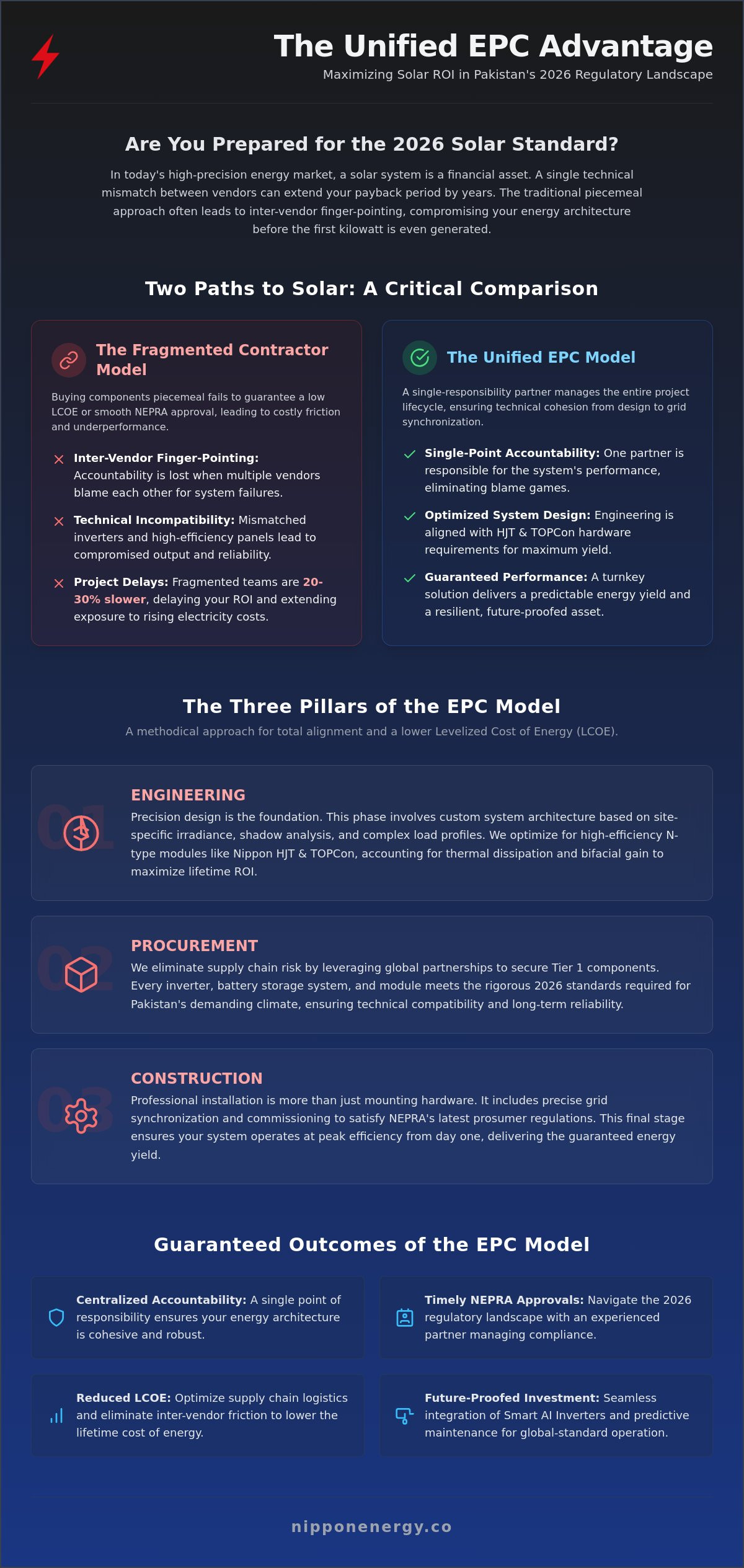
The Three Pillars of the EPC Model
The EPC framework rests on three critical functions that must operate in total alignment to achieve a low Levelized Cost of Energy (LCOE).
- Engineering: This phase involves custom system design based on site-specific irradiance and complex load profiles. It's not enough to install panels; the engineering must maximize the potential of high-efficiency N-type modules like Nippon HJT.
- Procurement: We leverage global supply chains to secure Tier 1 components. This ensures that every inverter and battery storage system meets the rigorous 2026 standards required for Pakistan's climate.
- Construction: Professional installation involves more than mounting. It includes precise grid synchronization and commissioning to satisfy NEPRA's latest prosumer regulations.
Fragmented Contractors vs. Unified EPC
Choosing fragmented vendor management often leads to inter-vendor finger-pointing when systems underperform. If an inverter fails to communicate with high-efficiency panels, the panel supplier blames the inverter manufacturer, who in turn blames the installer. A unified EPC model eliminates this risk by centralizing accountability. Technical incompatibility becomes a non-issue because the system is designed as a singular, cohesive unit. Data from industrial implementations suggests that unified teams finish projects 20% to 30% faster than fragmented ones. This accelerated timeline is crucial for businesses looking to mitigate rising electricity costs in Pakistan's volatile market. By consolidating the key stages of a solar epc project in pakistan, you ensure that your energy asset is future-proofed and optimized for maximum yield from day one.
The Engineering Edge: Precision Design for High-Efficiency Hardware
Precision engineering transforms raw hardware into a high-yield asset. While many vendors focus solely on installation, a true EPC leader prioritizes the design phase to align with Pakistan's renewable energy policy and its 2030 targets. This stage involves deep-dive shadow analysis and electrical load modeling. It ensures that every component is sized to handle the specific stressors of the local environment. This is arguably the most technical of the key stages of a solar epc project in pakistan, as it dictates the lifetime ROI of the infrastructure. Without a rigorous design phase, even the most expensive panels will fail to reach their rated output.
Optimizing for HJT and TOPCon Technologies
High-efficiency modules like Nippon HJT and Nippon TOPCon require specific mounting and string configurations to function correctly. In Karachi, where ambient temperatures often exceed 40°C, the low temperature coefficient of HJT cells is a massive advantage. However, this advantage is only realized if the engineering stage accounts for airflow and thermal dissipation. Designing for bifacial gain is also essential. In dusty industrial zones like Korangi or Sundar, rear-side energy capture must be optimized through elevated structures and specific surface albedo calculations. The symmetrical cell structure of HJT technology demands specific string sizing and voltage matching to reach its peak theoretical efficiency.
AI-Driven Energy Orchestration
Modern solar projects in 2026 rely on intelligence as much as hardware. Integrating Smart AI Solar Inverters during the initial structural design allows for real-time energy orchestration. This digital-first approach includes creating a digital twin of the solar plant. This twin predicts performance based on historical weather data from Lahore or Islamabad. It also ensures that the system is fully compatible with Lithium-Ion Battery Storage from day one. This proactive design prevents the technical friction often seen in retrofitted systems where components fail to communicate effectively.
Customizing for Pakistan’s extreme climates is non-negotiable for long-term durability. Sindh’s intense heat and Punjab’s high humidity require specialized mounting materials and cabling that resist thermal degradation. Engineering for 2026 means building systems that don't just survive but thrive in 50°C temperatures. If you want to see how these designs translate into real-world performance, you can explore our integrated solar project development services to understand our architectural approach. By focusing on the engineering edge, you secure a system that delivers consistent energy yield for decades.
Procurement and Construction: Eliminating Supply Chain and Installation Risk
Transitioning from a technical blueprint to a physical asset requires a sophisticated logistical framework. In Pakistan, where supply chain volatility can disrupt timelines, procurement and construction represent the most high-stakes of the key stages of a solar epc project in pakistan. A full-service EPC partner mitigates these risks by leveraging global supply chains and maintaining strict quality control from the factory floor to the project site. This ensures that the hardware arriving at industrial zones like Korangi or Sundar Industrial Estate matches the exact specifications defined in the engineering phase. By centralizing these processes, businesses avoid the delays and technical friction associated with third-party logistics and fragmented installers.
Strategic Hardware Sourcing
Effective procurement goes beyond simply buying components; it involves securing hardware that is designed to operate as a singular ecosystem. Proprietary sourcing allows for the integration of Nippon HJT panels and Nippon Smart AI Inverters, which are engineered for maximum synergy. This alignment follows the trajectory of Pakistan's renewable energy strategic roadmap, which emphasizes the need for high-efficiency, reliable generation to stabilize the national grid. EPC scale also provides a buffer against price fluctuations in the 2026 market. Every component, from the mounting structures to the DC cabling, must meet international IEC and UL standards to survive Pakistan’s grid conditions and maintain long-term hardware warranties.
Construction Excellence and Safety
Construction is where the 'as-designed' vision becomes the 'as-built' reality. Specialized solar construction teams outperform general electrical contractors because they understand the nuances of high-voltage DC systems and structural wind loads. Whether the project is in the humid plains of Punjab or the salt-heavy air of Karachi, adhering to rigorous safety protocols is non-negotiable. The construction phase concludes with a turnkey grid synchronization service. This includes managing the complex NEPRA and DISCO approval processes, ensuring that the system is legally and technically ready for net billing. Commissioning involves a battery of tests that verify the system's performance against its digital twin, guaranteeing that the projected ROI is achievable from the moment of activation.
Mastering these key stages of a solar epc project in pakistan allows for a seamless transition from design to generation. This unified approach protects your investment from the common failures of fragmented execution. If you are ready to secure your energy future with a partner who manages the entire lifecycle, you can explore our Solar Project Development and EPC services to begin your feasibility assessment.
Financial Performance: Maximizing ROI Through Single-Point Accountability
Financial performance is the ultimate metric for any industrial energy transition. In Pakistan's 2026 market, where electricity tariffs fluctuate between Rs. 40 and Rs. 60 per unit, the efficiency of your solar asset directly dictates your operational competitiveness. Achieving a competitive Levelized Cost of Energy (LCOE) is the primary objective during the final key stages of a solar epc project in pakistan. By centralizing accountability, the EPC model converts a complex engineering challenge into a predictable financial instrument. This single-point responsibility ensures that the theoretical yields promised during the design phase actually manifest as tangible savings on your balance sheet.
Lowering LCOE and Soft Costs
LCOE represents the average cost per unit of energy generated over the system's lifetime. A unified EPC team lowers this figure by eliminating material waste and reducing labor hours through synchronized project management. In urban industrial centers where roof space is at a premium, the use of high-efficiency Nippon HJT panels allows for maximum power density. This means you generate more megawatt-hours from the same square footage, significantly improving land utilization ratios. A mere 1% increase in energy yield achieved through precision engineering can compound into thousands of dollars in additional revenue over a 25-year project lifecycle. By streamlining Net Metering and DISCO approvals, an EPC also slashes the 'soft costs' that often inflate project budgets in the Pakistani regulatory environment.
Accountability and Warranty Management
The fragmented vendor model often leaves businesses vulnerable when hardware underperforms. If a system fails, owners shouldn't have to mediate between panel manufacturers, inverter suppliers, and mounting contractors. A turnkey contract provides one point of contact for all warranty claims, ensuring that technical issues are resolved without administrative delays. This level of professional oversight is why Solar EPC Services are now the preferred choice for commercial financing and insurance providers. They recognize that a performance-backed guarantee from a global partner reduces the risk profile of the investment. To maintain these yields over decades, integrating Solar System Maintenance into the initial agreement ensures that soiling and thermal stress don't erode your ROI.
To protect your capital investment and ensure your infrastructure meets the highest global standards, you can secure a performance-backed solution through our Solar Project Development and EPC team. By focusing on single-point accountability, you eliminate technical friction and secure a future-proofed energy architecture.
Selecting Your EPC Partner: The Nippon Energy Standard for 2026
Selecting the right partner is the most critical decision in the energy transition journey. It's the factor that determines whether the key stages of a solar epc project in pakistan result in a high-performing asset or a technical liability. In the 2026 market, technical prowess is defined by a deep understanding of HJT cell architecture and AI-driven energy orchestration. A partner must demonstrate more than just installation experience; they need to provide a unified energy architecture that bridges the gap between hardware potential and real-world yield. Determining the key stages of a solar epc project in pakistan is a technical exercise, but executing them requires an integrated partner with global reach.
A Global Vision with Local Expertise
Nippon Energy brings a Japanese heritage of precision engineering to the specific challenges of Pakistan’s industrial landscape. This global footprint, spanning Tokyo, Dubai, and regional centers in Karachi and Lahore, ensures that international standards are applied to local climate realities. Our regional success stories include high-performance installations that thrive in the extreme heat of Sindh and the humidity of Punjab. Beyond construction, the value of an EPC partner lies in their ability to provide 24/7 remote monitoring and predictive maintenance. This proactive oversight ensures that small technical anomalies are corrected before they impact your energy output. Technical reliability is built through this blend of international design and local execution.
The Future of Solar Integration
As we move into 2026, AI-managed systems are dominating the energy landscape. Hardware-agnostic contractors often struggle to match the synergy found in an integrated provider because they lack control over the communication protocols between components. The NipponHev System represents the pinnacle of this integration, where panels, inverters, and storage work as a single, intelligent organism. This unified approach is the only way to truly future-proof your infrastructure against shifting regulatory frameworks and rising energy costs. Moving from a feasibility study to final commissioning requires a partner who manages every technical detail with monumental confidence. You don't just need a contractor; you need an architect of energy independence.
To ensure your project adheres to the highest global standards while maximizing local ROI, you should consult with Nippon Energy for your turnkey EPC project in Pakistan today. Securing a reliable energy future starts with a partner who understands the intricate balance of high-tech architecture and regional execution. By choosing a partner that controls the entire lifecycle, you eliminate the risks of technical friction and ensure your investment delivers its maximum theoretical yield for decades to come.
Architecting Your Energy Independence in 2026
Executing a transition to high-efficiency solar requires a unified energy architecture that bridges the gap between hardware potential and operational reality. By consolidating the key stages of a solar epc project in pakistan into a single-responsibility model, industrial leaders eliminate the technical friction that often compromises long-term ROI. You've seen how precision engineering and proprietary hardware synergy, such as Nippon HJT and TOPCon technology, create a resilient system capable of thriving in Pakistan's demanding climate. This methodical approach ensures that your energy asset remains a stable financial instrument for decades to come.
Nippon Energy leverages Japanese-standard precision engineering and a global footprint across Japan, the Middle East, and Pakistan to deliver world-class infrastructure. Our integrated model provides the structural integrity and intelligence needed to lead the 2026 energy landscape. You don't have to manage fragmented vendors when you can partner with a global pioneer dedicated to technical excellence and monumental impact. It's time to transform your energy strategy into a definitive competitive advantage and secure a legacy of clean, reliable power.
Secure Your Energy Future with Nippon Energy’s Full-Service EPC Solutions
Frequently Asked Questions
What is the main difference between a solar EPC and a solar installer in Pakistan?
A solar EPC manages the entire lifecycle of a project, including Engineering, Procurement, and Construction, under a single-responsibility contract. In contrast, an installer typically focuses only on the physical assembly of components provided by the client or third parties. The EPC model ensures a unified energy architecture, where the provider is accountable for the system’s technical performance and regulatory compliance from design to commissioning.
Is a full-service EPC company more expensive than hiring separate contractors?
While the initial contract price for a full-service EPC may seem higher, the total Levelized Cost of Energy (LCOE) is usually lower. Hiring separate contractors often leads to technical friction and "vendor finger-pointing" when systems underperform. An EPC reduces these risks and eliminates the hidden soft costs associated with project delays and component mismatches, providing better long-term financial security for your investment.
How does an EPC company handle NEPRA permits and grid approvals?
An EPC provider manages the entire regulatory process as a turnkey service. This includes preparing technical feasibility reports, coordinating with local distribution companies (DISCOs), and securing net billing approvals under the latest NEPRA Prosumer Regulations of 2026. By centralizing this process, the EPC ensures that the system meets all grid synchronization standards, preventing administrative delays that can stall a project for months.
Can an EPC company integrate battery storage into an existing solar design?
Yes, an EPC can integrate Nippon Lithium-ion Battery Storage Systems into existing designs, provided the electrical architecture supports the upgrade. This requires precise modeling to ensure the new storage capacity aligns with the current inverter’s communication protocols. A professional EPC will conduct a technical audit to prevent compatibility issues, ensuring the integrated system optimizes self-consumption and provides reliable backup power during grid outages.
What performance guarantees should I expect from a solar EPC provider?
You should expect a Performance Ratio (PR) guarantee and a specific energy yield commitment for the first year of operation. These guarantees ensure the EPC partner is financially accountable for the system's output. A reliable provider will also offer long-term hardware warranties on HJT or TOPCon modules and provide performance monitoring to ensure the system achieves its projected ROI throughout its 25-year lifecycle.
How long does a typical commercial solar EPC project take from design to commissioning in Pakistan?
A standard commercial project typically requires 12 to 20 weeks to complete. This timeline encompasses the key stages of a solar epc project in pakistan, including initial engineering, the procurement of high-efficiency hardware, and the physical construction phase. Regulatory approvals from NEPRA and DISCOs often dictate the final commissioning date, but a unified EPC team can often finish the technical installation 20% to 30% faster than fragmented teams.
Why is the engineering phase considered the most critical part of the EPC process?
Engineering is the most vital of the key stages of a solar epc project in pakistan because it defines the system’s lifetime efficiency. Precision design involves site-specific shadow analysis and thermal modeling to account for Pakistan’s extreme heat. Without rigorous engineering, high-efficiency components like HJT panels cannot achieve their theoretical yield, leading to premature hardware degradation and a significantly longer payback period for the investor.
Does Nippon Energy provide EPC services for both residential and utility-scale projects in Pakistan?
Nippon Energy focuses on delivering high-tech architecture for industrial, commercial, and utility-scale solar projects. Our expertise lies in managing large-scale energy transitions where technical precision and global engineering standards are non-negotiable. While we provide the hardware for sophisticated energy systems, our EPC services are specifically optimized for stakeholders requiring robust, future-proofed infrastructure that can handle significant electrical loads and complex grid interactions.


