

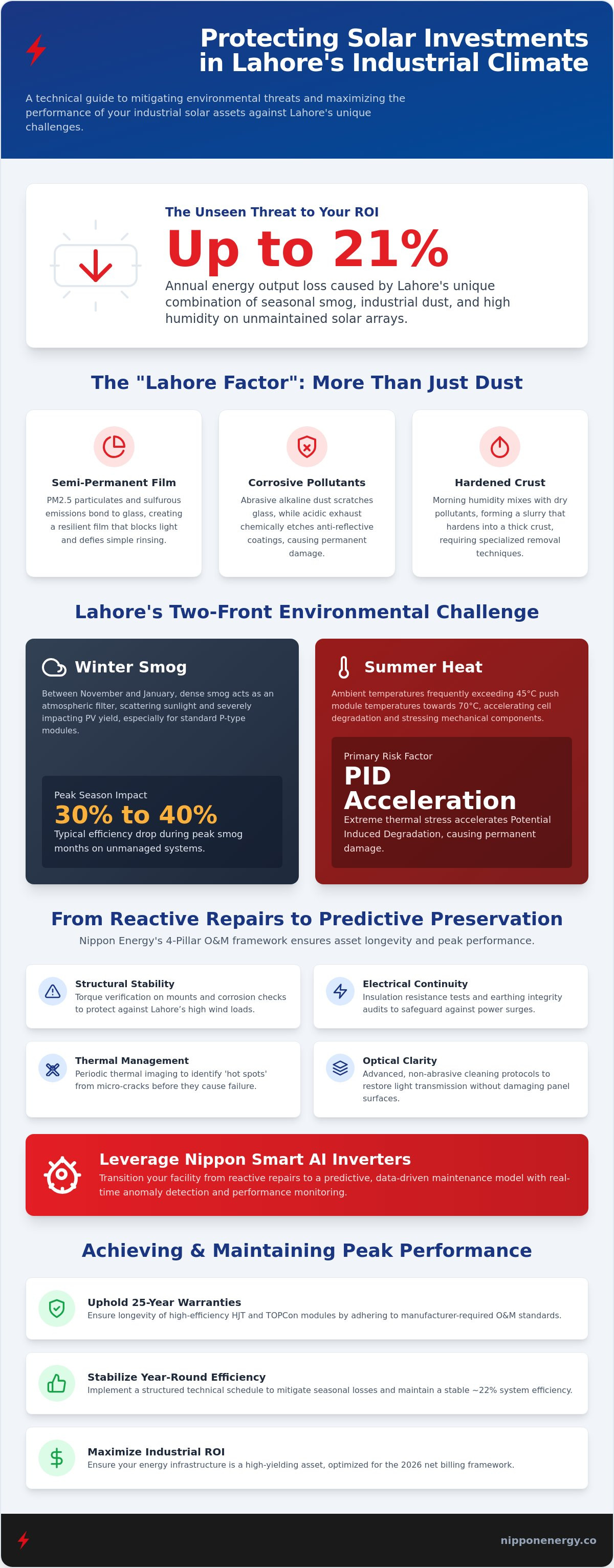
Did you know that Lahore's seasonal smog and dust storms can strip away up to 21% of your solar energy output before the first quarter ends? For a large-scale facility, this isn't just a minor technical dip; it's a direct threat to your industrial ROI under the 2026 net billing framework. You've likely noticed how rapidly efficiency drops when PM2.5 levels spike in industrial zones like Sundar or Quaid-e-Azam. Relying on manual, infrequent cleaning is no longer a viable strategy for high-capacity arrays. Specialized solar panel maintenance for factories lahore has become a critical engineering requirement to prevent these losses.
We understand that maintaining peak generation during high summer heat and dense winter haze is your primary operational challenge. This guide provides the technical protocols needed to achieve a stable 22% efficiency year-round while reducing O&M costs through intelligent automation. You'll learn how to utilize Nippon Smart AI Inverters for predictive monitoring and implement specialized care for HJT and TOPCon modules. By the end of this guide, you'll have a roadmap to ensure your energy infrastructure remains a high-yielding asset that's resilient against Lahore's unique environmental pressures.
Key Takeaways
- Identify how specific PM2.5 particulates and industrial exhaust in Lahore create a "semi-permanent film" that requires advanced cleaning protocols beyond simple rinsing.
- Implement a structured technical schedule for solar panel maintenance for factories lahore to mitigate the 21% output loss typically observed during the winter smog season.
- Leverage Nippon Smart AI Inverters for real-time anomaly detection, transitioning your facility from reactive repairs to a predictive, data-driven maintenance model.
- Ensure the longevity of high-efficiency HJT and TOPCon modules by adhering to technical O&M standards required for 25-year performance warranties.
- Maximize industrial ROI under the 2026 net billing framework by conducting mechanical integrity audits to protect arrays against Lahore’s high wind loads.
The Lahore Industrial Context: Mitigating Smog and Thermal Stress
Lahore's industrial climate presents a unique engineering challenge that goes beyond standard atmospheric dust. The "Lahore Factor" is defined by high concentrations of PM2.5 particulates that don't merely sit on the surface; they bond with it. In industrial zones like Sundar or Quaid-e-Azam, these particulates combine with sulfurous chemical emissions to form a semi-permanent film. This layer significantly reduces light penetration, making routine, low-pressure cleaning insufficient for maintaining peak performance. For any facility manager, understanding that this isn't just "dirt" but a complex chemical layer is the first step toward effective asset management.
The chemical composition of this film varies significantly by industrial zone. Factories located near construction hubs or cement plants face abrasive, alkaline dust that can scratch glass if handled improperly. Conversely, chemical and textile clusters deal with acidic exhausts that react with the module’s anti-reflective coating. When these pollutants interact with the city's high morning humidity, they create a corrosive paste. Without professional solar panel maintenance for factories lahore, these substances can etch the glass surface, leading to permanent transmission loss that no amount of future cleaning can fix.
The Smog Effect on Photovoltaic Yield
Between November and January, Lahore’s smog acts as a dense, atmospheric filter for solar irradiance. Urban aerosols scatter incoming photons, specifically affecting shorter wavelengths that standard P-type PERC modules rely on. While competitors often claim Lahore is "ideal for solar year-round," the reality is a documented 30% to 40% efficiency drop during peak smog months. N-type TOPCon and Nippon HJT Solar Panels demonstrate better spectral response in these hazy environments, but they aren't immune. We define soiling loss in the Lahore industrial context as the cumulative reduction in energy yield caused by the physical obstruction and chemical degradation of the module’s front glass by atmospheric pollutants. Implementing a strategy for mitigating soiling losses is essential to prevent the 21% output drop typical for unmaintained systems during the winter transition. Morning dew acts as a catalyst here, turning dry dust into a slurry that hardens into a crust once the sun rises, necessitating specialized cleaning tools.
Heat-Induced Degradation in Lahore Industrial Estates
Summer temperatures in Lahore frequently exceed 45°C, pushing internal module temperatures toward 70°C. This extreme thermal stress accelerates Potential Induced Degradation (PID), which can permanently damage the cell structure of lower-tier modules. Nippon HJT Solar Panels are engineered with a superior temperature coefficient, ensuring they maintain high output when standard panels begin to throttle. However, even the best hardware requires monitoring. Effective solar panel maintenance for factories lahore must include periodic thermal imaging. This allows technicians to identify "hot spots" caused by micro-cracks or shading before they lead to catastrophic failure. High ambient heat also stresses the mounting structures and cable insulation, making mechanical integrity audits a prerequisite for operational safety in the 2026 energy landscape.
Technical Protocols for Industrial Solar Asset Preservation
Industrial asset preservation requires a transition from basic janitorial cleaning to a rigorous engineering framework. We categorize the four pillars of O&M as: Structural Stability, Electrical Continuity, Thermal Management, and Optical Clarity. For solar panel maintenance for factories lahore, structural audits are paramount. Lahore’s high wind loads during the pre-monsoon season can exert significant uplift forces on large-scale arrays. Technicians must perform periodic torque verification on mounting fasteners and check for galvanic corrosion at contact points between different metals. This methodical approach ensures that the physical infrastructure remains resilient against mechanical stress over its 25-year lifecycle.
Electrical health checks focus on insulation resistance and earthing integrity. Lahore’s soil resistivity can vary significantly based on the local water table, making reliable earthing essential for protecting sensitive electronics from surges. Inverters, specifically those operating in dusty industrial zones, require aggressive cooling system maintenance. Clogged air filters reduce heat dissipation efficiency, which triggers thermal derating in sensitive electronics. Regular cleaning of heat sinks and fan replacement cycles ensures the Nippon Smart AI Inverters operate within their optimal thermal envelope. These technical safeguards are a core part of solar panel maintenance for factories lahore, preventing minor electrical deviations from escalating into system-wide outages.
Advanced Cleaning Methodologies for Factories
Manual cleaning on industrial rooftops often introduces micro-cracks through excessive weight or point-pressure from staff. We recommend using deionized water for wet cleaning to prevent mineral scaling, which is a common issue with Lahore’s hard groundwater. In large-scale installations, robotic cleaning solutions provide uniform pressure and eliminate human error. Adhering to Operational and Maintenance Best Practices ensures that cleaning cycles don't inadvertently shorten the lifespan of HJT or TOPCon modules. Proper methodology preserves the anti-reflective coating, maintaining the high transmissivity required for peak yield.
String-Level Performance Analysis
String-level monitoring identifies localized performance drops that system-level data might obscure. Soot from nearby boilers or shading from new industrial structures can create hotspots that degrade cells over time. We utilize IV curve tracing as a diagnostic tool to map the current-voltage relationship of each string. This level of detail is a core component of a comprehensive solar system maintenance program. For factories looking to secure their energy future, exploring Solar System Maintenance and Monitoring solutions is the logical next step in professional asset preservation.
Transitioning to Predictive Maintenance with Smart AI Inverters
Traditional maintenance models rely on fixed calendar intervals, which often fail to account for the volatile atmospheric conditions in Punjab. Implementing advanced solar panel maintenance for factories lahore requires more than just physical labor; it demands digital intelligence. Predictive maintenance, powered by Nippon Smart AI Inverters, shifts the paradigm from reactive repairs to proactive asset management. These systems analyze high-resolution data streams to detect performance deviations long before they manifest as a significant loss on the factory’s energy bill. By centralizing energy orchestration, AI ensures that every kilowatt-hour is accounted for, even during the dense smog cycles that define Lahore's winter months.
The core advantage of this technology lies in its ability to issue automated alerts based on specific soiling thresholds. Instead of cleaning panels on a arbitrary weekly schedule, the system triggers a maintenance request only when the particulate accumulation reaches a level that impacts ROI. This data-driven approach is essential for large-scale industrial arrays where the cost of manual cleaning is high; to explore how robotics can further optimize such operations, check out EdNex Automation. By integrating real-time smog data with inverter performance metrics, factory managers can maintain a stable 22% efficiency without overspending on unnecessary labor. It's a method that prioritizes technical precision over guesswork.
AI-Driven Fault Detection
Machine learning algorithms are now capable of distinguishing between transient weather patterns and genuine technical faults. While a standard inverter might report a general drop in yield during a dust storm, smart ai solar inverters pinpoint the exact string or module causing the bottleneck. This remote monitoring capability allows technical teams to identify issues like PID or micro-cracks without stepping onto the roof. By receiving predictive alerts about potential component failures, factories can schedule repairs during planned downtime, effectively eliminating the risk of sudden, expensive production halts.
Digital Twin Technology for Industrial Arrays
We utilize digital twin technology to create a high-fidelity virtual model of your factory’s solar plant. This simulation allows us to run "what-if" scenarios, optimizing cleaning cycles and thermal management strategies based on historical and real-time data. It's documented that integrating AI into your solar panel maintenance for factories lahore reduces overall O&M costs by 15% to 20% by eliminating redundant tasks and extending the operational life of the hardware. This virtual oversight ensures that the physical system is always performing at its theoretical peak, regardless of the environmental stressors outside.
Operational Checklist for Factory Solar Maintenance in Lahore
Systematic oversight is the only method to ensure an industrial solar array survives the environmental volatility of Punjab. A rigorous maintenance schedule prevents minor soot accumulation from evolving into permanent cell degradation. For solar panel maintenance for factories lahore, we utilize a tiered operational framework that scales from daily digital checks to annual structural audits. This disciplined approach ensures that your energy infrastructure remains a high-performing asset rather than a depreciating liability.
- Daily: Verify real-time yield against predicted irradiance using the Nippon Smart AI Inverter dashboard to spot immediate deviations.
- Weekly: Conduct a ground-level visual inspection for heavy dust or smog-induced film, particularly during the high-particulate months of November and December.
- Monthly: Execute a professional wet cleaning cycle using pH-neutral solutions and deionized water to prevent mineral scaling on the glass surface.
- Quarterly: Perform a comprehensive electrical health check, including terminal tightening and cleaning of inverter air filters to maintain cooling efficiency.
- Annual: Commission a full system audit featuring high-resolution thermal imaging and IV curve tracing to document performance against baseline benchmarks.
Managing the Cleaning Cycle
Lahore’s atmospheric conditions dictate that cleaning frequency cannot remain static throughout the year. During the October to February smog period, cleaning intervals must double to counteract the rapid accumulation of urban aerosols and industrial soot. It's critical to avoid using hard bore-well water for these cycles. High mineral content in local groundwater leads to calcification on the module surface, which creates permanent shading and reduces transmissivity. Safety remains paramount during these operations. Maintenance crews must adhere to strict fall-protection protocols when working on high-altitude factory roofs, utilizing certified anchor points and weather-monitored scheduling to avoid high-wind events.
Documentation and Warranty Compliance
Technical diligence is a prerequisite for financial protection. Maintaining a meticulous digital O&M log is essential for topcon solar panels warranty protection, as manufacturers require proof of professional upkeep to honor performance guarantees. By tracking degradation rates against Nippon’s performance benchmarks, you can identify outliers before they impact your operational budget. Effective inventory management for critical spares, such as DC fuses, MC4 connectors, and AI communication modules, ensures that any identified fault is rectified with zero lead time. For comprehensive asset protection, you should consult with Nippon Energy’s O&M specialists to design a site-specific protocol for your facility.
Nippon Energy’s Specialized O&M Services for Industrial Scale
Nippon Energy operates on a unified EPC+O&M (Engineering, Procurement, Construction, and Operations & Maintenance) model. This framework ensures that the technical integrity established during the initial installation phase is preserved throughout the asset's total lifecycle. For industrial complexes across Punjab, we provide custom maintenance packages tailored to the specific environmental loads of the Sundar, Quaid-e-Azam, and Kot Lakhpat industrial estates. Our local presence in Lahore facilitates the rapid deployment of technical teams, ensuring that system uptime is maximized during peak production cycles. By centralizing responsibility, we eliminate the common friction between installation warranties and long-term service agreements.
Our approach integrates direct Japanese engineering expertise with local operational agility. When complex troubleshooting is required, our Lahore-based teams utilize diagnostic protocols developed in our global technical centers. This high-level oversight is a critical component of solar panel maintenance for factories lahore, providing a level of precision that generic service providers don't match. We treat your solar array as a high-performance engine that requires specialized calibration to withstand the unique chemical and thermal stressors found in Pakistan’s industrial zones.
Why Factories Choose Nippon Energy O&M
Industrial scale energy systems can't afford prolonged or unplanned downtime. We provide guaranteed response times for industrial emergencies, ensuring that technical faults are addressed before they compromise your facility's output. Our maintenance framework is fully integrated with the nipponhev system, which centralizes the monitoring of solar generation, inverter health, and battery state-of-charge into a single dashboard. Every client receives a detailed monthly performance report. These documents offer total transparency into yield benchmarks, degradation rates, and any identified anomalies, allowing for data-driven decisions regarding your energy strategy.
Securing Your Industrial ROI
Professional oversight is the most effective method to protect your capital investment. Evidence suggests that rigorous O&M protocols can extend an industrial solar system's operational life by 10 years or more compared to unmaintained arrays. This technical diligence is particularly relevant for the health of your lithium ion battery storage. Improper charging cycles or thermal imbalances in dusty environments can lead to premature capacity loss. By synchronizing solar panel maintenance for factories lahore with battery optimization and inverter calibration, we create a resilient energy ecosystem that thrives under pressure.
The 2026 industrial energy landscape requires a proactive stance on asset preservation. Don't wait for a significant drop in yield to address the environmental challenges of Punjab. Contact Nippon Energy Lahore for a Factory Solar Audit to secure your facility's energy future today.
Future-Proofing Your Industrial Energy Infrastructure in Lahore
Lahore's evolving energy landscape in 2026 demands more than just hardware installation; it requires a commitment to technical precision. We've established that mitigating the effects of seasonal smog and thermal stress is essential for protecting your industrial ROI. By transitioning to a predictive model powered by AI monitoring and specialized cleaning protocols, you ensure your facility operates at peak efficiency year-round. This rigorous approach to solar panel maintenance for factories lahore transforms a standard solar array into a resilient, high-yield asset.
Our methodology combines Japanese Engineering Standards with AI-Powered Performance Monitoring to address the specific atmospheric challenges of Punjab. These specialized smog-mitigation protocols are designed to preserve the integrity of HJT and TOPCon modules over their entire operational lifecycle. To secure your system's long-term viability and performance, Request a Professional Industrial Solar Audit in Lahore today. It's time to optimize your energy architecture for a sustainable and profitable future.
Frequently Asked Questions
How often should factory solar panels be cleaned in Lahore?
Industrial arrays in Lahore require a dynamic cleaning schedule that adapts to seasonal particulate levels. During the standard operating months, a monthly professional cleaning cycle is typically sufficient to maintain optical clarity. However, during the intense smog period from October to February, we recommend increasing this frequency to twice per month to counteract the rapid accumulation of urban aerosols and industrial soot.
Does smog permanently damage solar panels?
Smog itself doesn't cause immediate permanent damage, but the chemical interaction between pollutants and humidity can lead to glass etching. When acidic particulates from industrial exhaust combine with morning dew, they create a corrosive film that can degrade the module's anti-reflective coating over time. Regular solar panel maintenance for factories lahore prevents these substances from bonding permanently to the glass surface, ensuring long-term transmissivity.
Is AI monitoring necessary for industrial solar plants?
Digital oversight is essential for managing the complexity of large-scale industrial energy systems. Nippon Smart AI Inverters provide real-time data streams that allow for predictive fault detection and string-level performance analysis. This technology enables facility managers to transition from reactive repairs to a proactive maintenance model, identifying technical deviations before they manifest as significant energy losses on the monthly bill.
What is the cost of solar panel maintenance for a 1MW factory in Lahore?
Maintenance costs for megawatt-scale installations are determined by the specific environmental load of the industrial estate and the required cleaning frequency. Factors such as the proximity to chemical plants, the height of the rooftop, and the integration of automated monitoring systems influence the total O&M budget. We recommend a site-specific audit to establish a technical protocol that balances operational expenses with maximum energy yield.
Can I use tap water to clean my industrial solar panels?
Using untreated tap water or hard bore-well water is technically discouraged due to the high mineral content prevalent in Lahore’s groundwater. These minerals cause calcification and scaling on the module surface, which creates permanent shading and reduces the efficiency of HJT and TOPCon cells. Professional solar panel maintenance for factories lahore utilizes deionized or softened water to ensure a residue-free finish that preserves the glass integrity.
What happens if I neglect solar maintenance during the smog season?
Neglecting maintenance during the winter months leads to a documented output drop of 21% to 40% depending on the local PM2.5 concentration. Beyond simple yield loss, heavy soiling can cause localized hotspots as certain cells are shaded while others remain active. This thermal stress accelerates the degradation of the cell structure and can lead to permanent micro-cracks, significantly shortening the system's 25-year operational lifespan.
How do I know if my solar inverter needs maintenance?
Performance derating and increased fan noise are the primary physical indicators that your inverter requires technical attention. In dusty industrial environments, heat sinks and air filters frequently become clogged, which reduces heat dissipation and triggers safety-related power throttling. Nippon Smart AI Inverters simplify this process by issuing automated alerts when internal temperatures exceed optimal thresholds, allowing for targeted cooling system maintenance.
Does Nippon Energy provide O&M for third-party solar installations?
Nippon Energy offers specialized Solar System Maintenance and Monitoring services for high-capacity industrial arrays, including those not originally installed by our teams. We begin with a comprehensive system audit to evaluate the existing hardware against our Japanese engineering standards. This assessment identifies performance bottlenecks and allows us to integrate your current infrastructure into our advanced AI-powered monitoring framework for enhanced reliability.


