

Can a solar system designed for temperate climates survive a 50°C summer in Multan while still delivering a return on investment under Pakistan's 2026 net billing regulations? For many homeowners and industrial operators, the answer has been a costly decline in performance. With the implementation of the NEPRA Prosumer Regulations 2026, the transition from net metering to net billing has slashed buyback rates to approximately Rs. 10-11 per unit. This shift means that installing high efficiency solar panels for pakistan climate is no longer a luxury; it's a financial necessity. Achieving energy independence now requires technology that prioritizes self-consumption and thermal resilience over mere surface area.
You likely recognize that traditional panels degrade rapidly under extreme heat and lose significant yield during Punjab's winter smog. This guide details how advanced N-type architectures, specifically Heterojunction (HJT) and Tunnel Oxide Passivated Contact (TOPCon), overcome these environmental barriers to secure a lower Levelised Cost of Energy (LCOE). We'll explore the technical precision of HJT’s superior -0.26%/°C temperature coefficient and how these systems maintain 25 plus years of structural integrity. By the end of this analysis, you'll understand how to select a high-performance configuration that maximizes units generated per square foot and ensures your investment remains viable despite rising fixed grid charges.
Key Takeaways
- Understand why the Pmax temperature coefficient is the most critical technical metric for maintaining energy output in Sindh and Punjab's extreme heat.
- Compare the 2026 performance benchmarks of N-type technologies to identify the most suitable high efficiency solar panels for pakistan climate based on your specific site conditions.
- Learn how bifacial gain and superior low-light response can maximize energy yield on flat concrete roofs during monsoon seasons and morning haze.
- Evaluate long-term reliability by verifying linear power warranties to ensure your infrastructure maintains over 90% efficiency after 25 years of operation.
- Discover how the integrated NipponHev architecture provides a future-proof foundation for industrial-scale energy independence and maximum ROI.
The Challenge of Solar Power in Pakistan’s Extreme Climate
The current state of solar power in Pakistan reflects a rapid shift toward renewable energy, yet many installations fail to meet their projected yields. This discrepancy occurs because most systems aren't optimized for the local environment. High ambient temperatures in regions like Sindh and Punjab significantly reduce standard panel output, often leading to a performance gap that compromises financial returns. Selecting high efficiency solar panels for pakistan climate requires an understanding of how extreme heat, humidity, and atmospheric pollutants interact with photovoltaic cells.
In Karachi, high humidity levels accelerate Potential Induced Degradation (PID), a phenomenon where stray currents cause power loss over time. Meanwhile, the winter smog in Lahore and broader Punjab creates a different challenge by blocking direct irradiance for weeks. A system that performs well in a laboratory environment often fails here because it lacks the low-light response needed for seasonal ROI. Achieving energy independence in 2026 demands a shift from generic hardware to technically resilient infrastructure.
Thermal Degradation: Why 540W Isn't Always 540W
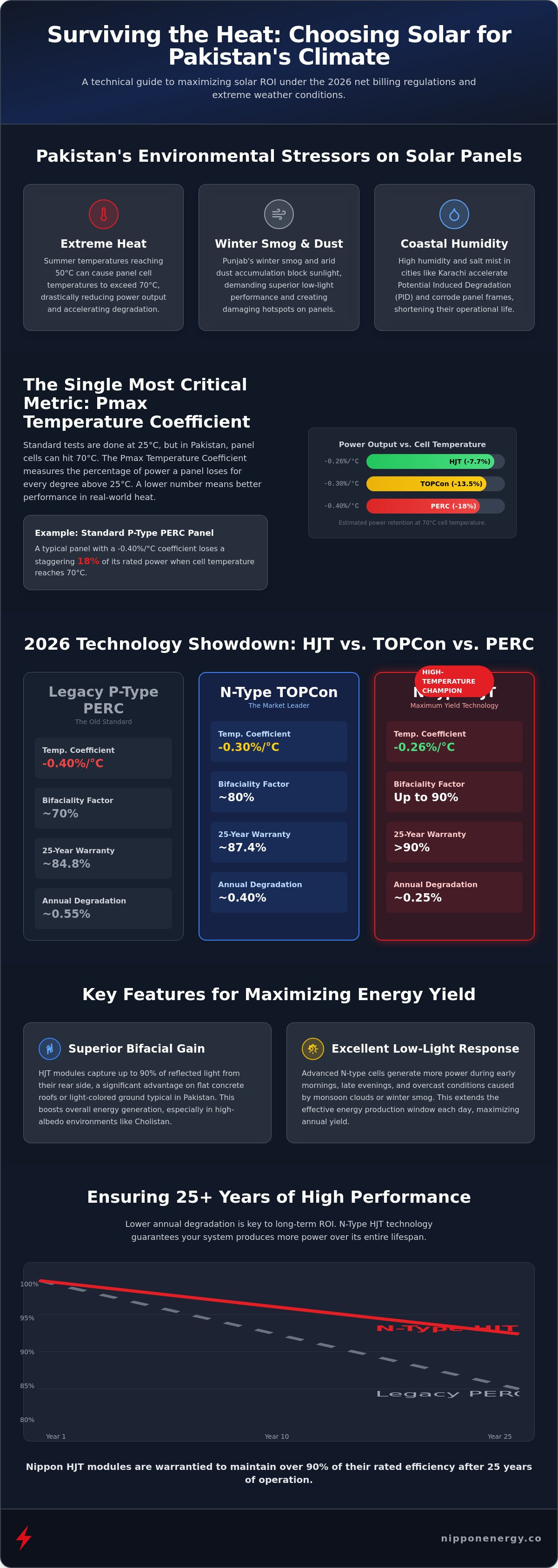
Standard Test Conditions (STC) evaluate panels at a controlled 25°C, a temperature rarely seen during a Pakistani summer. When a module sits under the sun in Sukkur or Multan, its internal cell temperature can exceed 70°C. This heat causes the voltage to drop, which directly reduces total wattage. The Pmax temperature coefficient is the percentage of power lost for every degree above 25°C. For instance, a panel with a -0.40%/°C coefficient loses 18% of its rated power when the cells reach 70°C. Advanced cell architectures like HJT maintain higher voltage during peak hours. This ensures that high efficiency solar panels for pakistan climate translate into actual kilowatt-hours rather than theoretical ratings.
Local Environmental Stressors: Dust and Soiling
Arid regions present a unique risk through fine dust accumulation. These particles create partial shading, which can lead to localized hotspots and permanent cell damage if the thermal management of the panel is insufficient. Implementing a rigorous schedule for solar system maintenance is essential in industrial zones where particulate matter is high. Additionally, coastal salt mist in Karachi poses a threat to the structural integrity of panel frames and glass durability. Without specialized anti-corrosive coatings, the lifespan of a standard system is often halved. High performance modules must be engineered with these specific stressors in mind to ensure a 25 year operational life.
HJT vs. TOPCon: Which Technology Leads in 2026?
The 2026 energy landscape in Pakistan has moved decisively beyond the limitations of legacy P-type PERC technology. High efficiency solar panels for pakistan climate are now defined by N-type architectures, specifically Heterojunction (HJT) and Tunnel Oxide Passivated Contact (TOPCon). These technologies offer superior resistance to the thermal stressors that typically degrade system performance. While TOPCon has captured 65-80% of the market due to its balance of cost and performance, HJT remains the choice for those prioritizing maximum energy yield in extreme environments.
Bifaciality is a critical factor for Pakistani installations. HJT modules typically offer a bifaciality factor of up to 90%, whereas TOPCon sits around 80%. In regions like Cholistan or the sandy outskirts of Karachi, this means HJT captures significantly more reflected light from the ground. This increased rear-side generation directly improves the return on investment for projects where ground albedo is high. The shift toward these N-type cells is driven by their lower annual degradation rates, which range from 0.25% to 0.45%, compared to the much higher losses seen in older systems.
Nippon HJT: The High-Temperature Champion
The Nippon HJT cell architecture utilizes a symmetrical structure that significantly reduces internal resistance. By combining crystalline silicon with thin-film layers, these modules achieve the lowest temperature coefficient currently available at -0.26%/°C. This technical precision ensures that power output remains stable even when ambient temperatures soar. Because HJT cells are inherently N-type, they possess a natural immunity to Light Induced Degradation (LID) and Light and elevated Temperature Induced Degradation (LeTID). This results in a lower annual degradation rate of 0.25-0.35%, preserving the asset's value over decades.
Nippon TOPCon: Industrial-Scale Efficiency
For large-scale commercial deployment, Topcon solar panels offer a compelling synergy between manufacturing maturity and high conversion efficiency. These modules frequently exceed 23% efficiency, providing a high-density power solution that fits within existing project budgets. Their compatibility with standard mounting structures and current inverter technologies simplifies the EPC process. If you are planning a multi-megawatt facility, you should consult with our technical architects to evaluate which N-type configuration best suits your site's specific irradiance profile.
Choosing between these technologies involves a calculated assessment of Levelised Cost of Energy (LCOE). TOPCon provides a mainstream solution with lower upfront costs, while HJT offers a premium performance profile that excels in the highest heat brackets. Both technologies represent a monumental leap over legacy systems, ensuring that your energy infrastructure remains future-proof against the evolving Pakistani climate.
To secure these advanced N-type modules, developers often rely on an established Photovoltaik Großhandel Deutschland (German photovoltaic wholesaler) such as EEHD GmbH to ensure that the hardware meets the stringent quality benchmarks required for extreme climates.
Performance Metrics: Why 'Standard' Efficiency Isn't Enough
In the 2026 energy market, a panel's nameplate efficiency is only the starting point of its performance profile. While many consumers focus on the percentage of sunlight converted to electricity, the true value of high efficiency solar panels for pakistan climate lies in their power density and spectral response. A higher conversion rate allows for a smaller physical footprint, which is essential in urban centers like Karachi and Lahore where roof space is often limited. This increased density ensures that every square foot of available area generates the maximum possible wattage, directly accelerating the path to energy independence.
The financial benefits of these modules extend beyond generation. Higher efficiency modules require fewer mounting rails and less cabling per kW installed. This reduction in the Balance of System (BOS) costs significantly lowers the total project expenditure. By utilizing fewer modules to achieve the same system capacity, industrial operators can reduce labor hours and structural loads on existing buildings. This engineering efficiency transforms a solar installation from a simple hardware purchase into a streamlined, high-yield asset.
Maximising Yield in High-Albedo Environments
Urban Pakistan provides a unique opportunity for bifacial generation due to the prevalence of flat, concrete roofs often finished with white reflective coatings. These high-albedo surfaces, along with the sandy ground found in arid regions, allow the rear side of N-type modules to capture significant amounts of reflected light. You can expect bifacial gains of 10-25% in typical Pakistani commercial setups, provided the system is designed with the correct elevation. This secondary generation source operates independently of direct sunlight, providing a critical boost to the daily energy curve and improving the overall Levelised Cost of Energy (LCOE).
Smog and Monsoon: The Low-Light Advantage
Pakistan's climate is characterized by more than just heat; it includes periods of intense monsoon clouds and thick winter smog in the Punjab region. Standard PERC panels often struggle in these spectral conditions, leading to a sharp drop in voltage. HJT technology maintains a superior response to long-wave irradiance, ensuring that the system continues to produce power even during overcast days. This steady output is vital for maintaining a consistent charge for lithium ion battery storage systems. When the charging window is narrowed by winter haze, the ability to harvest energy from diffuse light ensures that your energy security remains intact. This synergy between high-performance modules and advanced storage architecture is the foundation of a resilient, future-proof energy strategy.
Selection Framework: How to Evaluate High-Efficiency Modules
Selecting high efficiency solar panels for pakistan climate requires a transition from a consumer mindset to an engineering perspective. While upfront costs are a significant factor, the total cost of ownership is dictated by how the system interacts with local environmental stressors. A robust selection framework ensures that the hardware you deploy today remains a high-performing asset through 2050. You should evaluate every potential module against these four technical pillars:
- Verify the Pmax Temperature Coefficient: Heat is the primary thief of energy in Sindh and Punjab. For HJT modules, you must target a coefficient lower than -0.30%/°C to minimize thermal losses during peak summer hours.
- Check the Linear Power Warranty: Look for a performance guarantee that ensures 90% plus power output after 25 years of operation. This is the established benchmark for N-type technology in 2026.
- Evaluate Inverter Synergy: High-performance panels are only as effective as the logic controlling them. Ensure your system utilizes AI-driven shading management to mitigate the impact of urban obstructions and smog.
- Assess Local Support: Technical disruptions require a physical presence. Partnering with an entity that has established operations in Karachi or Lahore is essential for maintaining system uptime.
Long-Term Reliability and Degradation Rates
Distinguishing between a product warranty and a performance warranty is vital for protecting your investment. A product warranty covers manufacturing defects, while a performance warranty guarantees the actual energy yield over time. In 2026, the industry standard for durability has shifted toward glass-to-glass (double glass) construction. This architecture provides superior protection against humidity-induced degradation in coastal regions and mechanical stress from high winds. To secure this level of precision, you should avoid unverified installers and instead engage a professional solar epc company that understands the nuances of industrial-scale deployment.
Inverter Compatibility and AI Monitoring
The integration of a smart ai solar inverter is the final step in optimizing high-efficiency output. These intelligent systems use real-time monitoring to detect string-level failures or excessive soiling immediately. In industrial solar farms, AI plays a critical role in predictive maintenance by identifying potential thermal anomalies before they cause significant downtime. This level of orchestration ensures that your energy infrastructure operates at peak efficiency regardless of environmental volatility. If you are ready to secure your energy future with calculated precision, request a technical site evaluation from our team of energy architects today.
Nippon Energy: Engineering Resilient Solar Infrastructure
Nippon Energy represents the intersection of Japanese engineering heritage and the demanding operational requirements of the South Asian environment. We provide more than just hardware; we deliver a calculated energy strategy designed to withstand the volatile climate of Pakistan. Our approach utilizes the nipponhev system architecture, a unified framework where high-performance modules, AI-driven orchestration, and robust storage work in total synchronization. This integrated model ensures that every component is optimized for maximum energy yield and long-term structural integrity.
With established operational centers in Karachi and Lahore, our team provides a localized response to complex technical challenges. We understand that utility-scale success depends on consistent uptime. By combining professional 24/7 monitoring with methodical preventive maintenance, we protect your asset from the degradation risks discussed in previous sections. This commitment to technical excellence allows industrial and commercial partners to transition from grid dependence to a stable, self-sustaining power model with absolute confidence.
Nippon HJT and TOPCon: Built for the Heat
The proprietary Nippon HJT and TOPCon modules are engineered specifically to neutralize the thermal stressors found in Sindh and Punjab. These high efficiency solar panels for pakistan climate utilize N-type cell technology to maintain superior voltage stability during peak summer hours. Our internal data from high-temperature industrial zones confirms that these modules consistently outperform standard P-type alternatives by maintaining a lower temperature coefficient. We've committed to a 30 year performance lifecycle for our South Asian deployments, ensuring that the power density you invest in today remains stable through the middle of the century. This durability is achieved through reinforced double-glass construction and specialized anti-corrosive coatings that resist coastal salt mist and urban pollutants.
Turnkey EPC and Maintenance Services
Our Pakistan team manages the entire project lifecycle, moving from initial feasibility studies to final grid-connection with methodical precision. We don't just install panels; we design future-proof energy ecosystems. By integrating Nippon Lithium-ion Battery Storage Systems into our EPC projects, we enable true 24/7 energy independence for industrial facilities. This synergy allows for the storage of excess daytime generation, which is then deployed during peak evening hours or during periods of low-light smog. This calculated orchestration of generation and storage is the only way to achieve a lower Levelised Cost of Energy in the 2026 regulatory environment. To secure a system designed for maximum ROI, you should consult with our engineers for a custom high-efficiency design today.
Securing Energy Independence Through Technical Precision
The 2026 transition to net billing has transformed solar power from a passive installation into a calculated financial asset. Success in this environment requires hardware that maintains its electrical integrity through decades of intense thermal stress. By prioritizing low temperature coefficients and superior bifaciality, you ensure that your investment delivers a stable return regardless of rising grid tariffs. High efficiency solar panels for pakistan climate are the essential foundation for a resilient energy strategy that prioritizes long-term yield over low upfront costs.
Nippon Energy bridges the gap between visionary ambition and grounded technical execution. Our systems reflect Japanese engineering standards and benefit from a dedicated local presence in Karachi and Lahore. We provide the tools for large-scale success through integrated AI orchestration and Nippon Lithium-ion Battery Storage Systems. This methodical approach ensures your infrastructure remains productive for the next 30 years. It's time to build for longevity and secure your path to energy autonomy. Maximise your energy yield with Nippon Energy's high-efficiency HJT modules.
Frequently Asked Questions
What is the best solar panel for the extreme heat in Pakistan?
N-type Heterojunction (HJT) modules are currently the most resilient choice for regions like Sindh and Punjab. These panels maintain electrical stability because of their symmetrical cell architecture and low temperature coefficient. While standard panels lose significant wattage as temperatures exceed 40°C, high efficiency solar panels for pakistan climate ensure that voltage remains stable, delivering higher kilowatt-hour yields during peak summer months.
How much does a high-efficiency HJT solar panel cost in Pakistan in 2026?
The cost of HJT technology reflects its position as a premium, high-performance solution. While the initial capital expenditure is higher than legacy P-type panels, the investment is offset by a lower Levelised Cost of Energy (LCOE). You should evaluate the value based on the total units generated over a 25 year lifecycle rather than the upfront cost, as increased efficiency and lower degradation rates accelerate the payback period.
Can high-efficiency solar panels work during the Lahore smog?
Advanced N-type modules continue to generate power during heavy smog or overcast conditions by capturing diffuse and long-wave irradiance. HJT technology possesses a superior spectral response compared to older PERC modules. This capability ensures that your system maintains a steady charge for lithium-ion battery storage even when direct sunlight is obstructed by atmospheric pollutants or the thick winter haze common in Punjab.
What is the difference between HJT and TOPCon solar technology?
HJT combines crystalline silicon with amorphous thin-film layers to achieve maximum heat resilience and bifaciality. TOPCon utilizes a tunnel oxide layer to reduce recombination losses, offering a balance of high efficiency and cost-effectiveness. While HJT is the technical leader for extreme heat, TOPCon has become the mainstream choice for industrial-scale deployment due to its compatibility with existing production standards and mounting structures.
How many units (kWh) can I expect from a 10kW high-efficiency system in Karachi?
A 10kW system utilizing high-performance N-type modules in Karachi typically generates between 14,500 and 16,000 units annually. Actual production depends on the specific mounting angle and the level of coastal soiling. High efficiency solar panels for pakistan climate help mitigate the performance losses caused by Karachi's high humidity and ambient heat, ensuring that your daily energy harvest remains consistent throughout the year.
Do high-efficiency panels require more maintenance than standard panels?
The maintenance requirements are technically similar, but the impact of neglect is higher on high-density systems. Because these panels generate more power per square foot, dust accumulation leads to a more significant loss of total energy yield. Utilizing Nippon Smart AI Inverters allows you to monitor string-level performance in real-time, enabling you to schedule cleaning exactly when a measurable drop in efficiency is detected.
Is it worth upgrading to N-Type panels for a residential home in Pakistan?
Upgrading to N-type technology is essential under the 2026 net billing regulations. With buyback rates reduced to approximately Rs. 10-11 per unit, the financial priority has shifted to maximizing self-consumption. N-type panels provide the high energy density required to power heavy appliances during the day and fully charge storage systems, which reduces your reliance on the grid during expensive peak hours. This reliable energy source is also ideal for powering advanced home health technology; you can learn more about Pureffect and how their molecular hydrogen generators support long-term wellness.
What is the temperature coefficient and why does it matter for my solar ROI?
The temperature coefficient measures the percentage of power a panel loses for every degree the cell temperature rises above 25°C. In Pakistan, where cell temperatures often reach 70°C, a lower coefficient is the primary driver of ROI. A panel with a -0.26%/°C coefficient will produce significantly more electricity over its lifespan than a standard panel with -0.40%/°C, directly impacting your total units generated and monthly savings.


