
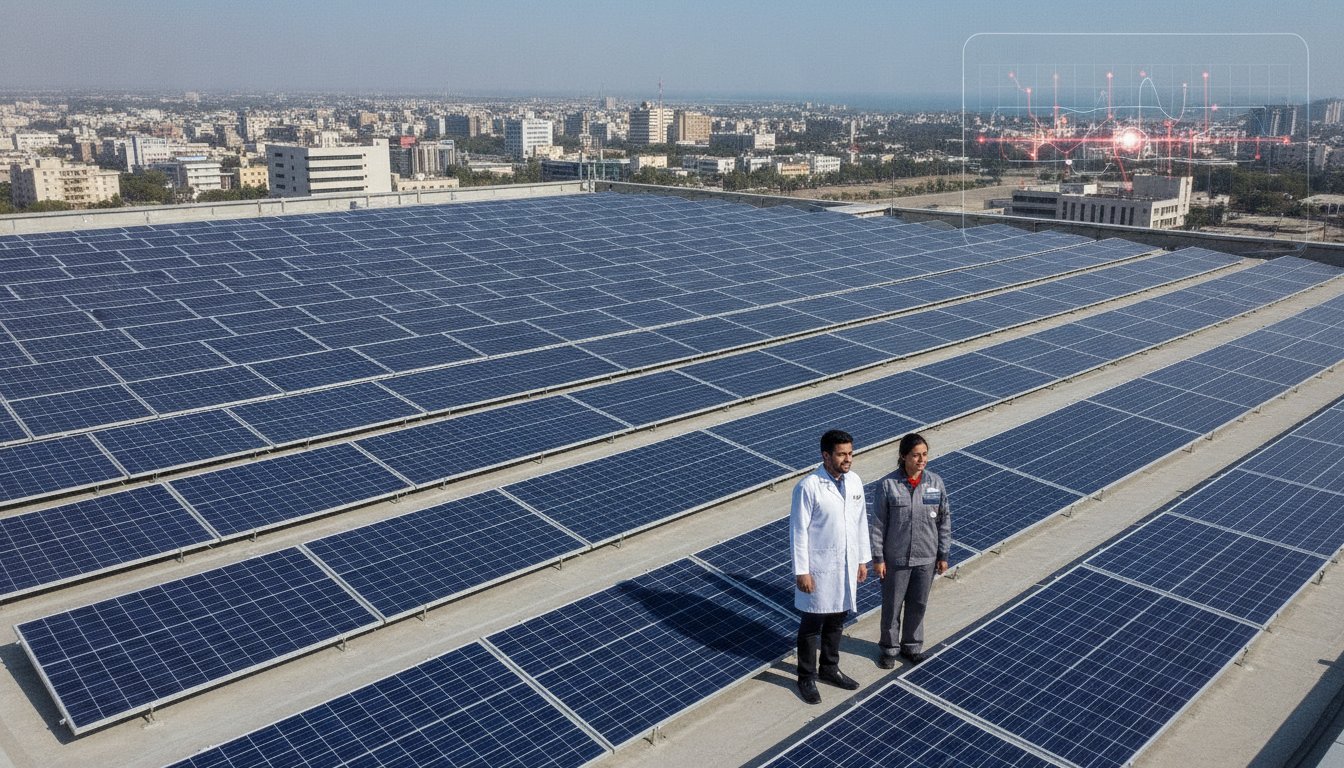
Can a hospital maintain clinical excellence when its life-support systems depend on a grid that fluctuates at a cost of up to Rs 80 per unit? For healthcare administrators, the convergence of escalating K-Electric commercial tariffs and persistent load shedding has made solar power for hospitals in Karachi a clinical necessity rather than a green option. You recognize that diesel generators are an inefficient, high-maintenance legacy solution that drains operational capital while offering no long-term price security. This guide details how integrating high-efficiency HJT technology and medical-grade lithium-ion storage provides a definitive path toward energy independence.
We'll examine how systems managed by smart AI-driven inverters secure 24/7 power for ICUs and surgical theaters under the 2026 net billing regulations. This technical roadmap focuses on optimizing self-consumption to reduce overhead by millions and establish a permanent hedge against grid instability. By transitioning to a resilient energy architecture, your facility can prioritize life-saving care without the burden of volatile utility costs.
Key Takeaways
- Understand why HJT technology is the technical standard for Karachi’s high-heat environment, ensuring peak performance where standard panels fail.
- Discover how solar power for hospitals in Karachi creates a permanent hedge against rising K-Electric commercial tariffs and the inefficiencies of diesel backup.
- Navigate the 2026 Sindh net billing framework to maximize the financial return on critical power infrastructure investments.
- Learn the importance of a specialized EPC partner in conducting structural feasibility studies for sensitive healthcare rooftops.
- See how integrated NipponHev architecture combines AI inverters and lithium-ion storage to guarantee uninterrupted power for surgical theaters and ICUs.
The Energy Imperative for Karachi’s Healthcare Sector in 2026
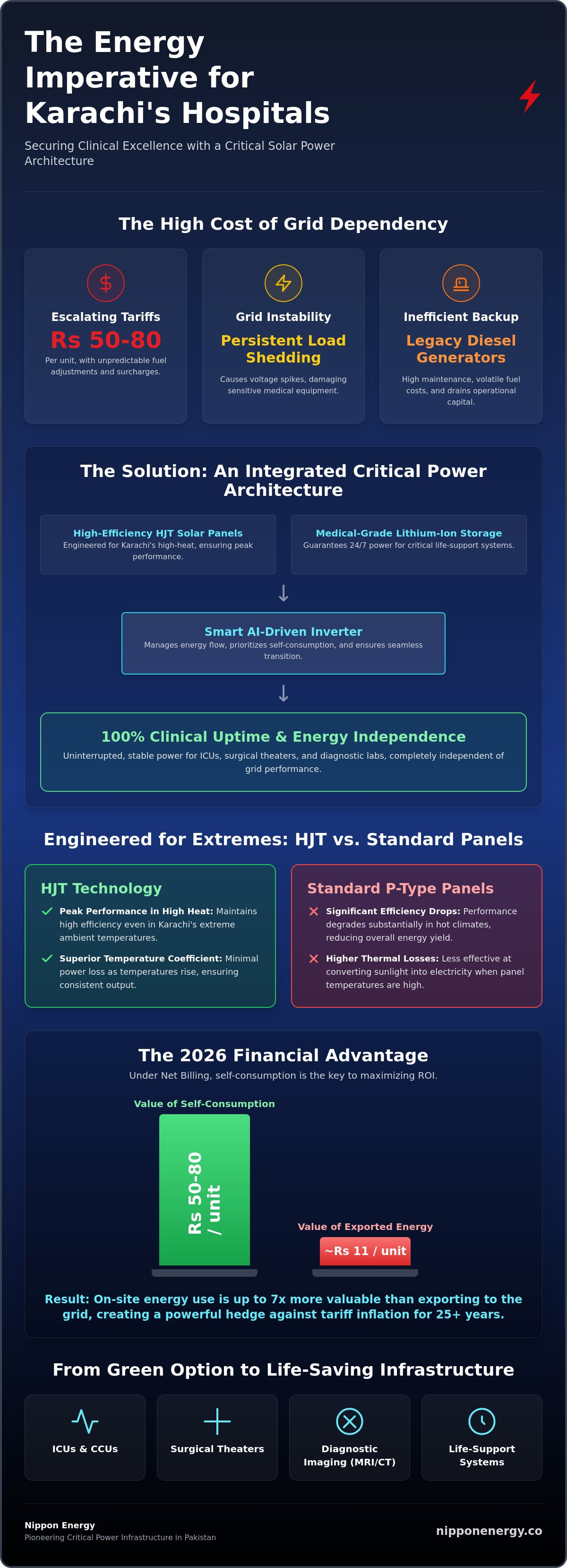
The convergence of escalating K-Electric commercial tariffs and systemic grid instability has transformed energy procurement into a survival-level challenge for healthcare administrators. In 2026, electricity is no longer a simple utility; it's a critical clinical input. The adoption of solar power for hospitals in Karachi has moved from an environmental preference to a structural necessity as commercial rates fluctuate between Rs 50 and Rs 80 per unit. These figures include monthly fuel cost adjustments and IMF-linked surcharges that make financial forecasting nearly impossible for private and public facilities alike.
A hospital's energy strategy must now center on "Critical Power Architecture." This is an engineered ecosystem designed to maintain 100% clinical uptime regardless of grid performance. While the broader growth of Solar power in Pakistan reflects a national pivot toward decentralized generation, the healthcare sector faces unique pressures. Traditional diesel backup systems, once the standard for reliability, are becoming financially unsustainable. High maintenance cycles and the volatile cost of fuel create an operational drain that diverts funds away from patient care and medical technology upgrades.
The regulatory landscape has also evolved. Under the 2026 NEPRA (Prosumer) Regulations, the shift from net metering to net billing has changed the ROI calculus. While the buyback rate for exported energy has been reduced to approximately Rs 11 per unit, the value of self-consumption remains at an all-time high. The Sindh Energy Department's current guidelines prioritize systems that maximize immediate usage, making high-capacity storage and efficient panel technology the pillars of any modern medical facility.
The High Cost of Grid Dependency
K-Electric's 2026 tariff hikes have placed an immense burden on healthcare providers. Beyond the visible monthly bill, grid dependency carries hidden costs that erode a hospital's bottom line. Frequent load shedding necessitates sudden transitions to backup power, which often causes voltage spikes that damage sensitive diagnostic equipment. MRI machines, CT scanners, and laboratory analyzers require stable, clean power that the aging municipal grid often fails to provide. By integrating solar technology, hospitals create a fixed-cost hedge. This transition locks in energy prices for 25 years, protecting the facility from the inevitable inflation of fossil-fuel-based electricity.
Beyond CSR: Solar as a Life-Saving Infrastructure
Modern healthcare cannot tolerate even a micro-second of power loss. For ICUs, neonatal incubators, and surgical theaters, solar energy paired with advanced lithium-ion storage is life-saving infrastructure. It's no longer about corporate social responsibility; it's about clinical risk management. Transitioning to a solar-first model ensures that life-support systems remain active during prolonged urban outages. This shift from "optional green energy" to "essential power security" allows Karachi’s urban healthcare hubs to reduce their carbon footprint while simultaneously guaranteeing the highest standards of patient safety. Reliable solar power for hospitals in Karachi ensures that the focus remains on medicine, not the mechanics of the power grid.
Engineered for Extremes: Why HJT and TOPCon Technology Suit Karachi
Karachi presents a unique set of meteorological challenges for solar infrastructure. The combination of high ambient temperatures and corrosive coastal humidity requires a specific class of photovoltaic architecture. Standard solar panels often suffer from significant efficiency drops as temperatures rise, but advanced N-type cells are designed to counteract these thermal losses. For those implementing Nippon HJT Solar Panels, the objective is to maintain high power output when grid demand is most strained. This reliability is the foundation of solar power for hospitals in Karachi, where energy availability is directly tied to patient outcomes.
Selecting between cell architectures is a decision of engineering precision. A detailed technical comparison of HJT and TOPCon solar cells reveals that while both offer superior performance over traditional P-type modules, HJT holds a distinct advantage in temperature-sensitive regions. TOPCon provides high efficiency and lower initial costs, making it ideal for large hospital rooftops with high energy density needs. However, HJT's symmetrical structure and bifaciality provide the durability needed to withstand Potential Induced Degradation (PID) in Karachi’s saline air. This technical resilience ensures that the system remains a reliable asset over its 25-year lifespan. If you are evaluating the technical specifications for a new facility, you can consult with our engineering team to determine the optimal configuration.
HJT Technology: The Thermal Resilience Advantage
The primary benefit of HJT technology lies in its exceptionally low temperature coefficient. Most standard panels lose efficiency at a rate of 0.35% to 0.45% for every degree above 25°C. Nippon HJT panels reduce this loss significantly, staying below 0.26% per degree. This means during a 45°C Karachi summer afternoon, an HJT system generates substantially more kilowatt-hours than a conventional setup. These heterojunction cells utilize a thin-film silicon layer that enhances carrier collection, resulting in a system that produces more energy during peak solar hours when hospital cooling loads are at their maximum.
Intelligent Energy Storage: Nippon Lithium-ion Systems
Critical care environments can't rely on the slow discharge and high maintenance of legacy lead-acid batteries. Integrating Lithium-ion battery storage into the power architecture allows for rapid response times and deep discharge cycles. These systems are sized specifically to prioritize life-support equipment, such as ventilators and neonatal monitors, before addressing general lighting loads. Nippon’s AI-driven discharge strategies monitor real-time consumption patterns. They intelligently manage state-of-charge to maximize battery cycle life, ensuring the system is ready for the next grid outage without the risk of capacity fade.
Financial Architecture: ROI and Net Metering for Hospitals in Sindh
The financial viability of solar power for hospitals in Karachi is anchored in the transition from a volatile operational expense model to a stable capital investment framework. Nippon Energy views every healthcare rooftop as a high-yield energy asset capable of generating consistent fiscal returns. In the 2026 regulatory environment, the intersection of high K-Electric tariffs and the Sindh Solar Energy Project (SSEP) guidelines has compressed payback periods to unprecedented levels. While the initial capital expenditure (CAPEX) for high-efficiency systems is higher than legacy alternatives, the drastic reduction in monthly utility bills creates an immediate impact on a facility's cash flow.
A critical component of this financial architecture is the utilization of tax incentives provided by the Government of Pakistan. Healthcare providers can leverage accelerated depreciation, allowing for a significant portion of the system's cost to be written off in the first year of operation. This tax shield, combined with the removal of various IMF-linked surcharges on self-generated units, enhances the internal rate of return (IRR). When comparing Nippon HJT systems to generic Tier-1 alternatives, the ROI is superior because HJT’s higher energy yield in Karachi’s heat results in more "avoided cost" units saved per kilowatt installed. This technical efficiency translates directly into faster debt servicing and long-term profitability.
Net Metering in Karachi: Turning Rooftops into Revenue
The 2026 shift toward a net billing framework under NEPRA regulations allows hospitals to monetize their energy surplus during periods of lower clinical activity, such as weekends or holidays. By exporting excess power to the K-Electric grid at the regulated buyback rate of approximately Rs 11 per unit, facilities build energy credits that offset peak-time imports. Optimizing the "export-to-import" ratio is essential for maximizing these credits. The application process for a net-metering license requires technical precision in system design, ensuring that the inverter’s synchronization parameters align perfectly with the provincial grid standards for a seamless approval cycle.
Financing the Transition: Green Healthcare Loans
Several financial mechanisms exist to facilitate the solarization of medical facilities without exhausting liquid reserves. The State Bank of Pakistan (SBP) continues to offer specialized renewable energy financing schemes with competitive interest rates tailored for industrial and commercial prosumers. Additionally, partnerships with private banks have emerged to provide "Green Healthcare Loans" that recognize solar infrastructure as a low-risk collateral. For a standard 500kW hospital system in 2026, the estimated payback period typically ranges between 12 and 18 months, contingent upon the facility’s specific self-consumption profile and prevailing tariff structures. This rapid ROI allows administrators to redirect energy savings back into clinical equipment and patient care services within a very short timeframe.
Seamless Integration: The Solar EPC Process for Medical Facilities
Executing a transition to solar power for hospitals in Karachi requires a level of engineering precision that exceeds standard commercial installations. A specialized Solar EPC partner is essential because hospital environments cannot tolerate the risks associated with generic contractors. The process begins with a Phase 1 feasibility study focused on structural rooftop analysis. Our engineers evaluate the building's load-bearing capacity and its ability to withstand Karachi’s coastal wind speeds, ensuring that the high-density HJT arrays are anchored with permanent structural integrity.
Phase 2 moves into precision engineering and AI energy orchestration. This stage involves mapping the hospital’s electrical architecture to identify critical versus non-critical loads. We design the system to prioritize life-support machinery while managing the broader energy footprint. Phase 3 is the most sensitive: zero-downtime installation and commissioning. By using a modular deployment strategy, we ensure that the physical installation of panels and inverters occurs without interfering with daily clinical operations. The final integration is a coordinated effort that guarantees a stable transition to a self-sustaining power model.
Engineering for Healthcare Continuity
The most technical challenge in hospital solarization is managing the "cut-over" from grid to solar without interrupting critical loads. We integrate Smart AI Solar Inverters directly with the hospital’s existing Building Management System (BMS). This allows the AI to act as the brain of the facility, routing power to ICUs and surgical theaters instantly if the grid fails. Safety protocols are built into the hardware level. We implement rapid shutdown requirements and advanced fire protection systems that meet international medical safety standards, protecting both patients and high-value diagnostic equipment from electrical faults.
Operations and Maintenance (O&M) in the Dust Belt
Karachi’s urban environment presents a "soiling" challenge where dust and soot can reduce solar yield by up to 30% if left unmanaged. Our O&M protocols are designed for the specific particulate profile of the city. We establish rigorous cleaning schedules that balance water conservation with maximum photon absorption. Beyond physical cleaning, we utilize remote performance monitoring to track real-time efficiency. Predictive alerts notify our technicians of any performance deviation before it impacts the hospital's energy budget. To initiate a structural audit of your medical facility, consult with our Karachi-based EPC specialists for a comprehensive technical proposal.
Nippon Energy: Pioneering Critical Power Infrastructure in Pakistan
Nippon Energy operates as a High-Tech Architect, treating energy not as a commodity but as a structural foundation for medical success. Our local presence in the Korangi Industrial Area hub ensures that global engineering standards are applied with local Karachi execution. This proximity allows for rapid deployment and immediate technical support, which is vital for facilities implementing solar power for hospitals in Karachi. We don't simply install panels; we engineer mission-critical power systems that withstand the city’s specific environmental and regulatory pressures. This commitment to local infrastructure allows us to bridge the gap between global innovation and the practical realities of the Sindh energy market.
The NipponHev advantage represents our integrated architecture for 2026. This system combines HJT panel efficiency, lithium-ion storage density, and AI-driven orchestration into a single, cohesive unit. This approach was recently demonstrated in a project for a multi-specialty hospital that transitioned to 70% energy autonomy. By prioritizing critical surgical and diagnostic loads through intelligent AI routing, the facility effectively decoupled its clinical operations from grid instability. High-tech architecture is the only viable solution for such mission-critical power requirements. It eliminates the single points of failure common in fragmented, low-tier solar setups and provides a permanent hedge against utility price volatility.
Global Technology, Local Execution
Our methodology leverages Japanese engineering standards to address Pakistani environmental challenges. We understand that Karachi's humidity and heat require more than just generic hardware; they require intelligent, resilient design. Nippon Energy invests heavily in training local Karachi engineers in HJT cell maintenance and AI energy management. This ensures that the technical edge of our systems is maintained throughout their lifecycle. Our end-to-end EPC footprint across Lahore and Karachi provides a standardized, high-performance energy solution for healthcare networks operating across multiple regions, ensuring that solar power for hospitals in Karachi meets international performance benchmarks.
The Future of Healthcare Energy
Our vision for 2030 involves the creation of fully autonomous, solar-powered medical cities. In this future, AI-managed microgrids and ultra-efficient HJT panels will redefine energy reliability, making grid outages irrelevant to patient care. By adopting these technologies today, administrators position their facilities at the forefront of this transition. The path to energy independence is a technical one, requiring precision, resilience, and a partner who understands the gravity of healthcare uptime. It's a journey from grid dependency to total operational sovereignty. You can consult with Nippon Energy’s EPC experts for your hospital’s solar transition to secure your facility's operational future and clinical excellence.
Securing the Future of Karachi's Healthcare Infrastructure
The transition to decentralized energy is no longer a strategic option; it's a fundamental requirement for clinical survival in a high-tariff environment. By integrating proprietary HJT high-temperature resilience and AI-managed critical care backup, medical facilities can convert volatile operational expenses into stable, long-term assets. This shift provides a permanent hedge against grid instability while ensuring that life-saving equipment remains operational during peak urban loads. Our Karachi-based EPC support team provides the technical precision necessary to navigate the 2026 regulatory landscape and structural challenges unique to the Sindh region.
Implementing solar power for hospitals in Karachi represents a commitment to both fiscal responsibility and patient safety. You can take the first step toward total energy autonomy by evaluating your facility's specific load profile and structural capacity. Request a Specialized Hospital Energy Audit from Nippon Energy to receive a comprehensive technical roadmap tailored to your institution's needs. We look forward to partnering with you to build a more resilient and self-sustaining healthcare ecosystem.
Frequently Asked Questions
How much rooftop space is required for a 100kW hospital solar system?
A 100kW system typically requires between 6,000 and 8,000 square feet of unobstructed rooftop space. The exact footprint depends on whether you utilize high-efficiency Nippon HJT panels, which offer greater power density than standard modules. Our engineers conduct a structural analysis to optimize panel tilt and spacing, ensuring maximum photon absorption while maintaining safe access paths for facility maintenance teams and medical staff.
Can solar power run heavy medical equipment like MRI and CT scanners?
Solar power for hospitals in Karachi can support MRI and CT scanners when integrated with high-performance inverters and lithium-ion storage. These heavy diagnostic tools create significant power surges during startup. Our systems utilize smart AI inverters designed to manage these spikes without compromising the stability of the local microgrid. This architecture ensures that sensitive clinical equipment receives clean, regulated power even during grid fluctuations.
What happens to a hospital’s solar power during a Karachi monsoon or dust storm?
Solar energy production naturally declines during cloud cover or heavy particulate accumulation from dust storms. However, the system remains operational. Our structural mounting is engineered to withstand Karachi’s coastal wind loads, while our O&M protocols include specialized cleaning schedules to restore peak efficiency after monsoon rains or soot buildup. Performance monitoring software provides real-time alerts so facility managers can track yield variations during these weather events.
Is net metering available for private hospitals in Karachi under K-Electric?
K-Electric provides net billing connections for private medical facilities under the 2026 NEPRA (Prosumer) Regulations. This framework allows hospitals to export surplus electricity to the grid at a regulated buyback rate. While the export tariff is lower than the import rate, it provides a valuable mechanism for building energy credits during periods of lower clinical activity. We manage the entire application process to ensure compliance with provincial grid standards.
What is the lifespan of Nippon Lithium-ion Battery Storage Systems in medical use?
Nippon Lithium-ion Battery Storage Systems are designed for a service life of 10 to 15 years in a clinical environment. These units typically support 6,000 to 8,000 cycles before reaching 80% of their original capacity. Unlike legacy lead-acid batteries, our lithium-ion architecture requires zero maintenance and offers deep discharge capabilities, making them the superior choice for securing 24/7 power for critical hospital loads and life-support systems.
How long does the typical EPC process take for a 500kW medical facility?
The typical EPC timeline for a 500kW medical facility spans 12 to 16 weeks. This duration includes the initial structural feasibility study, precision electrical engineering, and the procurement of high-tech components. The physical installation is executed using a modular approach to prevent operational downtime. Final commissioning and K-Electric net billing synchronization are the final steps in establishing a fully autonomous power architecture for the hospital.
Are there any government subsidies for hospital solarization in Sindh in 2026?
The Sindh Solar Energy Project (SSEP) focuses primarily on public healthcare facilities with World Bank assistance. Private hospitals in Karachi can access the State Bank of Pakistan’s renewable energy financing schemes, which offer subsidized interest rates. Additionally, tax incentives like accelerated depreciation allow facilities to write off a significant portion of the system cost in the first year, drastically improving the internal rate of return for the project.
Why are HJT panels better than traditional panels for Karachi hospitals?
HJT panels are the technical standard for solar power for hospitals in Karachi due to their exceptionally low temperature coefficient. Standard panels lose efficiency rapidly as Karachi’s ambient temperatures rise above 25°C. HJT modules maintain higher power output during peak summer afternoons when hospital cooling loads are at their maximum. Their bifacial design and resistance to humidity-related degradation ensure long-term durability in the city’s corrosive coastal air.


