
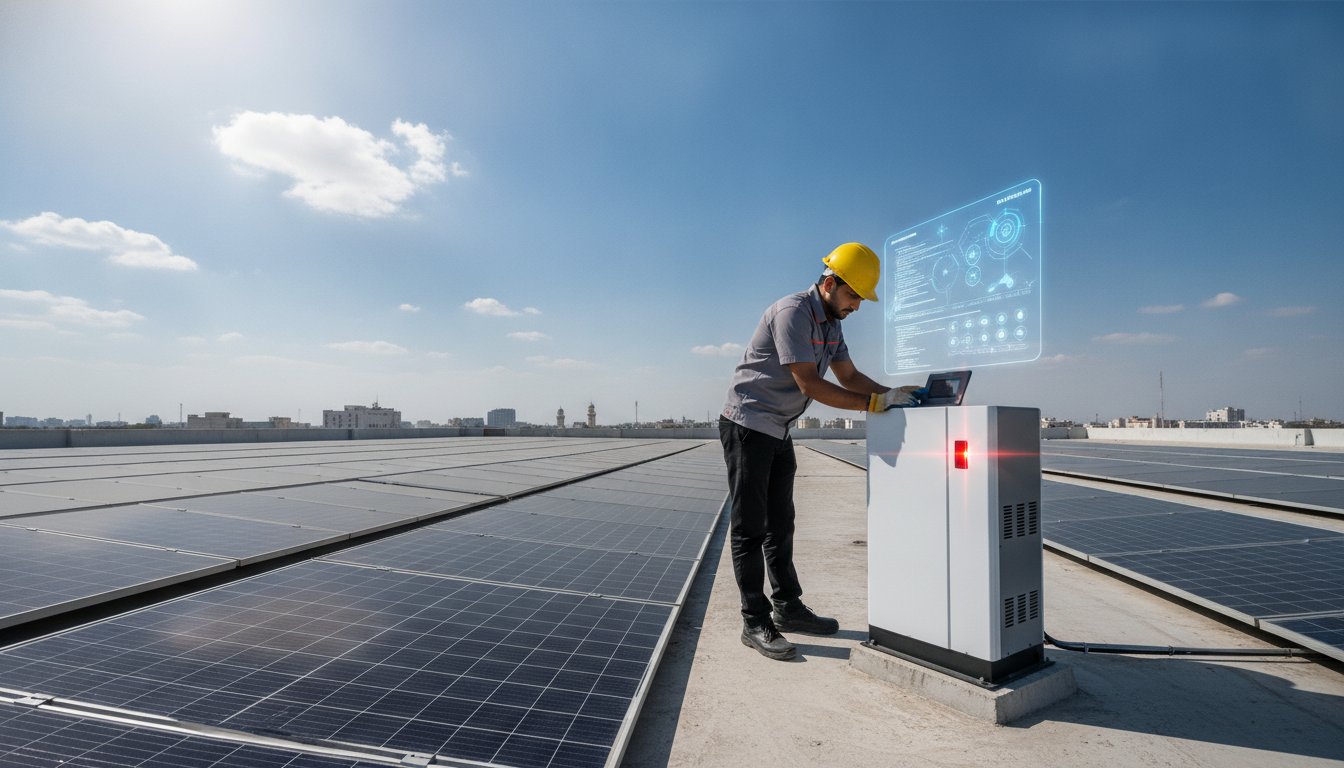
A retail rooftop in Lahore is either wasted square footage or your most reliable financial hedge against 2026 energy inflation. As LESCO's commercial tariffs fluctuate and the new NEPRA net billing regulations reduce buyback rates for surplus power, the priority has shifted from simple grid-exporting to sophisticated self-consumption. Implementing advanced solar solutions for retail stores lahore allows you to bypass the efficiency losses caused by 45°C temperatures and seasonal smog. By integrating Japanese-engineered HJT technology, you turn an unpredictable utility expense into a high-yield asset that powers your operations with technical precision.
You've likely felt the impact of rising operational costs and the complexity of securing net metering approvals under the latest 2026 guidelines. This guide provides a technical roadmap to achieving energy independence and fixing your power costs for over 25 years. We'll explore how Nippon Smart AI Inverters and high-efficiency modules maintain peak performance in Punjab's extreme climate while providing automated energy monitoring for multiple retail branches. You'll learn how to navigate the current regulatory landscape to ensure your commercial installation delivers maximum ROI from day one.
Key Takeaways
- Learn how to convert volatile LESCO commercial billing into a fixed, high-yield asset through strategic on-grid solar integration that offsets rising energy overheads.
- Discover why high-performance HJT and TOPCon architectures are essential for maintaining energy yields during Lahore’s extreme 45°C+ heat and seasonal smog events.
- Explore how Smart AI Inverters optimize energy orchestration by aligning real-time solar production with the specific peak load profiles of modern retail operations.
- Understand the critical importance of a turnkey EPC lifecycle, from high-fidelity site audits to LESCO commissioning, when deploying premium solar solutions for retail stores lahore.
- Gain insight into how Japanese engineering standards and localized expertise ensure the structural integrity and 25-year durability of your commercial energy infrastructure.
The Strategic Case for On-Grid Solar in Lahore’s 2026 Retail Economy
On-grid solar is a sophisticated energy asset designed to synchronize with the LESCO distribution network. It functions as a grid-tied mechanism that prioritizes the consumption of self-generated electricity while exporting surplus production to the utility. This architecture is central to modern Solar power in Pakistan, particularly as retail operations in Lahore seek to insulate their margins from grid instability. By deploying solar solutions for retail stores lahore, businesses transition from passive energy consumers to active prosumers. This shift allows for the immediate reduction of grid reliance without the capital intensity of large-scale battery banks.
The 2026 economic landscape necessitates a move away from traditional utility dependence. LESCO commercial tariff trajectories indicate a consistent upward trend, driven by a 21% increase in national electricity demand observed between 2023 and 2025. For a retail store, these rising operational costs are no longer manageable through simple conservation. On-grid systems offer a superior alternative to hybrid models for retail environments because they eliminate the round-trip efficiency losses associated with battery storage during peak daylight hours. The result is a more streamlined, efficient system that maximizes the utilization of every photon captured.
Understanding the LESCO Net Metering Framework
Under the NEPRA (Prosumer) Regulations 2026, the net metering landscape has evolved into a net billing system. New installations now operate under a buyback rate of approximately Rs. 10 to Rs. 13 per unit. While this is a reduction from previous years, the primary value remains in the direct offset of high-tier commercial units that cost significantly more. In high-density commercial zones like Gulberg and DHA, bidirectional meters allow stores to zero out their nighttime consumption by leveraging daytime generation. The standard agreement term for these new connections is now fixed at five years, providing a structured window for initial capital recovery and long-term grid-tied stability.
De-risking the Investment: From Opex to Capex
Shifting energy costs from an operating expense (Opex) to a capital expenditure (Capex) creates a predictable financial horizon. Instead of enduring volatile monthly utility adjustments, retailers invest in a fixed-cost energy infrastructure with a lifespan exceeding 25 years. Financial instruments like the State Bank of Pakistan’s renewable energy financing scheme offer a concessional markup rate of up to 6% per annum for systems up to 1 MW. This low-cost capital, combined with the current exemption of customs duty and GST on solar panels, accelerates the payback period. A High-Tech Architect approach ensures that these solar solutions for retail stores lahore are not just hardware installations but future-proofed financial instruments that enhance the valuation of the retail property.
Performance Architecture: Why HJT and TOPCon Excel in Lahore’s Heat
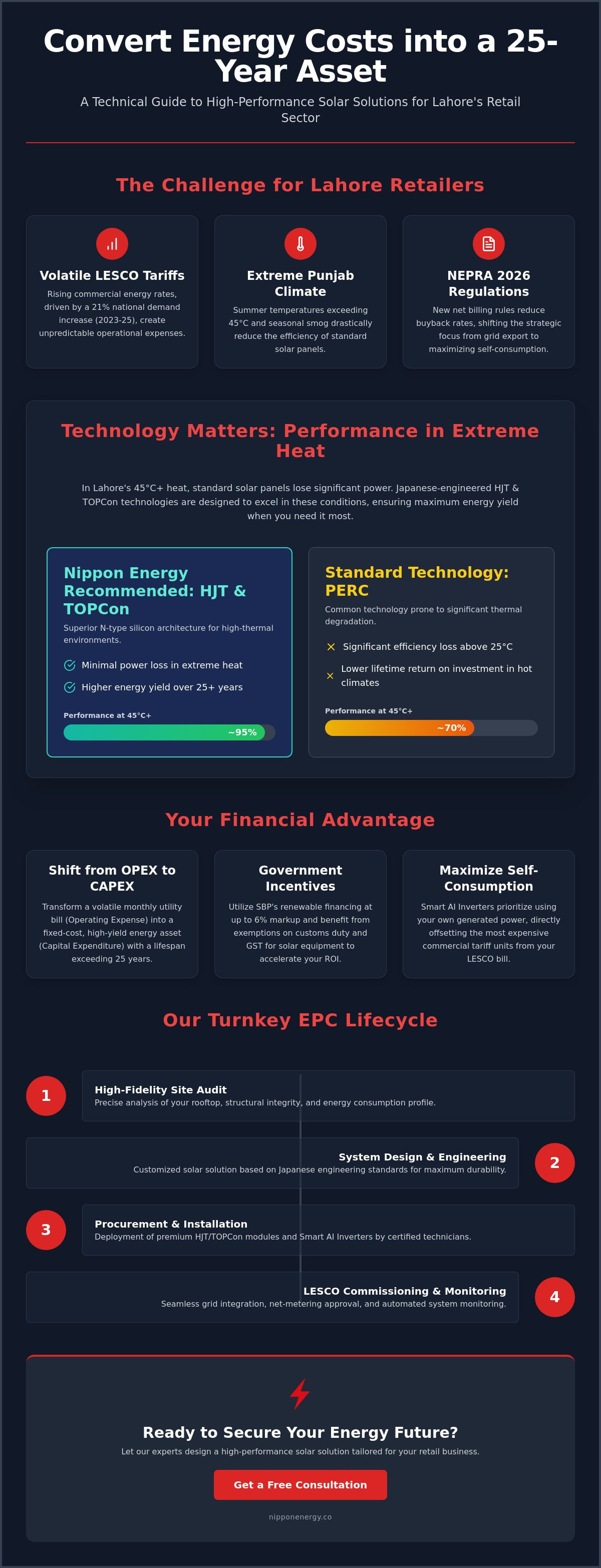
In the high-thermal environment of Punjab, hardware selection determines the difference between a 25-year energy asset and a premature system failure. Standard PERC (Passivated Emitter and Rear Cell) technology, while common, faces significant power degradation once ambient temperatures exceed 25°C. In Lahore, where summer peaks often surpass 45°C, panel surface temperatures can climb to 70°C. This thermal stress causes standard modules to lose a significant percentage of their efficiency for every degree above the baseline. For retail managers, this translates to a massive yield drop during the hours of peak solar irradiance. High-performance solar solutions for retail stores lahore solve this through N-type silicon architectures like HJT and TOPCon.
Technical standards set by the Alternative Energy Development Board (AEDB) emphasize the need for equipment that survives Pakistan's unique climate. Bifacial modules are particularly effective on Lahore’s high-albedo commercial rooftops. These rooftops reflect significant sunlight onto the rear of the panel, allowing for a bifacial gain that can increase total energy harvest by 10% to 30%. This extra generation occurs without increasing the system's physical footprint, making it ideal for space-constrained urban retail environments where maximizing every square inch of the roof is vital for ROI.
Nippon HJT Solar Panels: The High-Temperature Solution
Nippon HJT Solar Panels utilize a heterojunction structure that combines crystalline silicon with amorphous silicon thin films. This engineering choice results in a temperature coefficient as low as -0.26%/°C, which is the industry's most resilient response to extreme heat. While standard panels struggle, HJT maintains a steady output, ensuring that your store’s cooling systems remain powered during the hottest parts of the day. You can compare these high-yield tiers in our detailed breakdown of Topcon Solar Panels to see which technology fits your specific load profile. Choosing HJT means securing more kilowatt-hours per installed kilowatt over the system's entire lifecycle.
Nippon TOPCon: Industrial Scale Efficiency
Nippon TOPCon Solar Panels represent the 2026 benchmark for commercial-scale arrays. They offer a sophisticated balance between high efficiency and capital cost-effectiveness. TOPCon cells feature a tunnel oxide layer that minimizes electron recombination, leading to lower annual degradation rates compared to older P-type modules. Over a 25-year retail asset life, this durability ensures that your energy costs remain fixed and predictable. To combat Lahore’s seasonal smog and dust, these modules incorporate advanced anti-reflective and self-cleaning coatings. These surfaces reduce the frequency of manual maintenance and prevent the yield drops typically associated with particulate accumulation. If you're ready to stabilize your energy overhead, you can consult with our engineering team to design a high-performance array tailored to your rooftop.
Intelligent Energy Orchestration: Smart AI Inverters for Retail Management
The efficacy of a commercial solar array is not determined solely by its panels but by the intelligence of its central processing unit. While high-efficiency modules capture photons, the Nippon Smart AI Inverter serves as the command center for energy orchestration. This technology is critical for 2026 retail management, where electricity demand varies significantly between operational hours and nighttime security loads. With more commercial organizations turning to captive solar to mitigate rising grid costs, the ability to synchronize generation with consumption has become a competitive necessity. By deploying advanced solar solutions for retail stores lahore, businesses can automate their energy usage to ensure that every kilowatt produced is utilized with maximum financial impact.
Modern retail environments in Lahore, from high-street boutiques to large-scale malls, require real-time load matching. Nippon Smart AI Inverters analyze consumption patterns to prioritize self-consumption during peak LESCO tariff windows. When integrated with Nippon Lithium-ion Battery Storage Systems, these inverters facilitate peak-shaving, which involves discharging stored energy during high-demand periods to avoid expensive grid tiers. This orchestration ensures that the transition between solar, battery, and grid power is seamless and invisible to the store’s operations. Predictive maintenance capabilities further enhance this system by identifying subtle performance drops caused by shading or hardware anomalies before they impact the bottom line.
Nippon Smart AI Inverters: The Brain of Your Store
Nippon Smart AI Inverters utilize sophisticated algorithms to optimize DC-to-AC conversion, ensuring maximum LESCO grid-tie efficiency even under fluctuating voltage conditions. Business owners can access the Smart AI Solar Inverter management platform to monitor performance across multiple retail branches from a single interface. AI energy orchestration is the automated, real-time synchronization of solar generation, battery storage, and grid interaction to maintain maximum system stability and cost efficiency. This level of technical control allows for the precise management of energy assets, transforming a passive rooftop installation into an active contributor to retail profitability.
Maintenance Architecture for Lahore’s Smog Season
Lahore’s "smog season" presents a unique challenge to solar yield, as particulate matter can significantly obstruct light transmission. Traditional scheduled cleaning is often insufficient; instead, our systems utilize predictive maintenance to alert managers when particulate accumulation reaches a threshold that justifies intervention. This data-driven approach to Solar System Maintenance reduces unnecessary O&M costs while preventing the yield drops that typically plague unmanaged commercial arrays. By transitioning from reactive to predictive care, retail chains can maintain consistent performance through the most challenging environmental conditions in Punjab. Implementing these intelligent solar solutions for retail stores lahore ensures that your energy infrastructure remains resilient, efficient, and fully optimized throughout the year.
The EPC Lifecycle: From Site Audit to LESCO Commissioning
Turnkey EPC frameworks provide the structural accountability necessary for retail risk management. By consolidating engineering, procurement, and construction under a single technical authority, businesses eliminate the coordination gaps that often lead to performance degradation or safety hazards. Executing solar solutions for retail stores lahore requires a methodical progression from initial audit to final grid synchronization. This lifecycle ensures that every technical variable, from roof load-bearing capacity to inverter phase balancing, is optimized for a 25-year operational life.
High-fidelity site audits serve as the foundation of this process. Engineers conduct a detailed structural integrity assessment of the retail roof to verify its capacity for supporting Nippon HJT or TOPCon arrays. This is followed by custom energy modeling where historical LESCO consumption data is used to simulate annual yields and financial offsets. Once the design is validated, procurement focuses on Japanese-standard Nippon hardware. Professional execution then follows international electrical codes, ensuring that the installation is safe for public-facing commercial environments where fire safety and structural stability are non-negotiable.
Engineering Standards and Structural Safety
Lahore’s monsoon season brings high wind loads that can compromise poorly anchored mounting structures. Our engineering team performs rigorous wind load analysis to design secure mounting systems that exceed local safety requirements. Electrical safety is maintained through the use of fire-rated cabling and advanced AI-driven circuit protection that monitors for arc faults in real-time. You can explore our full methodology in our guide to Solar EPC Services. These standards prevent hardware failure and protect the long-term valuation of your retail property.
Navigating the LESCO Net Metering Process
Securing a net metering license in 2026 requires strict adherence to the latest NEPRA prosumer regulations. In commercial hubs like DHA, Gulberg, and Bahria Town, the approval timeline depends on accurate documentation and grid capacity assessments at the local transformer level. Nippon Energy manages this entire regulatory lifecycle, from the initial application to the installation of the bidirectional meter. We handle the technical compliance for 2026 NEPRA licenses, allowing retail owners to focus on their core business while we manage the utility interface. You can partner with our EPC team to initiate your site audit and secure your energy independence.
Nippon Energy: Engineering Long-Term Energy Assets for Lahore’s Businesses
Japanese engineering represents the pinnacle of photovoltaic reliability within the Pakistani commercial market. While many providers focus on short-term hardware delivery, Nippon Energy approaches every project as a permanent energy asset. Our localized expertise in Lahore is reinforced by a global supply chain that delivers Nippon HJT panels directly from our high-precision manufacturing facilities. This combination of world-class technology and local engineering presence ensures that solar solutions for retail stores lahore are built to survive the specific environmental stresses of the Punjab region. We back this commitment with comprehensive 25-year performance warranties, providing retail owners with the security of a global corporate presence that understands the necessity of long-term profitability. Our technical team oversees every deployment to ensure that the final installation mirrors the rigorous standards of our international projects. This disciplined approach eliminates the variability common in local installations, replacing it with a predictable and high-performing energy output that stabilizes your balance sheet.
The NipponHev Integrated Solution
Retail energy independence requires more than isolated components; it demands a unified architecture. The NipponHev System provides an integrated approach by combining Nippon HJT panels, Smart AI inverters, and proactive maintenance into a single performance-guaranteed package. This holistic strategy minimizes the Total Cost of Ownership (TCO) for Lahore retail stores by eliminating the inefficiencies of mismatched hardware. By orchestrating every element of the energy lifecycle, we ensure that your system operates at peak capacity regardless of seasonal smog or grid instability. The NipponHev model has already proven successful in diverse retail settings, demonstrating that an integrated architecture can outperform fragmented systems by a significant margin in high-heat environments. It's a calculated investment in operational resilience that delivers consistent value year after year.
Partnering with a High-Tech Architect
In the competitive retail sector, "cheap" solar often proves to be the most expensive mistake a business can make. Substandard installations frequently suffer from rapid degradation, structural failures during monsoons, or inverter malfunctions that lead to prolonged downtime. Nippon Energy’s role as a High-Tech Architect is to provide technical authority and future-proofed systems that remain productive for decades. We don't just install panels; we design energy infrastructure that evolves with your business. This commitment to excellence ensures that your store remains powered by the most advanced technology available in the 2026 market. You can schedule a professional feasibility study for your Lahore business to begin the transition toward a high-yield, independent energy future. Secure your margins today with the precision of Japanese engineering and the reliability of a partner dedicated to your long-term success.
Architecting Decades of Retail Energy Independence
The transition to high-performance energy infrastructure is a strategic necessity for Lahore’s commercial sector in 2026. By integrating N-type HJT modules with intelligent AI orchestration, businesses can finally decouple their operational costs from volatile utility tariffs. Implementing these advanced solar solutions for retail stores lahore ensures that your energy yields remain high even during extreme thermal peaks and seasonal smog. Our approach relies on Japanese Engineering Standards to deliver a system that functions as a high-yield financial asset rather than a simple utility offset. With full turnkey EPC management, we handle the entire lifecycle from structural audits to LESCO commissioning. This process is reinforced by a 25-Year Performance Warranty, providing the long-term security required for large-scale retail investments. Your store’s rooftop is its most underutilized resource; it's time to transform it into a precision-engineered power plant. Schedule a Feasibility Study for Your Business to secure your margins and lead the shift toward a sustainable, independent future.
Retail Solar: Frequently Asked Questions
How much roof space does a 100kW on-grid solar system need for a Lahore retail store?
A 100kW on-grid solar system typically requires between 7,000 and 8,500 square feet of unobstructed roof space. High-efficiency modules like Nippon HJT allow you to generate more power within a smaller footprint compared to traditional panels. This spatial efficiency is vital for urban retail locations in Lahore where rooftop area is often limited by HVAC equipment and structural constraints. Our engineers conduct precise site audits to maximize every square foot for peak generation.
What is the current payback period for a commercial solar system in Lahore in 2026?
The current payback period for a commercial solar system in Lahore is approximately 3 to 4 years. This rapid ROI is driven by the high cost of LESCO commercial electricity units and the technical efficiency of modern solar solutions for retail stores lahore. By transitioning from an operational expense to a capital asset, businesses can fix their energy costs for over two decades and protect their margins from future inflation while increasing property value.
Does LESCO net metering work during load shedding periods?
LESCO net metering does not provide power during load shedding because grid-tied systems must shut down to prevent back-feeding the grid during repairs. To ensure uninterrupted operations during outages, retail stores must integrate a Nippon Lithium-ion Battery Storage System. This setup allows your store to remain functional during grid interruptions while still benefiting from the financial advantages of net metering when the grid is active.
How do Nippon HJT panels compare to TOPCon panels for Lahore’s summer heat?
Nippon HJT panels outperform TOPCon panels in extreme heat due to their superior temperature coefficient of -0.26%/°C. While TOPCon is an excellent, cost-effective standard for large-scale retail arrays, HJT maintains higher yields when ambient temperatures exceed 40°C. Choosing HJT ensures that your cooling systems receive maximum power during the most demanding summer afternoons in Punjab. This technical resilience makes HJT the industry leader for high-temperature commercial environments.
What are the maintenance requirements for industrial solar in Lahore’s smog?
Maintenance for industrial solar systems in Lahore requires bi-weekly panel cleaning during the peak smog months of November through February. Particulate matter can significantly obstruct light transmission, but our Smart AI Inverters provide real-time alerts if yield drops below expected thresholds. This predictive approach to maintenance ensures that your solar solutions for retail stores lahore remain productive without the need for constant manual inspections or reactive repairs.
Can Nippon Energy handle the LESCO net metering application for my business?
Nippon Energy manages the entire LESCO net metering application and NEPRA licensing process as part of our turnkey EPC services. We handle the technical documentation, site inspections, and coordination with utility officials to ensure a seamless commissioning phase. This allows retail owners to focus on their core operations while we navigate the regulatory landscape to secure their grid-tie approvals. Our team ensures full compliance with the latest 2026 prosumer regulations.
Is there a tax credit for businesses installing solar in Pakistan in 2026?
Businesses in Pakistan can benefit from accelerated depreciation on solar energy equipment, which allows for a substantial tax deduction in the first year of installation. This policy, coupled with the current exemption of customs duties on solar panels, makes the 2026 fiscal year an ideal time for investment. These incentives are specifically designed to help commercial entities reduce their total cost of ownership while transitioning toward sustainable energy infrastructure.
What is the expected lifespan of a Nippon Energy on-grid retail system?
A Nippon Energy on-grid retail system has an expected operational lifespan of over 25 years. We provide comprehensive performance warranties that guarantee the system's output remains high throughout its entire lifecycle. By using Japanese-engineered components and professional EPC standards, we ensure that your energy infrastructure remains a durable and profitable asset. This long-term reliability is essential for businesses looking to secure their energy future in an unstable utility market.


