

Choosing the wrong cell architecture today will cost you more over the next five years than the entire initial system price. You've likely felt the impact of the February 2026 NEPRA net-billing regulations, where export rates plummeted to PKR 11 per unit while grid tariffs climbed toward PKR 60. It's frustrating to watch your investment underperform the moment the mercury hits 45 degrees Celsius. This technical analysis clarifies the hjt vs topcon solar panels in pakistan debate to ensure your infrastructure achieves the fastest possible payback period despite these aggressive regulatory shifts.
We'll examine the specific data behind HJT's superior 90% bifaciality and TOPCon's lower entry cost to determine which technology secures your energy independence for the next 25 years. You'll discover how a temperature coefficient of -0.24%/°C provides a decisive edge in Pakistan's thermal extremes compared to standard N-type alternatives. This comparison provides the engineering evidence needed to maximize units generated per square foot and ensure long-term system resilience in our increasingly harsh environment.
Key Takeaways
- Analyze the technical nuances of hjt vs topcon solar panels in pakistan to determine which N-type architecture maximizes energy harvest under the 2026 net-billing framework.
- Evaluate the impact of temperature coefficients on long-term yields, specifically how HJT’s thermal stability prevents performance drop-offs during Pakistan’s 45°C+ summer peaks.
- Understand the efficiency gap between TOPCon’s 22.5% average and HJT’s 23.5% potential to optimize power generation per square foot of installation space.
- Calculate the long-term ROI by comparing the initial cost premium of HJT against its lower annual degradation rates and superior 25-year lifecycle performance.
- Learn how to future-proof your infrastructure by synchronizing high-efficiency panels with smart AI inverters and lithium-ion storage for total energy autonomy.
The N-Type Shift in Pakistan: Understanding the HJT and TOPCon Landscape in 2026
The Pakistani energy sector has reached a decisive technological threshold. As grid tariffs continue to rise, the limitations of older P-type PERC (Passivated Emitter and Rear Cell) technology have become a liability for large-scale energy infrastructure. In 2026, the debate regarding hjt vs topcon solar panels in pakistan is no longer a theoretical exercise for engineers; it's the primary factor determining the levelized cost of electricity (LCOE) for industrial and residential prosumers. This year marks a tipping point where advanced procurement in cities like Lahore and Karachi has shifted entirely toward N-type architectures to combat rising operational costs.
N-type silicon represents the next evolution in photovoltaic architecture. Unlike traditional P-type cells, N-type wafers are doped with phosphorus, which removes the boron-oxygen defects that historically crippled panel performance. This foundation supports two dominant technologies: Tunnel Oxide Passivated Contact (TOPCon) and Heterojunction (HJT). When evaluating hjt vs topcon solar panels in pakistan, it's vital to recognize that TOPCon serves as an evolutionary step that optimizes existing production lines, while Heterojunction (HJT) solar cells represent a revolutionary shift by combining crystalline silicon with amorphous silicon layers to achieve superior electron flow.
Why P-Type PERC is No Longer Sufficient
In the extreme thermal environments of Multan or Jacobabad, PERC technology fails to maintain its rated output. These panels possess a higher temperature coefficient, meaning their efficiency drops sharply as the module heats up during peak summer hours. Additionally, Light Induced Degradation (LID) causes an immediate and permanent reduction in power generation during the first few weeks of installation. N-type silicon is inherently more stable than P-type because it lacks the boron-oxygen pairs that cause light-induced power loss. This stability ensures that the energy yield you pay for on day one remains consistent through the first decade of operation.
Nippon Energy’s Role in the N-Type Transition
We provide the technical bridge between global engineering standards and the specific environmental demands of the Pakistani market. By deploying Nippon HJT Solar Panels alongside our specialized TOPCon range, we offer solutions that prioritize long-term structural integrity over short-term savings. Successful deployment requires more than just high-spec hardware; it demands local EPC expertise to manage the unique particulate matter and humidity levels found in Karachi and the central plains. Our approach integrates Japanese precision with deep local insights to ensure that every kilowatt-hour of potential is realized through meticulous system design and maintenance.
Technical Performance Benchmarks: Efficiency, Temperature Coefficients, and Bifaciality
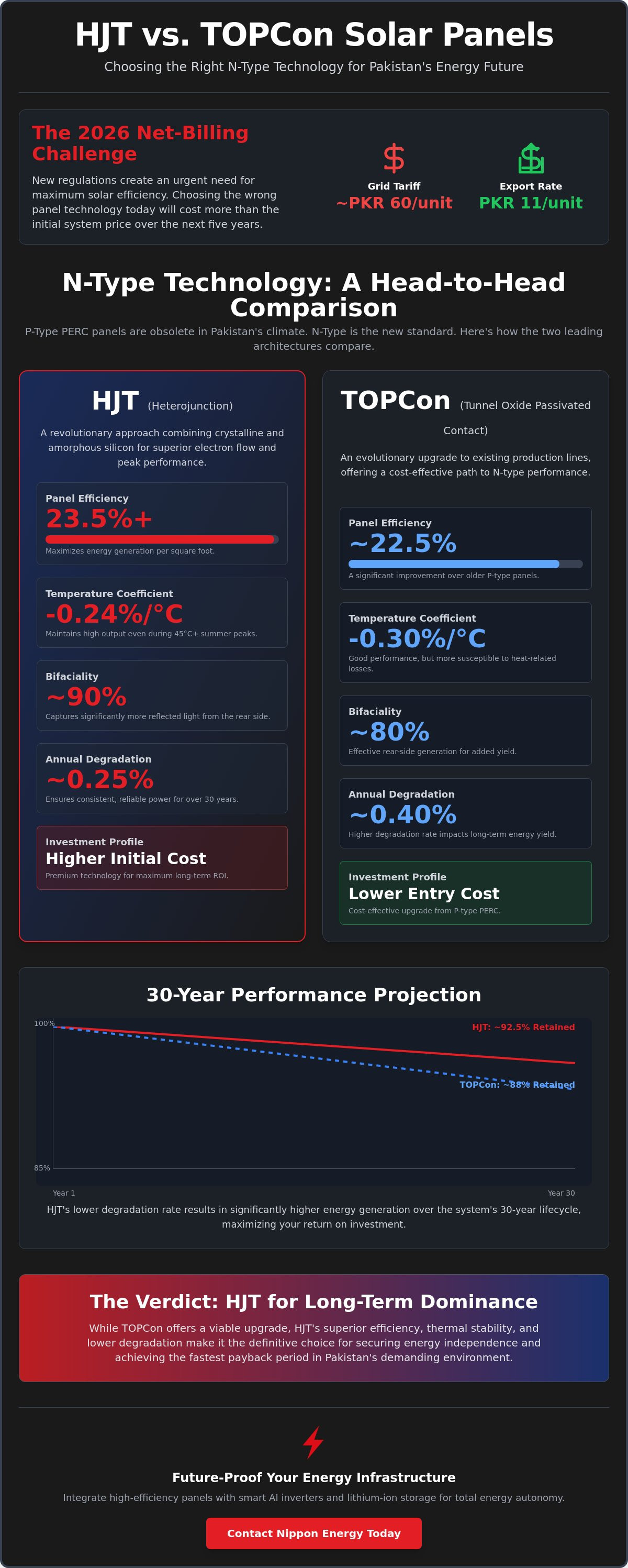
The technical divergence between hjt vs topcon solar panels in pakistan is best quantified through their respective efficiency ceilings and thermal resilience. While TOPCon panels maintain a respectable 22.5% average efficiency in 2026, HJT technology consistently pushes beyond the 23.5% threshold. This efficiency gap directly impacts your capital expenditure; higher energy density allows for a smaller system footprint, which reduces the cost of mounting structures and cabling. For industrial stakeholders in Pakistan, this means a higher energy yield per square foot of available roof space.
Long-term financial viability also depends on degradation rates and performance guarantees. HJT panels currently offer a superior annual degradation rate of approximately 0.25%, compared to 0.40% for TOPCon. Over a 30-year lifecycle, this delta ensures that an HJT-based system retains significantly more of its original nameplate capacity. Investors should consider a detailed LCOE analysis of TOPCon and HJT to understand how these marginal gains in efficiency and durability compound into substantial savings. If you're planning a large-scale deployment, you can request a technical feasibility study from our project development team.
The Thermal Performance Gap
Ambient temperatures in the Sindh and Punjab regions frequently exceed 45°C during the summer solstice, causing standard solar cells to lose significant power. HJT modules feature a temperature coefficient of -0.24%/°C, which is the lowest in the industry. In contrast, TOPCon typically operates at -0.30%/°C. When cell temperatures reach 50°C, HJT panels generate 2% to 3% more power than TOPCon alternatives. Nippon HJT panels utilize a symmetrical cell structure that manages heat stress more effectively, preventing the micro-cracking often seen in asymmetrical architectures during extreme thermal cycling.
Bifacial Yield and Rear-Side Efficiency
Bifaciality factors determine how much light the rear side of the panel converts into electricity, a critical metric for concrete rooftops and high-albedo commercial surfaces. HJT technology achieves a bifaciality rate of 90% or higher, significantly outperforming the 80% average found in Nippon TOPCon Solar Panels. On white-coated roofs common in Karachi’s industrial zones, this 10% difference in rear-side capture can increase total system output by up to 4%. This extra generation is essentially free energy that accelerates your payback period without increasing the system's physical footprint.
Real-World Performance in Pakistan: Adapting to Extreme Heat and Dust Loads
Pakistan's climatic profile presents a set of environmental stressors that laboratory tests often fail to simulate. High UV indices in the northern plains and abrasive particulate matter in industrial zones create a hostile environment for photovoltaic modules. When evaluating hjt vs topcon solar panels in pakistan, you must account for how these stressors degrade the protective layers of the cell over time. A recent technical comparison of HJT and TOPCon cells indicates that while both N-type technologies offer superior resilience to P-type, their response to local dust loads varies significantly. It's a critical distinction for long-term yield.
The "Soiling Effect" is the primary performance killer in the Punjab and Sindh regions. Dust accumulation blocks solar radiation and increases the operating temperature of the cells. While TOPCon panels are highly efficient, their front-side glass is susceptible to urban soot and fine clay particles. HJT panels, with their high bifaciality, also require clean rear-side environments to maintain their 90% yield potential. Ignoring rear-side soiling can negate the technology's efficiency advantage within months. This makes the choice between architectures a matter of maintenance strategy as much as it is a matter of physics.
Soiling and Cleaning Cycles in Punjab and Sindh
Fine clay dust in central Punjab creates a cement-like layer when combined with morning dew, requiring rigorous Solar System Maintenance. We recommend predictive cleaning strategies that utilize AI-enhanced monitoring to identify generation dips before they become systemic. HJT cells benefit more from frequent cleaning because their low temperature coefficient allows them to capitalize on the cooling effect of water during the process. Maintaining a clean surface ensures that the light-trapping properties of N-type silicon are fully utilized throughout the peak daylight hours of the summer season.
Humidity and PID/LeTID Resistance
In coastal regions like Karachi, salt-heavy humidity increases the risk of Potential Induced Degradation (PID). Traditional P-type panels suffer from significant leakage currents in these environments, but N-type architectures are naturally immune to these failure modes. The tunnel oxide layer in TOPCon and the amorphous silicon layers in HJT provide a robust barrier against ion migration. Nippon Energy tests all panels for extreme climatic resilience to ensure they survive the 25-year service life promised in our technical specifications. This immunity to PID and Light and elevated Temperature Induced Degradation (LeTID) is what secures your capital investment against the unique atmospheric chemistry of the Arabian Sea coast.
Calculating ROI and Long-Term Yield: Is HJT Worth the Price Premium?
The decision to invest in premium solar technology in 2026 hinges on a precise calculation of the Levelized Cost of Electricity (LCOE). While TOPCon panels dominate the market due to a lower initial price point, HJT modules command a cost premium of approximately 12-18% in mid-2026. However, evaluating hjt vs topcon solar panels in pakistan requires looking beyond the initial invoice. With the 2026 NEPRA net-billing regulations purchasing exported energy at only PKR 11 per unit while grid tariffs hover between PKR 40 and PKR 60, maximizing self-consumption through superior yield is the only way to protect your margins. It's a calculation of long-term resilience over short-term savings.
Inflation and the rising cost of capital in Pakistan make the durability of your energy infrastructure paramount. A system that degrades at 0.40% annually will produce significantly fewer units over 25 years than one degrading at 0.25%. When you factor in the "Heat Premium" discussed previously, where HJT generates up to 3% more power during peak summer months, the payback period for the HJT premium often compresses to within 18 to 24 months of additional operation. A granular analysis of hjt vs topcon solar panels in pakistan reveals that the higher bifaciality of HJT provides a faster path to energy autonomy for high-consumption industrial users.
Step-by-Step ROI Framework for Pakistani Businesses
To determine the viability of your investment, we recommend a four-step engineering audit that accounts for local economic variables. First, calculate total annual yield based on regional solar irradiance data for your specific city. Second, apply verified degradation factors to see how your capacity holds up over two decades. Third, factor in the extra units generated during the 120+ days of extreme summer heat in Sindh and Punjab. Finally, compare the total cumulative lifetime savings against the initial CAPEX difference to find the true break-even point. This methodical approach removes the guesswork from your procurement strategy.
Industrial Case Study: 1MW HJT vs. TOPCon Installation
Consider a textile mill in Faisalabad requiring a 1MW installation. Over a 25-year lifecycle, an HJT system is projected to generate roughly 2.5% to 4% more total energy than a TOPCon equivalent due to lower degradation and better thermal response. This translates to millions of additional units that offset expensive grid power. Beyond direct savings, high-efficiency systems accelerate the acquisition of international carbon credits and support corporate sustainability goals. Our Solar EPC Services ensure your system is architected to exploit these technical advantages from day one. You can consult with our technical architects to receive a customized ROI projection for your facility.
Future-Proofing Your Energy Infrastructure with Nippon Energy’s Advanced Solutions
The transition to a net-billing environment in 2026 has transformed solar from a simple generation tool into a complex energy management challenge. To achieve true energy independence, Pakistani prosumers must look beyond the module level and consider the entire system architecture. The choice between hjt vs topcon solar panels in pakistan becomes clearer when viewed through the lens of system integration. High-efficiency modules are only as effective as the infrastructure that manages their output, particularly when grid export rates are capped at PKR 11 per unit.
Our NipponHev System represents the pinnacle of this integrated approach. It synchronizes high-performance modules with Smart AI Solar Inverters to ensure that every photon captured is used or stored with maximum efficiency. This intelligent orchestration is essential for navigating current NEPRA regulations, as it prioritizes local consumption over grid injection. By utilizing AI-driven forecasting, the system anticipates peak demand and manages battery reserves to insulate you from rising consumer tariffs.
Integrating Storage for 24/7 Power Security
High-efficiency N-type panels provide the high-voltage stability required for modern Lithium-Ion Battery Storage. HJT's linear power output profile ensures a more consistent charging current, which preserves battery health over thousands of cycles. In a market plagued by unpredictable load shedding, this synergy provides 24/7 power security that standard P-type systems cannot match. A single-vendor ecosystem simplifies warranty claims and ensures that your performance monitoring software provides a unified view of your energy assets.
The Verdict: Your Strategic Procurement Guide
Determining the winner of the hjt vs topcon solar panels in pakistan debate depends on your specific site constraints and financial objectives. For large-scale ground mounts or commercial projects where initial CAPEX is the primary constraint, Nippon TOPCon panels offer the most balanced performance-to-cost ratio. They provide a significant upgrade over legacy PERC technology while keeping the initial investment manageable for rapid deployment.
For high-temperature regions like Sindh, limited urban roof spaces in Lahore, or industrial facilities seeking the maximum 30-year ROI, Nippon HJT is the definitive choice. Its superior temperature coefficient and 90% bifaciality ensure it remains the most resilient asset in your energy portfolio. We recommend that all prospective clients contact Nippon Energy for a site-specific technical feasibility study to ensure your procurement strategy aligns with your long-term infrastructure goals.
Securing Energy Autonomy in Pakistan’s 2026 Landscape
The transition toward N-type architecture is no longer optional for those seeking to mitigate the impact of NEPRA’s 2026 net-billing framework. This technical evaluation of hjt vs topcon solar panels in pakistan demonstrates that while TOPCon provides an efficient entry point, HJT’s superior thermal resilience and 90% bifacial gain offer the most robust defense against escalating grid tariffs. By prioritizing lower degradation rates and higher energy density, you ensure your infrastructure remains a high-performing asset for three decades. Success in this new era depends on selecting a technology that maintains its nameplate capacity despite the extreme heat of the Punjab and Sindh plains.
Integrating these advanced modules requires engineering precision. We combine Japanese Engineering Standards with Tier-1 Performance Guarantees to deliver systems that thrive in our specific climate. Our team provides deep local EPC expertise in Karachi and Lahore to ensure your project’s structural and electrical integrity. You can Request a Technical Consultation for Your Solar Project to begin architecting your transition to intelligent energy. It's time to transform your industrial or residential rooftop into a high-yield power plant that operates with total independence.
Frequently Asked Questions
Which is better for Pakistan's heat, HJT or TOPCon?
HJT panels are technically superior for Pakistan's extreme heat due to a lower temperature coefficient of approximately -0.24%/°C. This allows HJT modules to retain more power as ambient temperatures exceed 45°C compared to TOPCon's -0.30%/°C. In regions like Multan or Jacobabad, this thermal stability results in a measurably higher daily energy yield during peak summer months when cooling demands are highest.
What is the price difference between HJT and TOPCon panels in Pakistan in 2026?
HJT technology typically carries a cost premium of 12% to 18% over TOPCon modules in the mid-2026 market. This price delta reflects the more complex manufacturing process and the higher efficiency potential of the cell architecture. While TOPCon is more budget-friendly for initial CAPEX, the long-term ROI of HJT often justifies the investment through higher lifetime generation and lower annual degradation rates.
Do HJT solar panels really last 30 years in harsh climates?
HJT solar panels are engineered for a 30-year service life because they utilize N-type silicon which is immune to Light Induced Degradation (LID). The symmetrical cell structure of HJT also reduces mechanical stress during thermal expansion and contraction. This structural integrity is critical for survival in Pakistan's seasonal shifts where extreme temperature swings can cause micro-cracks in less resilient architectures.
How does bifaciality gain differ between HJT and TOPCon on a concrete roof?
HJT panels achieve a bifaciality rate of over 90%, while TOPCon panels generally range between 70% and 80%. On the white-coated or light-colored concrete roofs common in Lahore and Karachi, HJT captures significantly more reflected light from the rear side. This increased rear-side efficiency can boost total system output by an additional 4% to 6% depending on the mounting height and surface albedo.
Is HJT technology compatible with standard solar inverters used in Pakistan?
HJT modules are fully compatible with modern smart AI inverters and standard string inverters available in the local market. However, technical architects must account for the higher current output and voltage characteristics of HJT cells during the string sizing process. Using high-quality inverters ensures that the superior generation profile of the hjt vs topcon solar panels in pakistan is fully utilized without clipping losses.
What is the degradation rate of Nippon HJT solar panels compared to TOPCon?
Nippon HJT solar panels feature an annual degradation rate of approximately 0.25%, which is significantly lower than the 0.40% typical of TOPCon modules. This means that after 25 years of operation, an HJT system will maintain a higher percentage of its original nameplate capacity. This lower degradation is a primary driver for achieving a lower levelized cost of electricity over the system's full lifecycle in harsh environments.
Can I use HJT panels for a residential net-billing system in Lahore?
You can use HJT panels for residential systems, though new installations in 2026 operate under the NEPRA net-billing framework rather than traditional net-metering. HJT is particularly advantageous for Lahore residences with limited roof space because its higher efficiency maximizes wattage per square foot. This allows homeowners to generate more units for self-consumption, which is the most effective way to offset high grid tariffs.
Does dust accumulation affect HJT panels more than TOPCon?
Dust accumulation impacts all photovoltaic modules, but it requires specific attention in the context of hjt vs topcon solar panels in pakistan due to bifaciality. While the front-side performance loss is similar for both technologies, HJT's high rear-side yield can be significantly reduced if dust settles on the roof surface beneath the panels. Regular cleaning cycles are essential to maintain the bifaciality advantage that justifies the premium cost of HJT.


