
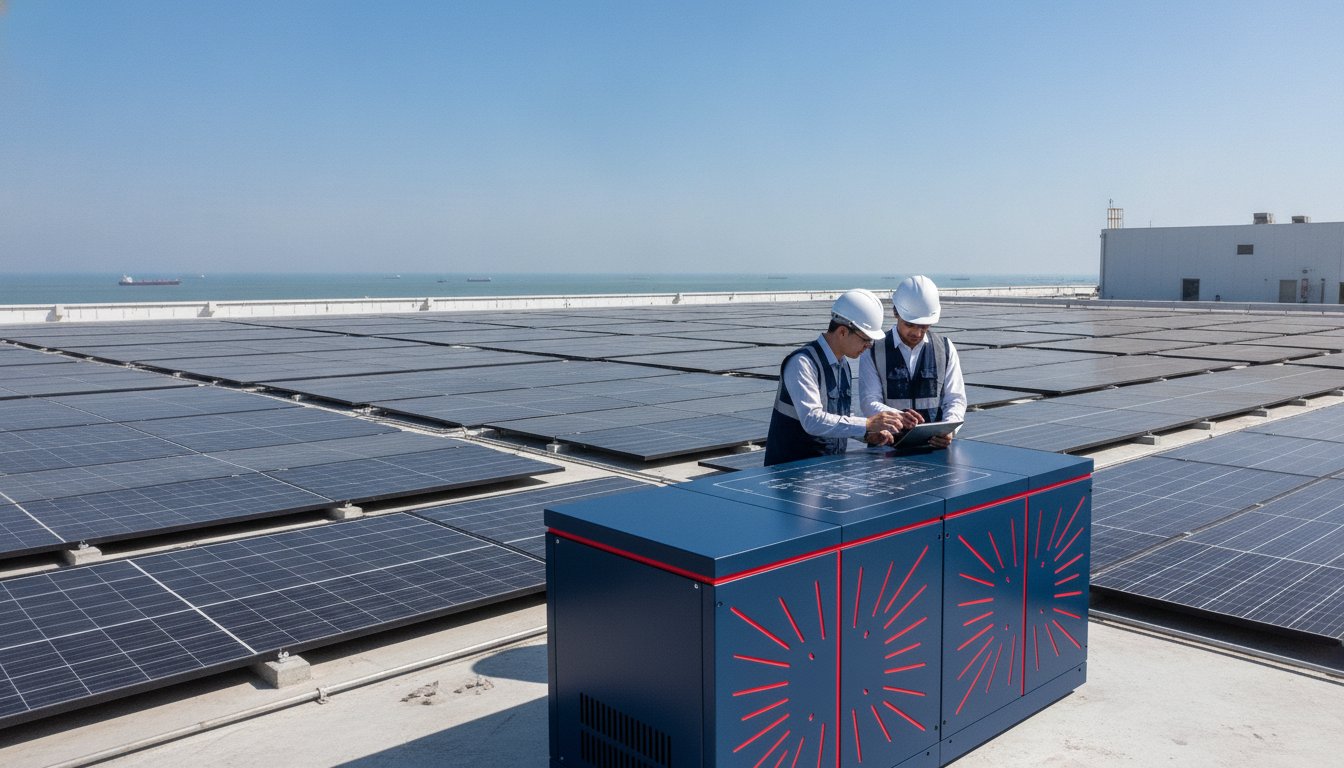
The transition from net metering to net billing has fundamentally altered the financial landscape for Karachi's industrial sector, making the pursuit of grid independence a technical necessity rather than a secondary goal. You understand that relying on a fragile grid while facing escalating fuel adjustment charges and salt-mist corrosion is a calculated risk that no longer pays off. Standard energy systems often buckle under these coastal conditions, especially when traditional lead-acid storage fails within unconditioned warehouses. This guide details how advanced N-type HJT technology and AI-coordinated commercial solar battery storage karachi provide a resilient solution to these systemic challenges. You'll discover the specific 2026 energy architecture required to ensure 24/7 business continuity, significantly reduce operational expenses, and secure a future-proof infrastructure that thrives in the unique climate of the Arabian Sea coast. We've structured this technical overview to move from the macro impact of NEPRA's policy changes to the micro specifications of high-performance hardware, ensuring your facility remains operational regardless of grid instability.
Key Takeaways
- Analyze how the 2026 transition to net billing necessitates hybrid systems to maintain 24/7 industrial uptime and mitigate rising energy tariffs.
- Evaluate the performance of HJT and TOPCon technologies in Karachi's high-humidity and salt-mist environments to ensure long-term hardware durability.
- Optimize your energy independence by integrating advanced commercial solar battery storage karachi with AI-driven inverters for automated load orchestration.
- Recognize the importance of professional EPC services, including shadow analysis and structural audits, to meet industrial compliance standards.
- Discover the NipponHev system as a comprehensive, unified energy architecture designed specifically for the Sindh region's industrial scale.
The Commercial Energy Landscape in Karachi: Why Hybrid Systems are Essential in 2026
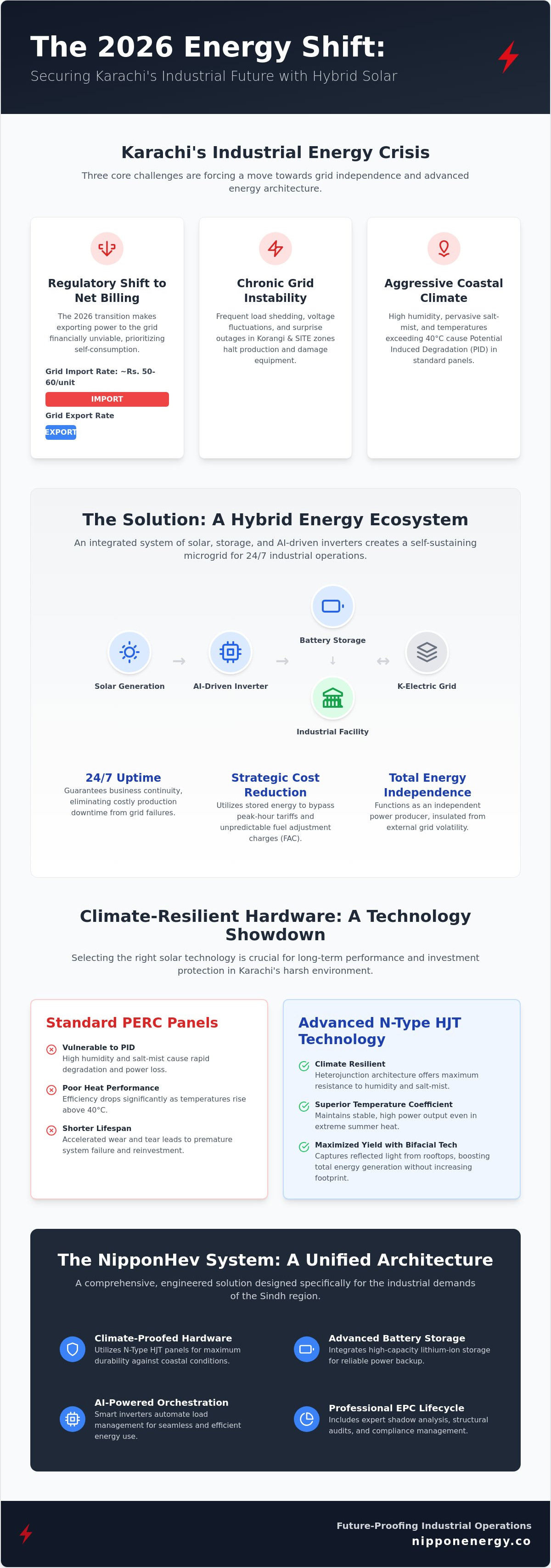
The energy architecture of Karachi has reached a critical tipping point. As the adoption of solar power in Pakistan accelerates, commercial entities in Sindh face a complex regulatory environment that demands technical precision. A commercial hybrid solar system serves as the definitive solution, integrating high-efficiency photovoltaic generation with advanced lithium-ion storage and intelligent grid connectivity to ensure 24/7 uptime. Unlike traditional systems, this architecture prioritizes self-consumption, which is vital given that 2026 grid import rates have reached approximately Rs. 50-60 per unit while export rates remain significantly lower under the net billing regime.
Relying on simple on-grid setups is no longer a viable strategy for business continuity. These systems lack the ability to function during grid outages, leaving industrial units vulnerable to the persistent load shedding cycles of Karachi. Implementing commercial solar battery storage karachi allows businesses to capture excess daytime production and deploy it during peak evening hours or during grid failures. This capability facilitates strategic peak-shaving, a process that reduces reliance on expensive grid power during high-tariff windows, directly protecting the company's bottom line from unpredictable fuel adjustment charges.
Overcoming K-Electric Grid Instability
Outages in industrial zones like Korangi and SITE are not merely inconvenient; they're financially destructive. Voltage fluctuations in the local distribution network often cause sensitive manufacturing equipment to trip, leading to expensive repair cycles and lost production hours. Investing in commercial solar battery storage karachi provides the necessary buffer against these disruptions, as the hybrid system offers a seamless transition to battery power. This architecture acts as a high-capacity stabilizer for the internal microgrid. By utilizing stored energy to bypass peak-hour fuel adjustment charges (FAC), businesses maintain a predictable operational expense model even when the external grid remains volatile.
Strategic Energy Independence for Karachi Businesses
Modern energy management requires a shift from passive consumption to active orchestration. The 2026 regulatory framework, characterized by the transition to net billing, rewards facilities that maximize their internal energy usage rather than selling power back to the grid at a deficit. Integrating hybrid architecture ensures that every kilowatt generated is utilized or stored for future use. This transition allows a facility to function as an independent power producer. The Hybrid Advantage for Karachi's commercial sector is the realization of a self-sustaining energy ecosystem that guarantees 24/7 reliability through the intelligent synchronization of solar, storage, and grid assets.
Climate-Resilient Hardware: Why HJT and TOPCon Matter for Karachi
Karachi's industrial zones, particularly those situated near the Arabian Sea, demand a higher standard of hardware resilience than inland installations. High humidity and pervasive salt-mist act as aggressive catalysts for potential induced degradation (PID) in standard solar modules, leading to premature failure. While traditional PERC panels often suffer from accelerated efficiency loss in these conditions, Nippon HJT Solar Panels utilize a heterojunction architecture that thrives in high-ambient temperatures. This technology offers a superior temperature coefficient, ensuring power output remains stable even when Karachi’s summer temperatures exceed 40°C. Aligning with global solar technology trends, the shift toward N-type cells is essential to secure long-term investment protection in coastal Sindh.
Bifacial technology further enhances the performance of these modules on reflective industrial rooftops common in SITE and Korangi. By capturing sunlight from both the front and rear surfaces, businesses maximize energy yield without increasing the system's physical footprint. This consistent energy harvesting is a prerequisite for the reliable operation of commercial solar battery storage karachi, as it ensures the storage system reaches full capacity even during hazy or overcast coastal days. The integration of high-yield modules with storage creates a stabilized energy buffer that standard systems cannot match.
Nippon TOPCon Technology for Industrial Scale
For high-density commercial arrays, TOPCon solar panels have become the industrial benchmark in 2026. These modules consistently achieve efficiency levels exceeding 22.5% in real-world Karachi conditions, providing a high power-to-area ratio for constrained factory roofs. N-type TOPCon cells offer exceptional LID (Light Induced Degradation) and LeTID (Light and elevated Temperature Induced Degradation) resistance. This structural integrity is critical for maintaining power retention in Sindh’s high-heat zones over a 25-year lifecycle. You can request a technical audit to determine the optimal module configuration for your specific site conditions.
Salt-Mist and Corrosion Resistance
Hardware longevity in Port Qasim and Korangi is contingent upon rigorous certification standards. All solar infrastructure must meet IEC 61701 standards to resist the corrosive effects of the coastal atmosphere. Glass-glass construction provides a superior moisture barrier compared to traditional backsheets, while high-grade anodized aluminum frames resist structural fatigue from seasonal wind loads. IP68-rated junction boxes prevent salt-mist ingress into critical electrical components. These specifications ensure that your commercial solar battery storage karachi remains supported by a robust generation source capable of withstanding the Sindh coast's aggressive environment for decades.
Intelligent Energy Storage: AI Inverters and Lithium-ion Integration
Traditional lead-acid batteries frequently fail in unconditioned Karachi warehouses due to extreme heat sensitivity and restricted depth of discharge. Transitioning to lithium ion battery storage is the only technically sound path for high-capacity industrial applications in 2026. Lithium Iron Phosphate (LiFePO4) chemistry provides a cycle life exceeding 6,000 cycles at 80% depth of discharge. In contrast, traditional deep-cycle batteries typically degrade after 500 to 1,000 cycles. This longevity fundamentally transforms the return on investment (ROI); it converts storage from a recurring operational expense into a stable capital asset that supports a facility for over a decade.
The operational efficiency of commercial solar battery storage karachi depends on the intelligence of the power conversion stage. Modern smart ai solar inverters utilize predictive algorithms to manage energy flow with surgical precision. By analyzing local weather forecasts and historical load-shedding patterns in industrial zones like SITE or Korangi, these systems pre-charge batteries during low-tariff windows or periods of surplus solar generation. This proactive orchestration ensures that stored energy is always available to bypass the most expensive peak-hour grid rates, effectively shielding the business from fluctuating utility costs.
Nippon Smart AI Inverters: The System Brain
These units serve as the central nervous system of your energy architecture. AI orchestration minimizes grid reliance by automatically prioritizing solar and battery power during high-tariff windows. Facility managers gain access to real-time monitoring and cloud-based analytics to track performance metrics across multiple production lines. For established operations, these inverters integrate seamlessly with existing industrial building management systems (BMS) through standard communication protocols. This connectivity allows for unified control of HVAC, lighting, and power generation, ensuring maximum efficiency across the entire site.
Commercial Lithium-ion Storage Sizing
Industrial applications require precise C-rating calculations to manage the high inrush currents of heavy machinery during startup. A properly engineered commercial solar battery storage karachi configuration prevents system trips when large motors or compressors engage. The modular nature of Nippon Lithium-ion systems allows for incremental expansion as your business operations grow in the Sindh region. Because many Karachi facilities lack climate control, our systems incorporate advanced thermal management and active cooling. These features maintain cell stability even when ambient warehouse temperatures reach 45°C, preserving the integrity of the lithium chemistry.
EPC Lifecycle: Engineering Your Solar Investment in Karachi
Transitioning from hardware selection to architectural implementation requires a rigorous engineering framework that prioritizes structural integrity over speed. A professional solar epc services partner ensures industrial compliance by managing the entire lifecycle from preliminary feasibility to final commissioning. This process is essential for integrating commercial solar battery storage karachi into existing power infrastructures without compromising safety or operational stability. Beyond simple mounting, the EPC phase involves precise electrical synchronization and procurement excellence to secure Tier-1 hardware through global supply chains.
The commissioning phase culminates in the formal Net Metering application with K-Electric. While the regulatory landscape for 2026 emphasizes net billing, the technical synchronization with the utility grid remains a complex hurdle. A structured EPC approach manages these bureaucratic and technical requirements, ensuring your facility meets all safety standards for grid-tied operation. This meticulous attention to detail transforms a collection of components into a high-performance energy asset capable of delivering predictable returns for decades.
Feasibility and Structural Engineering
Industrial rooftops in Sindh must withstand specific environmental stressors, including high-velocity coastal winds and the intense monsoon season. Structural integrity audits are conducted to verify that factory roofs can support the additional dead load of high-density arrays. Engineers perform detailed wind load calculations to design mounting structures that resist uplift during seasonal storms. Simultaneously, an electrical audit determines how to synchronize solar generation with existing diesel generators and the K-Electric grid. Conducting a rigorous shadow analysis is a technical prerequisite for dense industrial zones like North Karachi to ensure neighboring structures don't compromise energy harvest during peak generation windows.
Project Execution and O&M
Precision in project management ensures that the installation process causes zero disruption to your daily manufacturing cycles. Once the system is live, the focus shifts to long-term performance through solar system maintenance. This isn't merely about cleaning panels; it's about protecting a multi-million dollar investment. Our 2026 energy architecture utilizes AI-driven predictive maintenance to detect anomalies in commercial solar battery storage karachi before they lead to downtime. By identifying fault patterns in real-time, the system maintains peak efficiency and extends the operational life of the lithium-ion cells. You can consult our engineering team to initiate a site-specific feasibility study for your facility.
Partnering with Nippon Energy for Karachis Industrial Future
Nippon Energy's presence in Pakistan is anchored by our strategic operations center in the Karachi Korangi Industrial Area. This local hub ensures that our global technical authority is applied directly to the specific energy crises facing the Sindh region. Our approach goes beyond simple component assembly; we provide the nipponhev system, a unified energy architecture that synchronizes high-efficiency generation with intelligent storage. This integration is vital for businesses seeking true independence through commercial solar battery storage karachi. By applying Japanese engineering standards to local industrial challenges, we ensure that every installation is built for a 25-year lifecycle in an environment that typically degrades standard hardware in less than a decade.
Future-proofing your business against the 2026 energy transition requires more than just panels. It requires an orchestrated ecosystem that can adapt to rising grid tariffs and changing NEPRA regulations. The NipponHev architecture is designed to evolve, allowing for modular expansion as your facility's load profile grows. This foresight protects your capital investment from technical obsolescence, ensuring your facility remains a leader in operational efficiency while others struggle with grid volatility.
The Nippon Advantage in Sindh
Our engineers combine global technical authority with an intimate understanding of Karachi's industrial parks. We recognize that a manufacturing unit in Landhi faces different environmental and grid stressors than a commercial complex in Clifton. This local expertise allows us to fine-tune the orchestration parameters of our AI-driven systems. By focusing on technical precision, we've enabled Karachi-based manufacturing units to significantly reduce their OPEX through optimized self-consumption. Our systems don't just provide backup; they provide a competitive advantage by stabilizing energy costs in an unpredictable market. We maintain a discipline that values longevity and precision, projecting the image of a world-class partner for large-scale success.
Next Steps for Your Commercial Solar Transition
The path to energy independence begins with a granular understanding of your current consumption. You can request a comprehensive energy audit for your Karachi facility to identify peak-shaving opportunities and storage requirements. Our technical team provides detailed ROI projections for the 2026 fiscal year, factoring in the latest K-Electric tariff structures and fuel adjustment charges. Various financing options are available to facilitate the transition to advanced commercial solar battery storage karachi, making large-scale solar adoption more accessible for industrial leaders. To initiate your technical consultation, visit our Karachi team at Plot 14, Sector 15, Korangi Industrial Area. Our methodical approach ensures that your transition to a hybrid architecture is seamless, professional, and performance-oriented.
Securing Industrial Resilience on the Sindh Coast
The 2026 energy transition demands a decisive shift from passive consumption to active orchestration. We've explored how climate-resilient HJT panels and intelligent lithium-ion integration solve the dual challenges of salt-mist corrosion and grid instability. Implementing commercial solar battery storage karachi isn't just about providing backup power; it's about establishing a self-sustaining microgrid that optimizes every kilowatt generated. By adhering to Japanese engineering standards and leveraging our local presence in the Korangi Industrial Area, we provide the technical foundation for long-term operational success.
Our proprietary HJT and AI technology ensure your facility remains a leader in energy efficiency while others face rising tariffs and unpredictable grid behavior. It's time to move beyond the limitations of the traditional grid and embrace a future-proof architecture. Design your commercial energy future with Nippon Energy’s Karachi experts to ensure your facility remains a benchmark of industrial excellence. Your transition to a reliable, high-performance energy ecosystem is the most critical infrastructure investment you'll make this decade. We look forward to engineering your success.
Frequently Asked Questions
Is a hybrid solar system better than an on-grid system for a Karachi business?
A hybrid solar system is technically superior for Karachi businesses because it ensures operational continuity during K-Electric outages. While on-grid systems are limited by grid availability, hybrid architecture integrates commercial solar battery storage karachi to bridge gaps and maximize self-consumption under the 2026 net billing regulations. This setup prevents production stops during load-shedding cycles that would otherwise disable an on-grid system.
How long do lithium-ion solar batteries last in Karachis high temperatures?
Lithium-ion (LiFePO4) batteries typically maintain an operational life of 10 to 15 years in Karachi when supported by active thermal management. High ambient temperatures can accelerate chemical degradation; however, industrial-grade storage systems utilize internal cooling to preserve cell integrity even when warehouse temperatures exceed 40°C. This longevity far exceeds traditional lead-acid alternatives that often fail within two years in the Sindh climate.
Can a commercial hybrid solar system run heavy machinery during a power outage?
A properly engineered hybrid system can support heavy industrial machinery during an outage provided the inverters and batteries are sized for high inrush currents. This requires calculating specific startup loads and ensuring the storage system's C-rating can handle the momentary surge without tripping safety protocols. Strategic load prioritization ensures that critical production lines remain active while non-essential systems are managed during grid failures.
What is the typical ROI for a commercial solar installation in Karachi in 2026?
The typical return on investment for a commercial installation in 2026 ranges between three and five years. This timeline is achieved by prioritizing the self-consumption of solar energy to avoid grid import rates of approximately Rs. 50-60 per unit. By utilizing commercial solar battery storage karachi to minimize peak-hour grid reliance, businesses maximize their savings and accelerate the payback period of the capital expenditure.
Does the salt-air in Karachi damage solar panels over time?
Salt-air in coastal areas like Port Qasim and Korangi will damage standard solar panels through corrosion and potential induced degradation (PID). To prevent this, businesses must utilize modules with IEC 61701 salt-mist resistance certification and glass-glass construction. These technical specifications ensure a 25-year structural lifespan despite the aggressive atmospheric conditions found near the Arabian Sea.
How does net metering work with a hybrid system in Pakistan?
In a hybrid configuration, the system first prioritizes powering your facility and charging the internal battery reserves. Any surplus energy generated after meeting these needs is then exported to the grid under NEPRA's net billing policy. Credits for exported units are applied to your bill at the prevailing export rate, which is approximately Rs. 9-11 per unit as of 2026.
What maintenance is required for a commercial solar farm in an industrial area?
Industrial solar maintenance requires a methodical schedule of panel cleaning to prevent soiling losses caused by urban dust and industrial emissions. Additionally, periodic thermal imaging is necessary to identify electrical hotspots before they cause hardware failure. AI-driven monitoring software tracks inverter efficiency and battery health in real-time, allowing for predictive interventions that prevent unplanned operational downtime.
Can I expand my hybrid solar system later if my business grows?
Modern hybrid systems are designed for modular expansion, allowing you to increase battery capacity or add solar arrays as your industrial load grows. Parallel-ready inverters and stackable lithium-ion modules ensure that your initial energy architecture remains a scalable asset. This flexibility allows businesses to start with a baseline investment and expand their energy independence in line with their operational growth.


