
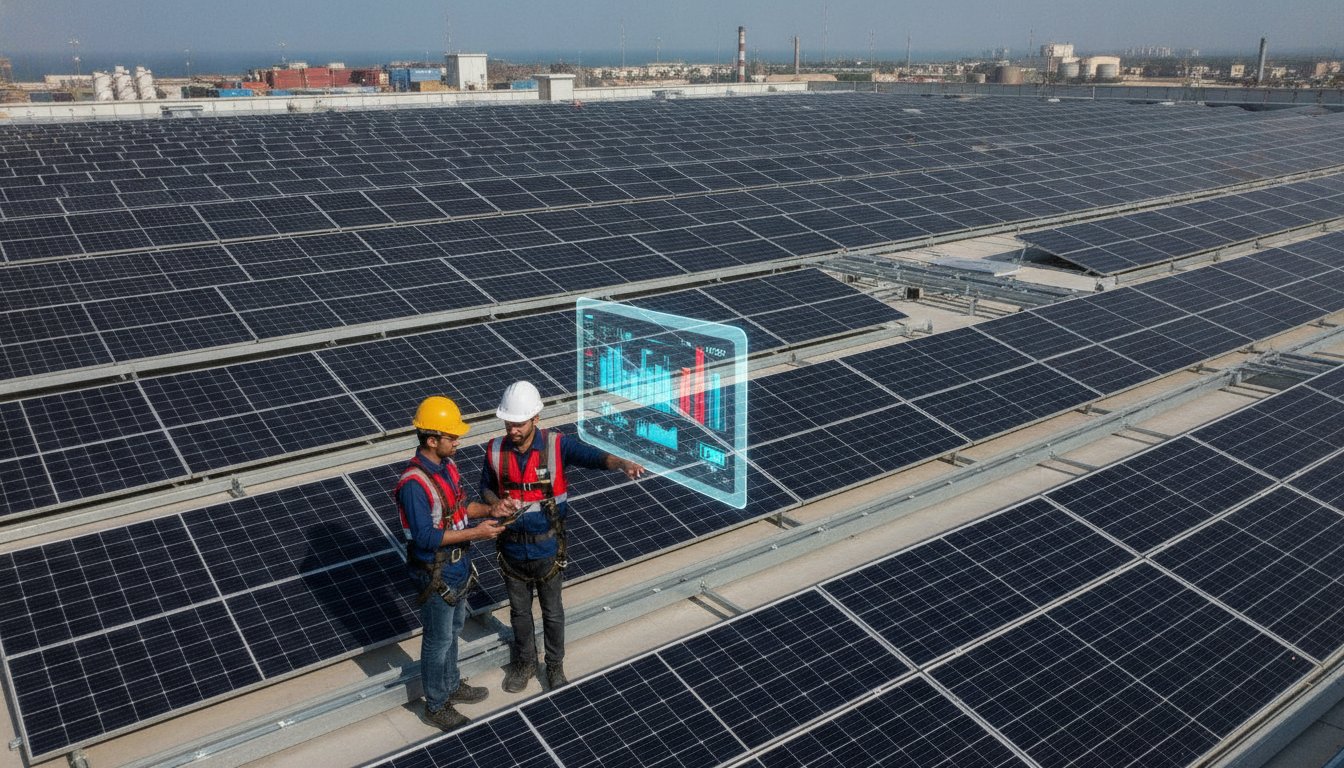
Your industrial facility cannot survive on the energy strategies of the last decade. With K-Electric unit prices now exceeding PKR 65 and the February 2026 shift to net billing, it's clear that rising overheads and grid instability are threatening your operational viability. For those investing in industrial solar power systems karachi, the challenge has evolved from basic procurement to sophisticated energy architecture. You need a system that doesn't just generate power but actively survives the intense high-temperature degradation unique to our coastal industrial zones.
We recognize that these technical and commercial complexities can make calculating a true ROI feel impossible while production schedules remain at the mercy of an unstable grid. This guide provides the technical blueprint to navigate the 2026 regulatory landscape, allowing you to secure energy independence through advanced N-type technology. We'll analyze the performance metrics of HJT modules, the impact of the latest SBP financing rates, and the precise engineering required to thrive under the current net billing framework. It's time to move beyond standard solar installations and build for permanent resilience in a volatile energy market.
Key Takeaways
- Analyze the thermal performance advantages of Nippon HJT Solar Panels to maintain high energy yields in Karachi's extreme industrial heat.
- Learn how to design industrial solar power systems karachi that prioritize high-efficiency self-consumption to maximize ROI under the 2026 net billing regulations.
- Discover the role of Nippon Smart AI Inverters in providing predictive load management and grid-forming capabilities for uninterrupted manufacturing operations.
- Establish a rigorous selection framework for EPC partners based on high-fidelity feasibility studies and proven expertise in multi-megawatt industrial deployments.
- Implement specialized predictive maintenance and cleaning protocols designed to mitigate the specific performance risks associated with Karachi's coastal industrial soiling.
The 2026 Industrial Energy Landscape in Karachi
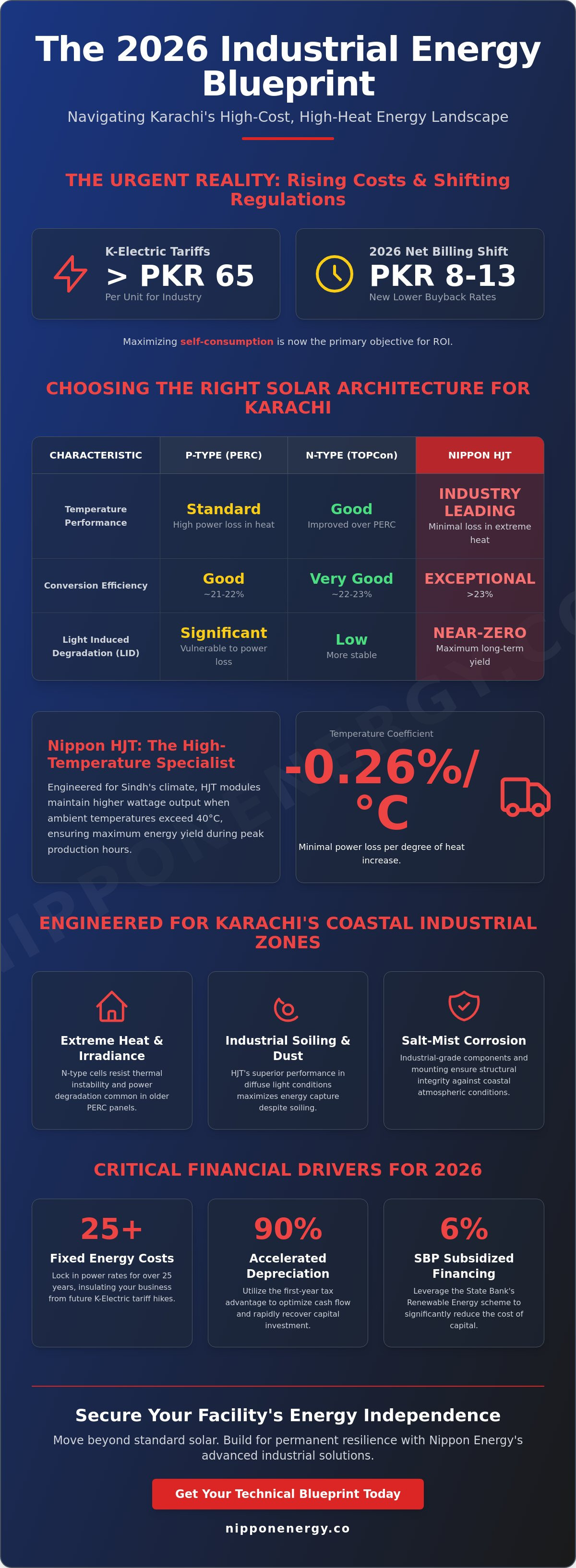
Karachi's industrial sectors, particularly in SITE and Korangi, are currently operating under a high-pressure energy regime. With K-Electric industrial tariffs now exceeding PKR 65 per unit, the financial burden on manufacturing has reached a critical threshold. Relying solely on the national grid is no longer a viable fiscal strategy; it's a liability that erodes profit margins. By integrating industrial solar power systems karachi, facilities can decouple their operational costs from the volatility of fuel price adjustments and currency-driven tariff hikes. This shift is not merely about sustainability. It's about maintaining a competitive edge in a market where energy costs are the primary driver of product pricing.
The transition from a passive consumer to an active "prosumer" is accelerated by the NEPRA (Prosumer) Regulations 2026. While the new net billing system offers lower buyback rates of PKR 8-13 per unit compared to previous years, the primary objective has shifted toward maximizing self-consumption. In this environment, the goal is to architect a system that eliminates the need for expensive grid power during peak production hours. This evolution in Solar Power in Pakistan reflects a move toward decentralized, resilient energy grids that empower individual industrial units to dictate their own energy future.
Economic Pressures: K-Electric Tariffs vs. Solar LCOE
Calculating the Levelized Cost of Energy (LCOE) is essential for any multi-megawatt project. Every month of delayed adoption represents a permanent loss in capital that could've been diverted to technological upgrades or capacity expansion. Industrial solar acts as a fixed-cost asset that protects your bottom line against an unpredictable inflationary environment. Consider the following economic drivers for 2026:
- Fixed Energy Costs: Lockdown power rates for 25 years or more, effectively insulating the business from future tariff hikes.
- Tax Advantages: Utilize the 90% accelerated depreciation allowance in the first year to optimize cash flow.
- Subsidized Financing: Leverage the SBP Renewable Energy scheme with its 6% markup rate to reduce the cost of capital.
The Environmental Factor: Karachi's High-Heat and Salt-Mist Challenge
Karachi's coastal geography presents unique engineering hurdles that standard "Tier-1" panels often fail to survive. High humidity and ambient temperatures frequently exceed the operating thresholds of older PERC technology, leading to rapid efficiency loss. For facilities near Port Qasim or the Karachi Port Trust, salt-mist corrosion is a constant threat to structural integrity. Industrial-grade energy architecture must prioritize climate-hardened components. Standard panels are insufficient; you require N-type cell architectures that maintain structural and electrical stability despite Sindh's aggressive atmospheric conditions. Investing in robust industrial solar power systems karachi ensures that your energy infrastructure remains a high-performing asset rather than a maintenance burden.
HJT vs. TOPCon: Selecting the Right Cell Architecture for Karachi
Selecting the optimal cell architecture is the most critical technical decision when designing industrial solar power systems karachi. Standard P-type modules often suffer from significant Light Induced Degradation (LID) and thermal instability, which are exacerbated by the city's intense solar irradiance. N-type architectures, specifically Heterojunction (HJT) and Tunnel Oxide Passivated Contact (TOPCon), have emerged as the necessary standard for high-performance energy architecture. HJT technology is defined by its industry-leading low-temperature coefficient, which ensures minimal power loss during the peak thermal stress cycles expected in 2026. This technology utilizes a synergy of crystalline silicon and amorphous silicon layers to create a superior energy barrier, resulting in higher conversion efficiencies and better performance in diffuse light conditions.
Nippon HJT: The High-Temperature Specialist
Nippon HJT Solar Panels are engineered to solve the specific thermal challenges of the Sindh region. These modules feature a documented temperature coefficient of -0.26%/°C, allowing them to maintain higher wattage output when ambient temperatures exceed 40°C. In the dusty, high-albedo environments of Karachi’s industrial zones, the bifaciality of HJT cells provides a significant yield advantage by capturing reflected light from the surrounding surfaces. Because HJT cells possess a symmetrical structure, they're less prone to micro-cracks and potential-induced degradation (PID). This structural integrity ensures the system maintains over 90% of its rated output after 25 years of operation. Understanding these technical nuances is vital as the Pakistan Renewable Energy Market matures toward high-efficiency deployments that prioritize longevity over low-quality components.
Nippon TOPCon: Balancing Efficiency and CAPEX
Nippon TOPCon Solar Panels offer a high-efficiency alternative for projects where initial capital expenditure must be balanced against long-term performance. The technical architecture involves a thin tunnel oxide layer that reduces recombination losses, pushing cell efficiency beyond the limits of traditional technologies. While HJT offers superior thermal resilience, TOPCon is often the preferred choice for large-scale industrial solar power systems karachi where roof space is abundant and the project requires a specific balance between performance and upfront cost. You can explore a deeper technical breakdown of this architecture by reviewing our detailed analysis of Topcon Solar Panels. Choosing between these technologies requires a detailed load profile analysis to ensure the selected architecture matches your facility's operational demands. You can examine our full product range to determine which cell technology aligns with your long-term energy goals.
Energy Orchestration: Integrating Storage and AI Inverters
The architecture of industrial solar power systems karachi has transitioned from basic energy generation to complex energy orchestration. Passive inverters are no longer sufficient for managing the high-load demands and grid volatility experienced in SITE or Korangi industrial zones. Nippon Smart AI Inverters now serve as the central intelligence unit, providing advanced grid-forming capabilities that allow your facility to maintain a stable microgrid even during total external grid failure. This orchestration is further refined through the nipponhev system, which synchronizes solar generation, battery discharge, and grid interaction to ensure a seamless power flow that eliminates production micro-stops.
As Pakistan's renewable energy policy targets a 60% renewable share by 2030, the integration of intelligent storage and AI-driven management becomes a prerequisite for industrial longevity. The shift toward net billing in 2026 has made maximizing self-consumption the primary driver of ROI, a task that requires predictive load-shedding logic and real-time energy balancing. By automating the response to grid instability, industrial operators can focus on production rather than manual power management.
Nippon Lithium-Ion Battery Storage: Industrial Scale Reliability
Industrial lithium-ion storage has replaced lead-acid as the 2026 standard for high-cycle applications. Nippon Lithium-ion Battery Storage Systems offer a significantly higher cycle life, supporting 24/7 manufacturing operations without the rapid capacity degradation associated with older chemistries. When sizing storage, the focus must shift from full facility backup to protecting critical industrial loads, ensuring that high-torque machinery and temperature-sensitive processes remain operational. This strategic sizing optimizes capital expenditure while maintaining resilience. For a comprehensive technical analysis of these storage architectures, consult The Definitive Guide to Lithium-Ion Battery Storage.
AI-Driven Management: Beyond Basic Monitoring
Intelligence is the differentiating factor in modern energy architecture. Nippon Smart AI Inverters utilize machine learning algorithms to optimize self-consumption in real-time, adjusting power distribution based on weather forecasts and historical load profiles. This proactive approach extends to predictive maintenance, where the AI identifies specific losses from shade or coastal soiling before they significantly impact your financial returns. You can explore the full capabilities of these systems in our guide to Smart AI Solar Inverters. These intelligent systems don't just monitor; they actively defend your investment against environmental and grid-based performance threats.
The Industrial Selection Framework: Evaluating EPC Partners
Deploying industrial solar power systems karachi involves more than just equipment procurement; it requires a disciplined execution strategy. A flawed installation can lead to structural failure or electrical hazards that jeopardize your entire facility. To mitigate these risks, industrial leaders must adopt a rigorous selection framework when evaluating Engineering, Procurement, and Construction (EPC) partners. This process ensures that your capital investment translates into a high-performing, permanent asset.
- Step 1: Conduct a high-fidelity feasibility study. This must include a granular load profile analysis to match generation with your facility's specific consumption patterns.
- Step 2: Verify the EPC partner's track record with multi-megawatt projects. Karachi's industrial zones have unique grid complexities that residential-scale installers aren't equipped to handle.
- Step 3: Audit the hardware supply chain. Insist on Nippon HJT or TOPCon quality to ensure the thermal resilience and longevity required for the Sindh climate.
- Step 4: Review structural engineering documents. All mounting structures must be certified for high-velocity wind loads to survive intense monsoon seasons.
- Step 5: Finalize the O&M contract. Performance-guaranteed Service Level Agreements (SLAs) are mandatory to protect your industrial-scale ROI.
Feasibility and Structural Integrity
Karachi's coastal location places it in a high-wind zone. Industrial roofs in areas like SITE or Korangi require specialized mounting structures that account for both dead loads and uplift forces. A simple visual inspection isn't enough. We utilize 3D shadow analysis to identify obstructions in dense industrial clusters that could cause hot spots or efficiency drops. Ensuring compliance with local building codes and electrical safety standards is non-negotiable. This engineering rigor prevents system downtime and protects the structural integrity of your factory buildings.
EPC Excellence: The Nippon Energy Approach
Our turnkey project management covers the entire lifecycle of your energy transition. This includes everything from the initial procurement of high-performance modules to navigating the complexities of NEPRA net metering approvals. Dealing with K-Electric and the Sindh energy departments requires technical precision and a deep understanding of the 2026 regulatory landscape. You can learn more about our comprehensive Solar EPC Services to understand how we manage these multi-faceted deployments. Our goal is to provide a seamless transition to energy independence while maintaining the highest standards of engineering excellence. Consult with our technical architects today to begin your load profile evaluation.
Maximizing ROI: Maintenance and Performance Monitoring
The long-term profitability of industrial solar power systems karachi is fundamentally determined by post-commissioning operational discipline. Many industrial operators view maintenance as a reactive necessity, yet in Karachi's aggressive environment, it must be treated as a proactive performance architecture. The "Karachi Soiling" problem is a unique phenomenon where high-density industrial particulate matter from SITE and Korangi combines with coastal humidity to create a resilient, light-blocking film on module surfaces. Standard cleaning schedules designed for inland regions fail here because they don't account for the rapid cementation of carbon and salt on the glass. Achieving maximum ROI requires a shift toward predictive maintenance, where real-time transparency allows for interventions before yield drops become significant.
Calculating the ROI of a 1MW system necessitates accounting for even minor performance deviations; a 1% efficiency gain can result in significant additional energy generation worth millions of PKR over the project's lifespan. Our monitoring suite provides this granular data, ensuring that every kilowatt-hour is accounted for. By integrating intelligent sensors and AI diagnostics, we move beyond simple uptime tracking to advanced health monitoring of every string in the array.
Specialized Maintenance for Karachi's Environment
Coastal industrial plants near Port Qasim face accelerated oxidation risks that demand specialized electrical audit protocols. Salt-mist protection isn't just about the panels; it involves the integrity of every connector, combiner box, and mounting rail. While automated cleaning systems are gaining traction, the specific nature of Karachi's industrial grime often requires a hybrid approach to ensure the structural and electrical longevity of the system. You can explore our detailed protocols in Solar System Maintenance to understand how we mitigate these environmental threats. Regular thermographic inspections are also essential to identify potential hot spots caused by uneven soiling or micro-cracks before they lead to component failure.
Financial Performance and Long-Term Yield
Tracking the Levelized Cost of Energy (LCOE) over 25 years reveals the true value of high-performance cell architectures. Because Nippon HJT modules feature lower annual degradation rates (approximately 0.25%) compared to standard P-type cells, the long-term yield remains consistently high, directly impacting the corporate balance sheet. AI monitoring further optimizes this financial performance by drastically reducing the Mean Time To Repair (MTTR) for industrial faults. When a fault is identified and diagnosed by AI before a technician even arrives on-site, the resulting reduction in downtime preserves your revenue stream. In the 2026 landscape, a well-maintained industrial solar power systems karachi deployment isn't just an energy source; it's a high-yield financial asset that provides predictable, inflation-protected returns for decades.
Architecting Permanent Energy Independence
The transition to high-performance energy architecture is no longer optional for Karachi's industrial leaders. Deploying industrial solar power systems karachi requires a precise integration of Japanese-engineered HJT and TOPCon technology to survive the city's unique thermal and environmental stresses. Success depends on moving beyond simple generation toward intelligent orchestration, utilizing AI-driven energy management to ensure 24/7 reliability across your production lines. By following a rigorous selection framework and prioritizing long-term LCOE over short-term savings, you secure a permanent hedge against volatile grid tariffs. We've established a proven track record in Karachi's most demanding industrial zones, providing the technical expertise needed to navigate the 2026 regulatory landscape. This strategic investment doesn't just lower costs; it future-proofs your operational capacity against an unpredictable energy market. Take the definitive step toward securing your facility's energy future today.
Design your industrial energy future with Nippon Energy's EPC experts. Your facility is ready to become a benchmark of efficiency and resilience in the new energy era.
Frequently Asked Questions
What is the typical ROI for industrial solar systems in Karachi in 2026?
The typical payback period for industrial solar installations currently ranges between 4 and 5 years. This calculation accounts for the 2026 transition to net billing and the current K-Electric industrial tariff structures. By prioritizing high-efficiency N-type technology, facilities can achieve a lower Levelized Cost of Energy (LCOE) and secure predictable financial returns over a 25 year period.
How do Nippon HJT panels perform in Karachi's extreme summer heat?
Nippon HJT panels are engineered with a superior temperature coefficient of -0.26%/°C, which is significantly lower than standard PERC modules. This technical advantage allows the cells to maintain higher power output during peak thermal stress. In Karachi's industrial zones, where ambient temperatures frequently exceed 40°C, HJT technology ensures minimal energy derating and consistent system performance.
Can industrial solar systems work during K-Electric load shedding?
Yes, your system can maintain operations during grid outages when configured with Nippon Smart AI Inverters and lithium-ion storage. These components provide grid-forming capabilities, allowing the facility to operate as an independent microgrid. This architecture ensures that critical manufacturing processes remain powered, effectively eliminating the downtime associated with local grid instability.
Is net metering available for large-scale industrial consumers in Karachi?
Large-scale consumers now utilize the net billing framework established under the NEPRA (Prosumer) Regulations 2026. While the previous net metering model has been replaced, you can still export surplus energy to the grid at regulated buyback rates. The current strategy for industrial solar power systems karachi focuses on maximizing daytime self-consumption to offset high peak-hour tariffs.
How does salt-mist corrosion affect solar panels near Port Qasim?
Salt-mist acts as a corrosive agent that can degrade aluminum frames, mounting hardware, and electrical junctions in coastal regions. Without specialized protection, this leads to structural weakening and potential electrical faults. We utilize climate-hardened components and advanced sealing techniques to ensure that systems installed near Port Qasim remain resilient against aggressive maritime atmospheric conditions.
What are the maintenance requirements for a 1MW solar plant in Karachi?
A 1MW plant requires a proactive maintenance schedule that includes bi-monthly cleaning to mitigate Karachi's unique industrial soiling. This should be supplemented by annual thermographic imaging and string-level electrical testing. Utilizing our AI-driven monitoring suite allows for predictive maintenance, identifying minor performance dips before they escalate into costly repairs or system downtime.
How long does the EPC process take for an industrial solar project in Pakistan?
The complete EPC lifecycle typically spans 4 to 6 months from the initial feasibility study to formal commissioning. This timeline includes approximately 8 weeks for detailed engineering and procurement, followed by 10 to 12 weeks for onsite construction and structural integration. Regulatory approvals for net billing and grid interconnection are managed in parallel to ensure a streamlined transition.
Why should I choose Nippon Energy over other local solar companies in Karachi?
Nippon Energy offers a sophisticated integration of Japanese-engineered HJT technology and AI-driven energy orchestration. We focus on "Energy Architecture" rather than simple hardware sales, ensuring every component is optimized for Karachi's specific environmental challenges. Our expertise in multi-megawatt industrial solar power systems karachi guarantees a system built for maximum durability, high performance, and verifiable long-term ROI.


