
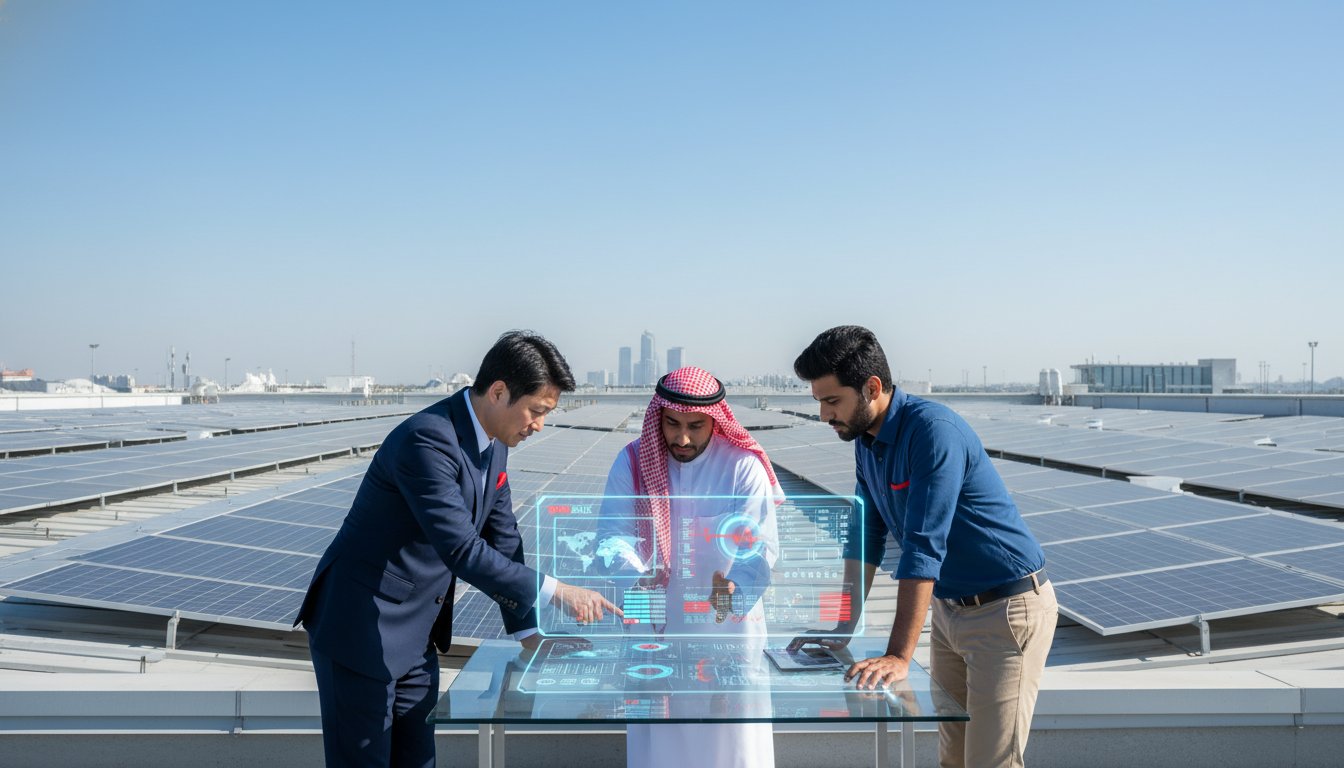
Could a single oversight in your solar epc contract negotiation pakistan turn a 25-year asset into a financial liability? With the implementation of the NEPRA (Prosumer) Regulations under S.R.O. 251(I)/2026, the transition from net metering to net billing has shifted the focus from energy export to strategic self-consumption. You likely recognize that securing a predictable ROI now requires more than just hardware; it demands a sophisticated legal and technical framework that accounts for a PKR 11 export rate and volatile procurement costs. Mastering these nuances is the only way to ensure your project maintains its structural integrity against regulatory shifts and currency fluctuations.
This article provides a strategic roadmap to help you secure a legally robust agreement that prioritizes long-term system resilience. You'll learn how to integrate high-efficiency HJT and TOPCon technologies into your specifications while ensuring strict compliance with the latest grid-code requirements. We'll examine the critical components of a 2026 checklist, including battery energy storage system (BESS) integration and hardware performance guarantees, to transform your solar installation into a future-proof energy powerhouse.
Key Takeaways
- Identify the technical advantages of N-Type technologies like HJT and TOPCon to insulate your industrial project against currency volatility and procurement risks.
- Execute a rigorous audit of your partner's engineering credentials to ensure full compliance with NEPRA grid-code and local zero-export protocols.
- Shift your focus from installed capacity to guaranteed energy yield by negotiating precise temperature coefficients tailored for the South Asian climate.
- Protect your long-term investment through strategic solar epc contract negotiation pakistan by defining clear risk allocation for regulatory approvals and local economic shifts.
The Landscape of Solar EPC in Pakistan: Why Negotiation Matters in 2026
The shift toward high-efficiency N-Type technologies is redefining the Pakistani industrial sector. As energy costs escalate, the adoption of Nippon HJT Solar Panels and Nippon TOPCon Solar Panels has become a strategic necessity for maintaining global competitiveness. The Landscape of Solar EPC in Pakistan is increasingly defined by a need for higher energy density, which means that solar epc contract negotiation pakistan is no longer just about the price per watt. It's about securing a technical architecture that optimizes yield and ensures long-term system resilience.
Identifying the difference between a simple hardware vendor and a strategic EPC partner is the first step toward project longevity. While a vendor focuses on the immediate sale of components, a strategic partner prioritizes the entire solar project lifecycle. This comprehensive approach ensures that the system is designed, procured, and maintained to meet specific industrial load profiles and regulatory standards.
Economic Volatility and Procurement Strategy
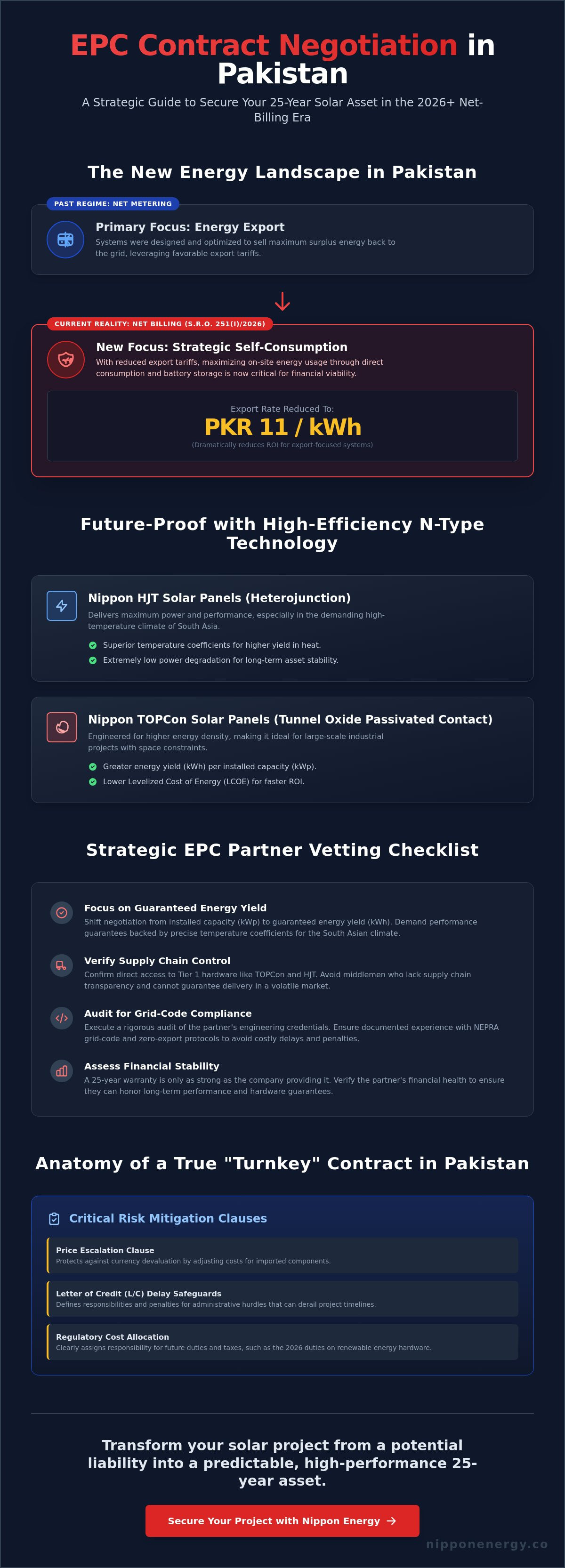
The current economic climate demands a sophisticated approach to procurement. Contracts must incorporate price escalation clauses for imported components to mitigate the risks of currency devaluation. Addressing the impact of Letter of Credit (L/C) opening delays is equally vital, as these administrative hurdles can derail project timelines without clear contractual safeguards. A robust solar epc contract negotiation pakistan also accounts for the 2026 duties on renewable energy hardware, ensuring that all regulatory costs are factored into the initial financial model before any capital is deployed.
The Definition of "Turnkey" in the Local Context
In the Pakistani market, a "turnkey" agreement must be comprehensive to be truly effective. It should cover every phase from geotechnical soil testing to final NEPRA net-billing integration under the 2026 regulations. High-level professionalism requires that turnkey solar projects are designed to integrate seamlessly with existing industrial power grids. This integration prevents technical friction and ensures that the system operates at peak efficiency from day one. Preliminary feasibility studies aren't just a formality; they're the technical foundation of a strong contract that guarantees specific energy output rather than just installed capacity.
A well-negotiated contract provides the stability needed for a 25-year return on investment. By focusing on detailed specifications and risk allocation, businesses can transform their energy transition into a predictable, high-performance asset.
The Strategic Checklist for Finding a Solar EPC Partner
Selecting the right partner requires a shift from superficial cost analysis to deep technical auditing. A Strategic Checklist for Finding a Solar EPC Partner serves as your primary defense against substandard implementation. During solar epc contract negotiation pakistan, you must demand proof of direct access to Tier 1 hardware like TOPCon and HJT. Middlemen often lack the supply chain transparency needed to guarantee delivery in a volatile market. It's essential to verify that your partner controls their inventory to avoid project delays caused by global shipping bottlenecks or local import restrictions. Transparency in component sourcing ensures that every module and bracket meets the rigorous standards required for industrial durability.
Beyond hardware access, evaluate their digital infrastructure for performance monitoring and O&M. Real-time data acquisition and AI-driven predictive maintenance are non-negotiable for 25-year assets. These tools allow for the early detection of string-level underperformance, which protects your cumulative yield over decades. A partner's financial stability dictates the validity of their long-term warranties; don't settle for promises that lack a strong balance sheet. Effective solar epc contract negotiation pakistan prioritizes these long-term safeguards over short-term savings. For those seeking a partner with established technical authority, exploring Nippon Energy's EPC solutions provides a baseline for excellence.
Technical Vetting of the EPC Team
In-house engineering is a hallmark of reliability. Inquire about certifications in high-voltage engineering and AI-driven energy management. Review past solar project development case studies in Karachi or Multan. These prove the team's ability to manage high temperatures and local grid instability. Ensure the partner provides in-house design rather than outsourcing. Outsourcing leads to communication gaps and design flaws that compromise the system's structural integrity and long-term yield.
Hardware Reliability and Supply Chain
Hardware must match regional environmental demands. Confirm the use of Nippon HJT Solar Panels for superior heat tolerance. Negotiate for Nippon Smart AI Inverters to ensure intelligent grid orchestration and zero-export compliance. These inverters optimize power flow while protecting industrial equipment from grid surges. Finally, verify the availability of local spare parts. Rapid response times are critical for maintaining uptime. Without a local supply chain, minor failures cause extended downtime and significant lost revenue.
Negotiating Technical Specifications: Hardware vs. Performance
A sophisticated approach to solar epc contract negotiation pakistan requires moving beyond simple nameplate capacity. Traditional agreements often focused on "kWp installed," but modern industrial standards demand a shift toward "Guaranteed Energy Yield" (kWh/kWp). This metric ensures the EPC partner is accountable for the entire system architecture, including cable losses, inverter efficiency, and thermal management. By specifying yield rather than capacity, you lock in the actual electricity production that drives your financial model and secures your 25-year ROI.
Thermal resilience is a critical negotiation point for projects across South Asia. You must negotiate the temperature coefficient within the contract to protect against efficiency drops during summer peaks. High-performance modules should ideally offer a coefficient of -0.26%/°C or better to maintain stability in extreme heat. Alongside this, the agreement should establish clear benchmarks for degradation, ensuring the system retains at least 88% of its original output after 25 years. These technical safeguards prevent the long-term yield erosion that frequently plagues substandard installations in the region.
The Performance Ratio (PR) serves as the definitive metric during the commissioning phase. Your contract must define exactly how PR is measured, typically requiring it to stay above 80% under standard operating conditions. This measurement must be verified using calibrated on-site sensors rather than relying solely on satellite data. Establishing these parameters during the initial solar epc contract negotiation pakistan creates a transparent, data-driven framework for system acceptance and final payment release.
HJT vs. TOPCon: Selecting the Right Technology
While topcon solar panels have become the industrial baseline for 2026, HJT technology offers a compelling premium for space-constrained sites. Negotiating the inclusion of HJT modules is justified when the higher bifaciality and lower degradation rates result in a lower Levelized Cost of Energy (LCOE). You should ensure the EPC agreement explicitly defines bifacial gain percentages, as these can vary significantly based on albedo and mounting height.
Inverter Intelligence and Grid Synchronization
Modern contracts must require smart ai solar inverter technology to facilitate remote fault detection and rapid shutdown. These intelligent systems allow for string-level monitoring, which reduces O&M costs and maximizes uptime. Integrating Nippon Lithium-ion Battery Storage Systems into the negotiation is equally vital for peak shaving and grid stability. This hardware combination ensures the system is compatible with future smart-grid updates and remains resilient against local frequency fluctuations.
Regulatory and Financial Safeguards in Pakistani Contracts
The regulatory environment in Pakistan presents unique challenges that can jeopardize project timelines if not addressed with technical precision. Effective solar epc contract negotiation pakistan must clearly allocate risk for delays in NEPRA licensing and DISCO approvals. If a project is stalled due to administrative friction, the contract should specify whether the EPC provider or the client absorbs the resulting standby costs. This clarity prevents legal disputes and ensures that both parties remain focused on the final grid-connection milestone under the 2026 net-billing framework.
Force Majeure clauses require precise tailoring to the local context. Beyond standard natural disasters, these clauses should address specific political or economic events that could impact procurement or site access. Similarly, Liquidated Damages (LDs) must be structured to provide genuine protection. These financial penalties should be triggered by both missed commissioning dates and performance shortfalls relative to the guaranteed energy yield established in previous technical sections. This creates a direct link between project execution and financial accountability.
Payment terms should mirror the physical progress of the project to maintain cash flow stability. A typical structure might include an initial mobilization fee, followed by payments tied to the arrival of major components like Nippon HJT Solar Panels and the completion of civil works. Final payment should only be released after successful power quality testing and the issuance of the net-billing certificate. This milestone-based approach ensures that capital is only deployed as value is added to the site.
Compliance with NEPRA and Grid Codes
Industrial projects must adhere to strict grid-code requirements to prevent local network instability. Your solar epc services agreement should mandate that the provider handles the entire net-billing application process from start to finish. This includes negotiating responsibility for grid-side infrastructure upgrades if the local DISCO determines the existing transformer is insufficient for the new solar load. Comprehensive power quality testing ensures the system doesn't introduce harmonics that could damage sensitive industrial machinery.
Warranty and Maintenance Terms
Differentiating between hardware and workmanship is critical for long-term asset security. While Nippon HJT panels carry their own performance guarantees, the EPC workmanship warranty covers the integrity of the installation itself. You should negotiate a comprehensive solar system maintenance contract for at least the first five years. This O&M agreement must define specific response times for critical failures, ensuring that downtime is minimized and your project ROI remains on track. To secure your industrial energy future with a partner who understands these regulatory complexities, consult with Nippon Energy’s project development team.
Nippon Energy: Your Strategic Partner for EPC Excellence
Nippon Energy represents the pinnacle of technical authority, offering a calculated blend of Japanese engineering precision and deep operational experience in Lahore and Karachi. A successful solar epc contract negotiation pakistan concludes with the selection of a partner capable of delivering global manufacturing standards within the local regulatory framework. We provide industrial clients with direct access to high-efficiency Nippon HJT and TOPCon solar technology, eliminating the supply chain uncertainties that often compromise project timelines. Our presence in Pakistan ensures that international quality standards are applied to every civil, electrical, and structural component of your energy asset.
Achieving true energy autonomy requires more than just panel installation; it demands the seamless integration of the nipponhev system. This integrated solar architecture is designed to provide industrial independence by orchestrating generation, storage, and consumption through a single, intelligent platform. By leveraging our proven track record in navigating the Pakistani regulatory landscape, we ensure that your project moves from the negotiation phase to grid-connection with minimal friction and maximum technical compliance.
The Nippon Advantage in Engineering
Our engineering mindset is reflected in the proprietary AI-driven design tools we use to optimize systems for specific Pakistani solar irradiation patterns. These tools allow us to predict energy yield with high accuracy, ensuring that the performance guarantees negotiated in your contract are grounded in data. We maintain rigorous quality control protocols that exceed standard Tier 1 requirements, focusing on the structural integrity and long-term asset architecture of every site. This commitment to excellence transforms a standard solar installation into a monumental energy asset that delivers predictable returns for over 25 years.
Taking the Next Step
Securing your industrial energy future begins with a granular understanding of your site's potential. You can initiate a comprehensive feasibility study with our Lahore or Karachi teams to evaluate the specific technical requirements of your facility. We offer detailed technical consultations to determine whether HJT or TOPCon deployment best suits your load profile and ROI objectives. Contact Nippon Energy today to receive a transparent, performance-backed proposal that simplifies the solar epc contract negotiation pakistan and sets the foundation for a resilient, high-performance energy transition.
Securing Your Industrial Energy Architecture
Mastering the complexities of the 2026 energy landscape requires a transition from reactive procurement to proactive asset architecture. By prioritizing guaranteed energy yield and integrating high-efficiency N-Type technology, you insulate your operations against the volatility of the Pakistani market. A successful solar epc contract negotiation pakistan isn't merely a legal checkbox; it's the technical blueprint for a 25-year high-performance asset that delivers measurable ROI. Clear risk allocation and rigorous hardware vetting are the pillars of this strategy.
Nippon Energy brings a global perspective to local challenges, leveraging a presence in Tokyo, Dubai, and Riyadh to deliver world-class engineering to the Pakistani industrial sector. Our specialization in high-efficiency HJT and TOPCon panels ensures that your system operates at the leading edge of modern technology. With dedicated local support teams in Lahore and Karachi, we provide the stability and precision needed to transform your energy vision into a monumental reality.
Consult with Nippon Energy Experts for Your EPC Project and take the first step toward securing a resilient, future-proof energy infrastructure. Your journey toward sustainable industrial power begins with a partner who values precision as much as you do.
Frequently Asked Questions
What are the key clauses to include in a Pakistani solar EPC contract?
Key clauses include energy yield guarantees, liquidated damages for commissioning delays, and specific force majeure terms for local economic events. These clauses ensure that solar epc contract negotiation pakistan results in a legally binding commitment to performance rather than just installation. Including a price escalation clause is also vital to manage procurement risks during the transition from initial design to the arrival of high-performance hardware.
How does NEPRA regulation affect the negotiation of an EPC agreement?
NEPRA S.R.O. 251(I)/2026 mandates a shift from net metering to net billing, which fundamentally changes the financial logic of your agreement. Negotiations must now prioritize system sizing for maximum self-consumption rather than grid export. Your contract should explicitly define the EPC partner's responsibility for managing the entire net-billing application process, including technical compliance with the 2026 grid codes and specific DISCO requirements.
Why is the temperature coefficient critical for solar projects in Pakistan?
The temperature coefficient determines how much power your panels lose as ambient temperatures rise above 25°C. In regions like Multan or Sukkur, where summer peaks exceed 45°C, a high coefficient leads to significant yield loss. Negotiating for N-Type technology like Nippon HJT panels, which offer coefficients as low as -0.26%/°C, ensures your system maintains high performance during the most demanding thermal periods of the year.
Can I negotiate for specific hardware brands in a turnkey EPC contract?
You can and should specify Tier 1 hardware like Nippon TOPCon panels or Nippon Smart AI Inverters to prevent the use of generic components. Turnkey agreements often leave hardware selection to the EPC partner's discretion unless you explicitly define brand and model requirements in the technical annex. This specificity ensures that the long-term asset architecture matches the high-efficiency standards required for a 25-year industrial lifecycle.
What is the standard payment structure for a solar EPC project in 2026?
The standard 2026 structure is milestone-based, typically starting with a 10% to 20% mobilization fee. Substantial payments are then triggered by the arrival of major components at the site and the completion of civil works. Final retention, usually 5% to 10%, is released only after successful commissioning and the issuance of the official NEPRA net-billing certificate, ensuring the EPC partner remains committed until the system is fully operational.
How do I protect my solar investment against currency devaluation in Pakistan?
Protecting your investment requires linking procurement costs to a stable currency or utilizing a partner with localized inventory. During solar epc contract negotiation pakistan, you might include a clause that adjusts the final price based on the PKR/USD parity at the time of component importation. Alternatively, selecting a partner who maintains a localized supply chain can lock in prices and mitigate the impact of sudden currency fluctuations during the construction phase.
What is the difference between an EPC contract and an O&M agreement?
An EPC contract focuses on the engineering, procurement, and construction phases until the point of commissioning. In contrast, an O&M agreement governs the long-term maintenance, performance monitoring, and cleaning of the system over its operational life. While the EPC contract builds the asset, a robust O&M agreement ensures the system achieves its guaranteed energy yield through predictive AI diagnostics and rapid response times for any technical failures.
How long does the EPC negotiation process typically take for an industrial project?
The negotiation period for an industrial project typically spans 4 to 8 weeks from the initial feasibility study to contract signing. This timeline accounts for geotechnical analysis, structural design reviews, and the alignment of financial terms with the 2026 regulatory framework. Complex projects requiring significant grid-side upgrades or battery storage integration may extend this period to ensure all technical and legal safeguards are comprehensively addressed before work begins.


