

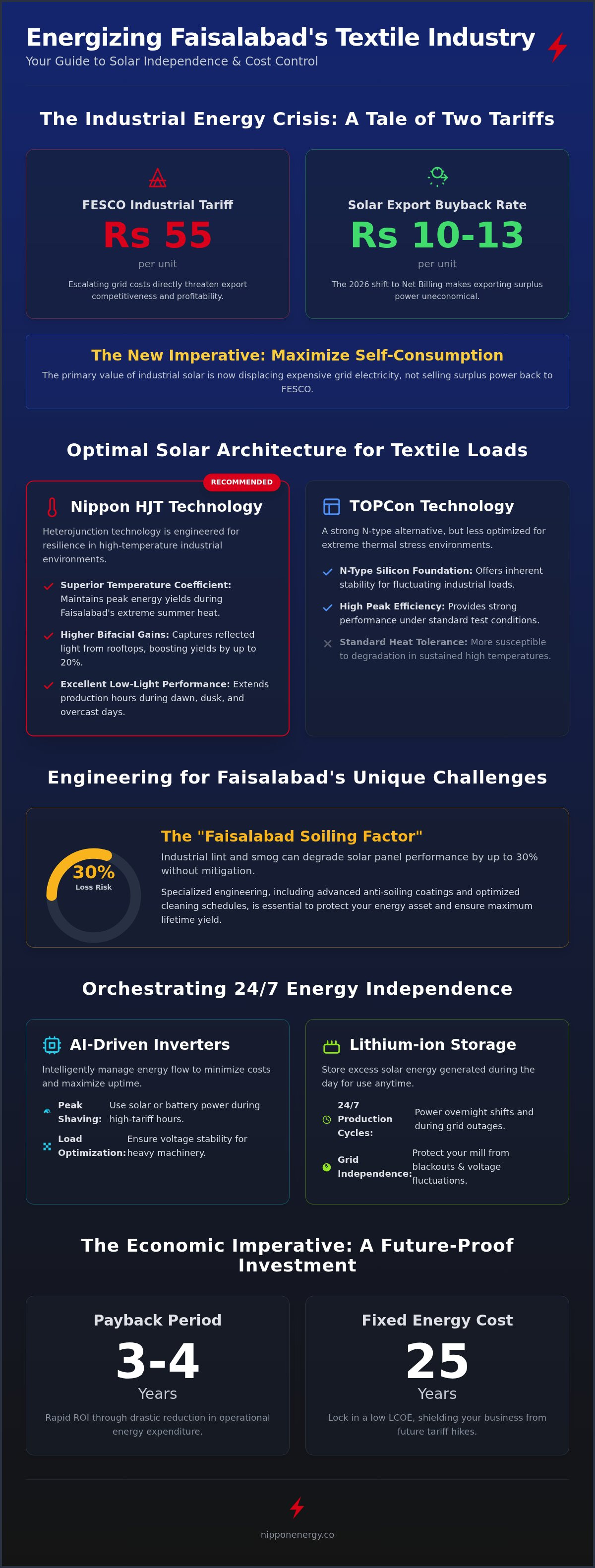
With FESCO industrial tariffs now reaching as high as Rs 55 per unit, the energy overhead for a textile mill in Faisalabad is no longer a manageable expense; it's a structural threat to global export competitiveness. The 2026 transition from net metering to net billing has fundamentally shifted the economic priority from exporting power to maximizing internal consumption. Securing a specialized solar epc for textile mills faisalabad is now the essential first step in re-engineering your facility to withstand these escalating grid costs and regulatory shifts.
You recognize that energy instability and rising tariffs are obstacles to long-term growth. This article provides the technical framework to master the transition to high-efficiency Nippon HJT solar and AI-driven energy storage. By utilizing Nippon HJT modules with superior temperature coefficients, mills can maintain peak energy yields during Faisalabad's extreme summer heat, resulting in a lower levelized cost of energy. You'll gain the engineering insights required to achieve 24/7 energy independence, ensuring a significant reduction in the cost-per-meter of fabric through a future-proof energy infrastructure.
Key Takeaways
- Understand the economic shift from net metering to net billing and how prioritizing self-consumption protects textile export margins against FESCO tariff escalations.
- Evaluate the performance of HJT versus TOPCon architectures, specifically focusing on how HJT’s superior temperature coefficient sustains energy yields during Faisalabad’s extreme thermal peaks.
- Identify specialized engineering strategies to mitigate the "Faisalabad Soiling Factor," where industrial lint and smog can degrade system performance by up to 30% without advanced coatings.
- Learn how to integrate AI-driven inverters and Nippon Lithium-ion Battery Storage to execute peak shaving and maintain 24/7 production cycles independent of grid instability.
- Discover the essential phases of a professional solar epc for textile mills faisalabad, moving from precision load analysis to the deployment of future-proof energy infrastructure.
The Industrial Energy Crisis: Why Faisalabad Textile Mills are Transitioning to Solar
Faisalabad’s industrial landscape is undergoing a forced evolution. As of August 2026, FESCO industrial tariffs for B-2 category consumers have surged to approximately Rs 50-55 per unit after factoring in all surcharges. This escalation directly erodes the global competitiveness of Pakistan's textile industry, where energy costs often represent the difference between a secured export contract and a lost opportunity. The systemic shortage of gas for captive power plants has accelerated this shift; mills can no longer rely on fossil fuel subsidies to maintain 24/7 operations. Consequently, engaging a specialized solar epc for textile mills faisalabad has transitioned from a sustainability goal to a survival requirement for clusters along Sargodha Road and the M-3 Industrial City.
FESCO Net Metering and the 2026 Regulatory Landscape
Adapting to the NEPRA (Prosumer) Regulations of 2026 requires a precise understanding of the new "net billing" framework. Unlike previous years, the value of industrial solar now lies in displacing expensive grid electricity rather than selling surplus power. The current buyback rate for exported energy is approximately Rs 10 to Rs 13 per unit, making self-consumption the primary driver of ROI. Navigating the FESCO approval process typically involves a 6-10 week timeline, requiring adherence to specific technical protocols:
- Load Study Requirements: A mandatory requirement for commercial net billing connections exceeding 100kW to ensure grid stability.
- Licensing Fees: Compliance with the Rs 1,000 per kW fee for new solar installations introduced in April 2026.
- Export Optimization: Structuring the system to prioritize daytime factory loads while utilizing the National Average Energy Purchase Price for surplus.
Our solar EPC services streamline these regulatory hurdles, ensuring that technical compliance aligns with your operational goals.
The Economic Imperative: Solar as a Structural Asset
Investing in energy infrastructure is now a capital expenditure that pays for itself through operational savings. High-efficiency systems utilizing Nippon HJT modules offer a predictable 3-4 year payback period, even when accounting for the August 2026 Fuel Cost Adjustment (FCA) increases. These assets provide a fixed levelized cost of energy (LCOE) for 25 years, shielding mills from the volatility of the national average tariff. By integrating lithium ion battery storage, mills can optimize their load profiles and mitigate the impact of peak-hour surcharges. This architectural approach transforms a textile mill from a passive utility consumer into an active energy prosumer, securing the margins necessary for long-term industrial growth.
HJT vs. TOPCon: Selecting the Optimal Architecture for Textile Loads
Selecting a cell architecture for a textile mill isn't just about peak efficiency; it's about resilience under high-load industrial cycles. As of 2026, the choice between TOPCon solar panels and Heterojunction (HJT) technology defines the long-term yield of your energy asset. Textile operations involve heavy machinery and frequent motor spikes that require superior voltage stability. N-type silicon, the foundation for both HJT and TOPCon, offers an inherent advantage here, maintaining performance during the rapid load fluctuations common in spinning and weaving units. Securing a high-performance solar epc for textile mills faisalabad ensures that the chosen hardware matches the specific thermal and electrical stress of your facility.
Integrating these technologies into a professional solar epc for textile mills faisalabad allows for the optimization of bifacial gains. Many industrial rooftops in Faisalabad provide high reflectivity, which can be leveraged to achieve up to 20% higher yields through back-side generation. This architectural precision is essential for addressing Energy Efficiency in the Textile Sector, where every kilowatt-hour saved directly impacts the bottom line. Our engineering approach prioritizes these marginal gains to maximize your total return on investment.
Nippon HJT Solar Panels: The High-Temperature Leader
In Faisalabad’s extreme climate, where summer peaks frequently exceed 45°C, HJT technology is the technical gold standard. Nippon HJT modules feature a temperature coefficient of -0.24%/°C to -0.26%/°C, significantly outperforming traditional panels. This means as temperatures rise, the power drop is minimal. Additionally, HJT offers the lowest annual degradation rates in the industry, approximately 0.25%, ensuring the system maintains 90% output after 25 years. For mills with limited rooftop area but high energy density requirements, HJT provides the highest power output per square meter.
Nippon TOPCon: The Versatile Industrial Standard
Nippon TOPCon modules balance high efficiency with a lower initial CAPEX, making them ideal for massive processing unit deployments. With commercial efficiencies ranging from 21.5% to 23.5%, TOPCon performs exceptionally well in the low-light conditions caused by Punjab’s seasonal smog and winter fog. These modules are fully compatible with the NipponHev system, which provides a unified energy management platform for real-time monitoring. If you're evaluating which architecture fits your specific load profile, you can consult with our engineering team for a detailed feasibility study.
Engineering for Faisalabad: Overcoming Soiling, Smog, and Heat
Faisalabad presents an engineering environment unique to the global textile industry. The "Faisalabad Soiling Factor" is a specific challenge where airborne textile lint combines with industrial particulate matter to form a resilient layer on panel surfaces. If left unmanaged, this accumulation reduces energy yields by up to 30%. A specialized solar epc for textile mills faisalabad must address this through the deployment of modules featuring advanced anti-reflective and anti-soiling coatings. These hydrophobic layers reduce the surface tension of the glass, preventing lint from bonding and ensuring that seasonal rains effectively clear the panels. This technical precision aligns with Pakistan's renewable energy policy, which encourages high-efficiency industrial adoption to stabilize the national grid.
Structural integrity is equally critical, as most textile facilities utilize Pre-Engineered Building (PEB) sheds. Our engineering teams perform rigorous wind load simulations and weight distribution analysis to ensure that the solar array doesn't compromise the shed's structural limits. We also mitigate the impact of winter smog through the use of high-efficiency N-type cells, which capture a broader spectrum of light during the low-irradiance months common in Punjab. This architectural approach ensures that the system remains a productive asset throughout the year.
Performance Architecture in Extreme Punjab Heat
Faisalabad’s extreme summer temperatures cause significant voltage fluctuations that can lead to equipment derating. Our Smart AI solar inverter technology uses dynamic Maximum Power Point Tracking (MPPT) to compensate for these thermal shifts in real time. We conduct comprehensive thermal mapping of industrial rooftops to identify heat-trapping zones. This data allows us to optimize panel spacing and airflow, while passive cooling strategies for inverter rooms prevent hardware overheating. These measures ensure that the system maintains peak performance even when ambient temperatures exceed 45°C.
Industrial O&M: Protecting the 25-Year Investment
A megawatt-scale solar plant requires a disciplined approach to operational longevity. Professional solar system maintenance is a technical necessity in high-dust textile zones like Sargodha Road and the M-3 Industrial City. We implement automated cleaning schedules that are synchronized with the factory’s lint discharge cycles to maintain optical clarity. Furthermore, our remote monitoring platforms utilize predictive fault detection to identify underperforming strings. This allows for rapid intervention before minor issues impact the mill’s overall production capacity or energy savings.
Energy Orchestration: AI Inverters and Lithium-Ion Storage
Generating solar power is merely the first phase of industrial energy independence. True efficiency in the 2026 market requires advanced orchestration. A comprehensive solar epc for textile mills faisalabad must integrate intelligent hardware that does more than convert DC to AC; it must manage the mill's entire load profile. By utilizing AI-driven orchestration, mill owners can execute peak shaving. This involves discharging stored energy during FESCO's highest tariff hours to avoid expensive surcharges. This strategic movement of energy reduces the reliance on expensive diesel generators and ensures that the cost-per-meter of fabric remains stable despite grid volatility. For facilities requiring complex power management, Tesla Electrical Company provides the generator synchronizing control panels necessary for seamless transition between power sources.
The transition to smart architecture allows for a shift from reactive to proactive energy management. Real-time data is no longer a luxury; it's an operational necessity. Mill owners can now track every aspect of their energy architecture performance via smartphone. This transparency ensures that technical teams can identify inefficiencies or potential faults before they impact the production line. Precision in energy management is what separates a modern textile giant from its competitors.
The Nippon Smart AI Inverter acts as the central nervous system for the factory's energy architecture. These units provide dynamic load management, automatically prioritizing critical machinery like spinning frames and electronic looms during low-sun hours or grid fluctuations. A technical priority for textile mills is harmonic distortion control. Sensitive electronic components in modern weaving machines are prone to failure if power quality is inconsistent. Our AI-driven inverters maintain high power quality and provide seamless grid synchronization, ensuring that production never halts during load shedding events.
Industrial Lithium-Ion Storage Solutions
The 2026 industrial landscape has seen a definitive shift toward lithium ion battery storage as the standard for 24/7 production. Unlike legacy lead-acid systems, Nippon Lithium-ion solutions offer a significantly higher cycle life and depth of discharge, which translates to a superior long-term ROI. We engineer storage architectures ranging from 100kWh to megawatt-scale configurations, tailored to the specific shift patterns of the mill. Safety remains paramount in Faisalabad’s high-temperature environments. Our storage systems include integrated thermal management and fire suppression protocols designed for industrial-scale deployment. If you're ready to stabilize your production cycles, you can request a storage capacity analysis from our technical team.
Implementing Your Solar Asset: The Nippon Energy EPC Journey
Transitioning a mill to solar requires more than just panel installation; it demands a "High-Tech Architect" approach to solar EPC services. At Nippon Energy, we treat every project as a critical piece of industrial energy architecture rather than a simple hardware purchase. This methodology ensures that the procurement of Nippon HJT and TOPCon hardware results in maximum system longevity and operational stability. By following a structured implementation lifecycle, we transform your facility into a high-performance power-generating asset that thrives in the competitive global market. Securing a professional solar epc for textile mills faisalabad is the final step in future-proofing your manufacturing capability.
Step 1: Precision Energy Audit and Feasibility
The foundation of a successful solar epc for textile mills faisalabad is a granular energy audit. Our engineers analyze 12 months of FESCO billing data to identify mill-specific load patterns and peak demand periods. We conduct comprehensive shadow analysis and structural integrity checks of factory sheds, ensuring the roof can withstand the 25-year static load of the array. This phase concludes with a detailed ROI projection and technical design specifically tailored for industrial approval under the 2026 NEPRA regulations. This precision prevents costly engineering revisions during the construction phase.
Step 2: Turnkey Engineering and Construction
We manage the entire lifecycle from engineering to commissioning. This includes navigating the FESCO net billing application process from start to finish, removing the administrative burden from the mill owner. Professional installation is executed by Nippon Energy certified industrial engineers, ensuring every electrical connection meets international safety standards. The process culminates in final testing, grid synchronization, and performance verification. We verify that every string of HJT or TOPCon modules operates at peak efficiency before the final handover.
Final Result: Total Energy Independence
Energy independence in 2026 means operating a textile mill with a fixed, predictable cost of power that is entirely decoupled from grid tariff escalations and fossil fuel shortages. This transition creates a zero-carbon, low-cost textile production model that satisfies global ESG requirements while protecting your bottom line. To begin your industrial energy re-engineering, Consult with Nippon Energy Architects for your Faisalabad Mill.
Architecting Energy Resilience for Faisalabad’s Textile Giants
The transition to high-efficiency solar is no longer a choice; it's a structural necessity for maintaining global textile export margins. By integrating proprietary HJT technology and AI-driven energy orchestration, mills can effectively decouple their production costs from the volatility of FESCO industrial tariffs. This strategic re-engineering ensures that industrial lint and extreme Punjab heat don't compromise your 25-year investment. You've seen how precision engineering and advanced storage can transform a mill from a passive consumer into a self-reliant power prosumer.
As a Red Dot Design Award winner with proven megawatt-scale industrial EPC experience in Pakistan, Nippon Energy provides the technical prowess required to future-proof your infrastructure. Selecting a specialized solar epc for textile mills faisalabad allows you to reclaim operational control and achieve true energy independence. It's time to transform your facility into a zero-carbon, high-performance power asset that leads the market in efficiency and reliability. Request a Technical Feasibility Study for Your Faisalabad Mill to begin your transition toward sustainable industrial growth.
Frequently Asked Questions
How much can a 500kW solar system save a textile mill in Faisalabad monthly?
A 500kW solar system can save a textile mill approximately 9,000 to 11,000 US Dollars monthly based on current grid tariffs. These savings are achieved by displacing expensive grid energy during peak production hours. Because the 2026 net billing regulations prioritize self-consumption, the financial return is maximized when the mill's daytime load matches the generation curve. This re-engineering of energy costs directly protects the mill's export margins.
Does FESCO allow net metering for systems above 1MW in 2026?
FESCO currently restricts standard net billing connections to a maximum capacity of 1MW under the 2026 NEPRA Regulations. For textile giants requiring larger capacities, a hybrid approach is utilized. This involves a 1MW net-billed connection for grid export credits combined with additional behind-the-meter solar capacity dedicated to direct consumption. This architecture ensures that larger industrial loads are satisfied without violating regulatory export limits or incurring unnecessary grid fees.
Is HJT technology worth the higher initial cost compared to TOPCon for industrial use?
HJT technology is a superior long-term investment for high-temperature industrial environments due to its industry-leading temperature coefficient of -0.24%/°C. While HJT carries a price premium over TOPCon, it generates significantly more power during Faisalabad’s summer peaks when ambient temperatures exceed 45°C. For mills with limited rooftop space, the higher efficiency and lower degradation rates of HJT provide a lower levelized cost of energy over the 25-year lifecycle.
How does industrial dust in Faisalabad affect solar panel efficiency?
Industrial dust and textile lint in Faisalabad can reduce system efficiency by up to 30% if the panels aren't properly maintained. This soiling factor creates a layer that blocks irradiance and can cause localized hotspots. Our solar epc for textile mills faisalabad addresses this through the use of hydrophobic anti-soiling coatings. These coatings prevent lint from adhering to the glass, ensuring that standard cleaning cycles remain effective and yield losses are minimized.
Can solar power run heavy textile machinery like spinning frames directly?
Solar power can run heavy machinery like spinning frames and looms when integrated with high-performance Smart AI inverters. This integration is a core component of a professional solar epc for textile mills faisalabad. To maintain 24/7 reliability, we combine solar generation with lithium-ion storage to bridge gaps during cloud cover. This integrated architecture ensures that sensitive electronic components in modern textile machinery receive stable, high-quality power.
What is the lifespan of Nippon Lithium-ion batteries in high-temperature Punjab climates?
Nippon Lithium-ion battery systems are engineered to provide a service life of 10 to 15 years in high-temperature Punjab climates. Unlike legacy lead-acid alternatives, these systems maintain high depth of discharge and efficiency even when subjected to frequent cycling. We incorporate active thermal management and fire suppression protocols to protect the cells from extreme industrial heat. This durability makes them the standard for 24/7 energy orchestration in the modern textile sector.
Does Nippon Energy provide financing options for textile sector solar projects?
Nippon Energy does not directly provide financing, but we facilitate the technical documentation required for the State Bank of Pakistan Renewable Energy Refinancing Scheme. This government-backed initiative offers specialized interest rates for industrial solar projects. Our engineering team assists mill owners by providing the precision load analysis and feasibility studies necessary for bank approval. This support streamlines the transition to solar by aligning technical excellence with available national financial frameworks.
What happens to solar generation during Faisalabad’s winter smog season?
Generation during Faisalabad’s winter smog season can drop significantly due to reduced irradiance levels. To compensate for this, we utilize high-efficiency N-type cells that exhibit better performance in low-light and diffuse light conditions. Our AI-driven energy management systems also adjust load priorities during these periods to maximize the use of available solar power. This proactive approach ensures that the mill remains productive even during Punjab’s most challenging environmental months.


