

Can a hospital truly fulfill its mission when the life-support systems in the ICU are at the mercy of an unstable national grid? In Karachi and Lahore, healthcare administrators face a dual crisis; life-threatening power outages and industrial (B2) electricity tariffs that continue to climb under the 2026 regulations. Relying on aging diesel generators is no longer a viable strategy for modern medical facilities. Implementing robust solar power for hospitals in pakistan has shifted from a sustainability goal to a mission-critical requirement for operational survival. You recognize that even a millisecond of voltage fluctuation can compromise sensitive medical imaging equipment or interrupt a surgical procedure.
This guide provides a technical roadmap to architecting a resilient energy infrastructure that guarantees a 24/7 uninterruptible power supply. We'll demonstrate how integrating high-efficiency HJT solar panels with AI-driven lithium-ion storage can reduce your operational energy costs by over 75% while securing a 25-year performance warranty in high-heat urban environments. You'll learn to navigate the 2026 net-billing framework and leverage intelligent inverters to prioritize critical medical loads. From mitigating the impact of rising tariffs to ensuring technical sovereignty, we'll explore the engineering precision required to future-proof your facility's power.
Key Takeaways
- Understand how the 2026 transition to net-billing affects healthcare margins and why technical energy sovereignty is the primary defense against volatile B2 industrial tariffs.
- Learn why HJT and TOPCon modules are critical for clinical facilities in Karachi and Lahore to maintain peak energy output during extreme 45°C heatwaves.
- Discover how to achieve 24/7 autonomy for surgical theaters by integrating lithium-ion storage with AI inverters that intelligently prioritize life-support equipment.
- Master the 5-stage EPC framework designed for hospital boards to ensure structural integrity and the successful deployment of solar power for hospitals in pakistan.
- Explore the NipponHev system as a unified turnkey architecture that synchronizes thermal resilience and intelligent energy orchestration into a single high-performance asset.
The 2026 Energy Landscape for Pakistan’s Healthcare Sector
The operational resilience of healthcare facilities in Pakistan is currently undergoing a fundamental transformation. Hospitals are moving beyond supplemental energy toward 100% technical energy sovereignty to protect clinical continuity. As the total capacity of Solar power in Pakistan reaches new milestones, the adoption of industrial-grade solar infrastructure has become the standard for modernizing medical centers in Karachi and Lahore. This shift isn't merely an environmental choice; it's a strategic necessity to isolate life-saving equipment from an increasingly volatile national grid.
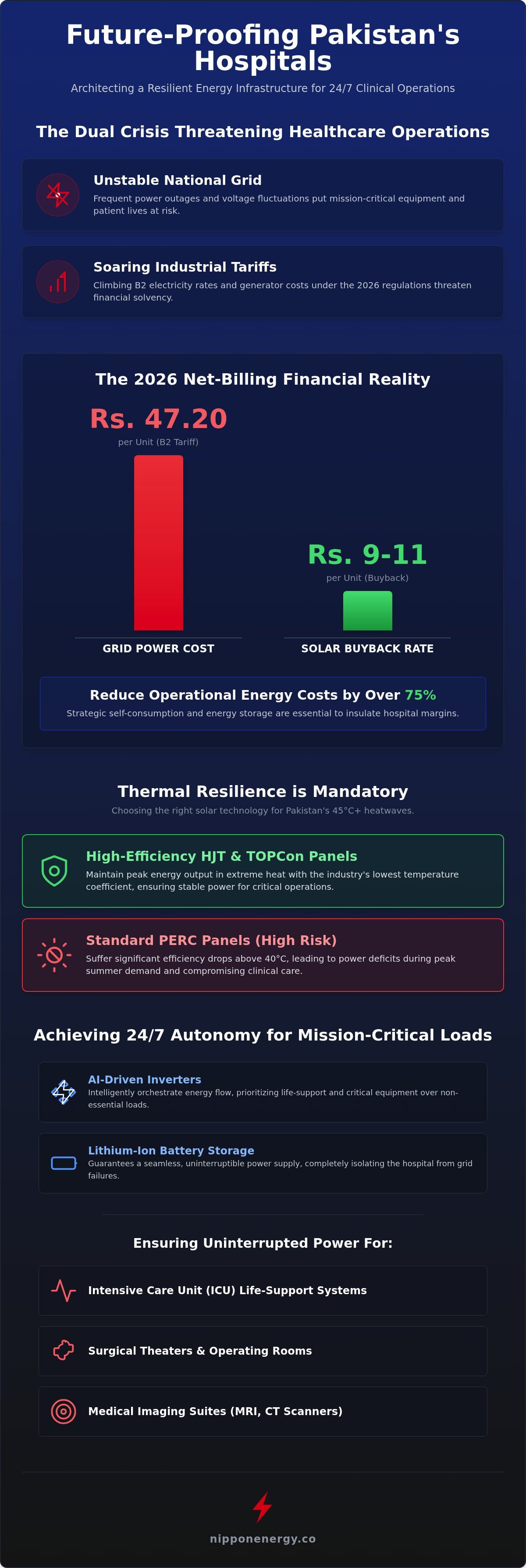
Under the NEPRA (Prosumer) Regulations 2026, the transition from net-metering to a net-billing framework has altered the financial logic of energy investments. Large-scale clinical facilities now face a widening gap between the national average buyback rate, estimated between Rs. 9 and Rs. 11 per unit, and consumer tariffs that can reach Rs. 47.20 per unit. This disparity makes high-capacity self-consumption and advanced storage essential. Implementing solar power for hospitals in pakistan is no longer just about reducing bills; it's about insulating private healthcare margins from the volatility of B2 and B3 industrial tariff slabs that threaten long-term solvency.
The Economic Cost of Grid Dependence in Hospitals
Relying on the national grid introduces hidden fiscal drains that compromise a hospital's bottom line. Diesel generator sets, once the primary fail-safe, now impose a prohibitive fuel-to-power ratio as global commodity prices fluctuate and local maintenance costs rise. Beyond fuel expenses, the instability of the urban grid produces frequent voltage transients that are catastrophic for sensitive medical imaging suites. MRI and CT scanners require ultra-stable power profiles; even minor fluctuations can result in hardware recalibration delays or permanent board failures. The 2026 healthcare energy mandate for urban hospitals dictates a transition from reactive backup to proactive, decentralized generation that isolates clinical operations from external grid volatility.
Regulatory Briefing: NEPRA and the Healthcare Sector
Achieving compliance within the 2026 regulatory environment requires a strategic approach to system design. To maximize utility credits under the net-billing framework, hospitals must deploy intelligent systems that synchronize generation with peak clinical demand. Regulatory standards for hospital-grade installations now demand higher safety certifications and rigorous structural load verifications to ensure the integrity of rooftop arrays. Additionally, there is a growing emphasis on green building certifications within the Pakistani medical sector. Facilities that meet these international energy standards often gain access to preferred financing and enhanced public reputation, positioning them as leaders in sustainable healthcare delivery. Proper alignment with these NEPRA regulations ensures that a hospital's energy infrastructure remains a performing asset rather than a regulatory liability.
Thermal Resilience: Why HJT and TOPCon Panels are Mandatory for Clinical Facilities
The physics of urban heat islands in Karachi and Lahore presents a unique engineering challenge for clinical power systems. Standard PERC (Passivated Emitter and Rear Cell) modules experience significant efficiency drops as ambient temperatures exceed 40°C. For critical healthcare infrastructure, Nippon HJT Solar Panels represent the gold standard in thermal resilience. These modules utilize a heterojunction structure that combines crystalline silicon with amorphous silicon thin films. This configuration results in the industry's lowest temperature coefficient, which ensures energy generation remains stable when traditional panels fail. Developing high-performance solar power for hospitals in pakistan requires hardware that maintains output during peak summer demand.
Bifacial technology further enhances this energy architecture. Hospital rooftops, often constructed with reflective concrete or light-colored membranes, are ideal for bifacial modules that capture sunlight from both sides. This can generate a 10% to 20% additional yield without increasing the system's physical footprint. As Pakistan's renewable energy policy pushes toward greater self-sufficiency, maximizing every square meter of clinical roof space is a financial imperative. It's a strategic move to ensure your facility doesn't lose power when the mercury rises.
Nippon HJT Technology: The Thermal Stability Standard
The N-type silicon used in HJT cells is inherently immune to Light Induced Degradation (LID) and Potential Induced Degradation (PID). This technical advantage ensures that your medical facility’s investment retains over 90% of its nameplate efficiency after 25 years of intense sun exposure. In high-humidity coastal environments like Karachi, HJT’s superior encapsulation prevents moisture ingress, which often causes premature failure in lesser modules. This long-term durability is essential for hospitals that can't afford the downtime associated with equipment replacement. High-heat resilience isn't a luxury; it's the foundation of clinical uptime.
TOPCon Modules for Large-Scale Hospital Complexes
For sprawling medical campuses with vast rooftop areas, Nippon TOPCon Solar Panels provide an excellent balance of high efficiency and cost-effectiveness. These modules achieve efficiency benchmarks exceeding 22.5%, making them ideal for high-density energy requirements where space is at a premium. Their mechanical load resilience is specifically engineered to withstand the high wind speeds often encountered on multi-story hospital structures in urban zones. Selecting the right module depends on your specific architectural constraints and energy density needs. You can determine the optimal configuration for your site by reviewing the latest efficiency benchmarks for 2026. This ensures your facility remains operational during the most demanding climatic events.
Mission-Critical Power: AI Inverters and Lithium-Ion Storage for 24/7 Autonomy
The transition from panels to the power room marks the shift from energy generation to energy orchestration. For surgical theaters and intensive care units, a standard backup system is insufficient. True clinical autonomy requires Lithium-Ion Battery Storage systems that provide instantaneous response times. These systems don't just bridge the gap during a blackout; they stabilize the entire microgrid. By integrating Smart AI Solar Inverters, hospitals can implement sophisticated load prioritization. These intelligent units distinguish between non-essential lighting and life-support machinery, ensuring that every available watt is directed toward patient safety when the grid fails.
Engineering a reliable system for solar power for hospitals in pakistan also involves solving the "inrush current" challenge. Heavy medical compressors and HVAC systems for sterile environments require massive surges of power to start. Standard inverters often trip under these loads, but Nippon Smart AI Inverters are designed to handle high-surge requirements without grid support. Additionally, these systems enable "peak shaving" in cities like Lahore and Karachi. By discharging stored energy during the most expensive tariff hours, hospitals can bypass peak-hour rates, significantly improving their operational bottom line.
Nippon Lithium-Ion Battery Storage Systems
Traditional lead-acid batteries are no longer viable for high-stakes medical environments due to their limited cycle life and high maintenance needs. Nippon Lithium-ion systems offer a superior Depth of Discharge (DoD), allowing hospitals to utilize more of their stored capacity without damaging the cells. These units feature advanced thermal management protocols, which are vital for maintaining battery health in unconditioned Pakistani industrial zones where temperatures fluctuate wildly. While the initial investment is higher, the ROI comparison shows that Lithium-ion is significantly more cost-effective than diesel generators or lead-acid alternatives over a 10-year horizon. It's a permanent solution for a permanent problem.
Intelligent Energy Orchestration
While large-scale systems handle the facility's heavy loads, the reliability of handheld medical devices is equally critical; to ensure your portable tools are also future-proofed, visit Horizon Battery for specialized advice on high-capacity rechargeable solutions.
The deployment of industrial energy assets requires a structured methodology to ensure clinical safety. For medical boards, the Solar EPC Services framework provides a 5-stage lifecycle designed for high-stakes environments. This process begins with a comprehensive structural audit to verify that hospital rooftops can support the significant static loads of industrial solar arrays and localized battery banks. We don't just install panels; we engineer resilience by following these critical phases:
- Technical Feasibility: Assessing structural integrity and roof load-bearing capacity.
- Precision Engineering: Designing the electrical synchronization between solar, grid, and diesel backup.
- Strategic Procurement: Sourcing HJT modules and AI inverters with high-heat resilience.
- Construction and Integration: Professional installation following medical-grade safety standards.
- Commissioning: Validating 24/7 autonomy through rigorous performance stress-testing.
Final commissioning involves performance testing in simulated outage environments to guarantee 0% downtime for critical theaters. When implementing solar power for hospitals in pakistan, this level of engineering precision prevents the technical failures that often plague lower-tier installations. Every stage of the EPC lifecycle is documented to ensure compliance with both international safety standards and local NEPRA regulations.
Energy Auditing and Medical Load Profiling
Precision sizing begins with an exhaustive energy audit that profiles 24-hour load cycles across all clinical departments. We identify 'phantom loads', which are the energy consumed by imaging equipment and laboratory systems in standby mode, to maximize the ROI of the solar investment. By analyzing these usage patterns, we can accurately size HJT arrays and storage capacity to cover peak demand without over-engineering the system. Financial modeling for private hospitals under 2026 tariffs demonstrates that this data-driven approach accelerates payback periods. It ensures that the facility prioritizes high-value self-consumption over the lower buyback rates offered by the net-billing framework, keeping operational costs predictable.
Post-Installation: Solar System Maintenance
The environmental conditions in Karachi and Lahore, specifically high soiling rates from urban dust and particulate matter, can reduce output by up to 25% within weeks if left unmanaged. Implementing Solar System Maintenance protocols is therefore mandatory for maintaining medical-grade performance. Our predictive maintenance strategy utilizes AI to monitor string-level performance, identifying potential panel failures or shading issues before they affect the hospital's power health. This proactive stance ensures that the system remains a resilient asset for its entire 25-year lifespan. To secure the technical sovereignty of your medical facility, you should consider a comprehensive EPC feasibility assessment to evaluate your current infrastructure.
Technical Sovereignty with NipponHev: The Future of Hospital Independence
The NipponHev System represents the culmination of advanced engineering for the healthcare sector. It functions as a unified energy ecosystem that synchronizes high-efficiency HJT modules, intelligent AI orchestration, and high-density lithium storage into a single turnkey architecture. This integrated approach eliminates the technical risks associated with mixing disparate hardware brands. By providing a synchronized energy stream, NipponHev ensures that critical medical loads receive ultra-stable power regardless of grid volatility. Implementing solar power for hospitals in pakistan through this unified framework allows administrators to move from fragmented backup solutions to a centralized, high-performance power plant.
Scalability is a core technical feature of the NipponHev architecture. As medical facilities in urban centers like Lahore expand their clinical wings or add new diagnostic suites, the energy system can be scaled modularly without requiring a complete overhaul of the existing infrastructure. This future-proofing ensures that the initial investment remains a performing asset as the hospital's power profile evolves. Technical sovereignty isn't just a cost-saving measure; it's a competitive advantage for Pakistani hospitals. It allows them to offer uninterrupted care and maintain stable operational margins while competitors struggle with the unpredictability of the national grid and rising fuel costs.
The NipponHev Advantage for Medical Boards
Medical boards benefit from a unified performance warranty that covers the entire energy lifecycle under one Japanese partner. This simplifies accountability and ensures that maintenance protocols are executed with manufacturer-level precision. Beyond financial gains, NipponHev assists facilities in meeting the 'Green Hospital' standards expected by 2026. By achieving 95%+ grid independence at Karachi and Lahore sites, hospitals can significantly reduce their carbon footprint while ensuring clinical continuity. This high level of autonomy transforms the energy room from a liability into a pillar of institutional resilience.
Next Steps for Healthcare Energy Independence
Transitioning to a sovereign energy model begins with a professional technical feasibility study. This assessment evaluates the specific architectural and electrical constraints of your facility to determine the optimal system sizing. Securing financing for large-scale medical solar projects in Pakistan has become more accessible as banks recognize the low-risk nature of HJT-based infrastructure with guaranteed performance. To begin the transition toward 24/7 technical autonomy, you can request a consultation for industrial solar projects with our engineering team. We provide the technical expertise required to architect a mission-critical power system that protects both your patients and your bottom line.
Securing Technical Sovereignty for 24/7 Clinical Excellence
Navigating the 2026 energy landscape requires a shift from reactive backup to proactive, mission-critical infrastructure. The transition to net-billing and the escalation of B2 industrial tariffs make technical energy independence a financial and operational imperative. By integrating Japanese-Engineered HJT Technology with AI-Driven Medical Load Orchestration, facilities can isolate life-saving equipment from grid volatility. Implementing robust solar power for hospitals in pakistan ensures that surgical theaters and ICUs remain operational during the most extreme urban heatwaves. Our turnkey EPC expertise in Karachi and Lahore provides the structural and electrical precision necessary to future-proof large-scale clinical complexes.
The path to 24/7 autonomy begins with a data-driven analysis of your facility's unique load profile and structural capacity. You can take the first step toward long-term energy security by partnering with a world-class technology architect. Request a Technical Feasibility Study for Your Hospital to evaluate your transition to a sovereign energy model. This investment protects your clinical mission, stabilizes your operational margins, and sets a new standard for healthcare resilience in the region. Your facility's future depends on the precision of its energy architecture today.
Frequently Asked Questions
How much solar capacity does a 200-bed hospital in Pakistan typically require?
A 200-bed hospital typically requires between 300kW and 800kW of solar capacity, depending on the density of medical imaging equipment and HVAC cooling loads. This estimation accounts for the continuous operation of ICUs, surgical theaters, and laboratory facilities. Precise sizing requires a technical feasibility study to profile 24-hour consumption cycles. Properly architected solar power for hospitals in pakistan ensures that peak generation aligns with the intensive daytime cooling demands common in urban centers.
Can solar power really run an MRI machine or CT scanner?
Solar power can effectively operate MRI machines and CT scanners when integrated with high-performance lithium-ion storage and AI-enabled inverters. These sensitive diagnostic tools require ultra-stable voltage and high inrush current support. Nippon Smart AI Inverters manage these surges without grid assistance, preventing the transients that cause equipment recalibration. This orchestration ensures that medical imaging remains functional during grid collapses, maintaining clinical throughput without the risk of hardware damage from voltage fluctuations.
Is net-billing still profitable for hospitals under the 2026 NEPRA rules?
Net-billing remains profitable under the 2026 NEPRA framework, though the financial strategy has evolved from selling surplus to maximizing self-consumption. Since the national average buyback rate is significantly lower than the consumer tariff, hospitals achieve the highest ROI by storing excess daytime generation in lithium-ion systems. This stored energy is then utilized during peak-hour tariff windows in Lahore and Karachi, shielding the facility’s operating margins from the high costs of industrial electricity slabs.
What is the lifespan of Lithium-ion batteries in Pakistan's high temperatures?
Modern Lithium-ion battery storage systems typically offer a functional lifespan of 10 to 15 years in Pakistan, provided they include advanced thermal management. Unlike traditional lead-acid batteries, Nippon Lithium-ion systems maintain a high cycle life even under the intense ambient temperatures of Karachi and Lahore. These systems are engineered with protective enclosures and intelligent cooling protocols to prevent thermal runaway, ensuring that the critical backup capacity remains a reliable asset throughout its projected operational duration.
How does HJT technology prevent power loss during a Karachi heatwave?
HJT technology prevents power loss by utilizing the industry's lowest temperature coefficient, which allows the panels to maintain high efficiency as ambient heat rises. While standard PERC panels experience significant efficiency drops above 25°C, HJT modules remain stable even when rooftop temperatures exceed 50°C during Karachi heatwaves. This thermal resilience is critical for maintaining the consistent energy output required to power hospital-grade HVAC systems and medical refrigeration units during extreme climatic events.
Can a hospital be 100% grid-independent using the NipponHev system?
Achieving 100% grid independence is technically feasible with the NipponHev system, though most facilities target 95% to optimize the initial capital expenditure. The system synchronizes HJT generation with high-capacity storage to cover all mission-critical loads, including ICUs and surgical suites. By creating a decentralized microgrid, hospitals achieve technical sovereignty and can operate indefinitely during prolonged grid failures. This architecture provides the security of a self-sustaining power plant while maintaining a minimal grid connection for secondary redundancy.
What are the maintenance requirements for solar panels in dusty urban areas like Lahore?
Maintenance in dusty urban environments like Lahore requires a structured cleaning schedule and predictive performance monitoring. High particulate matter and soiling can reduce energy yield by up to 25% if panels are not cleaned every two to four weeks. Nippon Energy utilizes AI-driven remote monitoring to identify string-level efficiency drops, allowing maintenance teams to intervene before power health is compromised. Regular inspections of mounting structures and electrical connections ensure the system withstands local wind loads and environmental stressors.
Will solar power interfere with sensitive medical electronic equipment?
Professionally engineered solar power for hospitals in pakistan does not interfere with sensitive medical electronics; it actually provides a cleaner power profile than the national grid. High-quality AI inverters produce a pure sine wave and include robust surge protection, which isolates MRI and EEG equipment from external grid noise and transients. This technical orchestration prevents electromagnetic interference and ensures that life-saving monitors and diagnostic tools operate with the precision required for clinical accuracy and patient safety.


