
A solar asset is only as resilient as its final validation against the harsh realities of the Indus Plain. While many developers focus on physical installation, the true risk lies in the transition from mechanical completion to grid synchronization under the NEPRA (Prosumer) Regulations 2026. You likely understand the frustration of seeing high-performance inverters trip due to grid instability or watching yield data plummet as high-heat degradation takes its toll. In an environment where the buyback rate has shifted to the National Average Energy Purchase Price of approximately Rs. 11 per unit, it's clear that every kilowatt lost to poor commissioning is a direct hit to your long-term ROI.
This solar project commissioning checklist pakistan provides the technical framework required to ensure your installation meets the rigorous standards of SRO 251(I)/2026. You'll learn how to validate 25-year performance warranties, overcome DISCO synchronization delays, and generate a bankable report that satisfies the most demanding lenders. We will break down the essential steps for thermal stress testing, harmonic analysis, and the configuration of smart AI systems to protect your investment from Pakistan's extreme climate.
Key Takeaways
- Align your project with the 2026 NEPRA (Prosumer) Regulations to ensure seamless grid synchronization and compliance with the latest net billing frameworks.
- Implement a technical solar project commissioning checklist pakistan to verify mechanical torque and DC stringing accuracy, preventing early-stage failures in high-load environments.
- Execute infrared thermography and temperature coefficient validation to guarantee that your solar asset maintains peak performance even in 45°C+ ambient temperatures.
- Optimize system intelligence by configuring smart AI inverters for advanced grid-code compliance, including reactive power control and anti-islanding protections.
- Develop a bankable commissioning report that validates 25-year performance warranties and secures the long-term financial viability of your energy infrastructure.
Pre-Commissioning: Regulatory Compliance and Safety in Pakistan
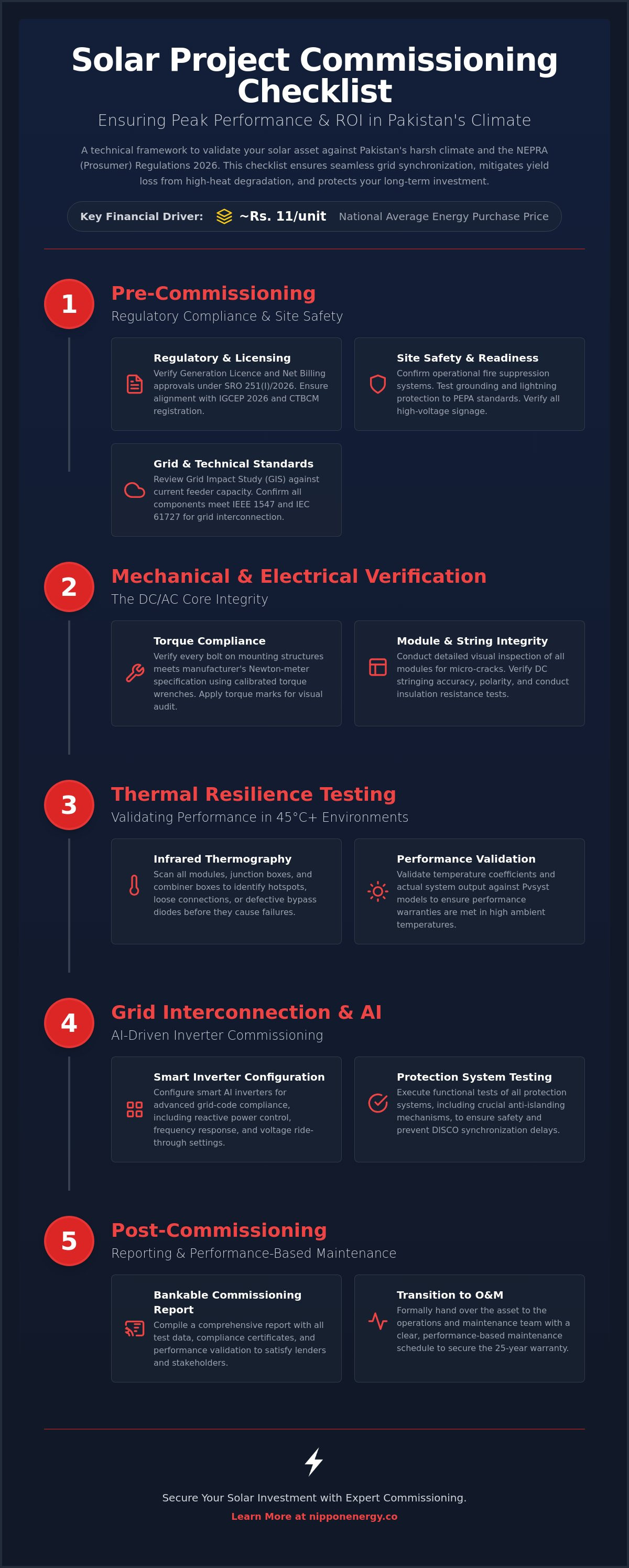
The transition from construction to operational status is a high-stakes phase where regulatory precision is as critical as electrical engineering. For industrial assets in 2026, a robust solar project commissioning checklist pakistan must begin with the absolute validation of the legal framework. This ensures the asset doesn't just generate power, but does so within the evolving parameters of the Solar Power in Pakistan sector. Before the first inverter is energized, developers must verify the Generation Licence and ensure that Net Billing approvals under SRO 251(I)/2026 are fully documented. This preliminary phase prevents costly delays during the final DISCO inspection and secures the project's status as a bankable energy source.
Regulatory and Licensing Documentation
Utility-scale and large-scale C&I (Commercial and Industrial) projects now face stricter alignment requirements with the Integrated Generation Capacity Expansion Plan (IGCEP) 2026. This alignment is mandatory to ensure that new capacity fits within the national grid's long-term stability goals. For projects operating under the Competitive Trading Bilateral Contract Market (CTBCM), registration as a market participant is a prerequisite for commissioning. Technical compliance isn't optional; every component must adhere to IEEE 1547 for grid interconnection and IEC 61727 for utility interface characteristics. Verifying these documents early mitigates the risk of NEPRA withholding operational authorization.
Site Safety and Environmental Readiness
Physical safety protocols must mirror the technical sophistication of the hardware. Commissioning teams must confirm that fire suppression systems are fully operational, particularly in confined inverter rooms or lithium-ion battery storage areas. Grounding and lightning protection systems must be tested to ensure they meet the Pakistan Environmental Protection Agency (PEPA) standards, protecting the asset from atmospheric surges common in the monsoon season. High-voltage DC and AC circuits require permanent, legible signage that follows international safety color codes. A comprehensive solar project commissioning checklist pakistan acts as a safeguard against the regulatory volatility that often characterizes the local energy market.
The Grid Impact Study (GIS) serves as the technical blueprint for synchronization. It's essential to review this study against actual feeder capacity at the time of commissioning, as local grid conditions may have shifted since the design phase. This review ensures that the plant's injection won't destabilize the local distribution network. On the human side, a final inspection of Personal Protective Equipment (PPE) is mandatory. Every technician must have access to arc-flash rated gear and calibrated testing instruments. These safety protocols aren't merely bureaucratic; they are the final barrier against operational hazards in high-voltage environments. Finally, all site-specific No Objection Certificates (NOCs) from local authorities must be physically present on-site to facilitate a smooth handover to the permanent operations team.
Mechanical and Electrical Verification: The DC/AC Core
The physical integrity of a solar plant determines its ability to withstand the structural stresses of Pakistan's diverse topography. A rigorous solar project commissioning checklist pakistan must prioritize mechanical validation before electrical energization. This phase moves beyond simple assembly; it requires a systematic verification of torque compliance across every mounting structure. Using calibrated torque wrenches, technicians must confirm that every bolt meets the manufacturer's specified Newton-meters. Once verified, applying a torque mark with a permanent paint pen provides a visual audit trail for future maintenance inspections, ensuring that vibrations from high-wind events in regions like the Jhimpir wind corridor don't compromise structural stability.
Module Integrity and Mounting
N-Type technology requires a higher level of handling precision than legacy P-type modules. A detailed visual inspection of Nippon HJT Solar Panels is necessary to identify micro-cracks or shipping damage that might not be visible to the untrained eye. Beyond the glass, commissioning teams must verify module-to-rail grounding and rail-to-earth continuity to ensure the system's lightning protection is fully integrated. In high-exposure regions like Sindh, cable management is a critical failure point; all DC string cables must be secured in UV-rated conduits or trays to prevent insulation degradation from intense solar radiation. Proper cable routing prevents the mechanical tension that often leads to connector failure in extreme heat.
DC and AC Electrical Testing
Open Circuit Voltage (Voc) and Short Circuit Current (Isc) testing serve as the fundamental baseline for string performance validation by ensuring that the measured electrical characteristics match the manufacturer's specific STC ratings. These measurements must be recorded using calibrated multi-meters to identify any polarity reversals or underperforming strings before they are connected to the inverter. To ensure the safety of the entire DC/AC core, insulation resistance testing, commonly known as Megger testing, is mandatory for all cabling. This process identifies potential ground faults or insulation breaches that could lead to catastrophic fires or system shutdowns.
Efficiency in large-scale plants is often lost through neglected technical details. Measuring the voltage drop across DC feeders allows engineers to confirm that the system meets its 1% to 2% efficiency targets. At the point of common coupling, technicians must verify AC phase rotation and voltage levels to ensure the plant is perfectly synchronized with the DISCO grid. For industrial leaders seeking to eliminate these technical risks, our Solar Project Development and EPC services provide a turnkey solution for high-performance energy architecture. Finalizing this stage involves a meticulous review of all electrical terminations in combiner boxes, where torque marking ensures that every connection is secure and ready for high-current operation.
Thermal Resilience Testing: Validating Performance in 45°C+ Environments
In the extreme climate of the Indus Basin, thermal management determines the difference between a high-performing asset and a rapid-degradation liability. A comprehensive solar project commissioning checklist pakistan must prioritize thermal resilience testing to ensure hardware survives ambient temperatures that frequently exceed 45°C. This phase isn't merely about checking if the system is operational; it's about validating that the engineering can withstand the intense thermal cycling characteristic of Punjab and Sindh. Engineers must perform Infrared (IR) thermography during peak sun hours, specifically when irradiance exceeds 800 W/m², to identify cell-level anomalies before they evolve into permanent hotspots. This rigorous scanning protects the long-term integrity of the DC/AC core and ensures the system operates within its design parameters.
Inverter behavior under high-heat conditions is a critical metric for industrial reliability. During commissioning, it's essential to monitor the derating behavior of inverters as they reach their thermal thresholds. If an inverter throttles its output prematurely, the projected ROI for the plant will never be realized. To mitigate this risk, the NipponHev System utilizes an integrated cooling architecture designed to maintain component longevity during the most severe summer peaks. Validating these cooling systems ensures that the power electronics remain efficient, even when the surrounding environment is hostile to standard hardware.
Hotspot Detection and IR Scanning
String-level IR scanning is mandatory to detect thermal gradients in DC combiner boxes and AC disconnects. These scans reveal loose terminations or internal cell defects that standard electrical tests might miss. For projects utilizing advanced technology, it's vital to verify that HJT panels maintain performance stability above 40°C, as their unique cell structure is engineered for superior heat tolerance. Documenting these thermal signatures during commissioning provides a baseline for all future solar project commissioning checklist pakistan audits, allowing for the early detection of degradation patterns.
Yield Normalization and Performance Ratio (PR)
Calculating the initial Performance Ratio (PR) requires adjustment for local ambient temperatures to provide an accurate assessment of system health. Commissioning teams must compare actual yield data against PVSyst simulations using specific Typical Meteorological Year (TMY) data for the site location. A -0.26%/°C temperature coefficient is the benchmark for Pakistani ROI because it minimizes the efficiency losses that occur as the cell temperature rises above the standard 25°C. By normalizing this data, owners can confirm that the plant meets its bankable performance guarantees before the final handover.
Grid Interconnection and AI-Driven Inverter Commissioning
The synchronization of an industrial solar plant with the national grid is the most technically sensitive phase of the installation. In the context of Pakistan's volatile grid conditions, a solar project commissioning checklist pakistan must move beyond manual startup procedures toward automated performance orchestration. Modern grid-code compliance requires inverters to do more than simply convert DC to AC; they must actively contribute to grid stability. Configuring Smart AI Solar Inverters allows for the precise management of reactive power control and voltage regulation, ensuring the plant remains connected during minor fluctuations while disconnecting instantly during major faults to protect the distribution network.
Safety during this phase is paramount, specifically regarding anti-islanding protection. This feature ensures that the solar plant does not feed power into a dead grid, which is a mandatory requirement for DISCO safety protocols. Commissioning engineers must also establish seamless communication between the power conversion system and the Lithium-Ion Battery Storage architecture. This integration involves verifying the Battery Management System (BMS) protocols to ensure that charge and discharge cycles are optimized based on real-time grid pricing and load requirements. For industrial operators looking to future-proof their energy supply, our Nippon Smart AI Inverters provide the necessary intelligence to manage these complex interactions automatically.
Intelligent Inverter Configuration
AI-driven MPPT (Maximum Power Point Tracking) settings must be optimized to account for localized environmental factors such as heavy dust accumulation in industrial zones or specific shading patterns from adjacent structures. These intelligent systems utilize automated fault detection to identify string-level issues before they impact total system yield. Furthermore, the 2026 net-billing framework necessitates the configuration of strict export limits within the inverter's software. Ensuring these limits are accurately set according to your specific DISCO agreement prevents regulatory penalties and maximizes the financial benefits of self-consumption.
Grid Stability and Response Testing
Testing the inverter's response to frequency and voltage fluctuations is essential for long-term operational reliability. Commissioning teams must perform a series of full system shutdowns and restarts to verify that safety disconnect timing falls within the narrow windows defined by NEPRA. This testing confirms that the hardware can handle the high-stress environment of the Pakistani grid without suffering internal component fatigue. Finally, the monitoring platform must be validated to ensure it provides real-time, granular data to both the project owner and the O&M team, enabling proactive performance management through AI-driven analytics.
Post-Commissioning: Transitioning to Performance-Based Maintenance
Successful execution of the solar project commissioning checklist pakistan culminates in a structured handover that transforms a physical installation into a high-yield financial asset. This final phase focuses on rigorous documentation and the establishment of operational protocols to ensure the project meets its 25-year financial projections. A bankable commissioning report serves as the legal and technical foundation for warranty activation and insurance coverage. It provides lenders with the necessary evidence that the installation adheres to both international IEC standards and the specific grid-code requirements of the 2026 NEPRA regulations. Without this granular data, the long-term bankability of the industrial plant remains at risk.
The transition to operations doesn't end with the flip of a switch. It requires a methodical transfer of knowledge and the implementation of sophisticated monitoring tools. Our Solar EPC Services are designed to eliminate the friction between construction and operation by providing a seamless transition framework. We ensure that the hardware is tuned for maximum longevity and that the operations team is fully equipped to manage the system's digital architecture. This comprehensive approach guarantees that the solar project commissioning checklist pakistan is not just a formality, but a roadmap for sustained industrial success.
The Commissioning Report and Handover
The final report must be compiled into a digital asset twin that includes all electrical test results, infrared thermography images, and a complete registry of component serial numbers. This level of detail is mandatory to verify the activation of 25-year linear performance warranties for HJT modules, protecting the owner against premature degradation. The handover process is finalized only after a formal sign-off from the lead engineer and the client, confirming that every mechanical and electrical termination meets the design specifications. This document becomes the baseline for every future performance audit over the plant's lifecycle.
Long-Term Asset Management
Once the plant is operational, the focus shifts to a proactive Solar System Maintenance strategy. Integrating predictive maintenance alerts into the AI monitoring dashboard allows operators to identify string-level issues before they impact the total system yield. A mandatory 30-day performance review is scheduled to verify that the actual energy export aligns with the initial PVSyst simulations and TMY data. Training site personnel on emergency procedures and system monitoring ensures that the industrial facility can respond rapidly to grid fluctuations or hardware alerts, maintaining the plant's structural and electrical integrity.
Contact Nippon Energy for Professional Solar EPC and Commissioning Services
Architecting Long-Term Energy Stability in Pakistan
Transitioning from construction to operation requires more than mechanical completion; it demands a rigorous validation of every system component against the 2026 regulatory landscape. By implementing a structured solar project commissioning checklist pakistan, developers ensure their assets are fully aligned with NEPRA and IGCEP standards while maintaining thermal resilience in extreme 45°C+ environments. This methodical approach secures the 25-year performance warranties that underpin the financial viability of industrial solar investments. Every technical check, from IR thermography to AI-driven grid synchronization, serves as a safeguard for your long-term ROI and operational security.
Nippon Energy brings Japanese engineering precision to the local market, specializing in HJT thermal resilience and intelligent power conversion. Our expertise ensures your energy infrastructure is not just operational, but future-proofed against grid volatility and intense climate stress. Secure Your Solar Asset with Nippon Energy’s Professional Commissioning Services. Your journey toward energy independence starts with a foundation of technical excellence and uncompromising quality.
Frequently Asked Questions
What is the most critical step in a solar commissioning checklist for Pakistan?
The most critical step is the validation of grid-code compliance and anti-islanding protection. This ensures that your solar project commissioning checklist pakistan addresses the safety requirements mandated by NEPRA to prevent reverse power flow into a dead grid. Failure to verify these parameters can lead to regulatory delays and potential hardware damage during frequent grid fluctuations.
How long does the commissioning process typically take for a 1MW project?
A standard 1MW industrial project typically requires 7 to 14 days for a full commissioning cycle. This timeline accounts for mechanical verification, electrical insulation testing, and a mandatory 72-hour continuous performance test. Complex projects involving lithium-ion battery storage may require additional time for BMS synchronization and discharge cycle validation to ensure system stability.
Is a third-party commissioning report mandatory for NEPRA licensing?
Independent verification is often required for large-scale industrial generation licenses and bankable project handovers. A third-party report provides an unbiased audit of the installation against the original Grid Impact Study. This documentation is essential for satisfying the technical requirements of DISCOs and securing long-term performance insurance for the asset's lifecycle.
How do high temperatures in regions like Multan affect commissioning tests?
High ambient temperatures in regions like Multan necessitate the use of temperature-corrected Performance Ratio (PR) calculations. Standard testing values must be normalized to account for the thermal degradation that occurs as cell temperatures rise above 25°C. Commissioning teams use high-precision IR scanners to identify thermal anomalies that might be obscured by the intense background heat of the Indus Plain.
What software is industry-standard for solar commissioning in 2026?
PVSyst is the global benchmark for comparing actual yield against theoretical simulations during the handover phase. In 2026, industry professionals also rely on AI-integrated monitoring software to manage complex solar project commissioning checklist pakistan data. These platforms automate the detection of string-level underperformance by analyzing real-time irradiance and temperature coefficients across the entire array.
Does Nippon Energy provide commissioning services for third-party installations?
Nippon Energy provides comprehensive commissioning and technical audit services for projects regardless of the original EPC provider. Our engineers use advanced diagnostic tools to verify that third-party installations meet the rigorous 2026 NEPRA standards. This service is designed to validate the structural and electrical integrity of an asset before it enters the long-term operations and maintenance phase.
What is the difference between cold and hot commissioning in solar projects?
Cold commissioning refers to all tests performed before the system is energized, such as cable insulation resistance and structural torque verification. Hot commissioning starts once the system is live, focusing on inverter synchronization and thermal behavior under load. Both phases are necessary to ensure the DC/AC core operates safely and efficiently before final grid interconnection occurs.
How does the 2026 Net Billing policy change the commissioning requirements?
The 2026 Net Billing policy prioritizes energy self-consumption over grid export. Commissioning now requires the precise configuration of export-limiting devices and smart inverters to match the DISCO-approved capacity. This ensures that excess energy is managed according to the National Average Energy Purchase Price (NAEPP) framework, directly impacting the plant's financial efficiency and regulatory compliance.


