
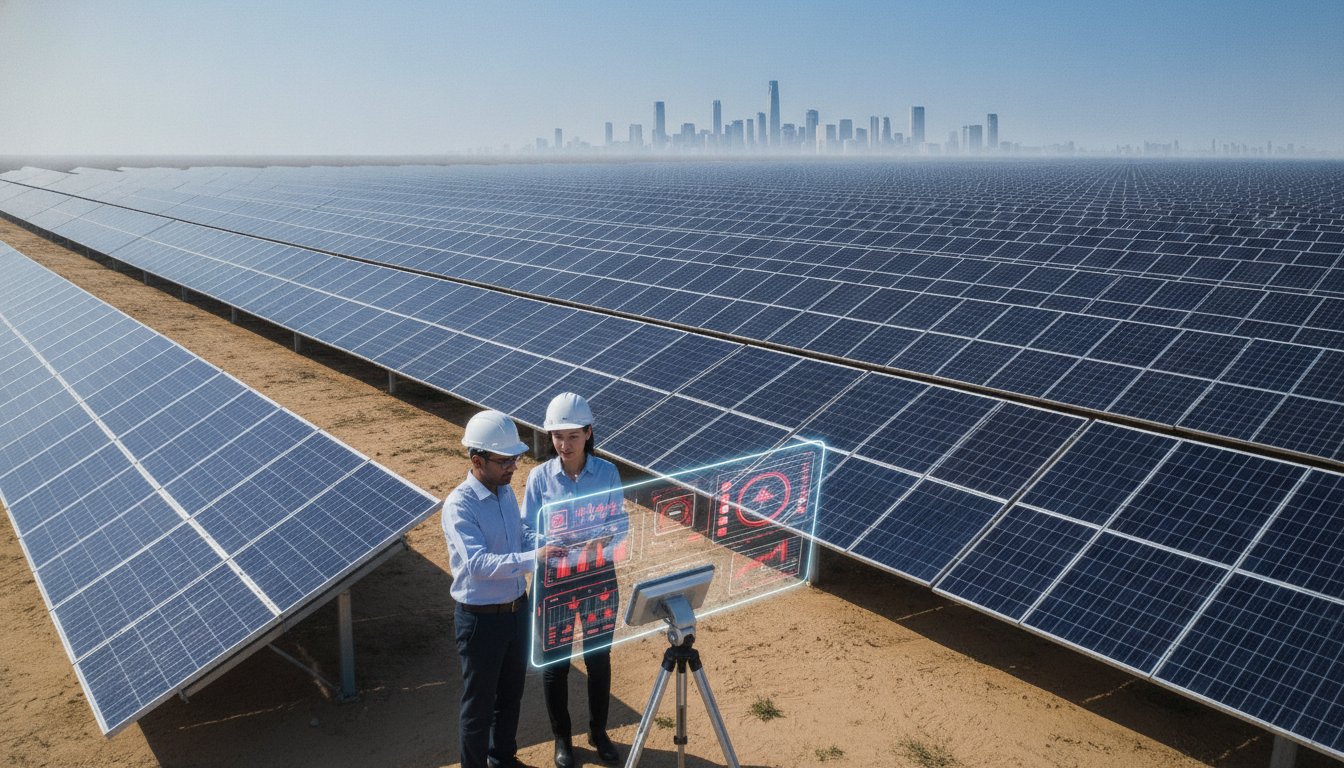
By mid-2026, TOPCon technology has captured approximately 65% of global solar production, effectively ending the era of P-type PERC dominance. Engineers recognize that topcon solar panel efficiency is the primary driver for this transition, but they don't always have access to the site-specific yield data required for massive deployments. The technical nuances between record-breaking 28% lab cells and the 22% to 24.8% efficiency found in commercial modules often remain obscured. Concerns regarding degradation in high-temperature regions and the precise performance delta between TOPCon and HJT continue to complicate long-term asset planning for global energy architects.
This technical reference provides a definitive breakdown of the Tunnel Oxide Passivated Contact architecture. We promise to move beyond simple STC metrics to deliver reliable 2026 benchmarks and energy yield validations that ground your procurement decisions in engineering reality. This analysis previews the structural evolution of N-type cells, examines how nanometer-scale passivation reduces carrier recombination to achieve a -0.30%/°C temperature coefficient, and provides the data necessary to future-proof large-scale energy infrastructure against the shifting standards of the current decade.
Key Takeaways
- Understand the structural evolution that allows topcon solar panel efficiency to surpass the theoretical limits of legacy P-type PERC systems.
- Identify the critical role of ultra-thin tunnel oxide and doped polysilicon layers in minimizing carrier recombination for higher energy conversion.
- Compare 2026 commercial benchmarks against laboratory records to establish realistic performance expectations for large-scale energy deployments.
- Evaluate the temperature-resilient characteristics of TOPCon modules to ensure stable power yields even in high-ambient-heat environments.
- Learn how optimizing string management with smart AI inverters reduces Balance of System (BOS) costs while maximizing overall system orchestration.
Understanding TOPCon Solar Panel Efficiency in the 2026 Landscape
TOPCon technology represents the most significant shift in photovoltaic architecture since the commercialization of PERC. By June 2026, Tunnel Oxide Passivated Contact (TOPCon) has moved from a premium alternative to the primary industry benchmark for N-type silicon. This transition is driven by a fundamental structural advantage: the ability to minimize carrier recombination through an ultra-thin tunnel oxide layer. Unlike legacy P-type cells, TOPCon utilizes N-type wafers that eliminate Light-Induced Degradation (LID), ensuring that topcon solar panel efficiency remains stable over decades of operation. This stability is a critical factor for global energy architects who prioritize long-term asset reliability and predictable power generation.
The Evolution from PERC to TOPCon
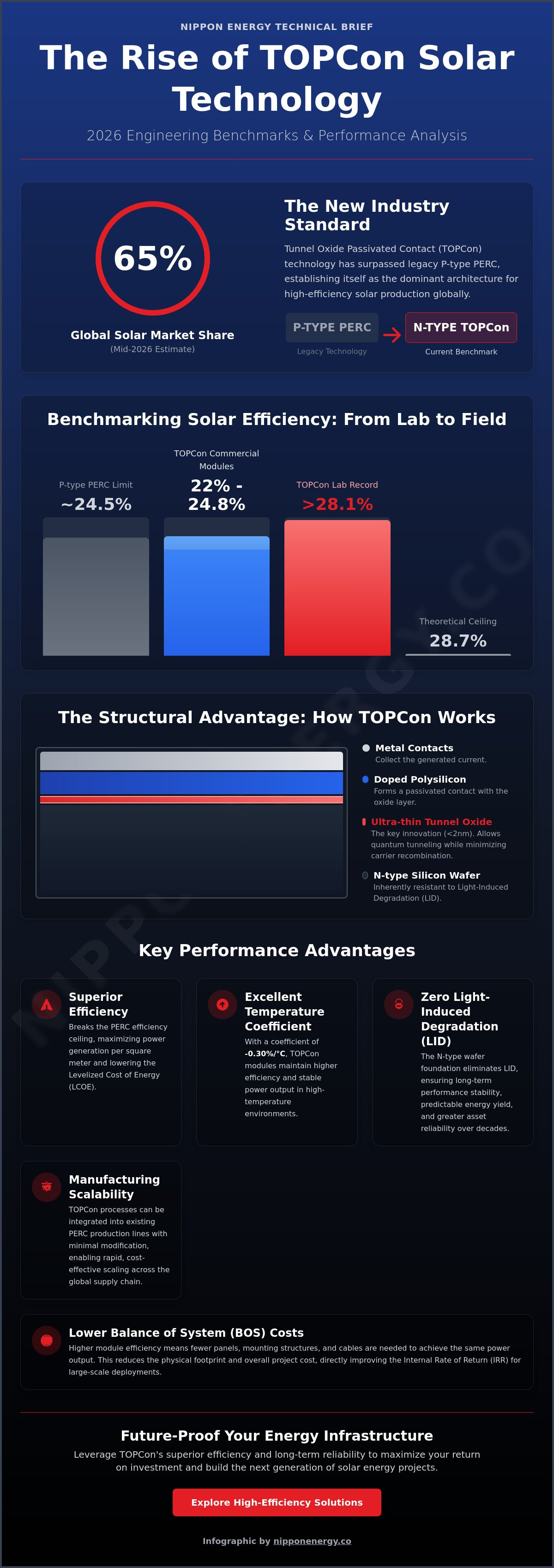
The industry reached a definitive "efficiency wall" with P-type PERC technology at approximately 24.5%. Beyond this point, the physical limitations of the architecture prevented further gains without significant cost increases. TOPCon serves as a sophisticated bridge between traditional solar panel technologies and future perovskite-silicon tandem cells. By adding a nanometer-scale oxide layer, manufacturers can repurpose existing production lines to achieve higher conversion rates. This structural evolution allows the industry to push toward a theoretical efficiency ceiling of 28.7%, providing a clear roadmap for performance growth without requiring entirely new manufacturing ecosystems.
Key Efficiency Benchmarks for 2026
While laboratory records have surpassed 28.1% in early 2026, mass-produced commercial modules typically operate within a specific performance band. The delta between lab and field performance continues to narrow as manufacturing tolerances improve. The following benchmarks represent the standard for high-performance deployments this year:
- Commercial Module Range: 22% to 24.8% efficiency for Tier 1 industrial shipments.
- Theoretical Ceiling: Approximately 28.7% for single-junction N-type silicon cells.
- Wafer Standards: 182mm and 210mm formats dominate the utility-scale market, optimizing module density.
Efficiency is no longer just a laboratory metric; it's the primary lever for reducing the Levelized Cost of Energy (LCOE). Higher topcon solar panel efficiency allows developers to generate more power from a smaller footprint. This reduction in physical area translates directly into lower Balance of System (BOS) costs, including fewer mounting structures, less cabling, and reduced labor. For massive deployments, these marginal gains in cell performance create monumental shifts in project internal rates of return (IRR), making TOPCon the logical choice for future-proofed energy infrastructure.
The Structural Architecture of Tunnel Oxide Passivated Contacts
The structural superiority of TOPCon lies in its sophisticated three-layer stack. This architecture consists of an ultra-thin tunnel oxide layer, a heavily doped polysilicon layer, and the final metal contacts. By integrating these specific materials, the cell creates a "passivated contact" that fundamentally changes how charge carriers interact with the surface. In traditional cells, metal contacts directly touch the silicon, which creates high recombination rates and losses. TOPCon solves this by using the tunnel oxide layer to separate the metal from the silicon substrate. This separation is the primary reason why topcon solar panel efficiency has reached such high commercial benchmarks in 2026.
Charge transport in this stack relies on the quantum tunneling effect. The tunnel oxide layer is thin enough, typically less than two nanometers, to allow majority carriers to "tunnel" through the barrier while effectively blocking minority carriers. This selective transport mechanism reduces electrical resistance and prevents the loss of energy that usually occurs at the cell's surface. Because this architecture can be integrated into existing PERC manufacturing lines with only minor equipment additions, it's allowed for a rapid, cost-effective scale-up across the global supply chain. This manufacturing efficiency ensures that high-performance modules remain accessible for large-scale infrastructure projects.
N-Type Wafer Purity and Longevity
The foundation of this architecture is the N-type silicon wafer. Unlike P-type wafers that use boron, N-type silicon is doped with phosphorus. This choice is critical because boron-doped silicon is susceptible to the Boron-Oxygen complex, which causes Light-Induced Degradation (LID). By eliminating this complex, n-type topcon solar cells maintain their performance integrity over a 30-year lifespan. The higher purity of N-type wafers ensures that internal resistance remains low, contributing to a more resilient energy yield across the module's operational life.
Minimizing Recombination Losses
Surface recombination is the primary bottleneck for increasing Open Circuit Voltage (Voc). The passivated contact structure reduces these losses so effectively that commercial modules now routinely achieve Voc values exceeding 730mV. High-quality passivation also improves the cell's low-light response, allowing for energy generation during dawn, dusk, or overcast conditions. Ongoing U.S. Department of Energy TOPCon research continues to validate these architectural gains, highlighting how precise layer engineering pushes topcon solar panel efficiency toward its theoretical maximum. For developers seeking to maximize site-specific yield, evaluating the structural integrity of Nippon Energy's technical specifications provides the necessary validation for long-term procurement decisions.
Benchmarking Performance: Lab Records vs. Real-World Yield
While laboratory environments have pushed N-type silicon to unprecedented heights, the gap between controlled records and field deployment remains a critical consideration for project developers. In April 2026, industry leaders achieved record-breaking cell efficiencies of 28.13%, yet commercial module shipments typically operate within the 22% to 24.8% range. This delta represents the transition from idealized physics to industrial-scale durability. High Fill Factors (FF), often exceeding 80% in TOPCon cells, ensure that the module operates close to its maximum power point even under fluctuating irradiance. Additionally, TOPCon modules exhibit a superior spectral response, capturing a broader range of the blue and UV spectrum compared to legacy P-type technologies. This sensitivity increases energy harvest during early morning and late afternoon hours, providing a more consistent generation profile. For a technical perspective on how these metrics stack up against competing technologies, consult the 2026 solar panel efficiency comparison.
Bifacial Efficiency and Albedo Gains
The architecture of Tunnel Oxide Passivated Contacts is inherently suited for bifacial applications, typically offering a bifaciality factor between 80% and 85%. This metric indicates that the rear side of the cell is nearly as effective as the front at converting reflected light into electricity. In high-albedo environments, such as snow-covered terrain or specialized ground covers, bifacial topcon solar panels can increase total energy harvest by up to 25% compared to monofacial alternatives. This secondary energy capture is facilitated by the symmetrical nature of the passivated contact stack, which allows for efficient carrier collection from both sides of the wafer without significant resistive losses.
Efficiency Retention Over 30 Years
Long-term energy yield is defined by the resilience of the cell architecture against environmental stressors. TOPCon modules exhibit a standard Year 1 degradation of approximately 1%, followed by a linear annual decline of just 0.4% over a 30-year period. This is a substantial improvement over PERC modules, which typically degrade at rates between 0.55% and 0.7% annually. When calculated over three decades, the cumulative topcon solar panel efficiency advantage results in significantly higher total kilowatt-hours produced per kilowatt-peak installed. This resilience ensures that the initial capital expenditure translates into a lower Levelized Cost of Energy (LCOE) and a more secure return on investment for utility-scale stakeholders who prioritize the structural integrity of their energy assets.
Environmental Resilience: Efficiency in High-Temperature Climates
Thermal loads represent the most significant threat to photovoltaic performance in high-irradiance regions. A common technical objection suggests that topcon solar panel efficiency might be compromised when cell temperatures exceed standard test conditions. Modern data proves the opposite. TOPCon modules feature a superior temperature coefficient of Pmax, typically ranging from -0.29%/°C to -0.30%/°C. This is a measurable improvement over legacy PERC modules, which frequently operate at -0.35%/°C. This lower coefficient ensures that as cell temperatures climb toward 70°C, the power output remains stable, preventing the steep production drops common in older architectures.
This thermal stability is a direct result of the high Open Circuit Voltage (Voc) inherent to the N-type passivated contact structure. Because the initial voltage is higher, the relative degradation per degree of temperature increase is less impactful on the total wattage. Additionally, the N-type substrate is inherently resistant to Light and elevated Temperature Induced Degradation (LeTID). This resistance is crucial for maintaining performance integrity during the first few years of operation in extreme climates. It ensures that the system doesn't suffer from the sudden, permanent efficiency losses that often plague P-type systems in the field.
Performance in Desert and Tropical Regions
For large-scale projects in Riyadh, Dubai, and Karachi, the synergy between high irradiance and thermal resilience is a primary driver of project ROI. In these environments, ambient temperatures often push cell temperatures well above 65°C. TOPCon's ability to maintain higher voltage under these conditions results in a significantly higher daily energy harvest. Furthermore, because these modules operate more efficiently, they generate less internal waste heat. This cooler operation reduces thermal stress on the encapsulation materials, extending the physical lifespan of the module in harsh desert or tropical conditions. To secure these yields, engineers often specify Nippon Energy's utility-scale solutions for their proven thermal performance.
Low-Light and Diffuse Radiation Capture
Efficiency isn't only about peak sunlight. TOPCon's N-type spectral response is superior for capturing energy during dawn, dusk, and cloudy conditions. The architecture is particularly effective at converting diffuse radiation and light at non-ideal angles into usable electricity. This sensitivity extends the daily "energy window," allowing the system to begin generation earlier in the morning and continue later into the evening. For developers, this translates into a more consistent generation profile that reduces the reliance on storage and improves the overall stability of the energy supply. This broader spectral sensitivity ensures that topcon solar panel efficiency delivers value even when the sun isn't at its zenith.
Strategic Implementation: ROI and System Orchestration
Translating topcon solar panel efficiency from a technical specification into a commercial advantage requires a holistic view of the energy ecosystem. By mid-2026, the narrow 2-5% price premium for TOPCon over legacy PERC has made it the default choice for large-scale infrastructure. The primary financial driver isn't just the module cost, but the significant reduction in Balance of System (BOS) expenses. High-efficiency topcon solar panels allow for higher power density, which means fewer mounting structures, reduced cabling, and lower labor costs for the same total capacity. This optimization is a cornerstone of modern solar epc services, where physical footprint directly impacts the project's bottom line.
Orchestrating these high-efficiency strings requires advanced power electronics. Because TOPCon cells produce higher current than traditional P-type cells, they demand 2026-standard smart ai solar inverters to manage the load effectively. These intelligent systems use machine learning to optimize maximum power point tracking (MPPT) in real-time, especially in complex bifacial setups. This synergy between the module's structural efficiency and the inverter's algorithmic intelligence ensures that the energy yield remains maximized even as environmental conditions fluctuate. This level of orchestration is what separates a standard installation from a future-proofed energy asset.
Calculating the Efficiency-to-ROI Ratio
Financial modeling for 2026 tenders shows that land and racking savings often outweigh the marginal cost of N-type hardware. When searching for topcon solar panels for sale, procurement officers prioritize the Levelized Cost of Energy (LCOE) over initial capital expenditure. High-efficiency systems serve as a long-term hedge against rising grid prices, providing a predictable and stable energy source for thirty years. The reduced footprint also opens up opportunities for sites with limited space, such as commercial rooftops, where maximizing wattage per square meter is the only way to achieve energy independence.
Nippon Energy’s Architectural Approach
Nippon Energy integrates these modules into the nipponhev system to create a unified energy architecture. This approach ensures that every component, from the passivated contacts to the battery storage, operates with synchronized precision. Preserving the nameplate topcon solar panel efficiency over the system's life requires professional solar system maintenance, focusing on automated cleaning and thermal imaging to prevent hot spots. For utility-scale deployments, the superior bifaciality and thermal resilience make TOPCon the definitive standard, while commercial users benefit from the rapid ROI driven by high power density and simplified installation.
Advancing Global Infrastructure through N-Type Precision
The transition to Tunnel Oxide Passivated Contact technology represents a permanent shift in the global energy landscape. By eliminating the fundamental recombination losses of legacy P-type cells, this architecture delivers the structural integrity and high-voltage performance required for 30-year asset longevity. The mastery of topcon solar panel efficiency allows developers to maximize power density while significantly reducing Balance of System (BOS) costs, ensuring that every square meter of a project generates peak value. This technical evolution provides a stable foundation for large-scale energy independence across diverse and challenging climates.
Nippon Energy combines Japanese precision engineering with extensive global EPC expertise across MEA and Asia to redefine the Levelized Cost of Energy (LCOE). Our integrated approach ensures that structural efficiency translates directly into monumental financial returns for utility-scale and commercial stakeholders. It's time to ground your procurement decisions in the reliability of advanced N-type systems that are designed to perform for decades.
Explore Nippon TOPCon Solutions for Your Next High-Efficiency Project
We look forward to partnering with you to build a more resilient and high-performing energy future.
Frequently Asked Questions
What is the current record for TOPCon solar panel efficiency in 2026?
The current laboratory record for a silicon solar cell is 28.13%, achieved in April 2026. This milestone follows a rapid series of breakthroughs that pushed N-type silicon beyond the previous 28% threshold. While these records demonstrate the material's peak potential, commercial modules typically operate between 22% and 24.8% to ensure a balance between performance and industrial-scale durability.
How does TOPCon efficiency compare to HJT (Heterojunction) technology?
TOPCon technology serves as the mainstream commercial benchmark, accounting for approximately 65% of global production in 2026, while HJT is positioned for premium applications. HJT can achieve slightly higher cell efficiencies exceeding 25% but typically carries a higher manufacturing cost. TOPCon provides a more optimized balance of high conversion rates and competitive capital expenditure for large-scale energy infrastructure.
Does TOPCon technology lose efficiency faster in hot climates?
No, TOPCon technology is specifically engineered to resist efficiency drops in extreme heat. With a temperature coefficient of approximately -0.30%/°C, these panels outperform legacy PERC systems which typically lose 0.35% of power for every degree above standard conditions. This thermal resilience makes TOPCon the preferred choice for high-irradiance desert and tropical regions where ambient temperatures are high.
Why is N-type silicon more efficient than the traditional P-type used in PERC?
N-type silicon utilizes phosphorus doping, which is inherently more efficient than the boron-doped P-type silicon used in PERC. This structural choice eliminates the Boron-Oxygen complexes that cause Light-Induced Degradation (LID). The result is a higher purity wafer that maintains topcon solar panel efficiency more effectively over the long term without the initial power drop common in older technologies.
Can TOPCon solar panels reach 25% efficiency in mass production?
Mass-produced TOPCon modules in 2026 typically reach 22% to 24.8% efficiency, with premium lines approaching the 25% threshold. While laboratory cells have exceeded 28%, industrial-scale manufacturing requires specific tolerances that slightly lower the conversion rate. The industry focus remains on narrowing this delta to ensure that mass-produced systems deliver the highest possible energy yield at a manageable cost.
How much does bifaciality add to the overall efficiency of a TOPCon module?
A TOPCon module's bifaciality factor typically ranges from 80% to 85%, allowing for significant secondary energy capture from the rear side. In environments with high-albedo ground cover, such as snow or specialized white membranes, this can increase total energy harvest by up to 25% compared to monofacial panels. This secondary yield is a critical factor in reducing the Levelized Cost of Energy (LCOE) for utility-scale projects.
What is the expected degradation rate of TOPCon panels over 30 years?
The expected degradation for TOPCon panels is approximately 1% in the first year and 0.4% annually for the remaining 29 years. This performance profile is significantly more resilient than PERC technology, which often degrades at 0.55% to 0.7% per year. This lower rate ensures that a higher percentage of nameplate topcon solar panel efficiency is preserved over the system's full 30-year operational life.
Is TOPCon efficiency high enough to justify the cost for residential use?
TOPCon efficiency is highly justifiable for residential use because it maximizes power generation within a limited roof footprint. Higher efficiency reduces the number of panels, mounting rails, and labor hours required for installation, which lowers the overall Balance of System (BOS) costs. Even though the US federal tax credit for homeowners expired after 2025, the increased energy yield provides a faster return on investment through utility bill savings.


